The reason nerites are recommended so consistently is one biological fact, and it is worth stating before anything else because it is the whole appeal.
Nerite larvae need brackish or salt water to develop. In a freshwater tank the eggs are laid and they do not hatch. So you get an animal that eats algae steadily for a long time and never produces the population explosion that makes people regret adding snails.
That single property is why they are on this list and pest snails are on a different page. It also comes with the one genuine annoyance, which nobody warns beginners about, and which is the second half of this article.
What they actually eat, and what they do not
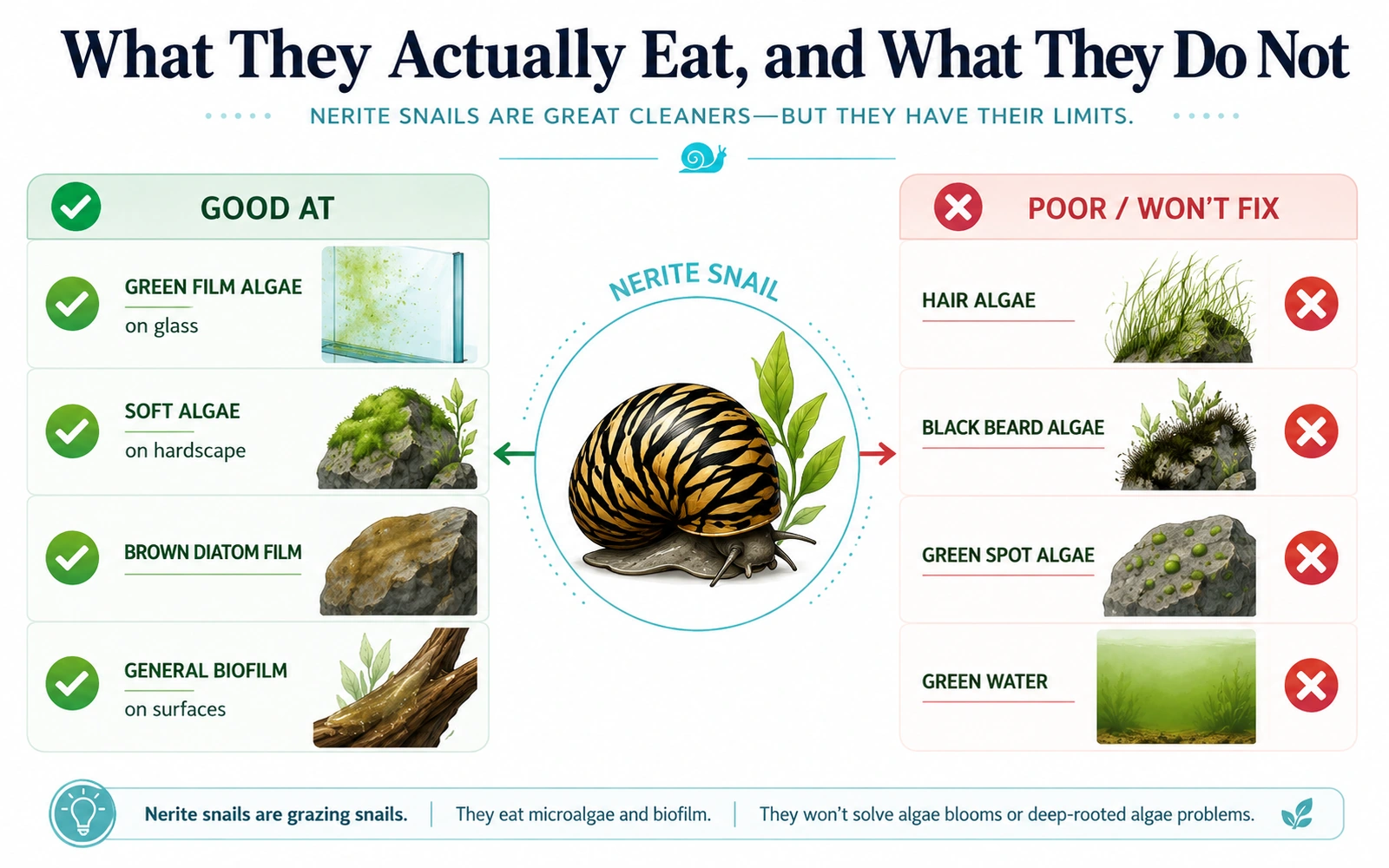
Nerites are grazers. They work over hard surfaces continuously, and they are genuinely effective on the kinds of algae that are attached to glass, rock and equipment.
They are good at: the green film on the glass, soft green algae on hardscape, brown diatom film, and the general biofilm that accumulates on everything in a running tank. On a tank with a diatom bloom they are noticeably effective, and brown diatom algae in a new tank covers what that bloom is and why it usually passes on its own anyway.
They are indifferent to: hair algae and most stringy growth, which they will graze around rather than through.
They will not touch: black beard algae, in general. This is the most common disappointment, because black beard is the algae people most want removed and the one no common grazer reliably eats. Black beard algae covers what actually slows it, and the answer is not an animal.
They also make very little impression on green spot algae, the hard dots on the glass. Some individuals scrape it, most do not. Green spot algae on the glass covers why it appears.
And to be plain about the largest misconception: a nerite will not clear green water. A bloom suspended in the water column is not on a surface, so there is nothing for a grazer to graze. Green water is a different problem with a different answer.
The point everyone gets backwards
An algae eater is not a substitute for the conditions that produce less algae.
Algae grows where there is light and there are nutrients, and the amount of both is set by your lighting hours, your feeding, your plant load and your water change routine. A snail eats some of what grows. It does not change how much grows.
The practical consequence: a tank with a genuine algae problem and three nerites in it is a tank with an algae problem and three well-fed snails. Fix the inputs, then add grazers to keep the surfaces tidy. That order works; the other order does not.
The corollary matters for the snail: a spotlessly clean tank has nothing in it for a grazer to eat, and a nerite in a tank with no algae will slowly starve unless you feed it. Blanched vegetables and sinking foods work for this. If you have added snails to solve a problem and then solved the problem, you now have animals to feed.

The eggs, which is the thing nobody mentions
Here is the trade for the no-population-explosion benefit.
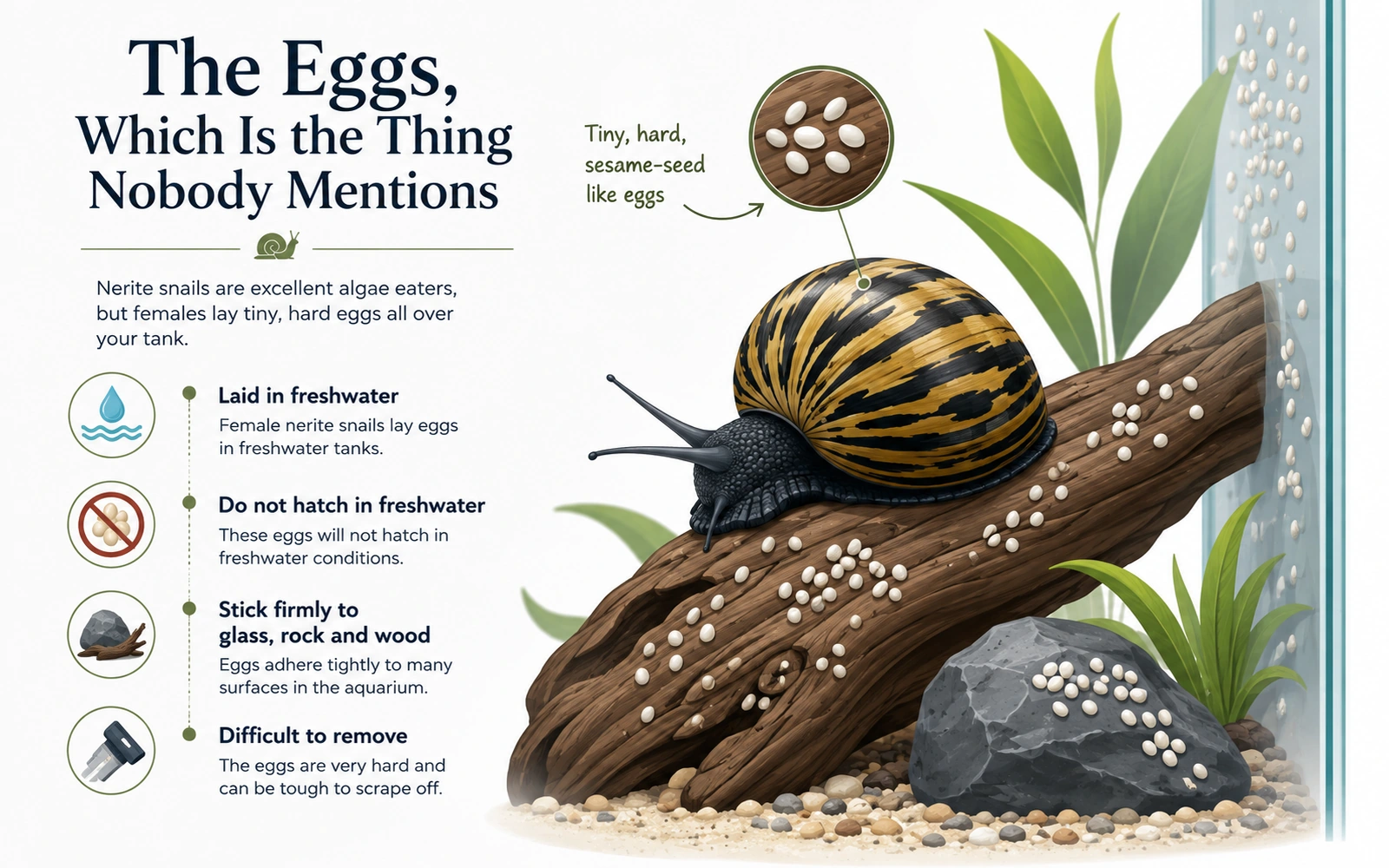
Female nerites lay eggs anyway. The eggs are small, hard, white, and stuck firmly to hardscape, glass, equipment and plant leaves. They look like grains of sand or tiny sesame seeds glued in place.
They will not hatch in fresh water, and they do not come off easily. They resist scrubbing, they are visible on dark surfaces, and on driftwood they can be genuinely difficult to remove. A blade on glass takes them off. On wood and rock, most people give up and live with them.
This is worth knowing before you buy rather than after. It is the standard complaint about an otherwise excellent animal, and there is no fix beyond keeping fewer, or keeping only males, which you cannot reliably identify at purchase.
They climb out, and here is why
Nerites leave the water. This is normal behavior, not necessarily distress, and in the wild they live in a zone that is periodically above the water line.
That said, a snail that has left the water and is heading determinedly upward is often telling you something. The things worth checking:
- The water. Test it. A snail leaving a tank is one of the classic early signs that something is wrong with the water before the fish show anything. Aquarium water parameters covers what to read.
- The food supply. A tank with nothing left to graze is a tank a grazer will try to leave.
- The water level. Space between the surface and the rim gives them somewhere to go that is not the floor.
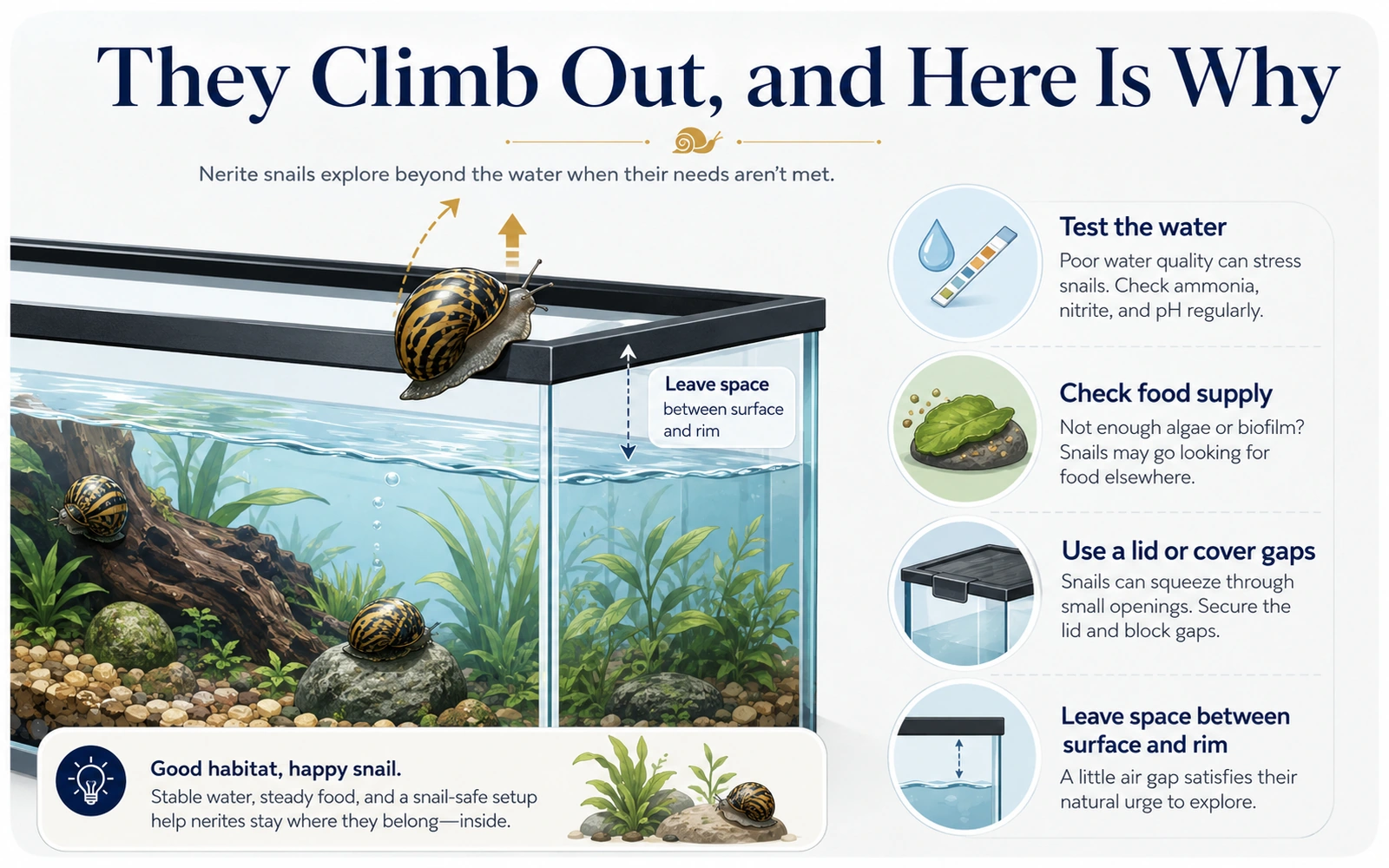
The practical response is a lid, or at minimum something covering the gaps around the filter and the cables. A snail found dry on the carpet may be recoverable if it was recent; one that has been there overnight generally is not. Do not put a dead snail back in the tank, because a decomposing snail in a small tank is a genuine ammonia event.
Their shells, which are not decoration
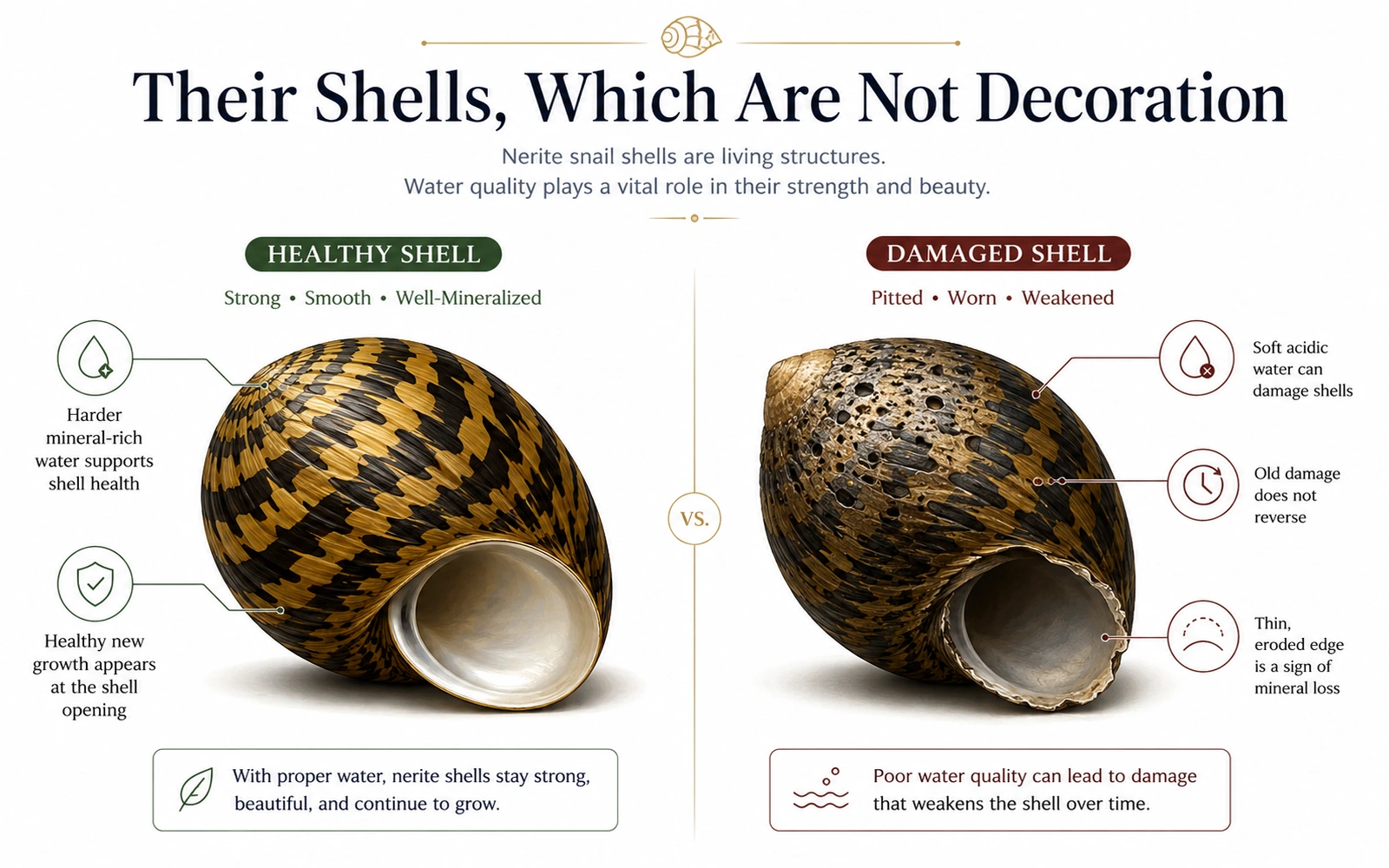
A snail's shell is made from what it takes out of the water, and a shell that is pitting, eroding at the tip, or going thin and translucent at the edge is telling you about your water rather than about the snail.
The general direction: shells suffer in soft, acidic water and hold up better in harder water with more mineral content. This site does not publish a target hardness figure, because published recommendations disagree and because a colony that adapted to one set of conditions is not evidence for another. GH and KH explained covers what those two measurements actually are, which is the prerequisite for judging your own tank.
What is reliable rather than numerical: damage that is already there does not reverse. New growth at the shell opening can be healthy while the older whorls stay pitted, and that is a recovering snail, not a failed one.
Adding them, and the one hard rule
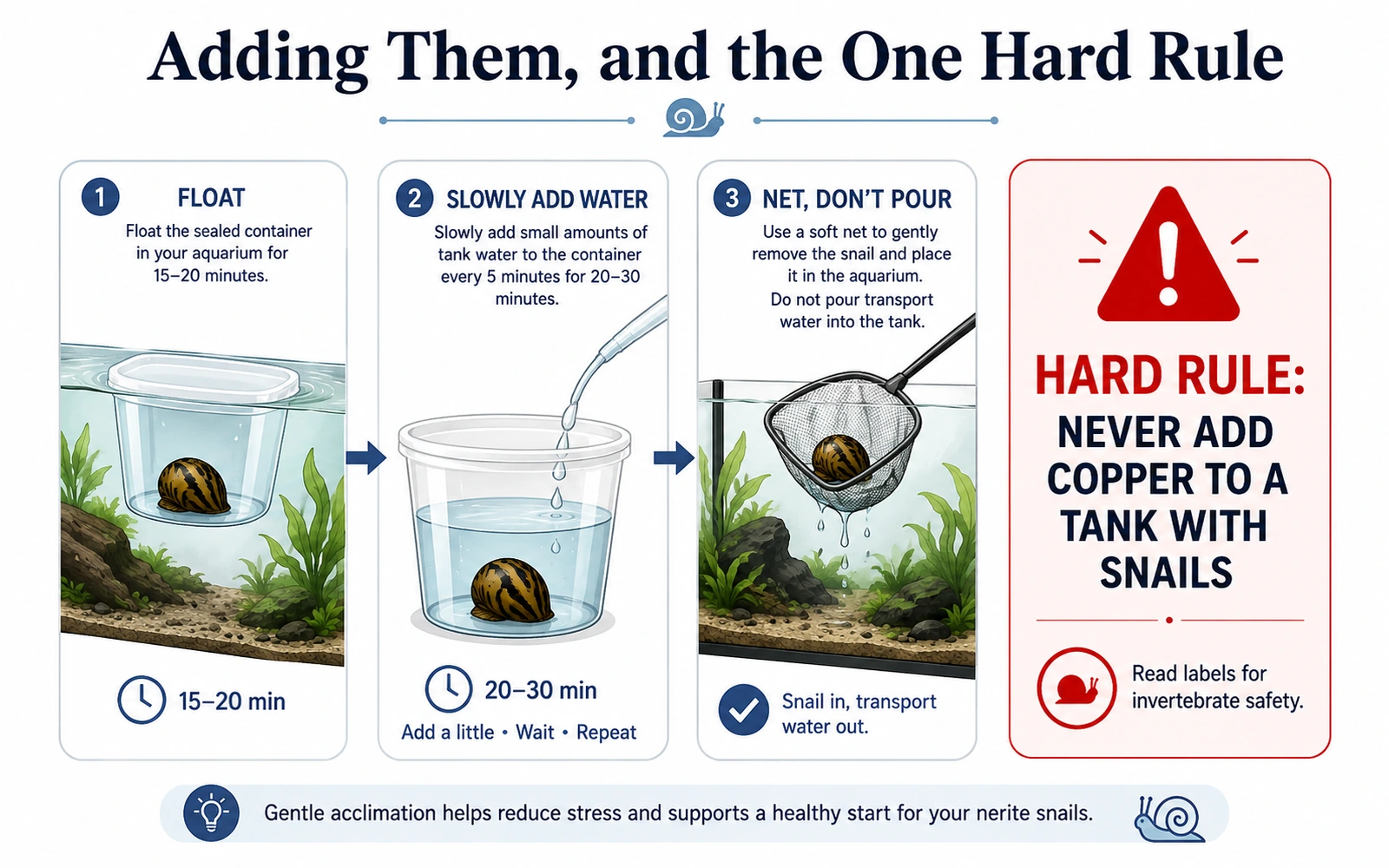
Acclimate them slowly, the same way you would shrimp. A chemistry change delivered in one step is the thing that kills them, not the destination.
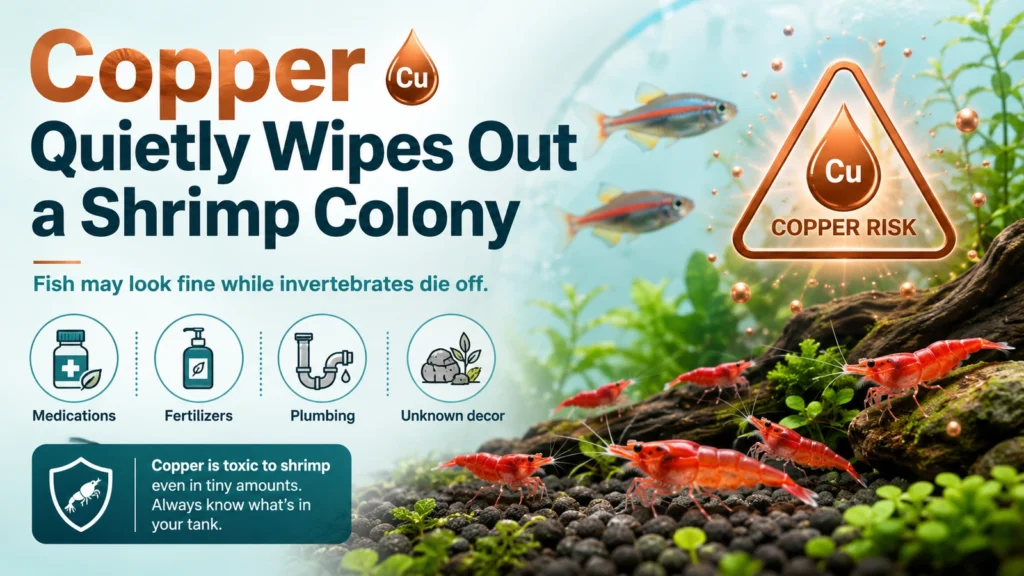
And the rule that applies to every animal in this cluster: copper. Do not put copper into a tank with snails in it, in any amount, for any reason. It arrives in fish medications, snail treatments, some plant fertilizers and some foods, and it is lethal to invertebrates at exposures fish barely notice. Read the label of anything you add and look specifically for what it says about invertebrates. If it says nothing at all, assume the answer is bad.
If a fish in the tank needs treating, that is a diagnosis question rather than a shopping one, and this site publishes no medication and no dose anywhere. When to contact an aquatic veterinarian and how to find one covers who can actually answer it.
The short version
- They cannot breed in fresh water. That is the whole reason to choose them.
- Good on film algae and diatoms. Useless on black beard, hair algae and green water.
- A grazer tidies surfaces. It does not reduce how much algae grows.
- The eggs are permanent and ugly. Know that before you buy.
- They climb out. Use a lid, and treat a climbing snail as a prompt to test the water.
- Soft acidic water is hard on shells, and existing damage does not reverse.
FAQ
Will nerite snails take over my tank? No. Their larvae need brackish or salt water to develop, so in a freshwater tank the eggs are laid but never hatch. That single property is the whole reason they are recommended over other snails.
What algae do nerite snails actually eat? They are effective on the green film on the glass, soft green algae on hardscape, brown diatom film and general biofilm. They are indifferent to hair algae, will not touch black beard algae in general, make little impression on green spot algae, and cannot clear green water.
What are the small hard white dots stuck to my glass and driftwood? Nerite eggs. They will not hatch in fresh water and they do not come off easily. A blade takes them off glass; on wood and rock most people give up and live with them. This is worth knowing before you buy.
Why does my nerite snail keep climbing out of the water? Leaving the water is normal for the species, but a snail heading determinedly upward is often telling you something. Test the water, check whether there is anything left to graze, and use a lid or cover the gaps around the filter and cables.
Why is my nerite's shell pitted or eroding? Shells suffer in soft, acidic water and hold up better in harder water with more mineral content. Damage that is already there does not reverse, but healthy new growth at the shell opening means a recovering snail rather than a failing one.