Green spot algae on aquarium glass is a hard, small, disc-shaped green algae that is usually associated with strong or prolonged lighting combined with a shortage of nutrients in the water, phosphate in particular. It is not evidence of a dirty tank, and in most tanks it is a maintenance chore rather than a warning sign. You remove it mechanically, with a blade scraper on glass or a plastic-safe pad on acrylic, and you slow it down by shortening the photoperiod and making sure the tank is not nutrient-starved. The counterintuitive part, and the reason so many people fight it for months, is that cutting feeding and nutrients further usually makes it worse. If something else is wrong with the tank, start at something is wrong with my tank.
How to Identify It
Green spot algae, often written GSA, appears as small, distinct, bright green circular spots. Two properties separate it from everything else green in your tank:
- It is hard. A magnet cleaner glides over it. A cloth does nothing. You feel it as a raised dot under your fingertip.
- It stays put and stays discrete. It forms spots rather than a film, and the spots hold their shape as they grow.
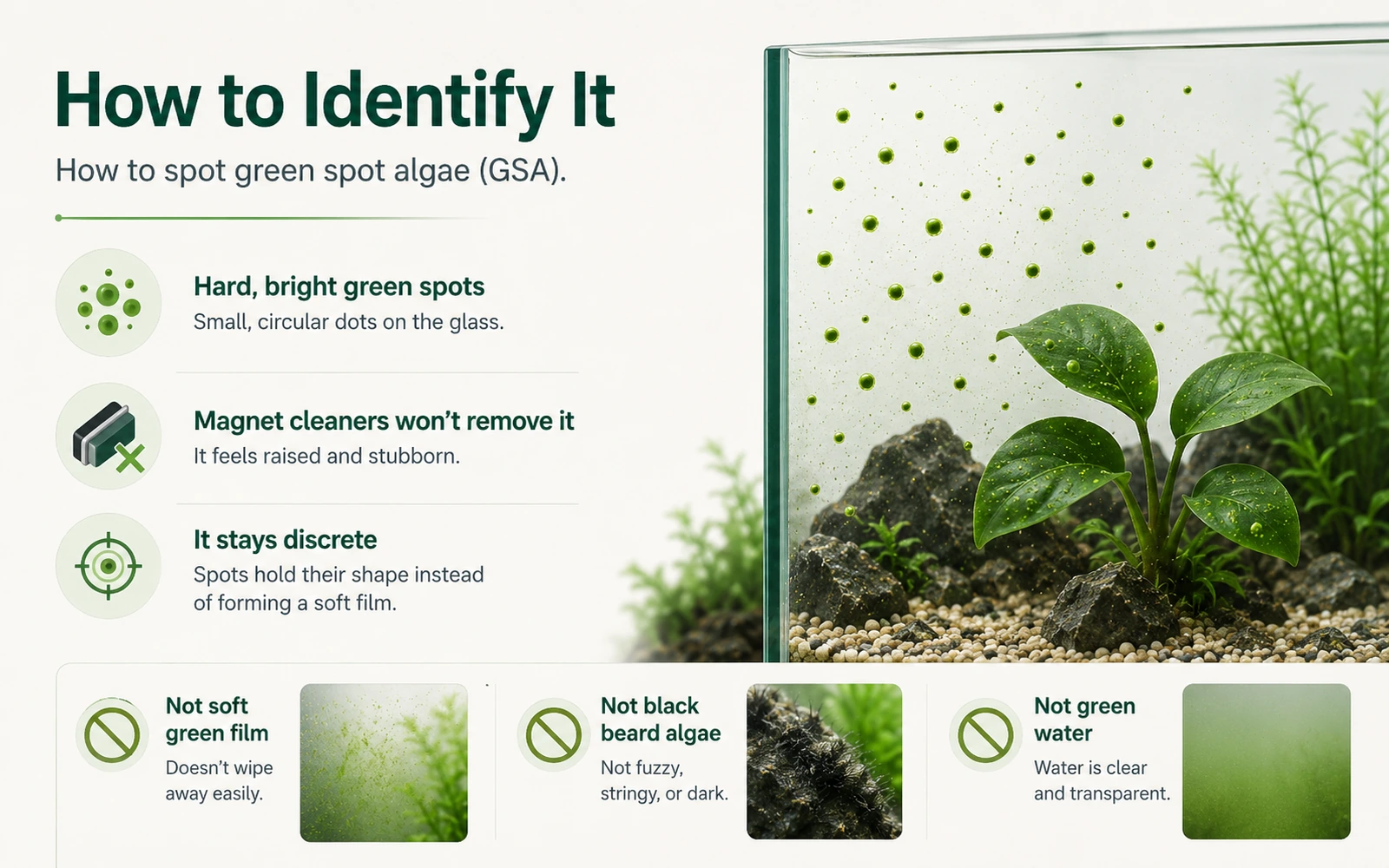
Compare that with the alternatives: a soft green film that wipes away easily is a different, much less stubborn green algae; dark bristly tufts on leaf edges and hardscape are black beard algae; a green tint through the water itself, with the glass clean, is green water, which is free-floating and needs an entirely different approach; and a brown dust in a young tank is a diatom phase that passes on its own.
Green spot algae also appears on the leaves of slow-growing plants, especially anubias, and on hardscape. On the glass it is a nuisance. On anubias leaves it is close to permanent.
What Causes It
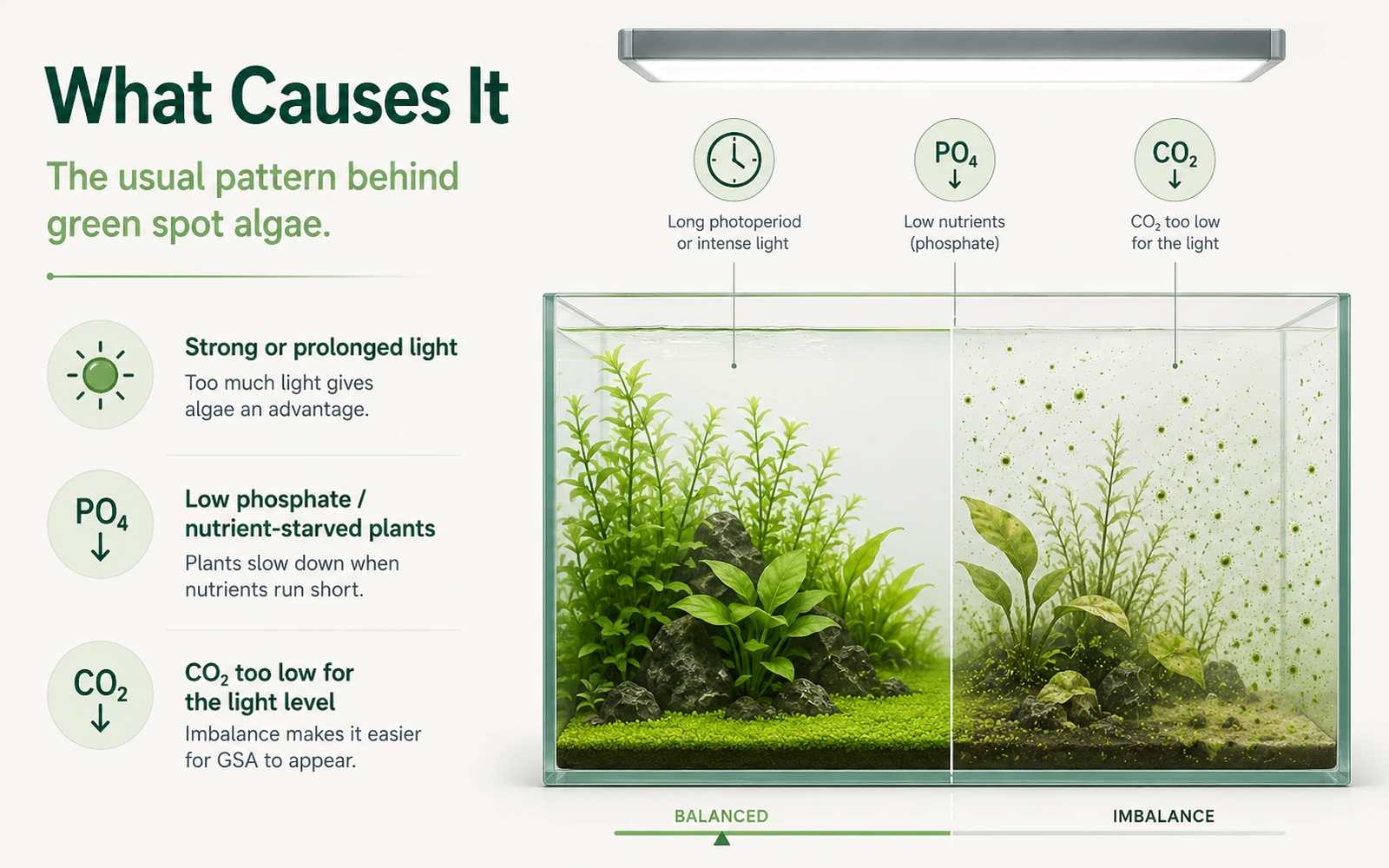
Planted-tank references, including 2Hr Aquarist and Aquasabi, converge on a short list: strong or long lighting, insufficient CO2 relative to the light provided, and low phosphate. Some sources add that very high phosphate can also be implicated, which is a useful reminder that "balance" here is genuinely a balance rather than a direction.
The low-phosphate association is the one worth understanding, because it inverts the usual instinct.
Most algae problems in a beginner tank are excess problems: too much food, too much waste, too much light. So when algae appears, the reflex is to feed less, change more water and dose nothing. With green spot algae, that reflex tends to backfire. If phosphate is the limiting nutrient, driving it lower does not starve the algae. It starves the plants, which stops them competing, and the algae takes the light that the plants are no longer using.
That is why green spot algae is common in two very different tanks: heavily lit planted tanks running lean on fertilizer, and lightly stocked, lightly fed tanks with a bright light on for a long day.
What Actually Reduces It
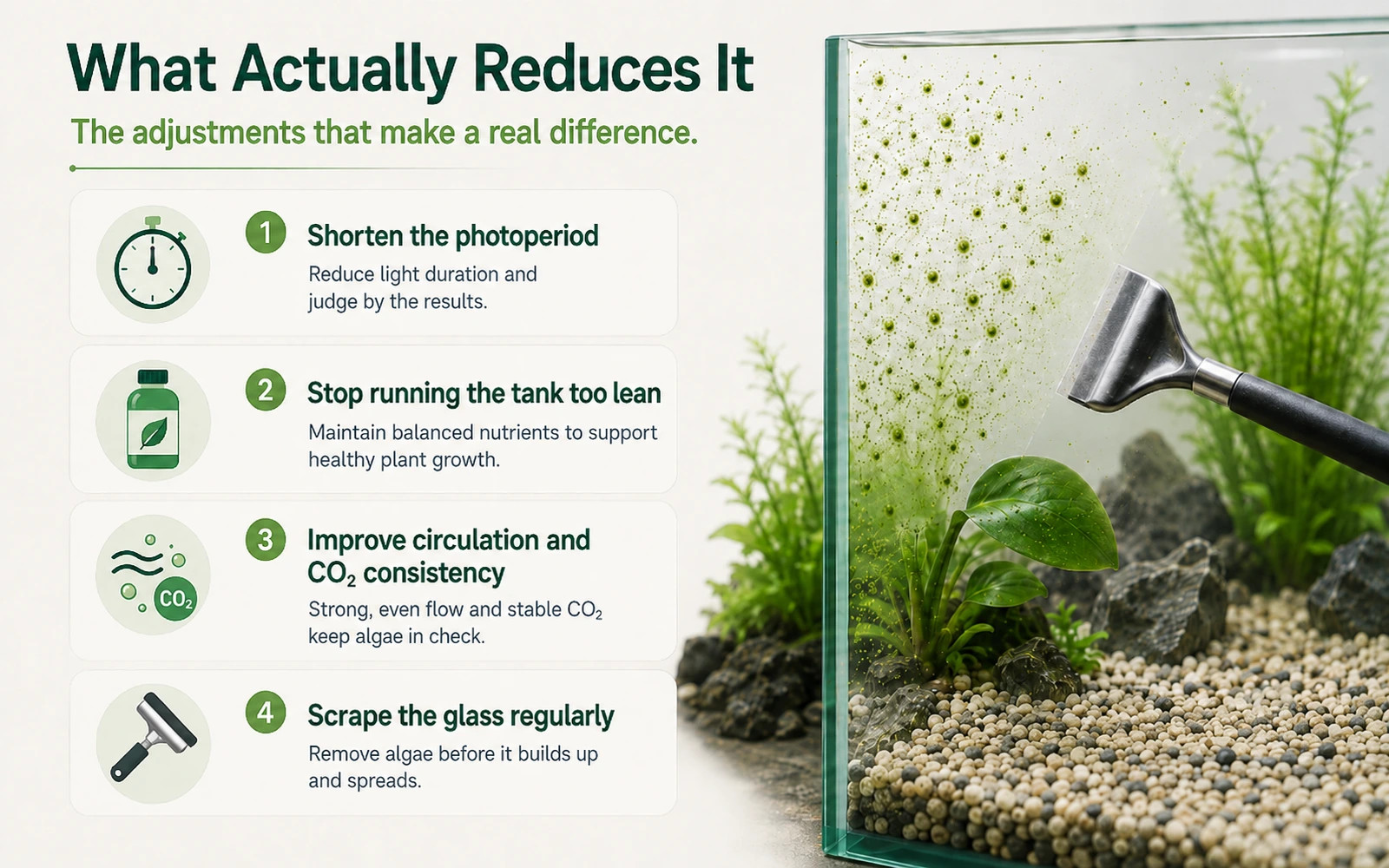
Shorten the photoperiod. Light duration is the easiest variable to change and the one most directly under your control. I will not name a number of hours, because the correct photoperiod depends on your fixture's intensity, your plant load and your tank, and any figure quoted here would be invented rather than measured. Reduce it, watch for a few weeks, and judge by the result.
Stop the tank from running nutrient-starved. In a planted tank this means a fertilizer that actually contains phosphate, used according to its label. In an unplanted, lightly stocked tank it often means that the tank is simply very clean and very brightly lit, and the practical response is less light rather than deliberately dirtying the water. If your nitrate consistently reads at or near zero in a stocked tank, that is worth understanding on its own terms, and aquarium nitrate levels covers what a low reading does and does not mean.
Improve circulation and, in an injected tank, CO2 consistency. Sources associate green spot algae with CO2 that is insufficient for the amount of light given. In a low-tech tank without injection, the practical equivalent is reducing the light rather than raising anything.
Clean the glass on a routine, before it hardens. Young spots come off far more easily than established ones. Making the front pane part of the weekly routine is less work than a quarterly battle.
Accept it on anubias. Green spot algae on a slow-growing leaf is very difficult to remove without damaging the leaf. Removing badly affected old leaves is usually the better outcome, and the plant will replace them.
Removing It Without Damaging the Tank
This is the practical section, and it contains the one genuine risk on this page.
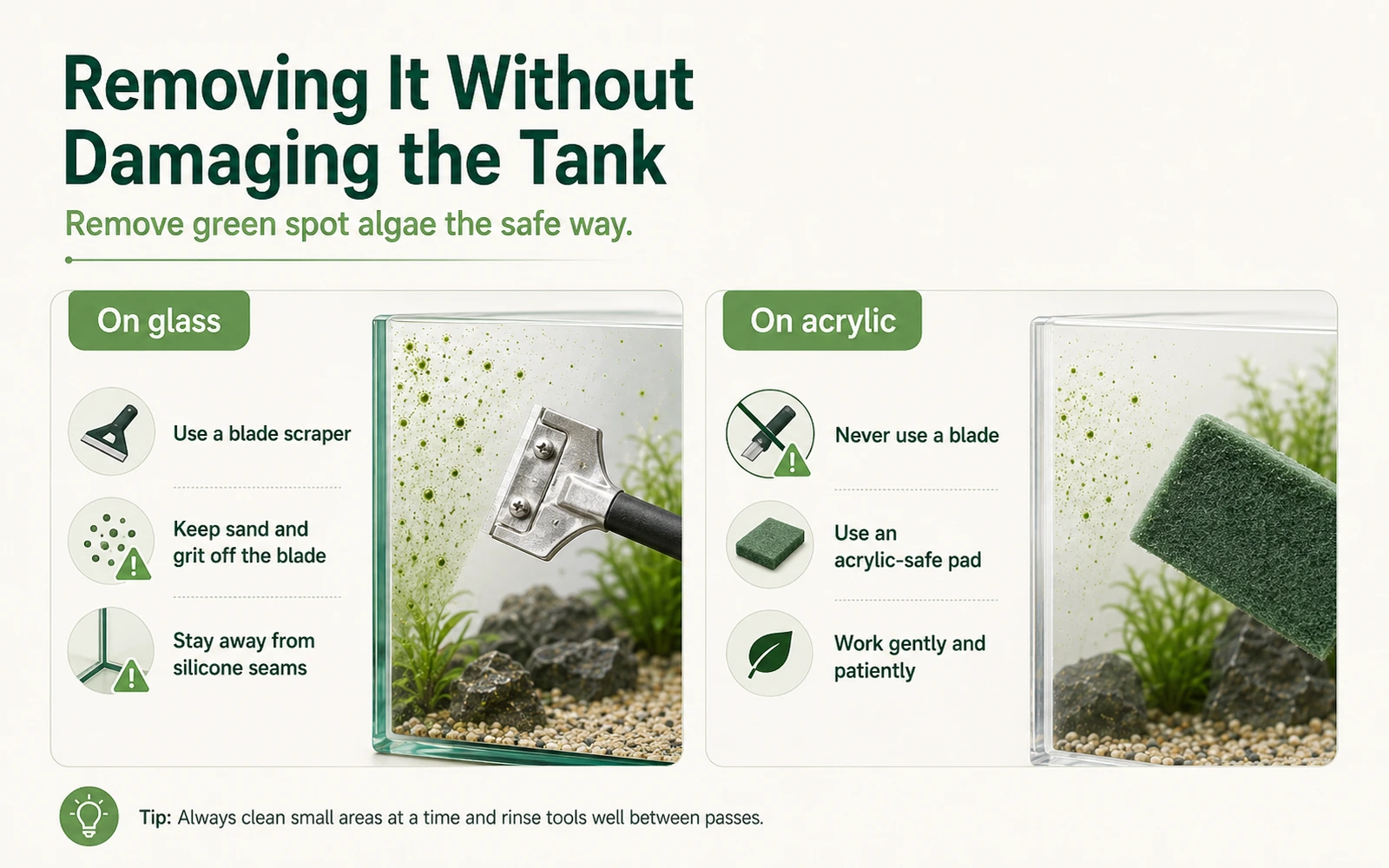
On glass: a blade scraper is the tool that works. Algae scraper blades, or a plain razor blade in a holder, cut hardened spots off cleanly. Keep the blade flat to the pane and work in overlapping passes. Watch two things: keep sand and gravel grains off the blade, since a trapped grain will scratch the glass, and stay away from the silicone seams, because a blade run along a seam can cut the sealant and that is a leak you have created yourself.
On acrylic: do not use a blade. Acrylic scratches easily and permanently, and a razor blade will ruin the panel in a single pass. Use a pad or scraper explicitly sold as acrylic-safe, expect it to take more patience, and accept that some hardened spots may need repeated gentle passes rather than force. If you are not certain whether your tank is glass or acrylic, tap it, look at the corners (acrylic tanks typically have seamless, rounded or bonded corners rather than silicone joints), and if in doubt treat it as acrylic.
Magnet cleaners are for maintenance between scrapes. They do not remove hardened green spot algae and running one over grit is another way to scratch a panel.
Nerite snails are widely reported as the most effective grazers on green spot algae, and they are hardy enough to be a fair addition to a stable tank. The usual caution applies: add an animal because you want to keep it, not as a cleaning appliance, and check that its needs match your tank first. No snail will fully clear a heavily affected pane.
When Green Spot Algae Is Telling You Something
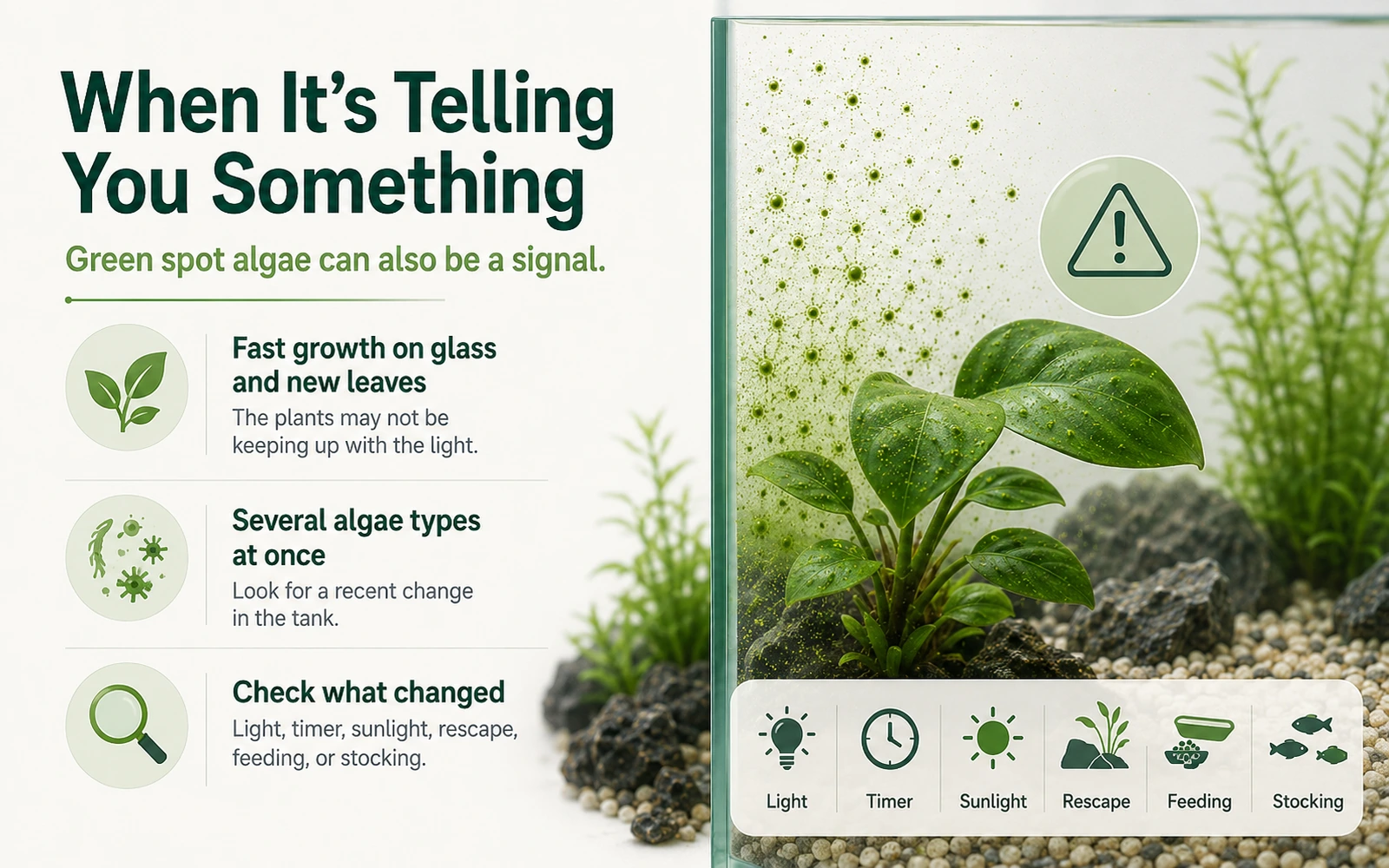
Most of the time this algae is cosmetic. Two patterns are worth reading as signals:
- It appears fast and everywhere, including on new plant growth. That points at a light level the plants cannot keep up with, and it is worth reducing the photoperiod rather than scraping more often.
- It arrives alongside other algae types at the same time. Multiple algae appearing together usually means the tank has changed rather than that you have several separate problems. Look for what changed: a new light, a longer timer setting, a rescape, a change in stocking or feeding, or the tank having moved into direct sunlight.
Algae does not make fish ill. If your fish are unwell as well as your glass being spotted, treat those as two separate matters, and when to contact an aquatic veterinarian covers where the line falls.
FAQ
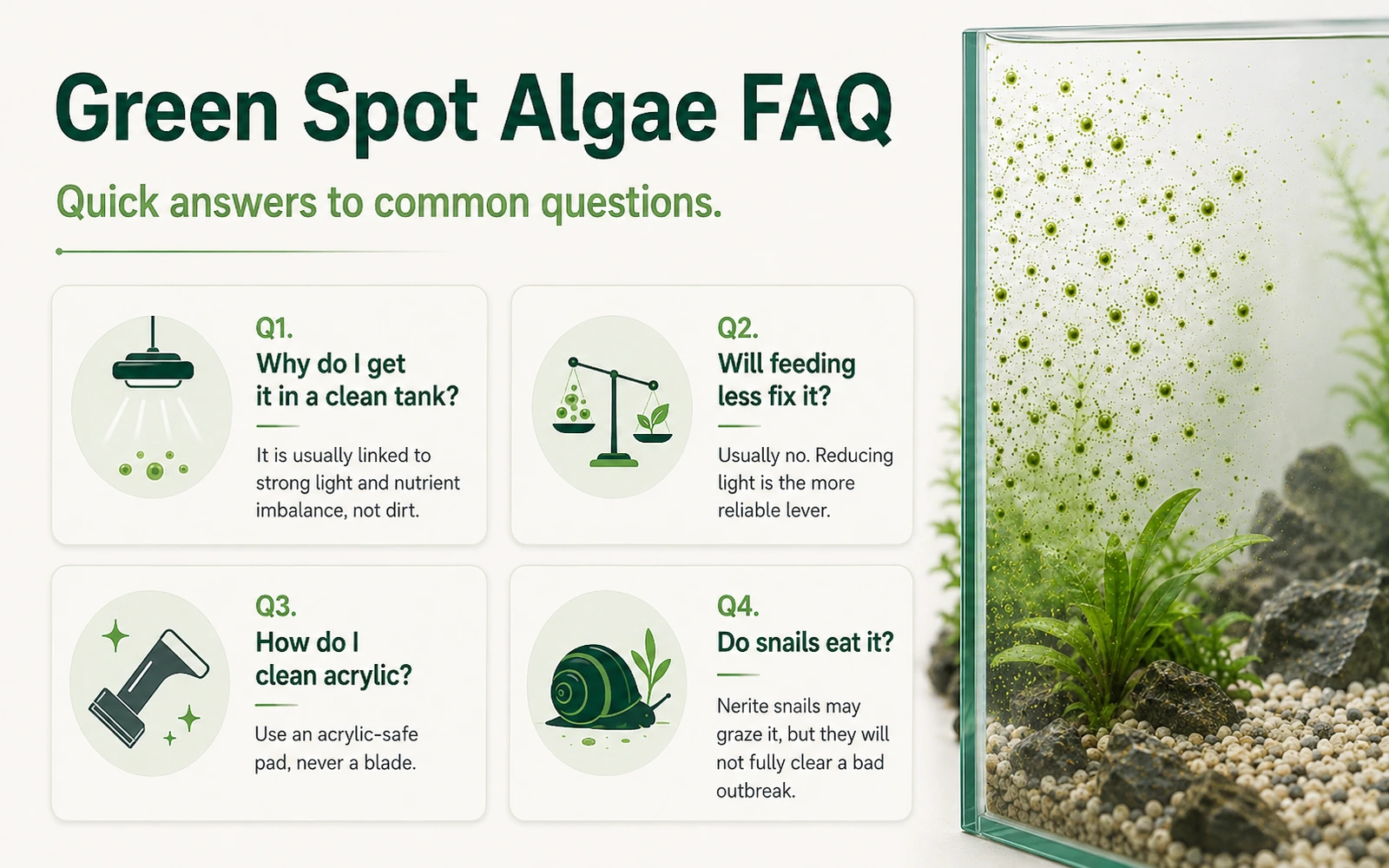
Why do I get green spot algae on the glass when my tank is clean? Because it is generally not a cleanliness problem. It is associated with strong or long lighting combined with a shortage of nutrients, particularly phosphate, which is a common combination in a bright, lightly stocked tank.
Will feeding less get rid of green spot algae? Usually not, and it can make things worse. Feeding less lowers the nutrients your plants need to compete. Reducing light duration is the more reliable lever.
How do I get green spot algae off acrylic? Never with a blade. Use a pad or scraper sold as acrylic-safe, and accept that it takes longer. A razor blade permanently scratches acrylic.
Does green spot algae hurt plants? It can. On slow-growing leaves such as anubias it blocks light and does not come off cleanly, so removing badly affected older leaves is often the better option.
Do snails eat green spot algae? Nerite snails are the most commonly recommended and are reported to graze it effectively. They will not fully clear a badly affected pane, and they should be added because you want to keep them, not purely as a cleanup measure.