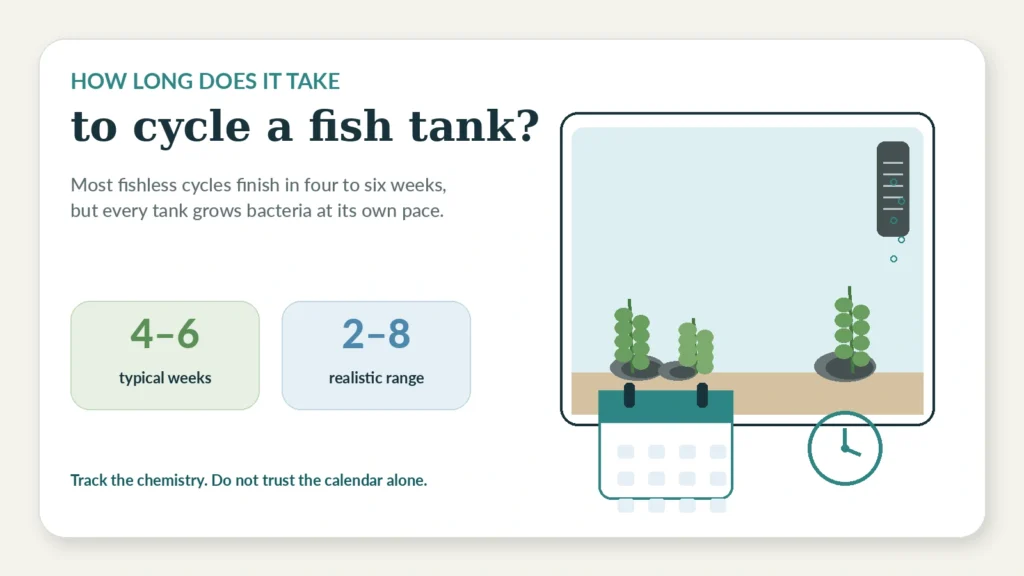
Cycling a new aquarium means growing a colony of beneficial bacteria that convert toxic ammonia and nitrite into far less harmful nitrate, and you do this before any fish go in the water. It takes weeks, not days. For most tanks the process runs about two to six weeks. You cannot safely rush it, and the honest, fish-friendly way to do it is a fishless cycle: you feed the tank a source of ammonia yourself, test the water every few days, and add fish only once ammonia and nitrite both read zero and nitrate is present. That is the whole answer. The rest of this guide shows you exactly how, with a day-by-day example so you can see what a real cycle looks like in numbers.
My name is Hossain, and I built Aquarium Answers because when I set up my first tank, almost every guide told me what to do and almost none told me why or what the readings should actually look like along the way. This is the guide I wish I had.
What "Cycling" Actually Means: The Nitrogen Cycle
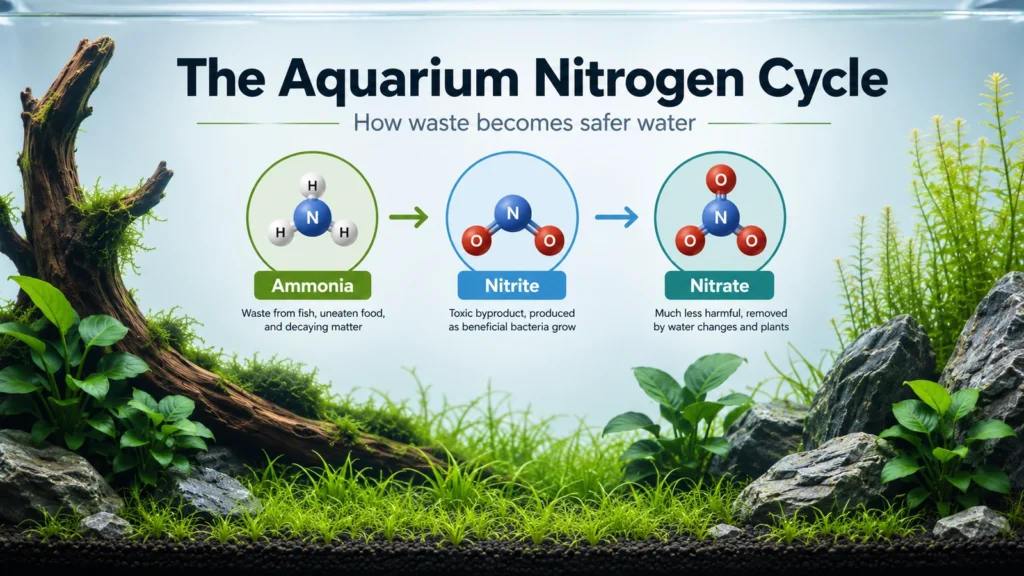
Fish constantly produce waste, and leftover food breaks down too. Both release ammonia, which is toxic to fish even at low levels. In an established tank, you never see ammonia build up because two groups of beneficial bacteria handle it for you. This chain is called the nitrogen cycle:
- Ammonia (NH3) appears from fish waste, uneaten food, and decaying plant matter. It is the most immediately dangerous of the three.
- One group of bacteria converts ammonia into nitrite (NO2). Nitrite is also toxic to fish. It stops their blood from carrying oxygen properly.
- A second group of bacteria converts nitrite into nitrate (NO3). Nitrate is much less harmful and only becomes a problem at high concentrations, which you control with regular water changes.
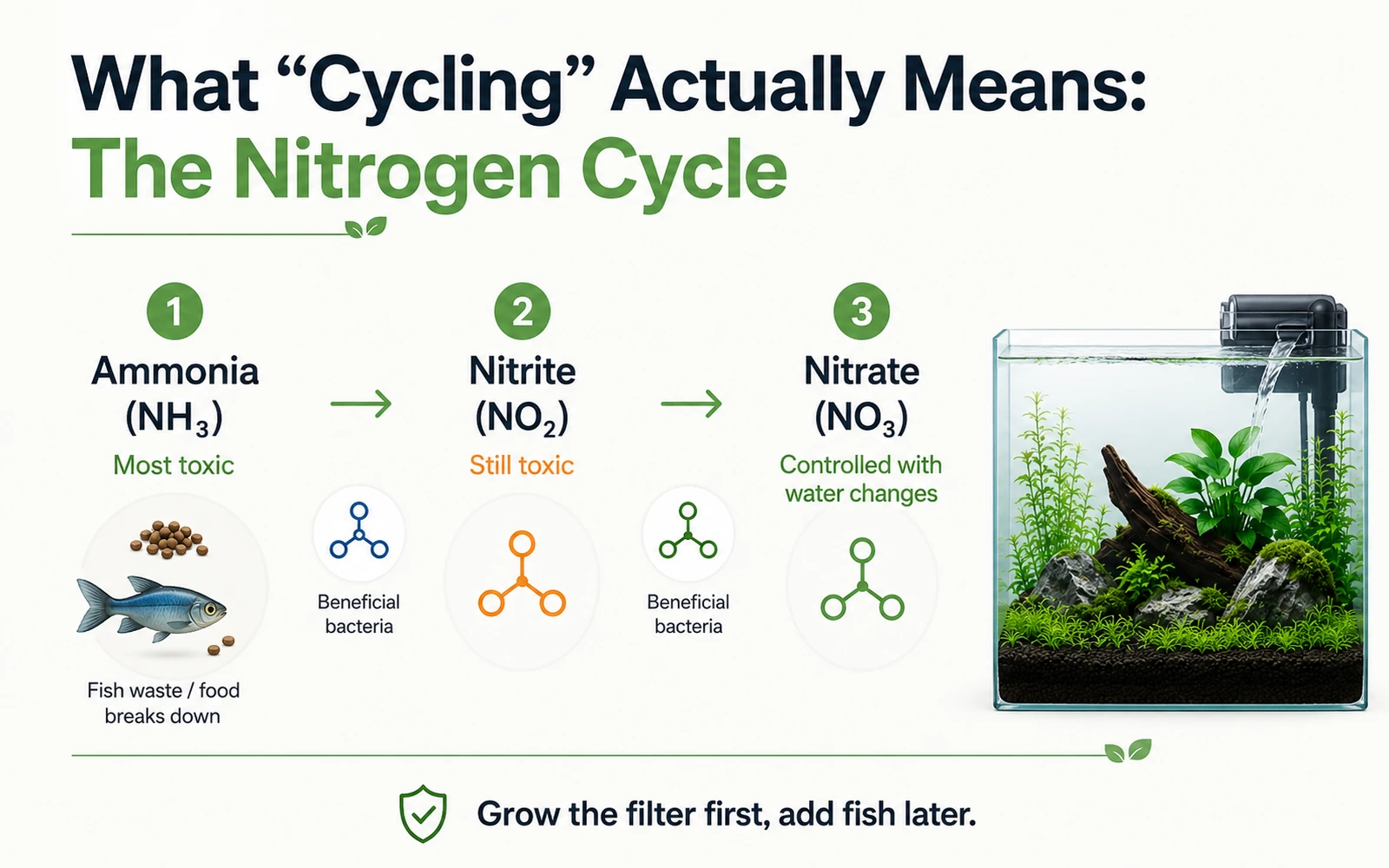
"Cycling" is simply the period you spend growing those two bacteria colonies until they are large enough to process waste as fast as it is produced. A brand-new tank has almost none of these bacteria, so if you drop fish straight into fresh water, ammonia and then nitrite climb with nothing to break them down. That poisoning event is what hobbyists call "new tank syndrome," and it is the single most common reason beginner fish die in the first month.
The key idea to hold onto: grow the filter first, add livestock later. Everything below serves that one goal.
Fishless vs. Fish-In Cycling: Why I Recommend Fishless
There are two ways to get ammonia into the tank so the bacteria have something to eat. You can add it yourself with no fish present (fishless cycling), or you can put a few hardy fish in and let their waste supply it (fish-in cycling). I recommend fishless cycling, and here is the honest reason.
During a fish-in cycle, the fish are living inside the exact ammonia and nitrite spike the cycle produces. That is not a theoretical risk. It is chemical burns to the gills, stress, and often death. It is possible to do a fish-in cycle without losing fish, but only if you commit to frequent, large water changes to keep ammonia and nitrite diluted the entire time, sometimes daily, and you test constantly. In other words, the "faster" method is actually more work and it puts an animal through a poisoning it did not have to experience.
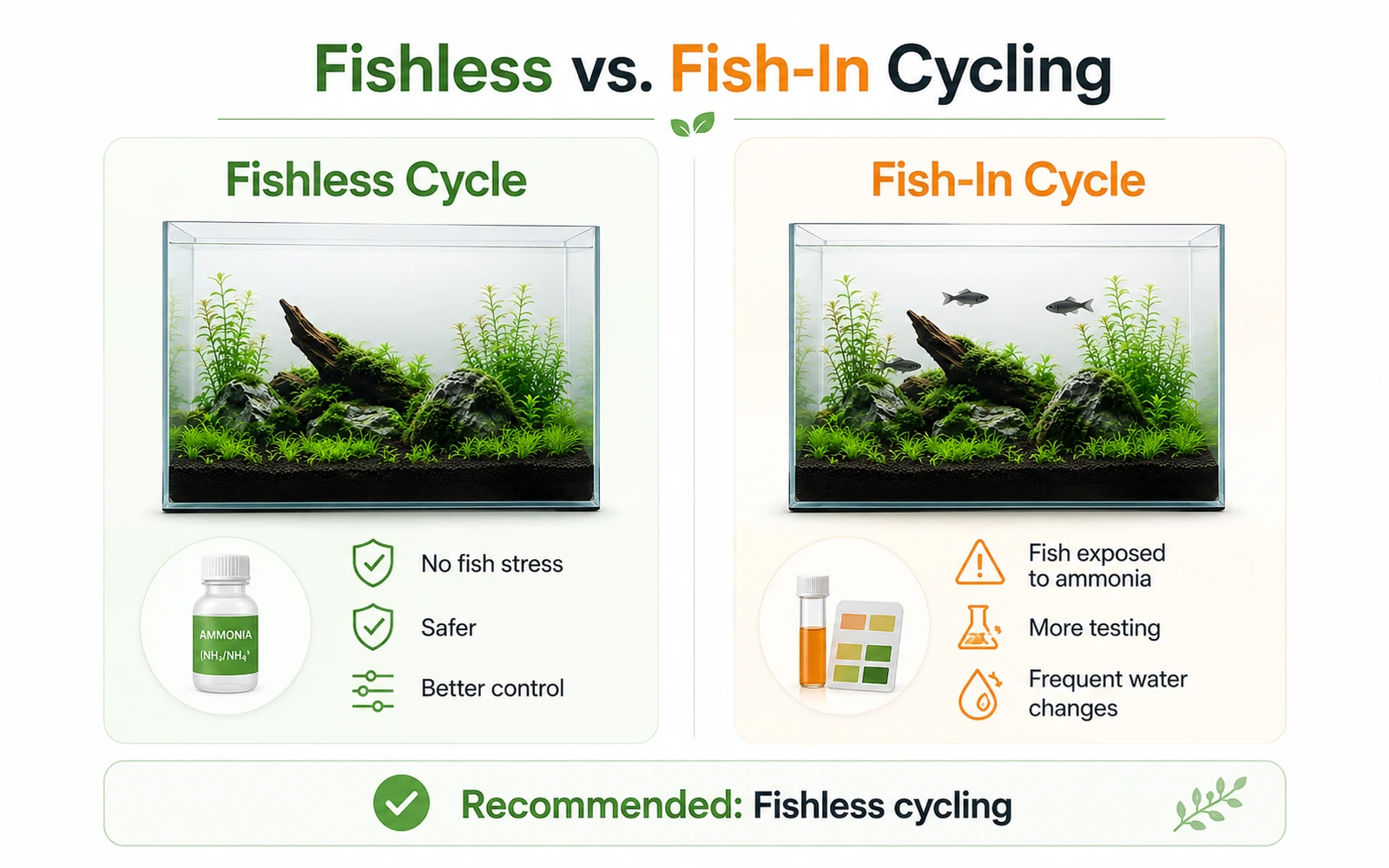
Fishless cycling removes that trade-off. No fish are exposed to anything, you can push the tank harder to build a bigger bacteria colony, and you add fish only when the water is genuinely safe. On this site the reader's fish come first, so fishless is the default I will always point you to. If you have already added fish and only now learned about cycling, do not panic and do not tear the tank down. Skip to the fish-in rescue section further down.
What You Need Before You Start
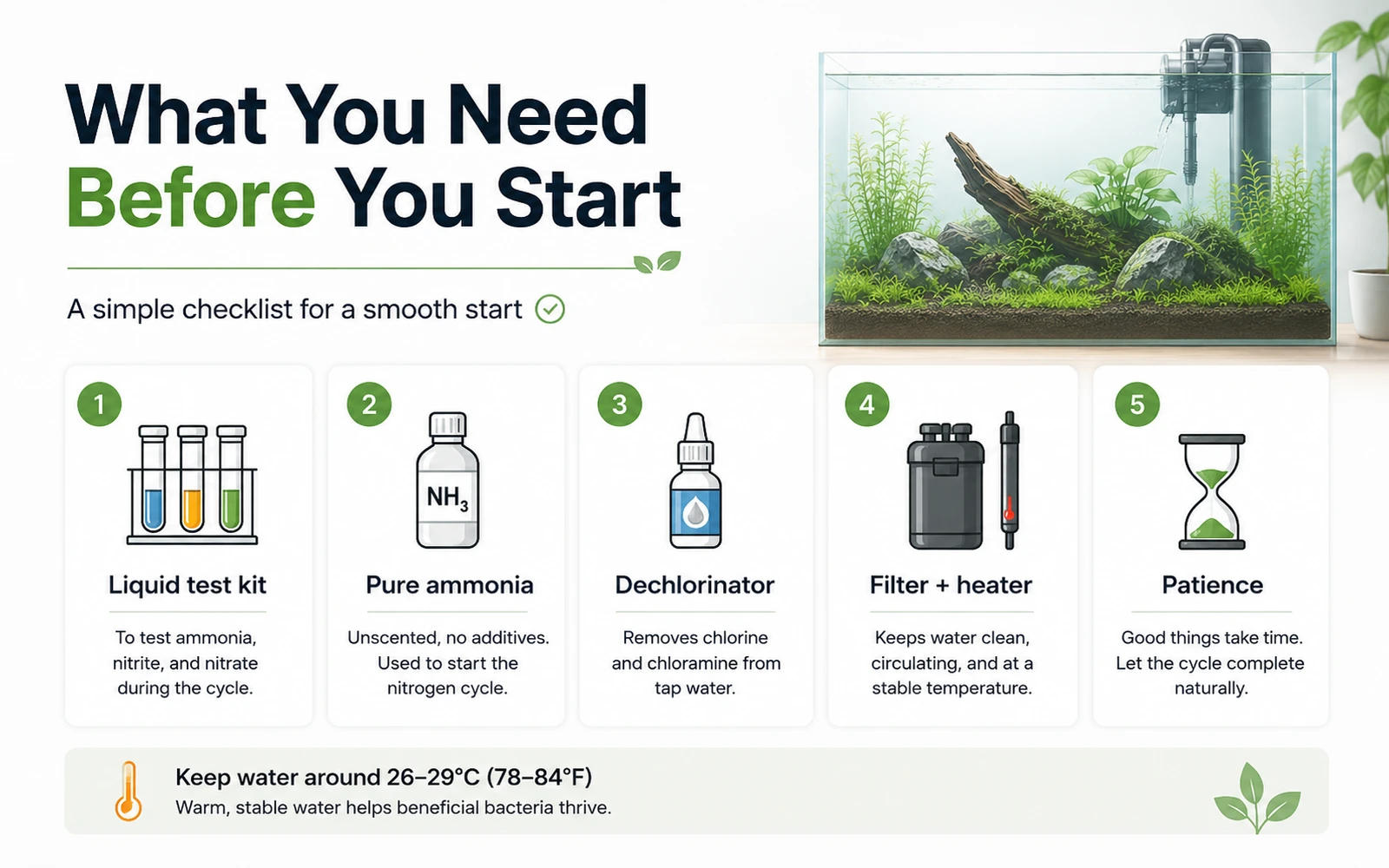
You do not need much, but two items are non-negotiable.
- A liquid test kit for ammonia, nitrite, nitrate, and pH. Liquid reagent kits are more accurate and far cheaper per test than paper test strips, which is why they are the standard hobby recommendation. You cannot cycle a tank "by feel." The whole process is invisible without testing.
- An ammonia source. Use a bottle of pure ammonia (also sold as ammonium chloride for aquariums) with no added surfactants, perfumes, or colorants. If you shake the bottle and it foams up, it has additives and is not safe. Do not use household cleaning ammonia.
- A dechlorinator (water conditioner). Tap water contains chlorine or chloramine that kills the very bacteria you are trying to grow. Treat every drop of tap water that goes in the tank.
- Your fully set-up tank: filter running, heater on, substrate and decor in place. If you are still assembling the tank, work through my first aquarium setup checklist first, then come back here.
- Patience. This is the real ingredient. Warmer water helps the bacteria establish faster, so setting the heater around 26 to 29 C (about 78 to 84 F) gives the cycle a head start, but nothing makes it instant.
For a deeper reference on what each reading means and the safe target range for every parameter, see my full guide to aquarium water parameters. Keep it open while you cycle.
How to Fishless Cycle, Step by Step
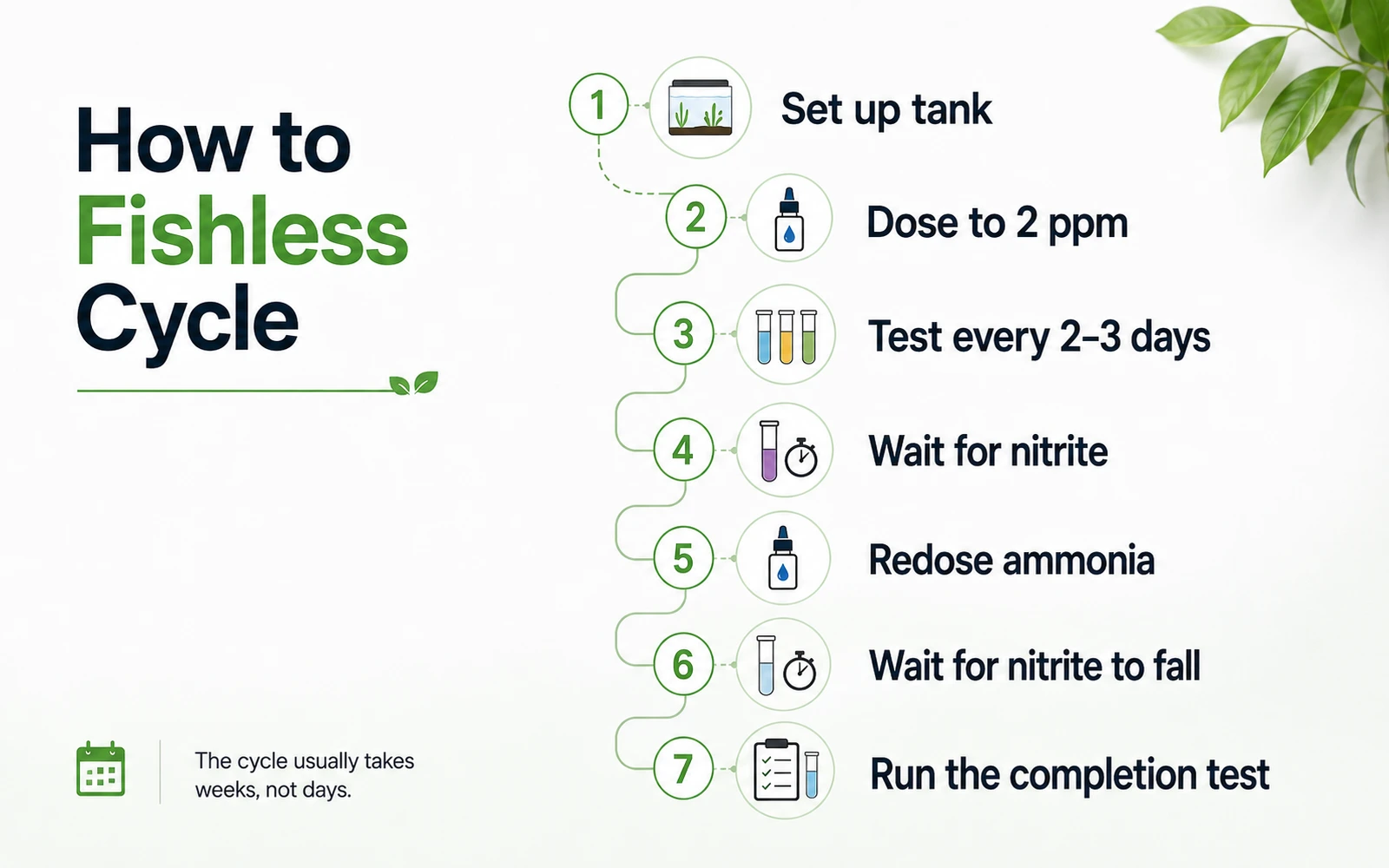
- Set up and treat the water. Fill the tank, add dechlorinator, and get the filter and heater running for a day or two before dosing anything.
- Dose ammonia to about 2 ppm. Add your pure ammonia a little at a time and test until the reading sits near 2 ppm. Write down how many drops or milliliters got you there so you can repeat the dose later. Aiming for 2 ppm rather than higher avoids stalling the cycle, which very high ammonia can do.
- Test every two to three days and log the numbers. In the first week or two, expect almost nothing to change. That is normal. The first bacteria colony is still tiny.
- Wait for nitrite to appear. When ammonia starts dropping and nitrite starts rising, the first half of the cycle is working. Nitrite often does not show up until somewhere around days 10 to 20.
- Keep feeding ammonia. Whenever ammonia drops back near zero, redose to about 2 ppm. The bacteria need a steady food supply to keep multiplying. Do not let the tank sit empty of ammonia for days, or you starve the colony you are building.
- Wait for nitrite to fall and nitrate to rise. This is usually the longest, most frustrating stage. Nitrite can sit stubbornly high for a week or more before the second bacteria colony catches up.
- Run the completion test (see below). When it passes, do a large water change to drop the accumulated nitrate, then add fish.
A Real 30-Day Cycle, Day by Day (Illustrative Example)
The table below is an illustrative example, not data from a specific customer's tank. Every aquarium is a different system and yours will not match these numbers exactly. The point is the shape of the curve, so you can tell whether your own readings are heading the right way. All figures are ppm.
| Day | Action | Ammonia | Nitrite | Nitrate | What it means |
|---|---|---|---|---|---|
| 0 | Dose to 2 ppm | 2.0 | 0 | 0 | Cycle started, bacteria feeding begins |
| 3 | Test | 2.0 | 0 | 0 | Nothing yet, this is normal |
| 7 | Test | 2.0 | 0 | 0 | Still nothing, do not give up |
| 10 | Test | 1.0 | 0.25 | 0 | First bacteria working, nitrite appears |
| 14 | Test | 0.25 | 1.0 | 5 | Ammonia dropping fast, nitrite climbing |
| 15 | Redose to 2 ppm | 2.0 | 1.0 | 5 | Keep feeding the colony |
| 18 | Test | 0 | 2.0 | 10 | Ammonia handled in days now, nitrite spikes |
| 21 | Redose to 2 ppm | 2.0 | 5.0+ | 20 | Nitrite stuck high, the slow stage |
| 25 | Test | 0 | 1.0 | 30 | Second colony finally catching up |
| 28 | Test | 0 | 0.25 | 40 | Almost there |
| 30 | Dose to 2 ppm, retest 24h later | 0 | 0 | 40 | Both zero in 24h: cycled |
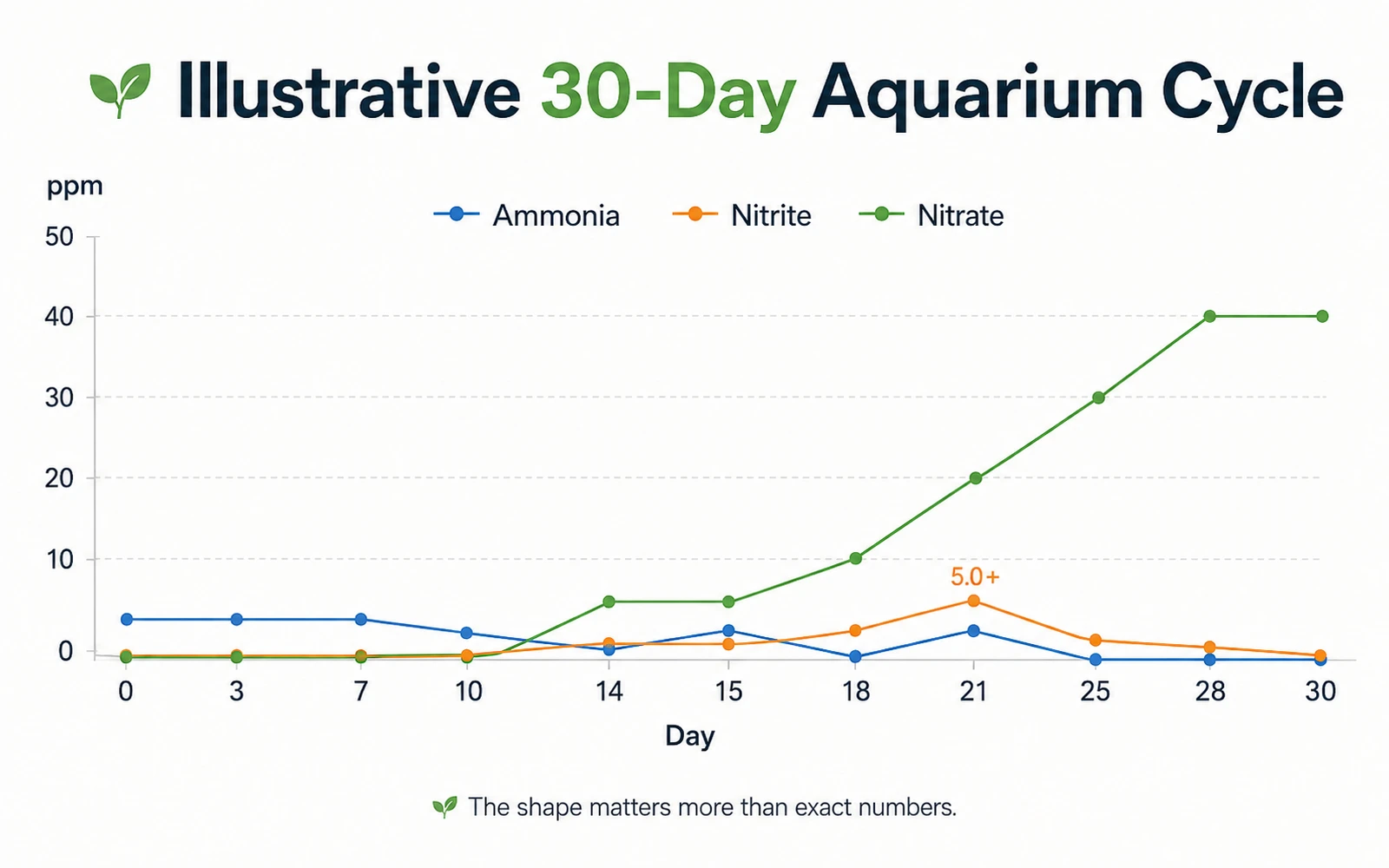
Notice how little happens in the first week and how long nitrite hangs around in weeks three and four. That pattern trips up beginners who assume a flat reading means something is broken. It usually just means the bacteria are still multiplying.
How to Know It's Done: The Three-Number Checklist
A tank is cycled when it passes this specific test, not just when a number looks good once:
- Dose ammonia back up to about 2 ppm.
- Wait 24 hours and test again.
- The cycle is complete only if, after 24 hours, ammonia reads 0 AND nitrite reads 0, with nitrate present.
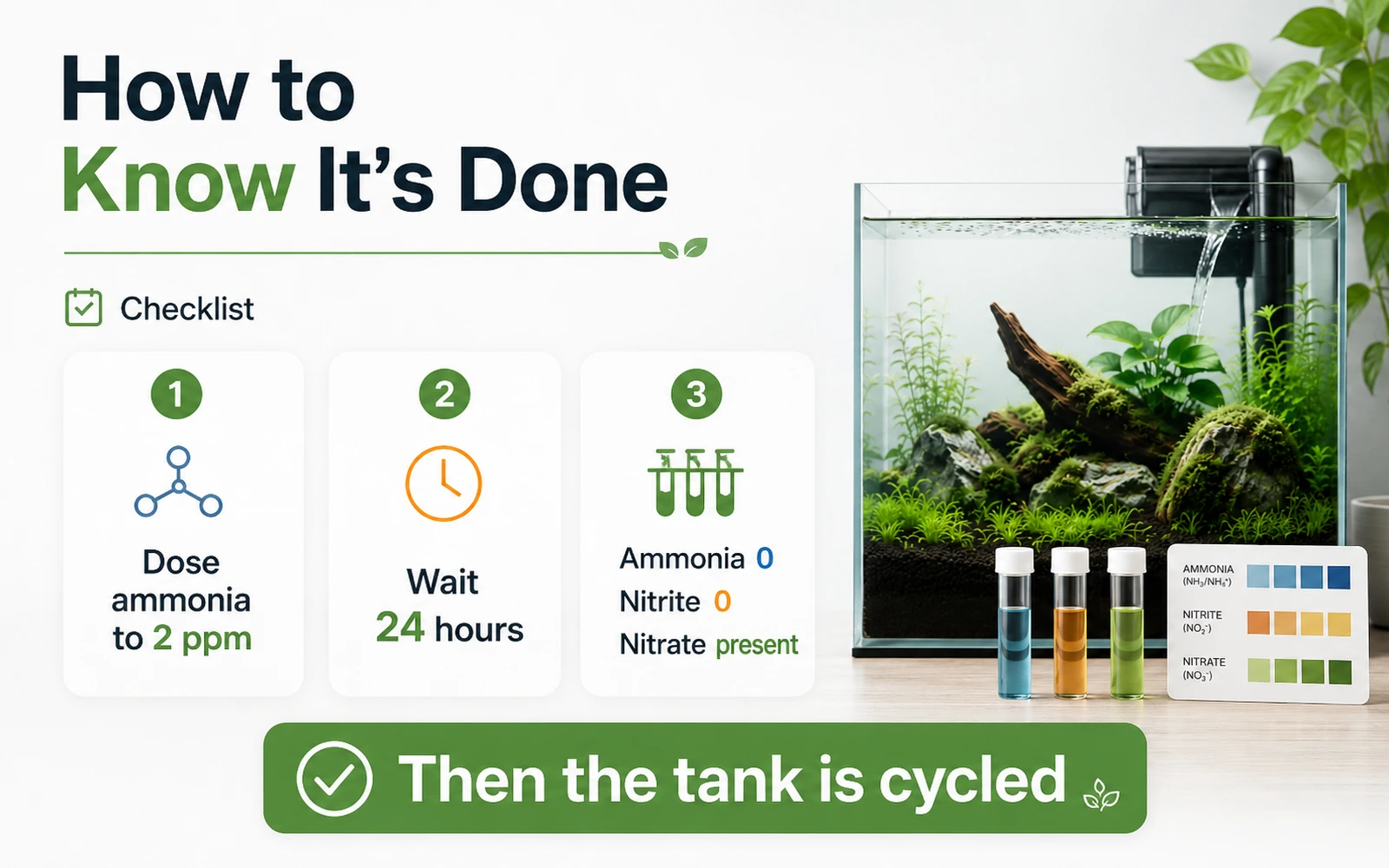
Processing a full 2 ppm of ammonia all the way to nitrate in a single day means both bacteria colonies are big enough to protect fish. A reading of zero ammonia alone is not enough, because nitrite can still be lurking. All three numbers have to line up: 0 ammonia, 0 nitrite, some nitrate. Once they do, do a large water change (nitrate will have built up to a level you do not want fish sitting in), match the temperature, and you are ready to stock, slowly.
Troubleshooting: When the Cycle Stalls
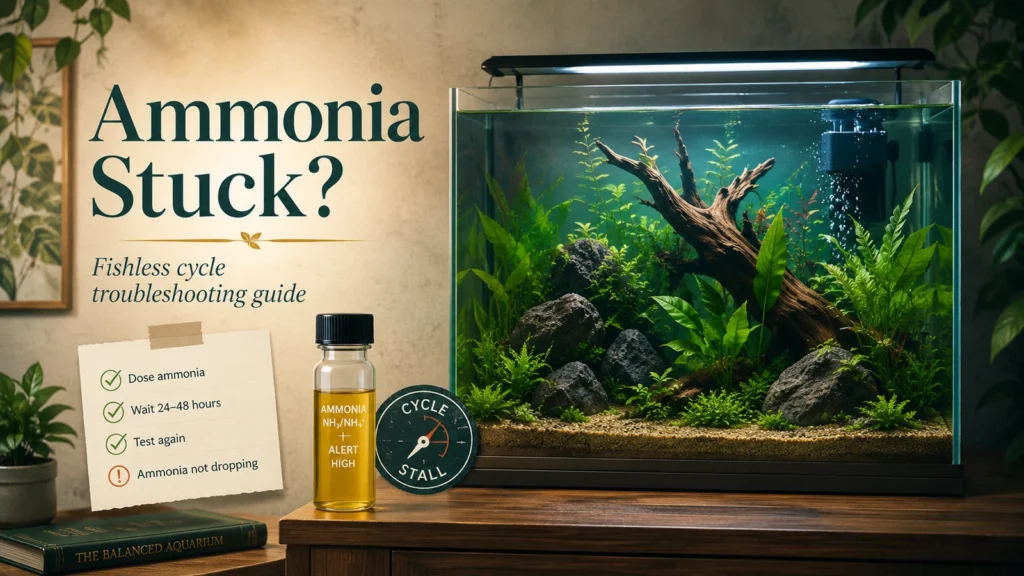
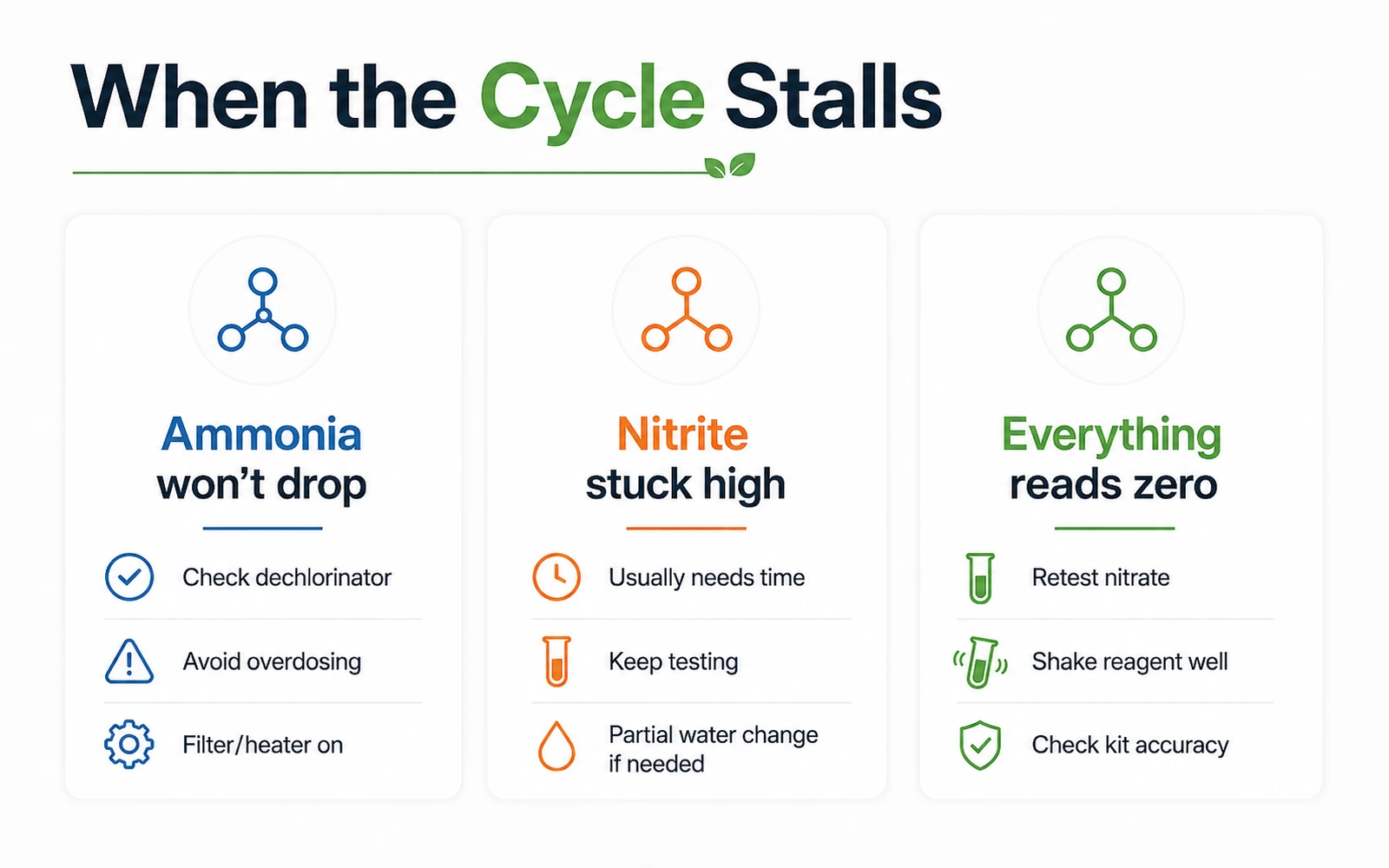
Ammonia won't drop after two weeks. Check that your dechlorinator did its job and that you did not dose ammonia far above 2 ppm, since very high ammonia can stall a cycle. Confirm the heater is on and the filter is running around the clock. Bacteria live in the filter media and need constant flow and oxygen.
Nitrite is stuck high for days. This is the most common sticking point and usually just needs more time. The nitrite-to-nitrate bacteria are slower to establish. Keep dosing ammonia to about 2 ppm and keep testing. If your test kit maxes out its scale, a partial water change lets you read the number and dilutes it slightly, but it will not stop the cycle.
Everything reads zero but you never saw nitrate. Retest carefully. The common nitrate reagent test needs vigorous shaking of the second bottle for the full time on the instructions, or it reads falsely low. A true zero across all three on a brand-new tank usually means the reagent was not mixed properly.
If a reading ever alarms you mid-cycle or a fish already in the tank looks distressed, my aquarium emergency help page walks through the calm, immediate steps. Panic causes more losses than the original problem.
Can You Speed Up a Cycle? An Honest Verdict on Bottled Bacteria
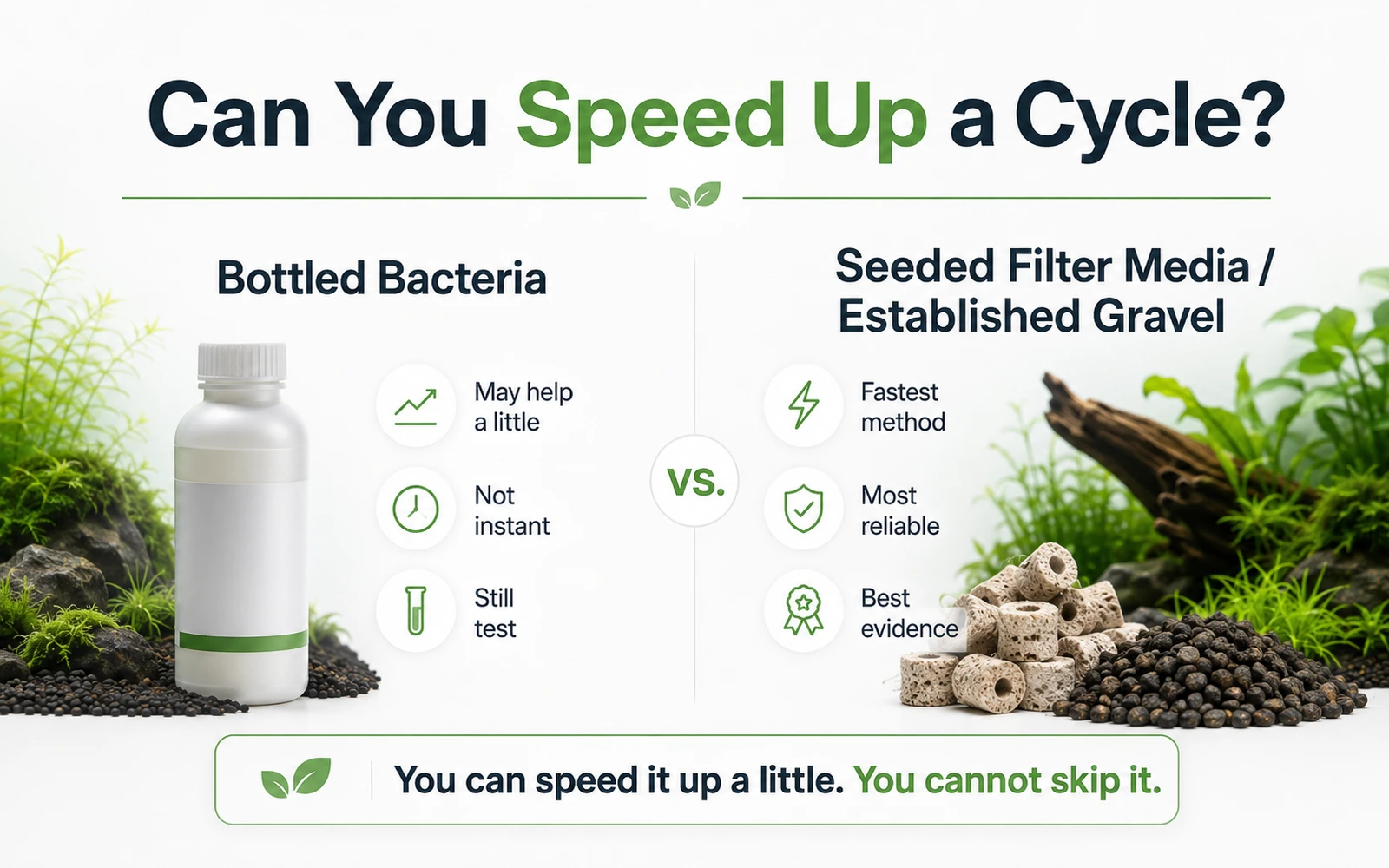
Bottled "starter" or "instant cycle" bacteria are the product beginners most want to believe in, so here is the straight answer. Independent hobby testing, including detailed write-ups at Aquarium Science, has found that many of these products do little to nothing to speed up a cycle, and some contain bacteria strains that are not even the ones that colonize a freshwater filter long term. A few products perform better than others, and adding one is unlikely to hurt. But treating any bottle as a magic "add fish today" button is exactly how beginners lose fish.
The real accelerators are not in a bottle at all. The fastest, most reliable way to jump-start a cycle is to seed your new filter with established bacteria: a handful of gravel, a piece of filter media, or a sponge squeezed out from a healthy, disease-free established tank. That transplants a living colony instead of hoping a bottle contains one.
So, can you speed up a cycle? A little, sometimes. Can you skip it? No. Any product or method that promises you a safe tank in 24 hours from scratch is selling you something the biology does not support. The bacteria grow at their own pace, and your fish depend on you respecting that.
Adding Your First Fish Safely
Even after a completed cycle, add fish gradually. Your bacteria colony is sized to the ammonia load you fed it, so a small first group of fish is safe, but stocking the tank fully on day one can outpace the bacteria and cause a small "mini cycle." Add a few fish, wait a week or two, test, and add more only when readings stay at zero ammonia and zero nitrite.
From there, the job shifts from cycling to maintenance, and the main tool is the water change. How much and how often depends on your stocking and nitrate readings, which I cover in how often to change aquarium water.
FAQ
How long does it take to cycle a new aquarium?
Usually two to six weeks for a fishless cycle, though it can be faster with seeded filter media or slower in a cold tank. Do not go by the calendar alone. Go by the completion test: ammonia and nitrite both processing to zero within 24 hours, with nitrate present.
Can I add fish while the tank is cycling?
It is better not to. That is a fish-in cycle, and the fish live through the toxic ammonia and nitrite spike. If you must, keep ammonia and nitrite diluted with frequent large water changes and test daily. Fishless cycling avoids the whole problem.
What ammonia level should I dose for a fishless cycle?
Around 2 ppm. That gives the bacteria a steady food supply without the very high levels that can stall a cycle. Redose back to about 2 ppm each time the reading drops toward zero.
Do I really need a liquid test kit?
Yes. Cycling is invisible without testing. Liquid reagent kits are more accurate and cheaper per test than paper strips, and you cannot judge ammonia or nitrite by looking at the water.
My ammonia dropped to zero, is the tank cycled?
Not necessarily. You also need nitrite at zero and nitrate present. Zero ammonia alone can still mean nitrite is dangerously high. Run the full 24-hour completion test before trusting the tank with fish.
Does bottled bacteria really cycle a tank instantly?
No. Independent testing shows many products do little to speed the cycle, and none reliably deliver a safe tank overnight from scratch. Seeding your filter with media from an established, healthy tank works far better. Still test before adding fish.