You did the cycle properly. Ammonia goes to zero, nitrite goes to zero, nitrate is present. Every guide says that is the finish line, so why would anyone tell you to wait longer?
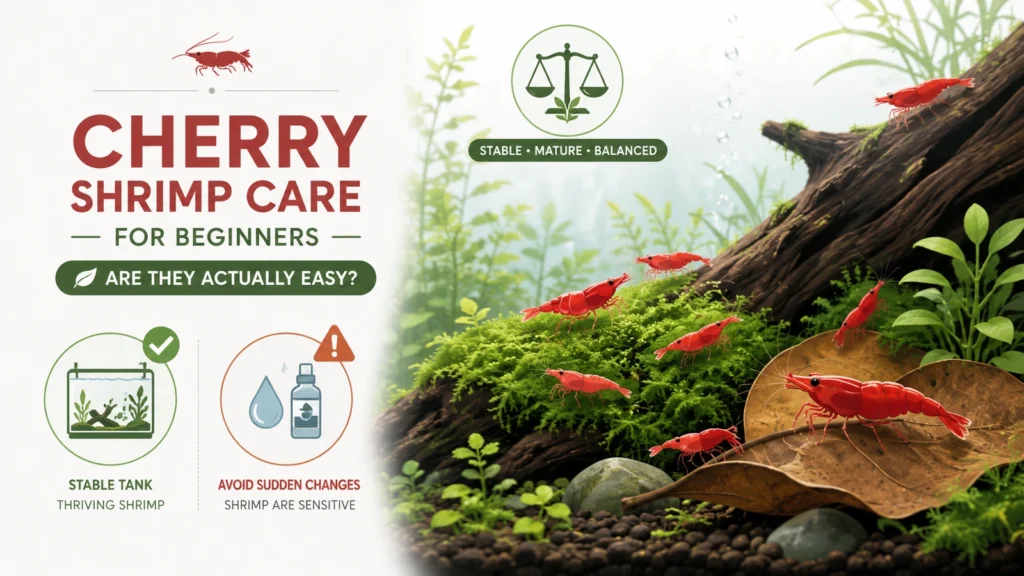
Because a cycled tank and a mature tank are two different things, and shrimp need the second one.
Cycled means the tank can process waste without poisoning its occupants. That is a chemistry statement and a test kit can confirm it. Mature means the tank has developed the surfaces, the biofilm and the population of small organisms that a grazing animal lives on, and that it has been stable long enough to prove it will stay stable. No test kit reports on that.
Fish can be added to a cycled tank. Shrimp do much better in a mature one, and the gap between the two is measured in months rather than days.
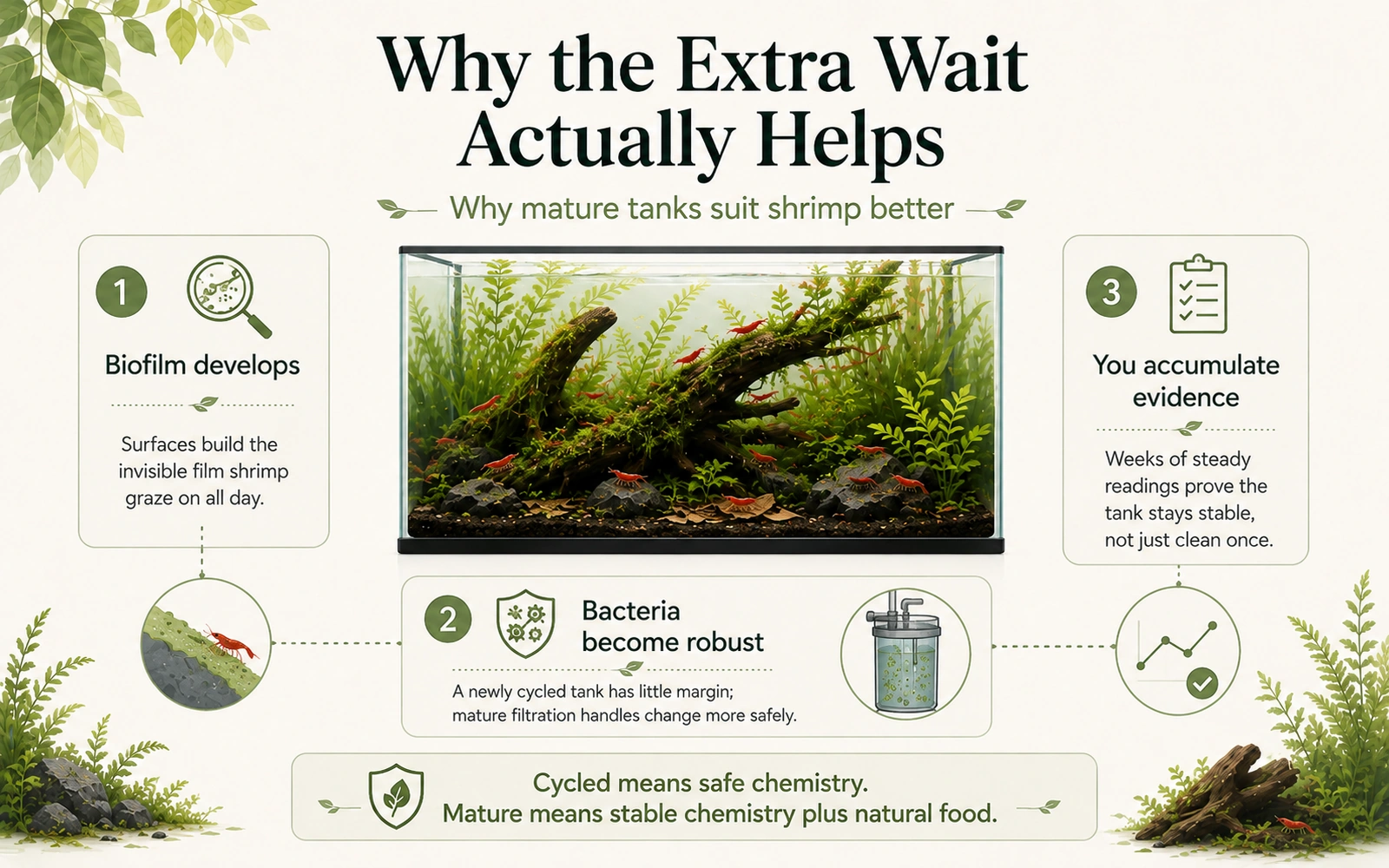
Why the extra wait actually helps
Three separate things happen in the weeks after the cycle completes.
Biofilm develops. Every surface in a running tank slowly acquires a thin layer of bacteria, algae and micro-organisms. It is invisible to you and it is the primary food source for a shrimp colony. A brand new tank has bare glass, bare substrate and clean decor, which from a shrimp's point of view is an empty cupboard.
The bacterial population becomes robust rather than adequate. A tank that has just finished cycling has enough bacteria for the load it was cycled with. It has very little margin. Add anything, clean anything wrong, lose power for an afternoon, and it can stall. An aquarium cycle crash covers what that looks like, and shrimp feel it before fish do.
You accumulate evidence. After eight weeks of readings you know whether this tank is steady or whether it wanders. That is not a chemistry fact, it is a track record, and it is the single best predictor of whether a colony will survive in it.
How long, and why the recommendations disagree
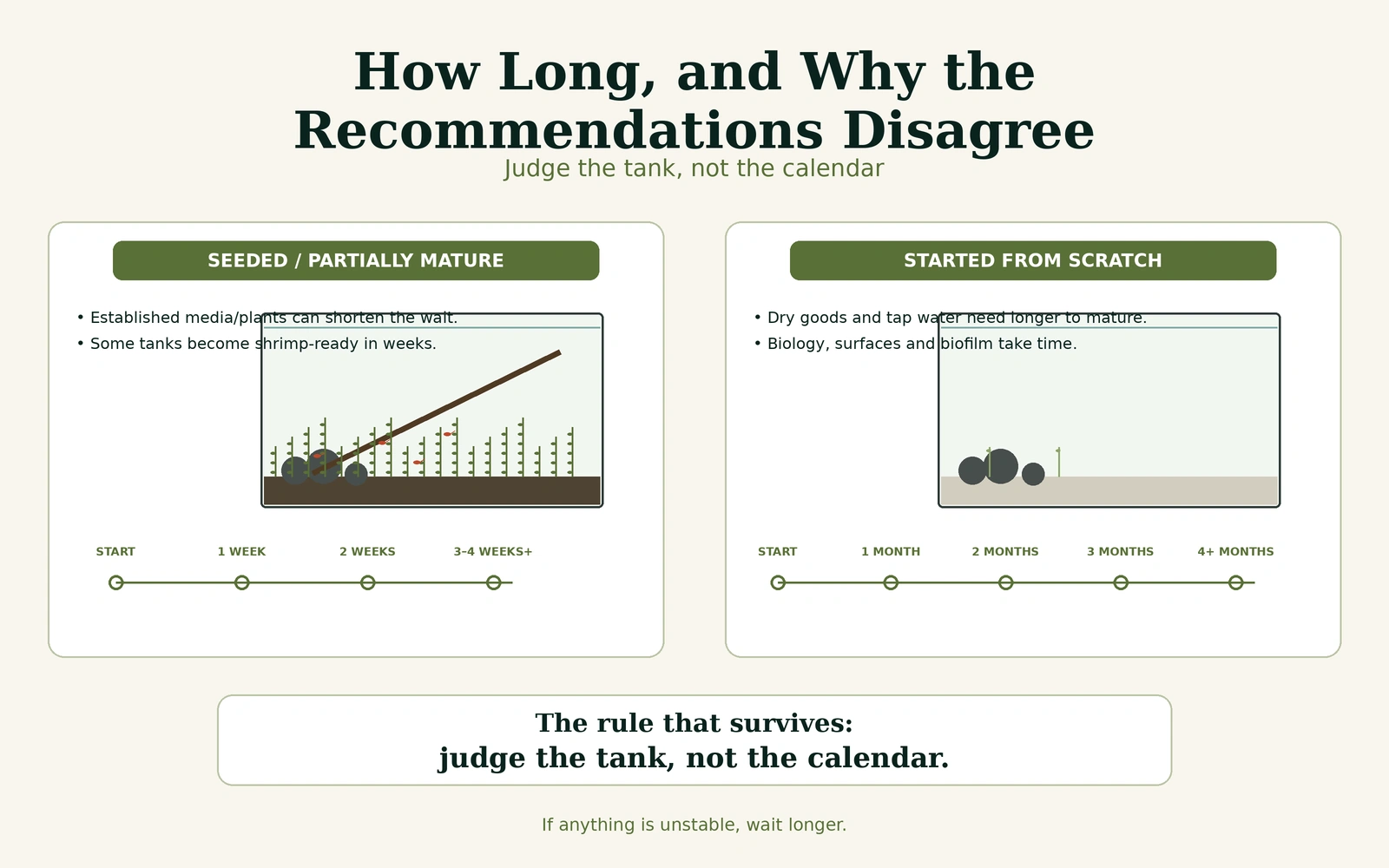
You will find advice ranging from "as soon as it is cycled" to "not for six months", stated with equal confidence.
The disagreement is real and it is not stupidity on either side. The short recommendations come from keepers seeding a new tank from an established one, where the filter, the substrate and often the plants arrive already mature and the tank skips most of the waiting. The long recommendations come from keepers starting genuinely from nothing.
The rule that survives whichever camp is right: judge the tank, not the calendar. A tank set up with mature media and a bucket of established substrate can be ready in weeks. A tank started from dry goods and tap water is not ready in weeks whatever the test kit says. Seeding a new filter from an established tank is the technique that moves the date forward legitimately.
If you want a rough default for a tank started from nothing, most keepers who care about their colonies wait a couple of months past the end of the cycle, and the ones who lost a colony wish they had waited longer.
The readiness checks
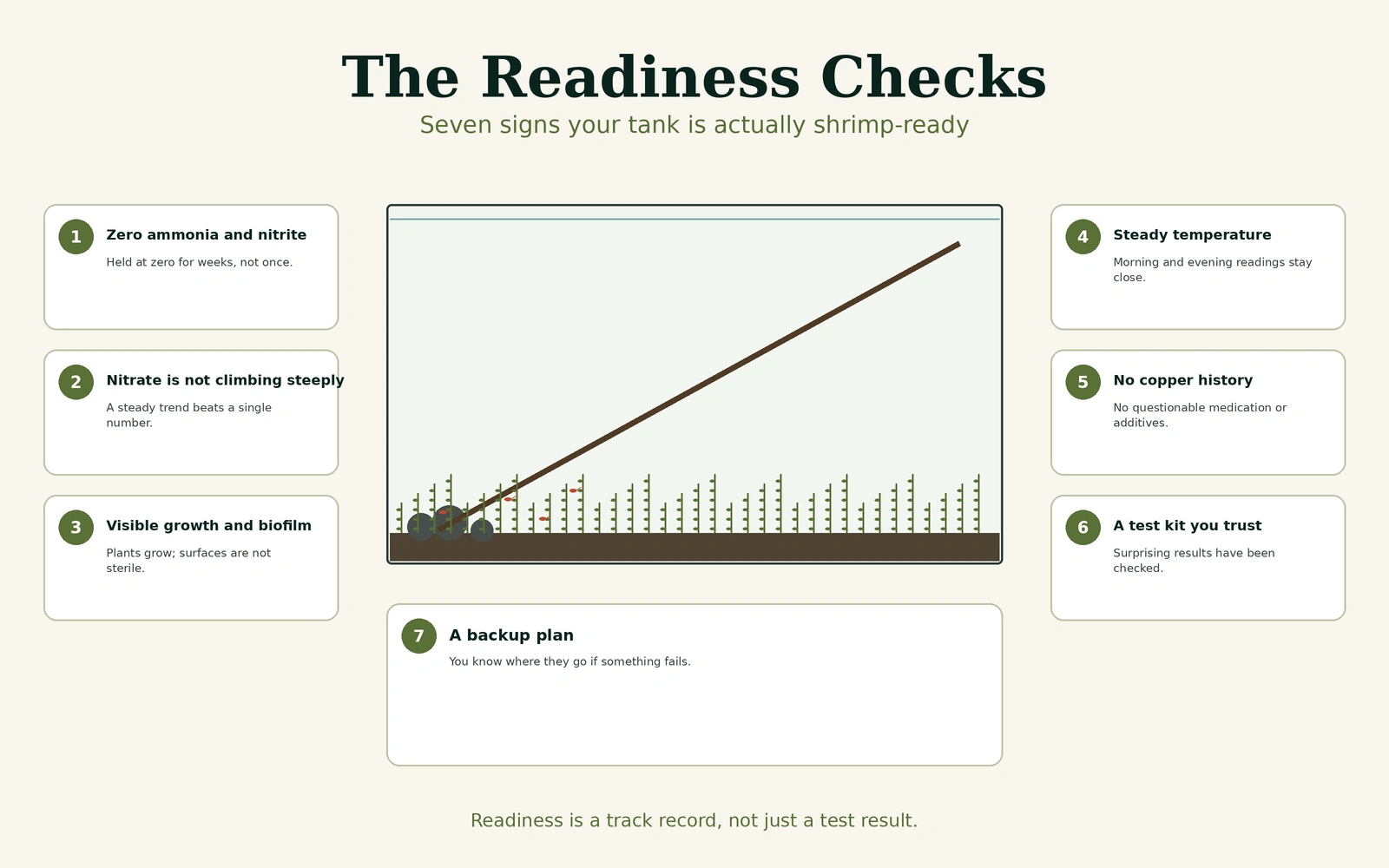
Work through these rather than counting days.
1. Ammonia and nitrite read zero, and have done for weeks. Not once. Repeatedly, across a period where you were also feeding the tank. How often to test aquarium water covers the routine that produces this evidence.
2. Nitrate is present and is not climbing steeply between water changes. Present means the cycle is running. A steep climb means the routine is not keeping up, which is a stability problem regardless of the number. Aquarium nitrate levels explains why the slope is the information rather than the level.
3. There is visible growth. Some algae on the glass, some green or brown film on the decor, plants that have put out new leaves rather than melting. A spotless tank is a young tank.
4. The temperature is steady across the day. Not a particular temperature, a steady one. Check it morning and evening for a week. Aquarium water temperature covers why stability is the thing that matters.
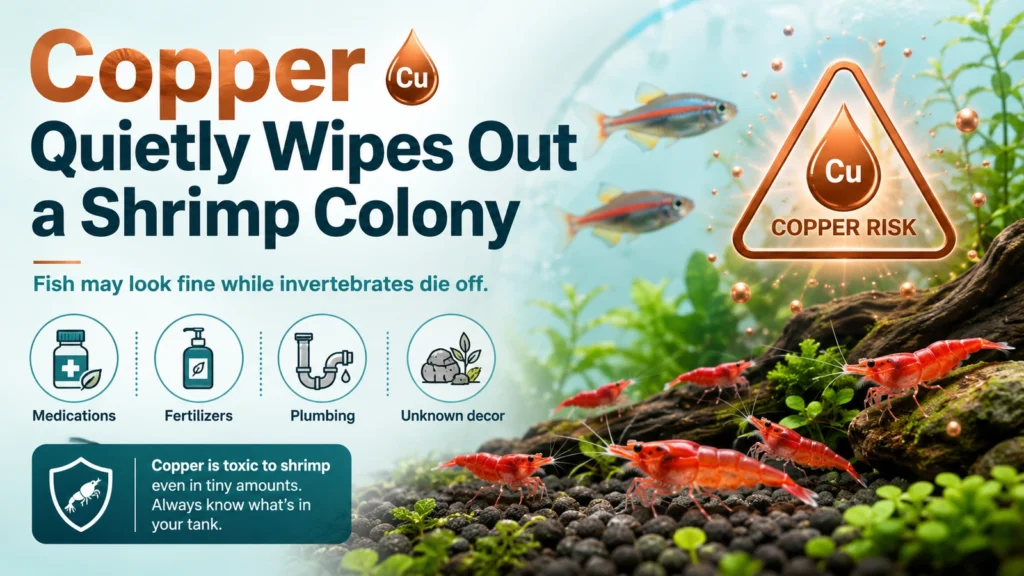
5. Nothing has been added to this tank that could contain copper. Fish medications, snail treatments, plant fertilizers, some foods. If this tank has ever been medicated, that is a serious question and not a wait-a-bit-longer one. Some treatments persist in substrate and silicone and are not removed by water changes.
6. Your test kit is one you trust. A false zero is worse than a bad reading. If your results have surprised you recently, when a test kit gives a wrong reading covers the control test.
7. You have somewhere to put them if it goes wrong. Not a requirement, but keepers who have a second running tank make bolder decisions safely.
Adding them: slower than you would add a fish
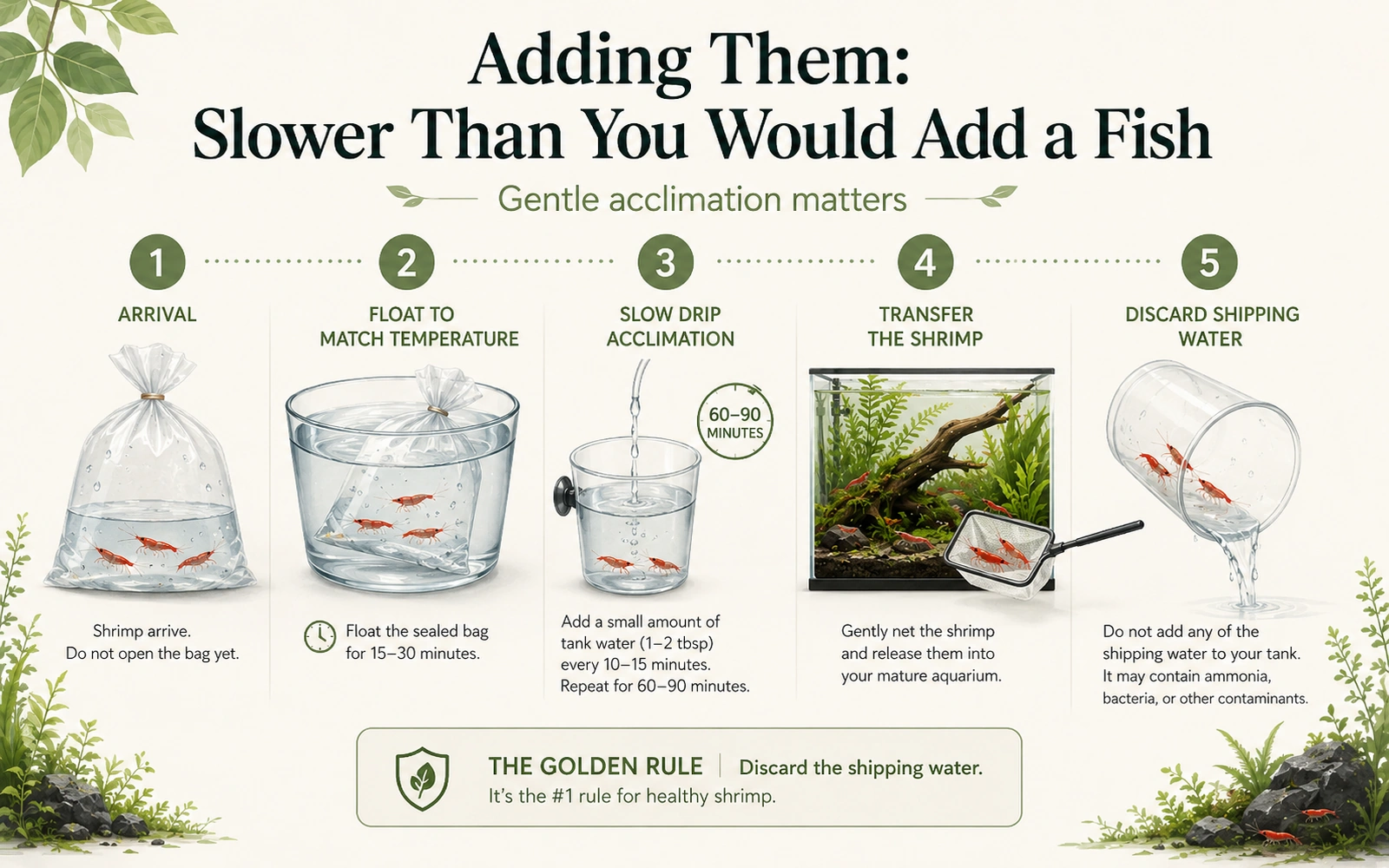
Shrimp handle a chemistry change badly, so the acclimation is longer and gentler than for fish.
The principle is to change their water gradually rather than in one step. Float the bag to match temperature, then add small amounts of your tank water to their container over a long period, an hour or more, before netting them across. The exact schedule matters less than the gradient being shallow.
Two rules that matter more than the schedule.
Do not pour the shipping water into your tank. Net them across and discard it. Whatever was in that water stays out.
Do not add the whole colony at once if you can help it. A small first group tells you whether the tank is what you think it is, and losing a few is a much better lesson than losing thirty. This is the same reasoning as adding fish to a new tank slowly, applied to an animal that is less tolerant.
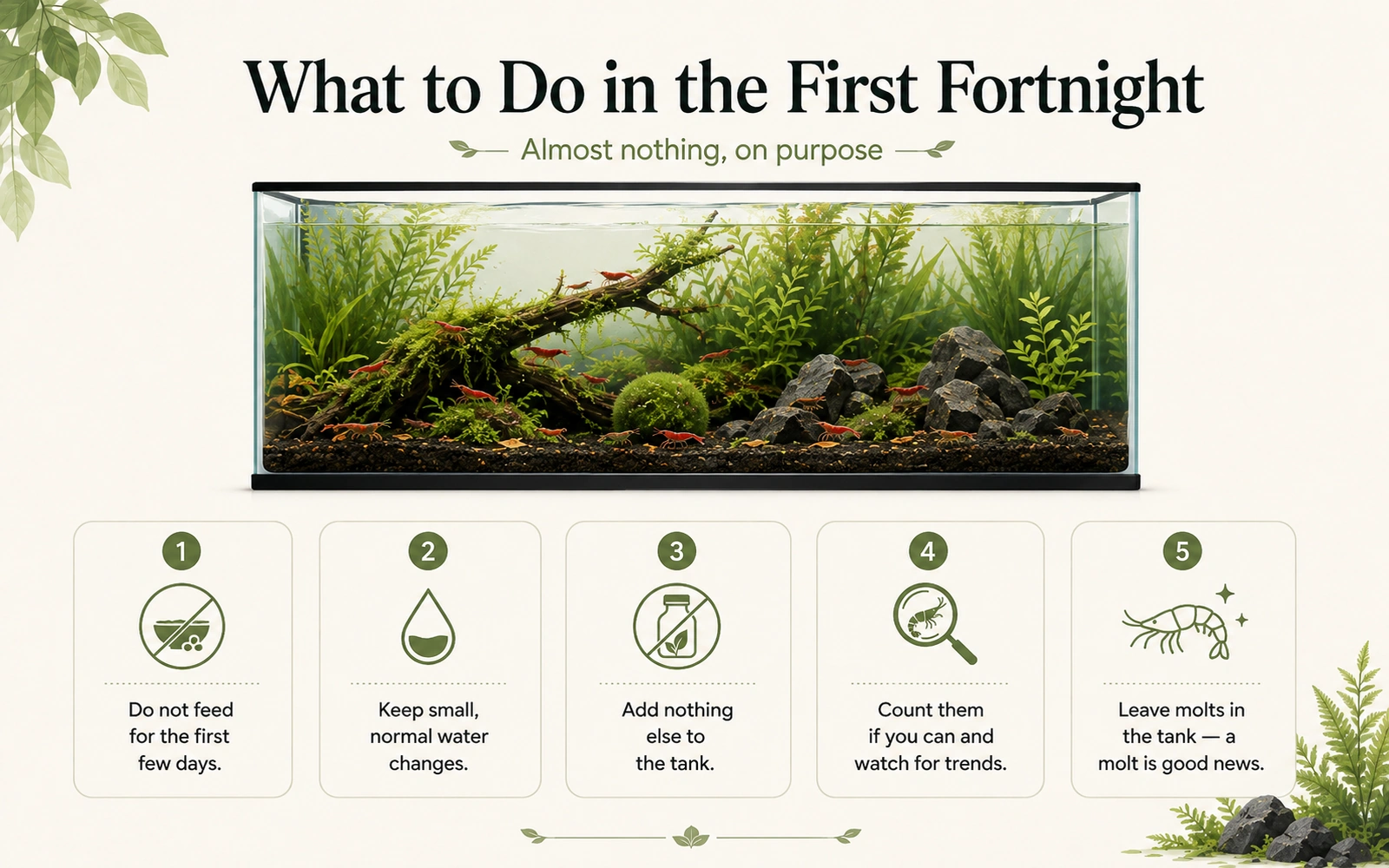
What to do in the first fortnight
Almost nothing, deliberately.
- Do not feed for the first few days. A mature tank already has food in it and uneaten food is the thing most likely to cause a problem.
- Change water on your normal schedule, small and temperature-matched and conditioned.
- Do not add anything else to the tank. No fertilizer, no treatment, no new decor.
- Count them if you can. Shrimp hide constantly, so a low count is not necessarily a loss, but a trend downward over two weeks is real.
- Watch for molts. A discarded exoskeleton on the substrate looks alarmingly like a dead shrimp and is the opposite: it is a growing animal. Leave it in the tank.
A colony that survives its first month and produces its first berried female is a colony that has told you the tank is ready. That is the actual test, and it is the only one that reports on all of the variables at once.
The short version
- Cycled is a chemistry result. Mature is a track record plus a food supply.
- The published waiting periods disagree because they assume different starting points. Judge the tank.
- Seven checks, not a calendar. Zero readings held over weeks, visible growth, steady temperature, no copper history.
- Acclimate slowly, discard the shipping water, add a small first group.
- Do nothing for the first fortnight. A molt is good news.
FAQ
Can I add shrimp as soon as my tank finishes cycling? Fish can be added to a cycled tank; shrimp do much better in a mature one. Cycled means the tank can process waste, which a test kit confirms. Mature means it has developed the biofilm a grazing animal lives on and has been stable long enough to prove it, and the gap is measured in months rather than days.
Why do the recommended waiting times disagree so much? Because they assume different starting points. The short recommendations come from keepers seeding a new tank with mature media and established substrate, which skips most of the waiting. The long ones come from tanks started genuinely from nothing. Judge the tank, not the calendar.
How do I acclimate shrimp to a new tank? Slower and more gently than a fish. Float the bag to match temperature, then add small amounts of your tank water to their container over an hour or more before netting them across. Never pour the shipping water into your tank, and add a small first group rather than the whole colony.
Should I feed shrimp right after adding them? No, not for the first few days. A mature tank already has food in it, and uneaten food is the thing most likely to cause a problem in the first fortnight.
I found what looks like a dead shrimp on the substrate. Is it dead? Check whether it is a molt. A discarded exoskeleton looks alarmingly like a dead shrimp and is the opposite: it is a growing animal. Leave it in the tank.