Black beard algae is a tough, dark tufted algae that takes hold where conditions are unstable and organic waste is high, and the things that actually slow it down are not chemicals. Steady conditions (particularly steady carbon availability in a CO2-injected tank), less organic debris in the substrate and filter, sensible light duration, appropriate flow, and physically removing affected leaves and hardscape are what change the trajectory. Chemical treatments exist, they work, and they are also the fastest way to kill shrimp and sensitive plants if you get them wrong, which is why this page tells you to read the manufacturer's label and does not publish a rate of its own. If something else in the tank is wrong, start at something is wrong with my tank.
How to Know It Is Black Beard Algae
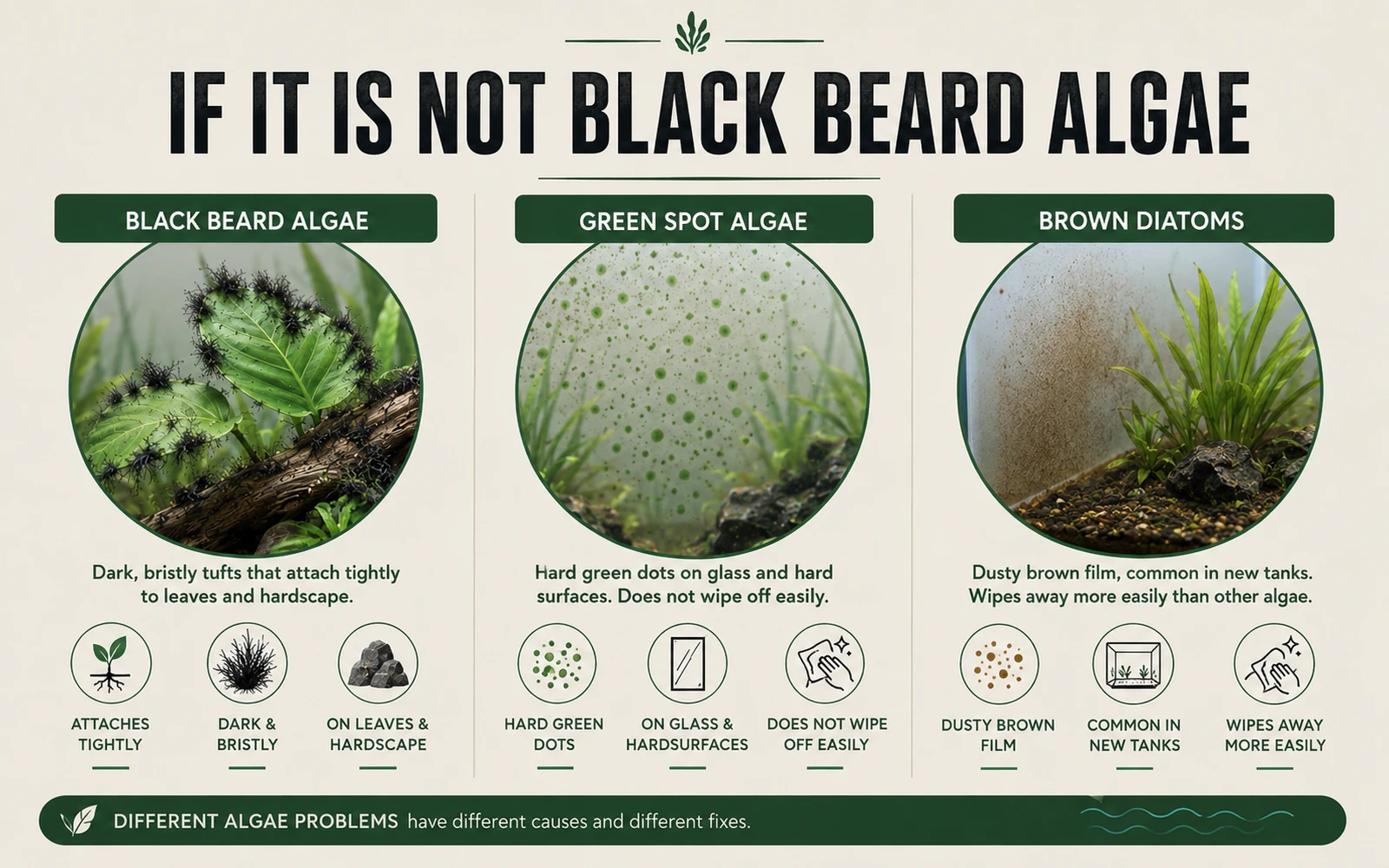
Black beard algae, usually shortened to BBA, is a red algae despite its color. In an aquarium it appears as short dark tufts, from near-black to dark green to grayish, with a bristly texture. It attaches hard. That is the identifying feature: green algae wipe or scrape off, and BBA holds on so tightly that you usually end up removing the leaf rather than the algae.
Where it appears is diagnostic, and this is the part most guides leave out.
| Where you find it | What that tells you |
|---|---|
| Edges of slow-growing plant leaves (anubias, java fern, older leaves) | It colonizes surfaces that do not grow or shed. Slow growers give it a stable platform |
| Filter outlets, spray bars, powerhead nozzles, intake strainers | High-flow surfaces deliver a constant supply of nutrients and organics past a fixed anchor point |
| Driftwood and rock, especially at the edges of the flow path | Permanent hard surfaces, same logic |
| New growth on fast-growing stem plants | Unusual. If it is colonizing new growth, the plants are losing, and the imbalance is more severe |
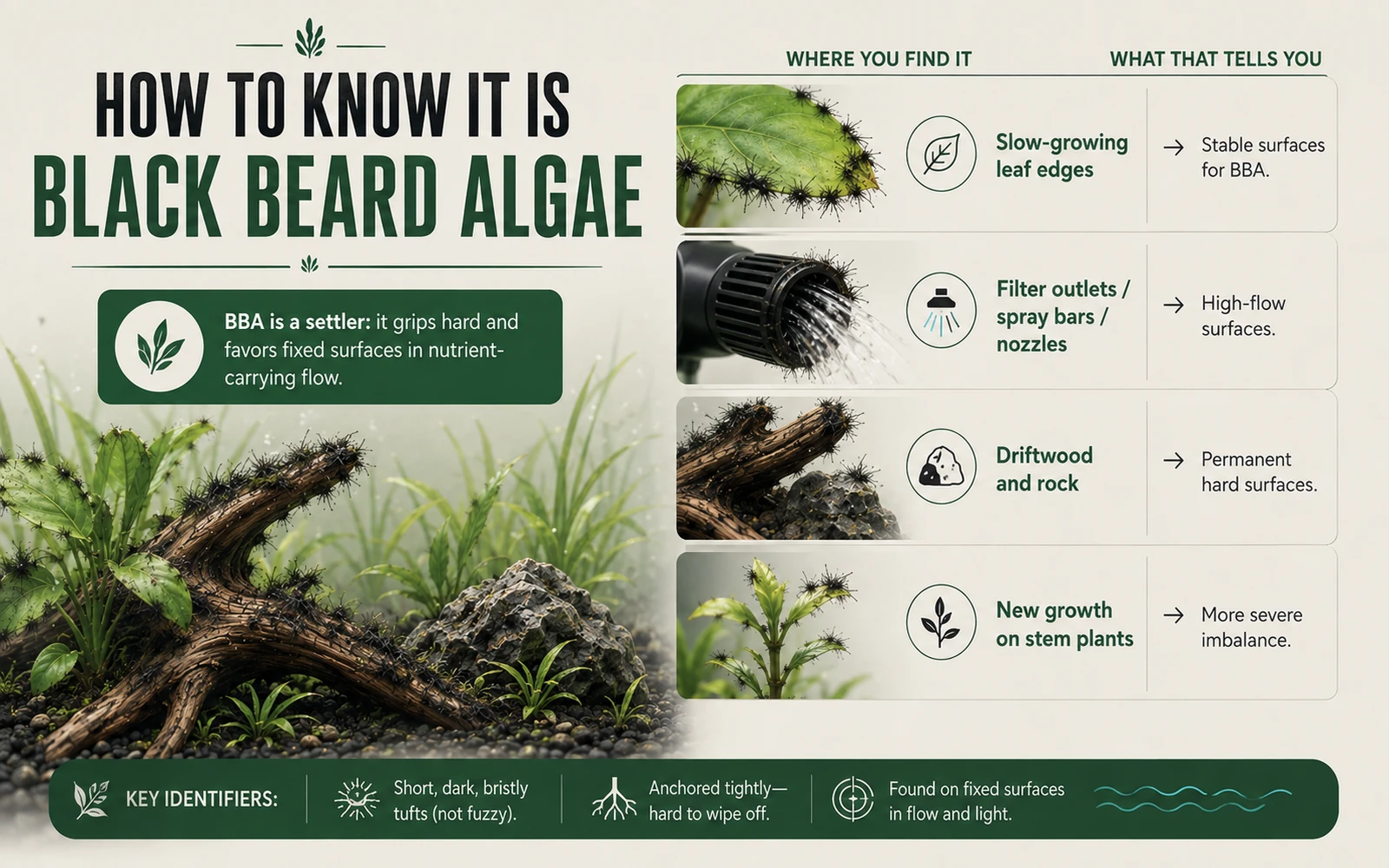
Read that table backward and it becomes a diagnosis. BBA is a settler. It wins on surfaces that do not renew themselves, in water that carries plenty of organic material past them.
What Actually Causes It
Aquascaping sources are consistent on the main drivers, and they disagree less than the forums suggest. Across 2Hr Aquarist, BucePlant and other planted-tank references, the recurring list is: unstable or insufficient CO2 in injected tanks, accumulated organic waste, too much light for the plant load, and general instability.
Instability, not any single number. The most commonly named trigger in CO2-injected tanks is fluctuating CO2 rather than a specific level. Plants that cannot photosynthesize reliably stop competing, and algae takes the surplus.
Organic waste. Detritus in the substrate, a filter that has not been serviced in a long time, decaying leaves and uneaten food all raise the organic load. This is the driver that applies to every tank, whether or not it injects CO2.
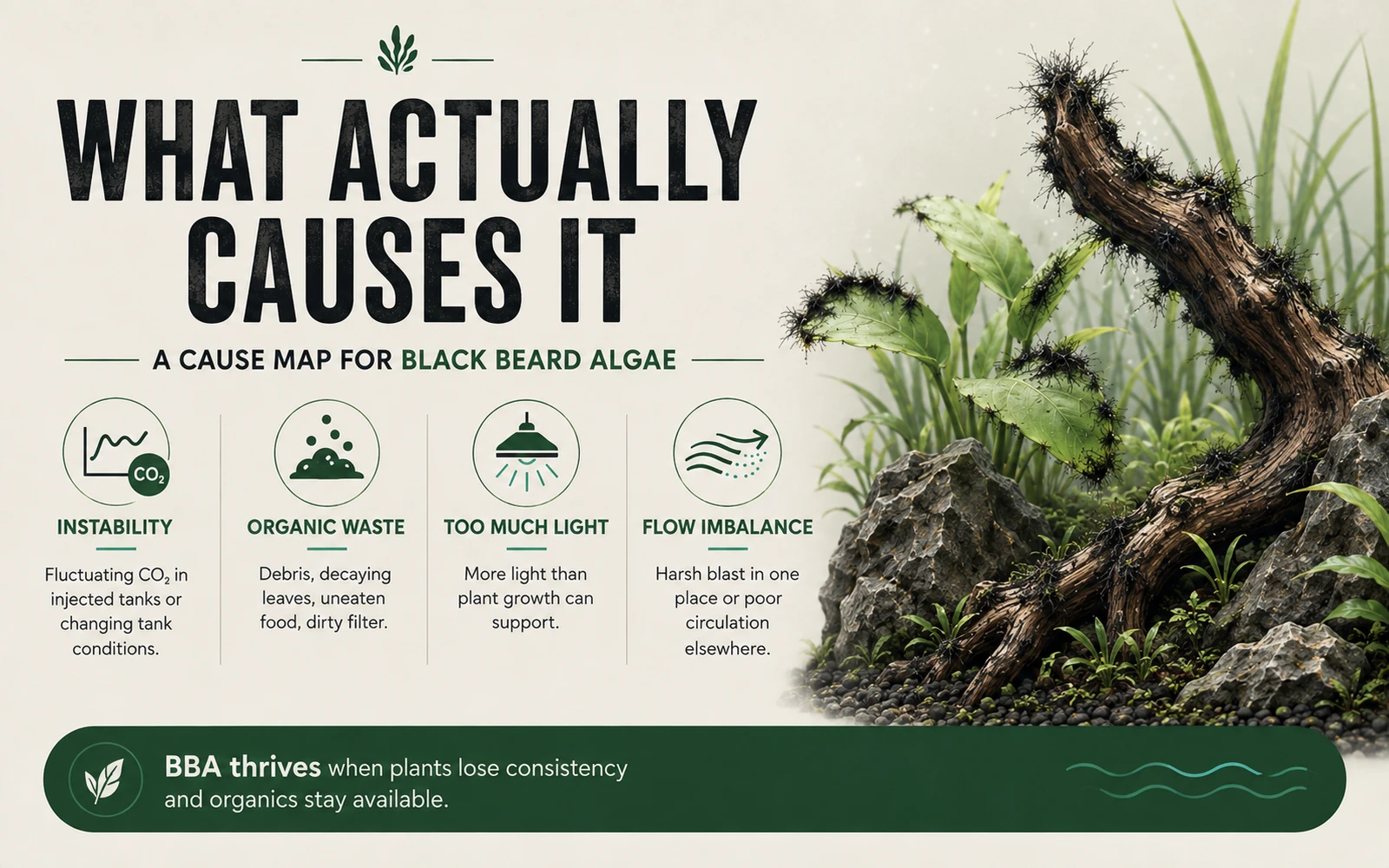
Light. Too much light for the amount of plant growth the tank can support. Note that this is a ratio, not a threshold. I am not going to give you a photoperiod in hours, because the right answer depends on your fixture, your plants and your tank, and a number invented here would be worthless.
Flow. BBA thrives in high-flow spots, but low flow causes its own problems by letting debris settle. What you want is even circulation without blasting a specific area.
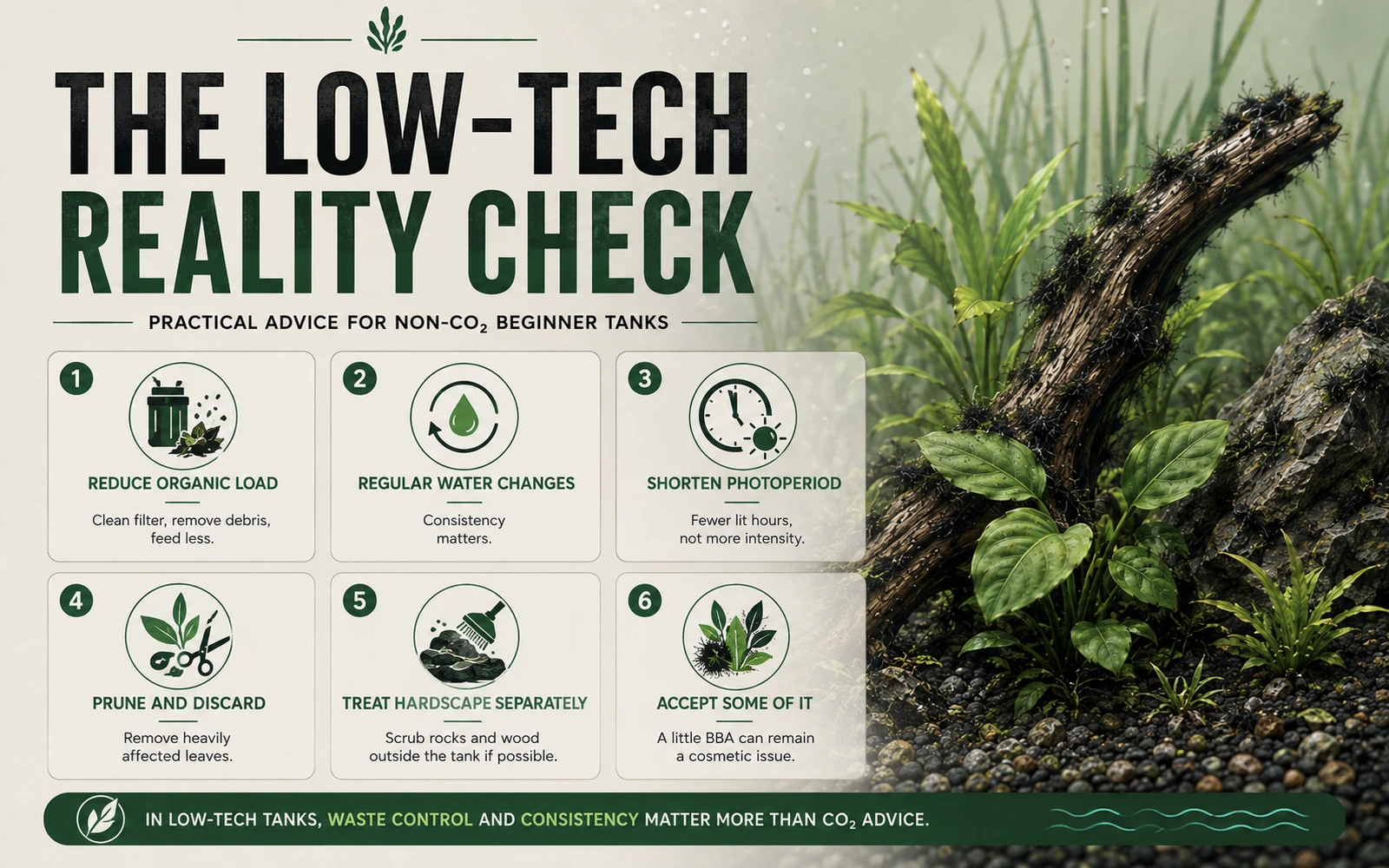
The Low-Tech Reality Check
Here is the honest part that most BBA guides skip. Most of the standard advice assumes a CO2-injected planted tank, because that is the kind of tank the people writing it keep. "Stabilize your CO2" is useless advice if you do not inject CO2.
If you run a low-tech tank, which describes most beginner setups, this is what is left after you subtract the CO2 advice:
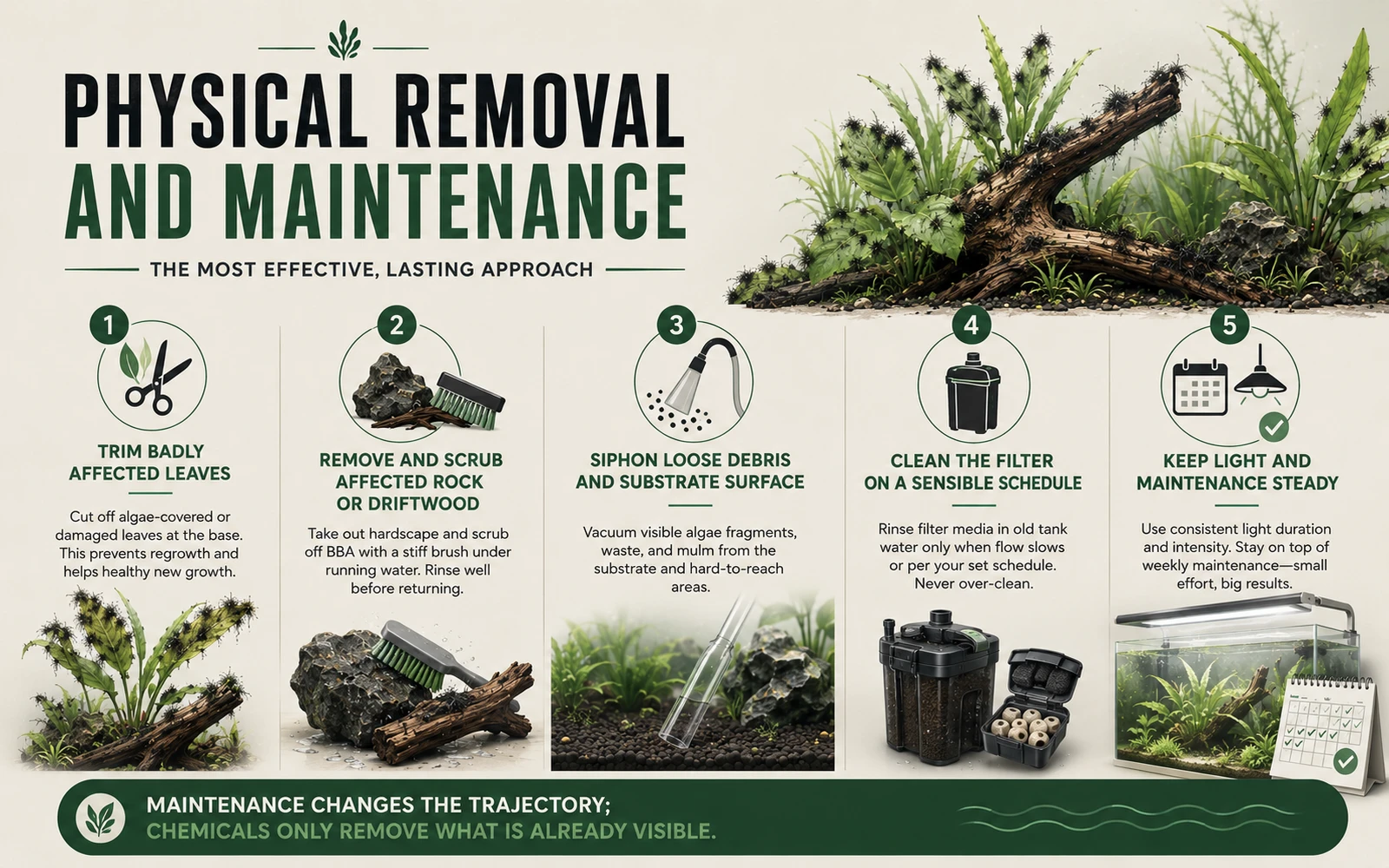
- Reduce the organic load. Clean the filter on a sensible schedule, siphon the substrate surface where debris collects, remove dying leaves, and feed less. This is the single most actionable lever in a low-tech tank.
- Keep water changes regular. Consistency is doing more work here than volume. How to do a water change covers the mechanics.
- Shorten the photoperiod rather than dim the light. Fewer lit hours is the easier variable to change and it directly reduces the energy available to algae.
- Prune and discard. Cut off badly affected leaves and throw them away rather than trying to clean them. On anubias and java fern, an affected leaf rarely recovers its appearance.
- Treat hardscape separately. Rocks and wood can be removed, scrubbed, and in some cases left to dry out entirely before going back in. This is far easier than treating them in the tank.
- Accept some of it. A little BBA on a piece of driftwood in an otherwise healthy tank is a cosmetic issue. Chasing it to zero causes more damage than living with it.
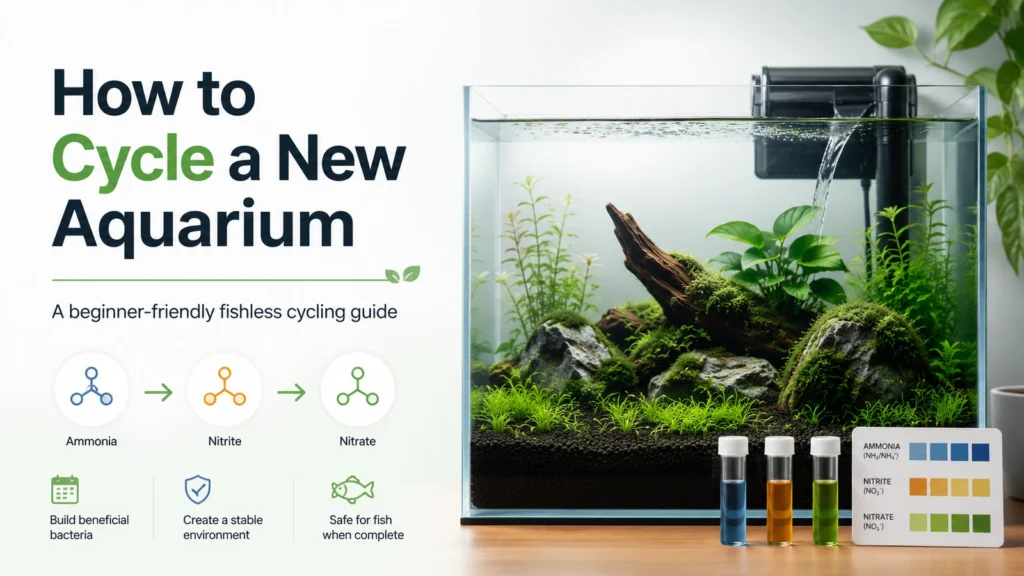
If your tank is planted and still establishing, cycling a planted aquarium covers the early instability that gives algae its opening in the first place.
About the Chemical Treatments
There are three categories people reach for: glutaraldehyde-based "liquid carbon" products, hydrogen peroxide used as a spot treatment, and general algaecides. They do work on black beard algae. Treated tufts typically turn red or pink and then break down.
This page does not publish a dosing rate, a volume per unit of water, or a spot-treatment concentration for any of them, and here is why.
These products are toxic by design. The margin between the amount that kills algae and the amount that harms the tank's inhabitants is narrower than the confident tone of most forum posts suggests, and it is not the same for every animal in your tank. Shrimp and other invertebrates commonly die at amounts that the fish in the same tank tolerate. Some plants, vallisneria among the most frequently reported, react badly to glutaraldehyde-based products even when used as directed. Sensitive fish species and fry are also more vulnerable than robust adult community fish.
So:
- The manufacturer's label is the only authority on how much to use. Not this page, not a forum post, not a video. Read it before the bottle is anywhere near the tank.
- If you keep shrimp, snails or any invertebrate, read the label specifically for what it says about invertebrates, and if it does not say, assume the answer is bad.
- "Double it for stubborn algae" is how people kill their livestock. It is one of the most repeated pieces of advice in this hobby and one of the worst. The algae being stubborn is not evidence that a higher amount is safe.
- Spot treating means removing the affected item where possible, rather than adding chemicals to a tank full of animals. Taking the rock out is safer than treating around the fish.
- Never combine treatments or follow one product with another without knowing what happens when they meet. You will not be able to interpret the result if something goes wrong.
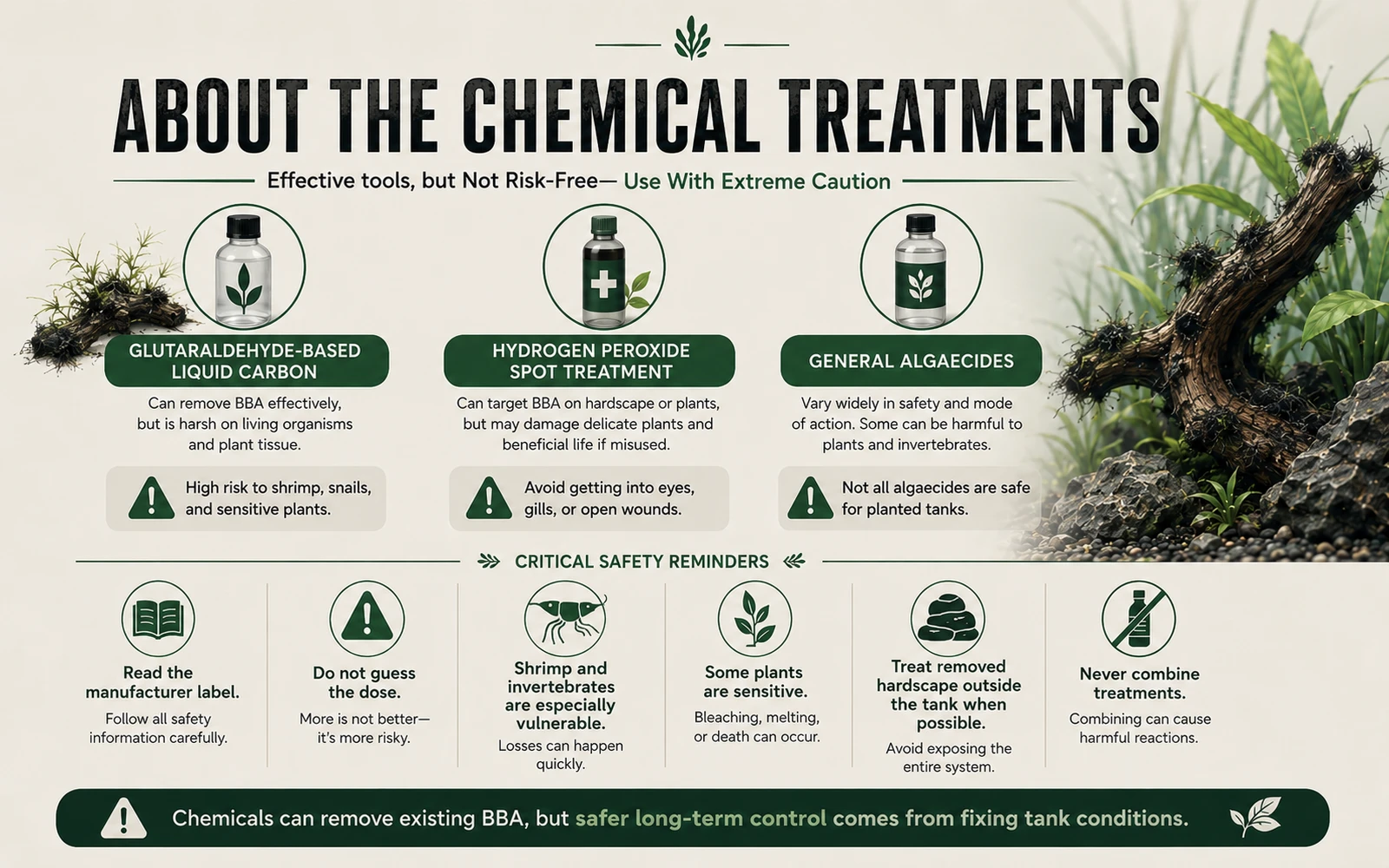
None of the above is a reason to feel helpless. The non-chemical measures in the previous section are the ones that change the tank's trajectory. Chemicals remove the algae that is already there while leaving the conditions that grew it intact, which is why so many people report it coming straight back.
Algae itself does not make fish sick. If your fish are unwell rather than your glass being ugly, that is a separate matter and when to contact an aquatic veterinarian covers it.
Biological Control
Siamese algae eaters (Crossocheilus species) are the fish most often credited with eating BBA, and reports of their effectiveness range from enthusiastic to disappointed. Two honest caveats: they are frequently misidentified in shops, with several similar-looking species sold under the same name, and they grow larger and more active than beginners expect, which makes them a poor fit for a small tank.
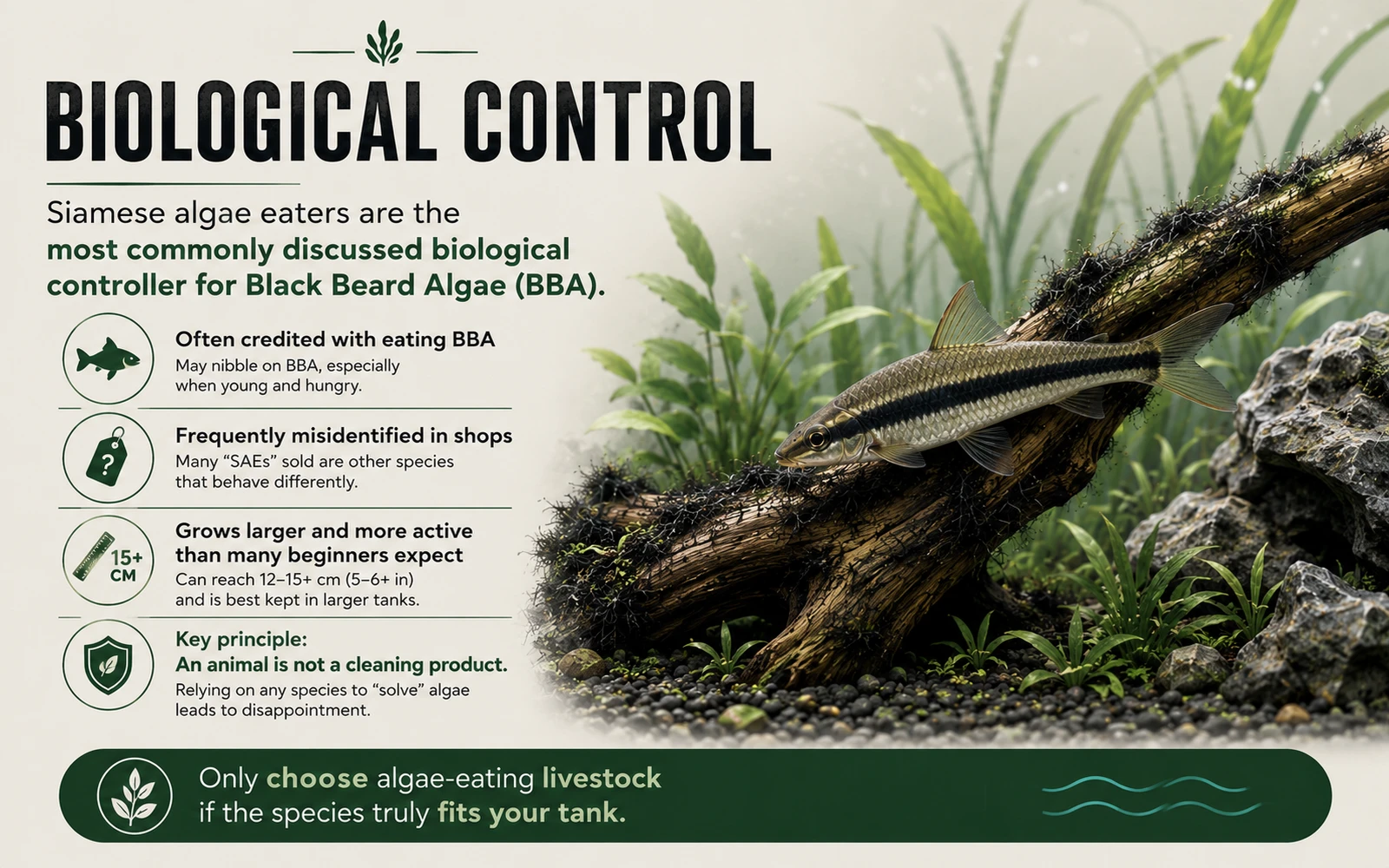
The wider principle applies here as it does elsewhere on this site: an animal is not a cleaning product. If a fish does not suit your tank on its own merits, do not buy it to solve an algae problem.
If It Is Not Black Beard Algae
Hard green dots on the glass that resist wiping are a different organism with a different cause: see green spot algae on the glass. A brown dusty film in a new tank is a diatom phase that passes on its own: see brown algae in a new aquarium.
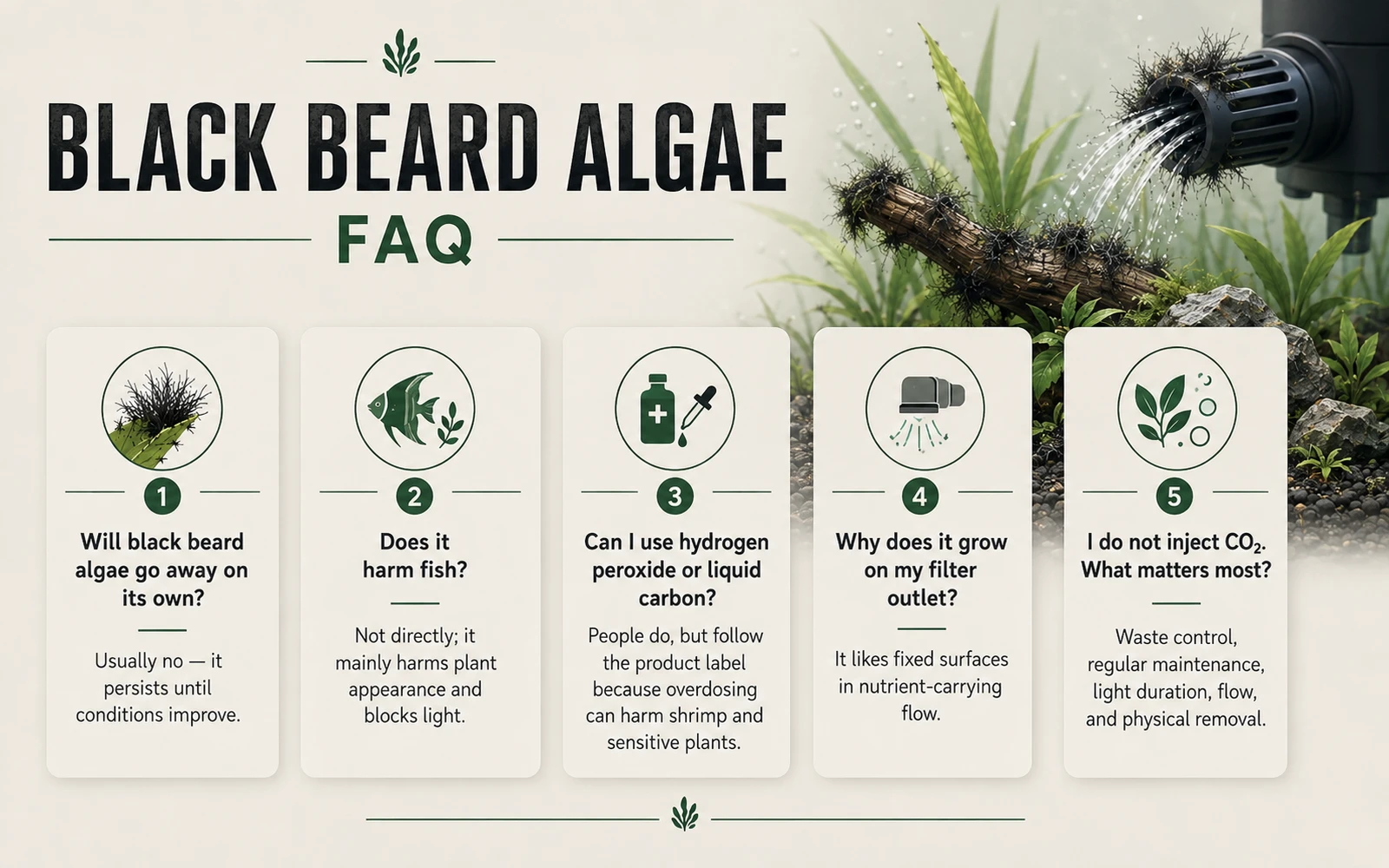
FAQ
Will black beard algae go away on its own? Generally not. Unlike the diatom phase in a new tank, BBA persists until the conditions that favor it change. It also rarely explodes overnight, which means you usually have time to fix causes rather than reach for a bottle.
Does black beard algae harm fish? No. It harms plants indirectly by covering leaves and blocking light, and it is unattractive, but it is not toxic to fish or invertebrates.
Can I use hydrogen peroxide or liquid carbon on it? People do, and it works. This site does not publish quantities for either, because overdosing kills shrimp and can damage sensitive plants, and the correct amount is what the manufacturer's label says for that specific product. Read the label, and treat removed hardscape outside the tank where you can.
Why does it grow on my filter outlet? Because that is a fixed surface with a constant supply of nutrient-carrying water moving past it. Location is a clue: BBA colonizes surfaces that do not renew themselves.
I do not inject CO2. Does the CO2 advice apply to me? No, and that is worth knowing, because most BBA guides are written for injected tanks. In a low-tech tank the levers are organic waste, light duration, flow, regular water changes and physical removal.