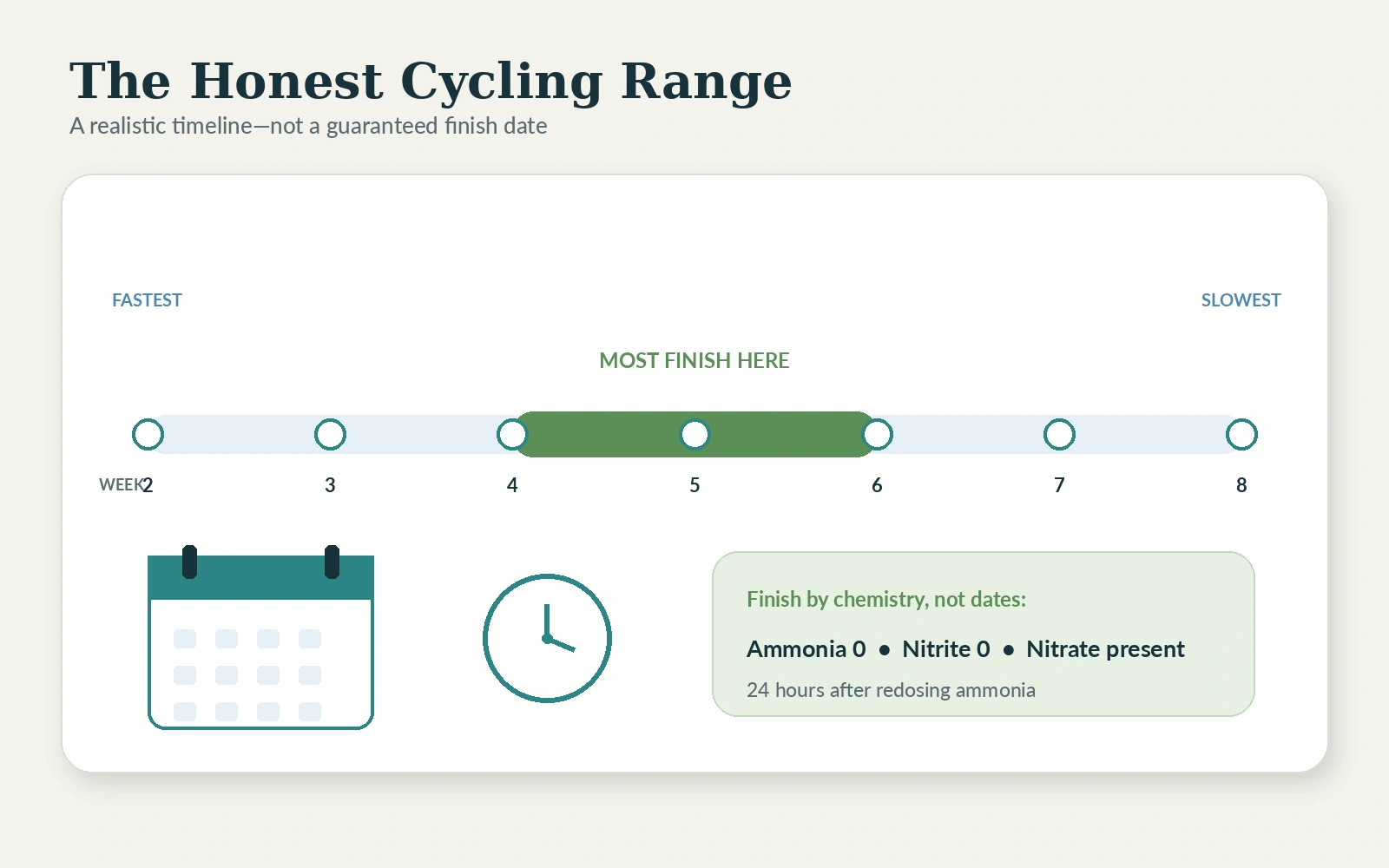
Most fishless cycles finish in roughly four to six weeks, though the honestly reported range across the hobby runs closer to two to eight weeks depending on temperature, seeding, and how consistently you dose ammonia. There is no fixed calendar date that applies to every tank, because you are growing a live bacteria colony, not running a timer. The reliable way to know a cycle is actually finished is the completion test described in how to cycle a new aquarium: ammonia and nitrite both reading zero, with nitrate present, 24 hours after dosing ammonia back up. Everything below explains why the range is so wide and how to tell, before that test passes, whether your own tank is tracking normally.
The Honest Range, and Why It Is So Wide
You will see different numbers depending on where you look. Some sources quote four to eight weeks; others say most tanks land closer to two to six. Both are reasonably accurate descriptions of the same underlying reality: this is a biological process with real variability, not a fixed procedure with a guaranteed runtime. A handful of factors explain most of the spread, and understanding them is more useful than memorizing any single number.
What Slows a Cycle Down
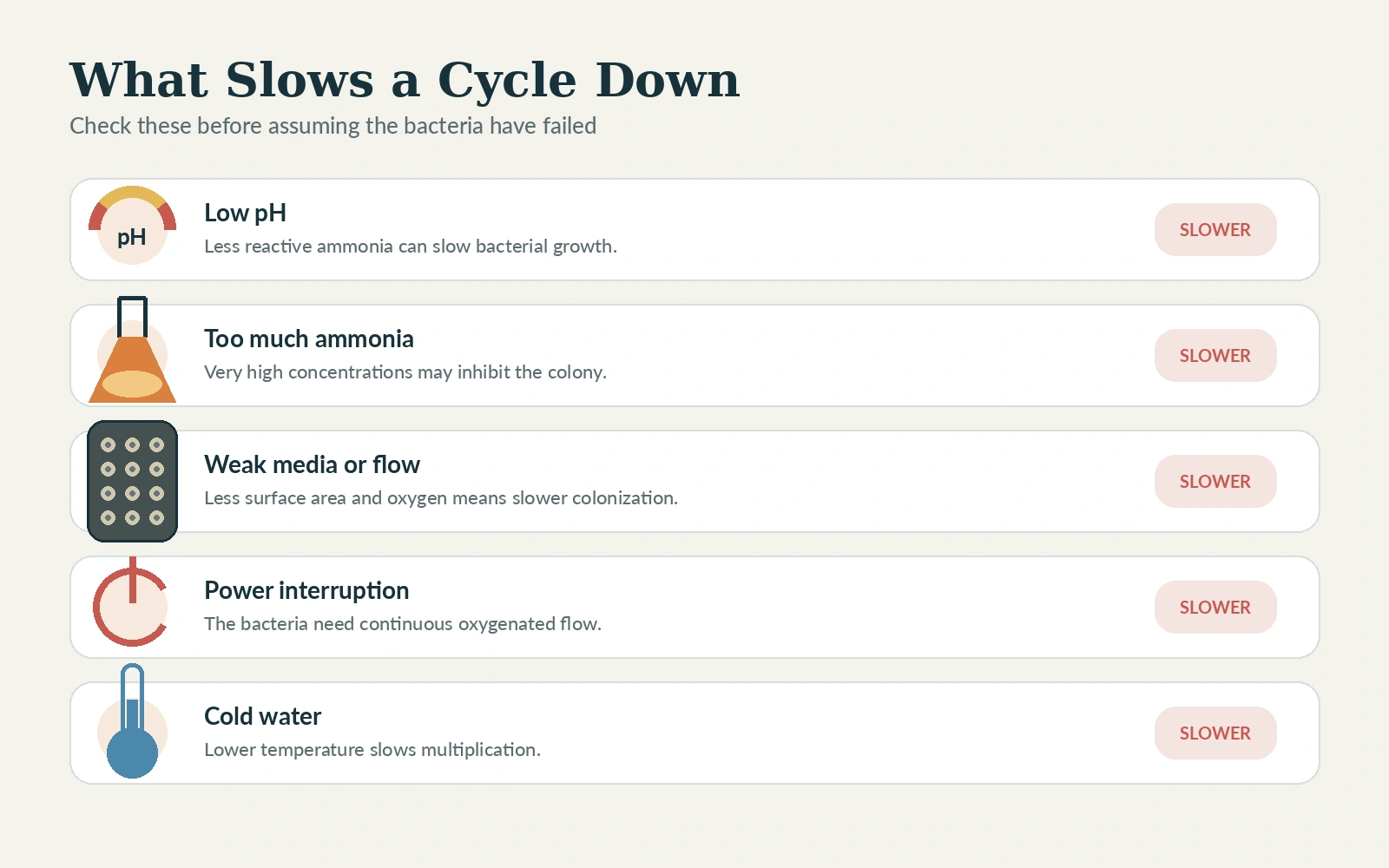
- Low pH. Ammonia converts to a less reactive form at low pH, which can leave the bacteria with less to feed on and slow their establishment. A cycle in very soft, acidic water is commonly reported as taking noticeably longer than one in moderately hard, neutral water.
- Overdosed ammonia. Pushing ammonia far above a moderate dosing target does not feed the colony faster; several hobbyist accounts describe it stalling the cycle outright, likely because very high ammonia becomes inhibitory to the bacteria themselves rather than simply "more food."
- Insufficient surface area or flow. A filter that is undersized for the tank, or one that is not running continuously, gives the colony less room and less oxygen to establish on.
- Interrupted power or filtration. Bacteria need continuous oxygenated flow. A filter that stops running for extended stretches, even for cleaning, sets the colony back.
- A cold tank. The reverse of the warmth point above: a cycle run at the lower end of a tropical range, or in an unheated tank in a cool room, is commonly reported as slower to complete.
Early Signs You Are Tracking Normally
You do not have to wait until the finish line to know things are moving in the right direction. A few early milestones, well before the full completion test passes, are genuinely reassuring:
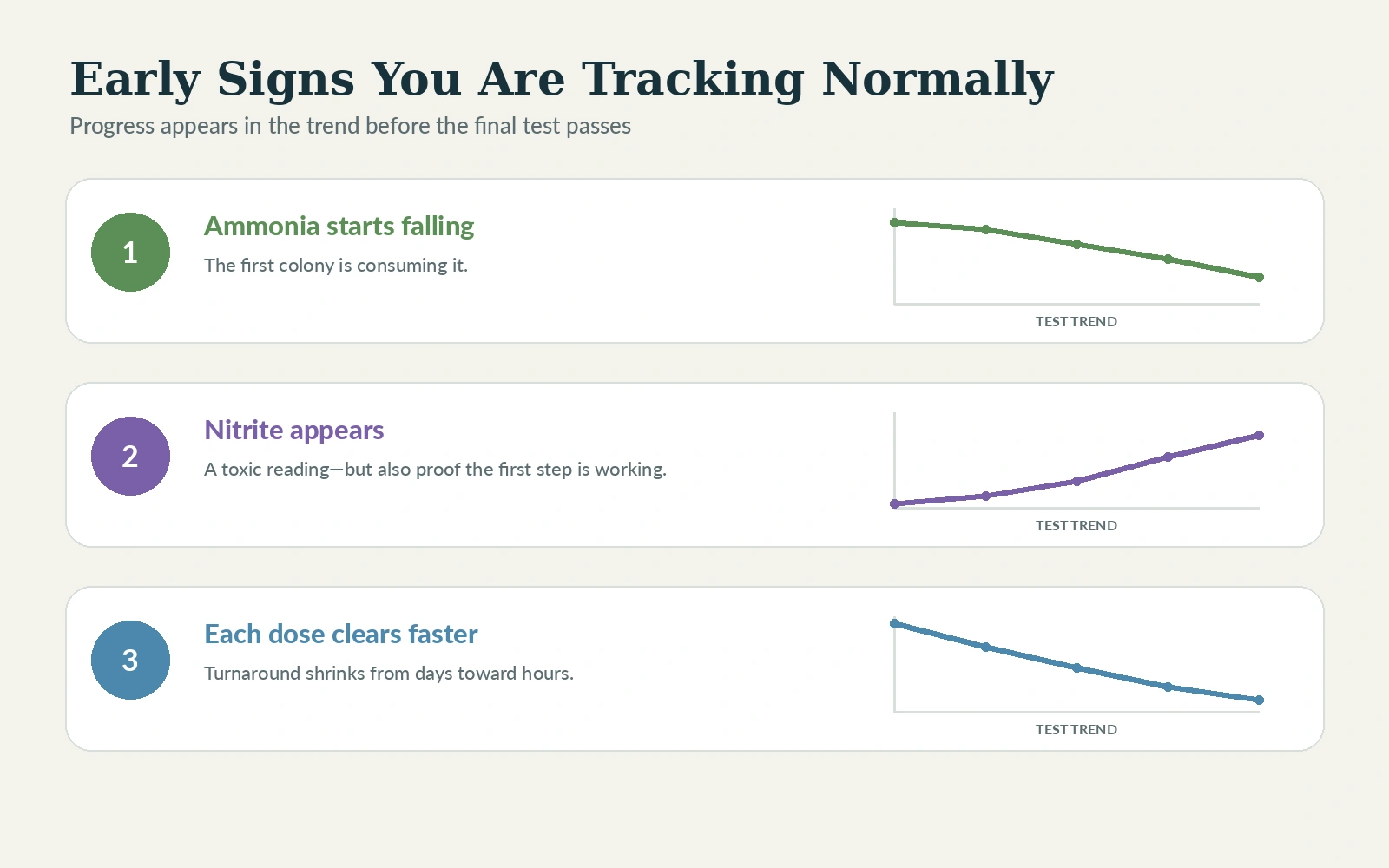
- Ammonia starts falling between doses, even slightly, instead of holding flat at your dosed level. That means the first bacteria colony has established and is actively consuming it.
- Nitrite appears on the test kit for the first time. This can feel alarming, since nitrite is itself toxic, but its appearance is actually a milestone: it means the first bacteria colony is working well enough to be producing a byproduct. A cycle with a rising nitrite reading is progressing, not failing.
- Ammonia clears faster on each retest. As the first colony grows, it processes each new dose of ammonia more quickly than the last. Watching that turnaround time shrink from days down to hours is one of the clearest signs the process is on track.
If you are seeing none of these signs at all after two to three weeks of consistent dosing, that is the point to check the specific troubleshooting guides for a stalled ammonia reading or, if you are past that stage, nitrite that will not fall.
The Slow Middle Stretch: Why Week 3-4 Feels Like Nothing Is Happening
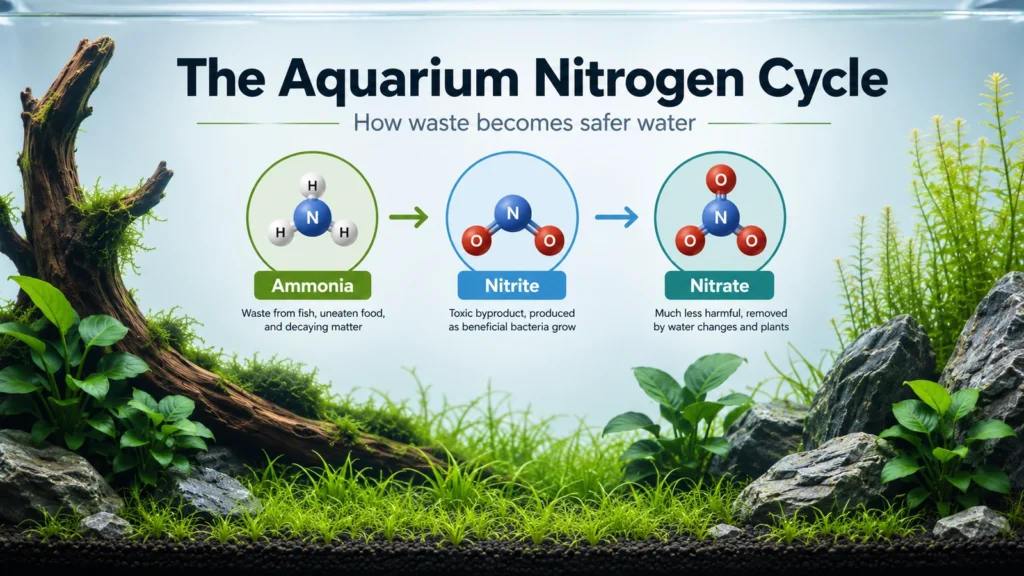
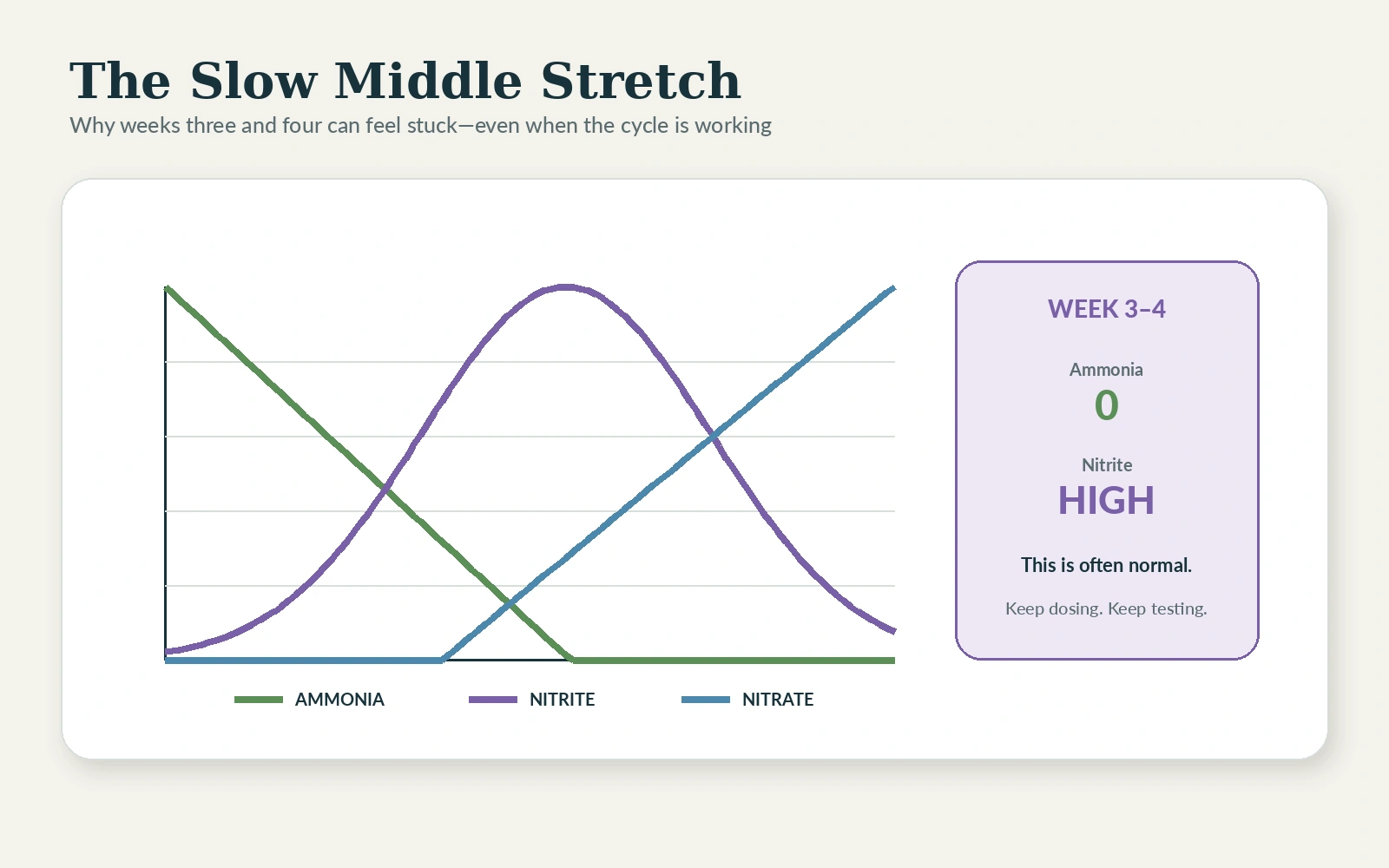
This is the stage that convinces the most beginners something has gone wrong, and it is usually the stage where the process is working exactly as expected. Ammonia has typically already cleared, but nitrite has spiked and is sitting stubbornly high, sometimes for a week or more, because the nitrite-consuming bacteria establish more slowly than the ammonia-consuming ones did. There is genuinely very little to do here except keep dosing ammonia to a steady level, keep testing, and wait. It is the stage the nitrogen cycle explainer covers in more mechanical detail, including why nitrite is often the harder half of the process.
Fishless vs. Fish-In: Why the Clock Runs Differently
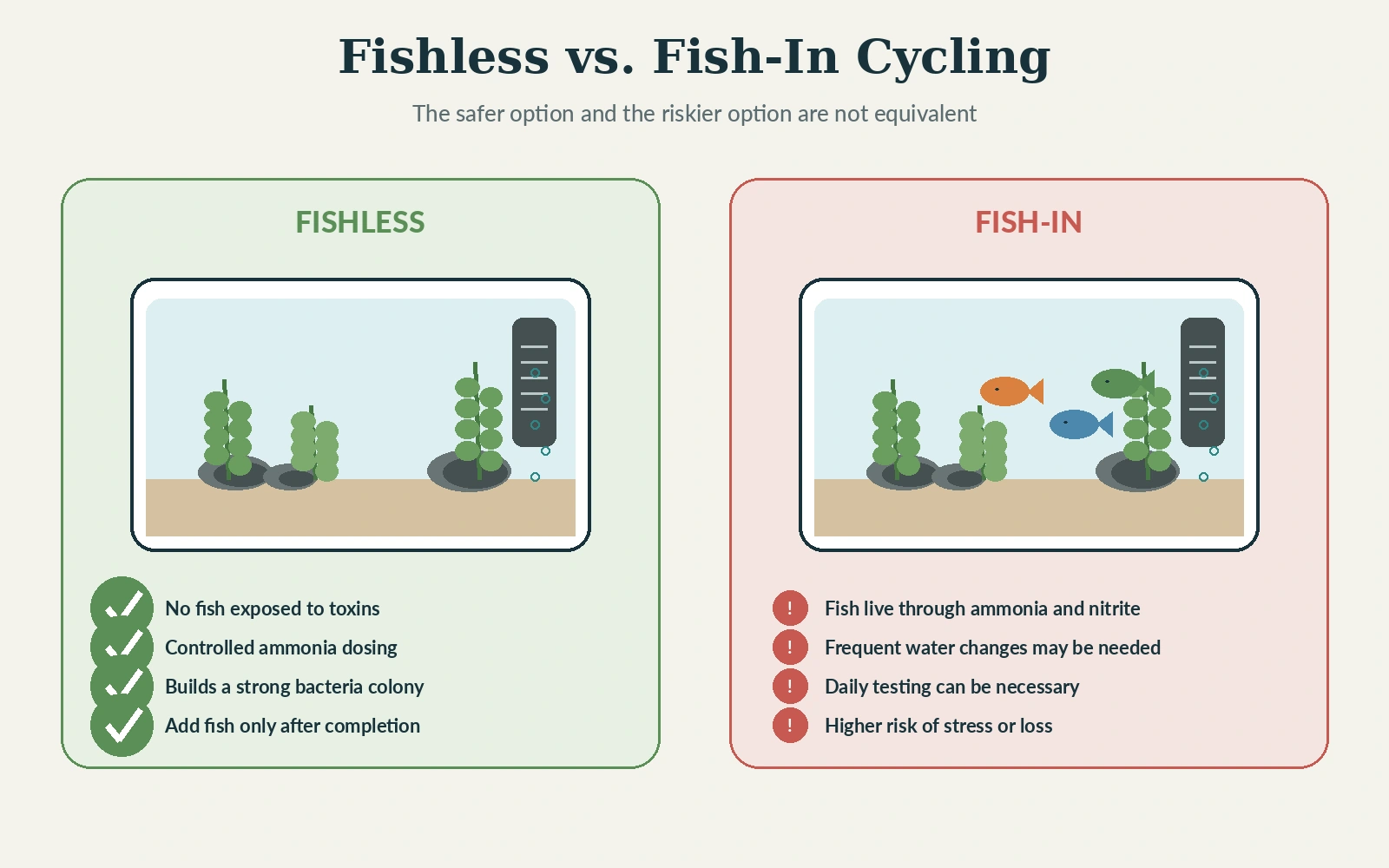
The ranges above describe a fishless cycle, where you are dosing ammonia deliberately and can push the process as hard as the bacteria can handle, since no fish is exposed to the toxic intermediate stages. A fish-in cycle, where a few hardy fish supply the ammonia through their own waste, generally has to run more gently and cautiously, with frequent water changes to protect the fish along the way, which typically stretches the practical timeline out rather than shortening it. If you already have fish in a tank that was never cycled, that is a different situation from the one this guide describes: the priority shifts to frequent, larger water changes that keep ammonia and nitrite diluted while the bacteria establish, rather than to deliberately dosing ammonia into an empty tank.
When "Slow" Becomes "Stalled" (and Where to Go Next)
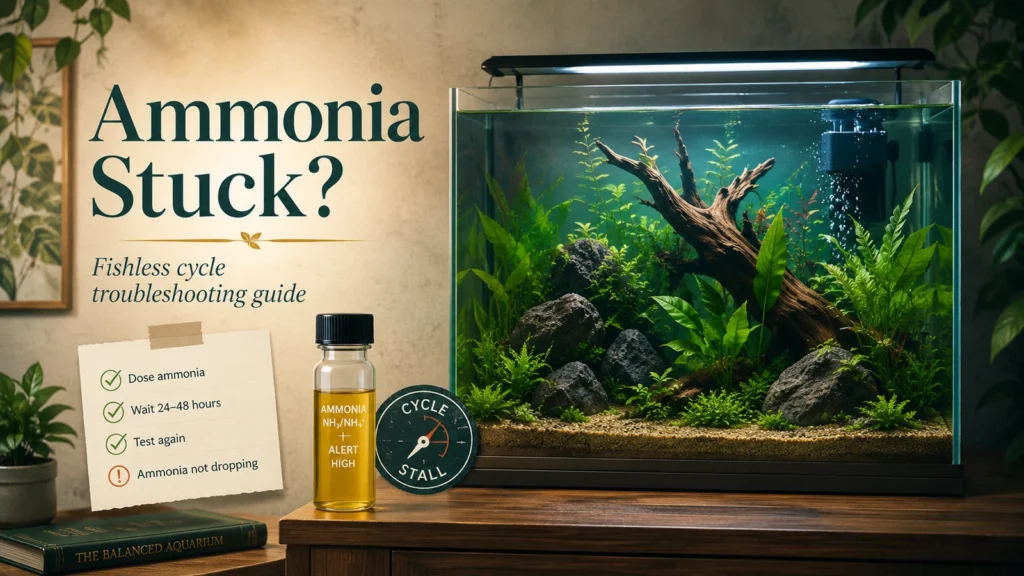
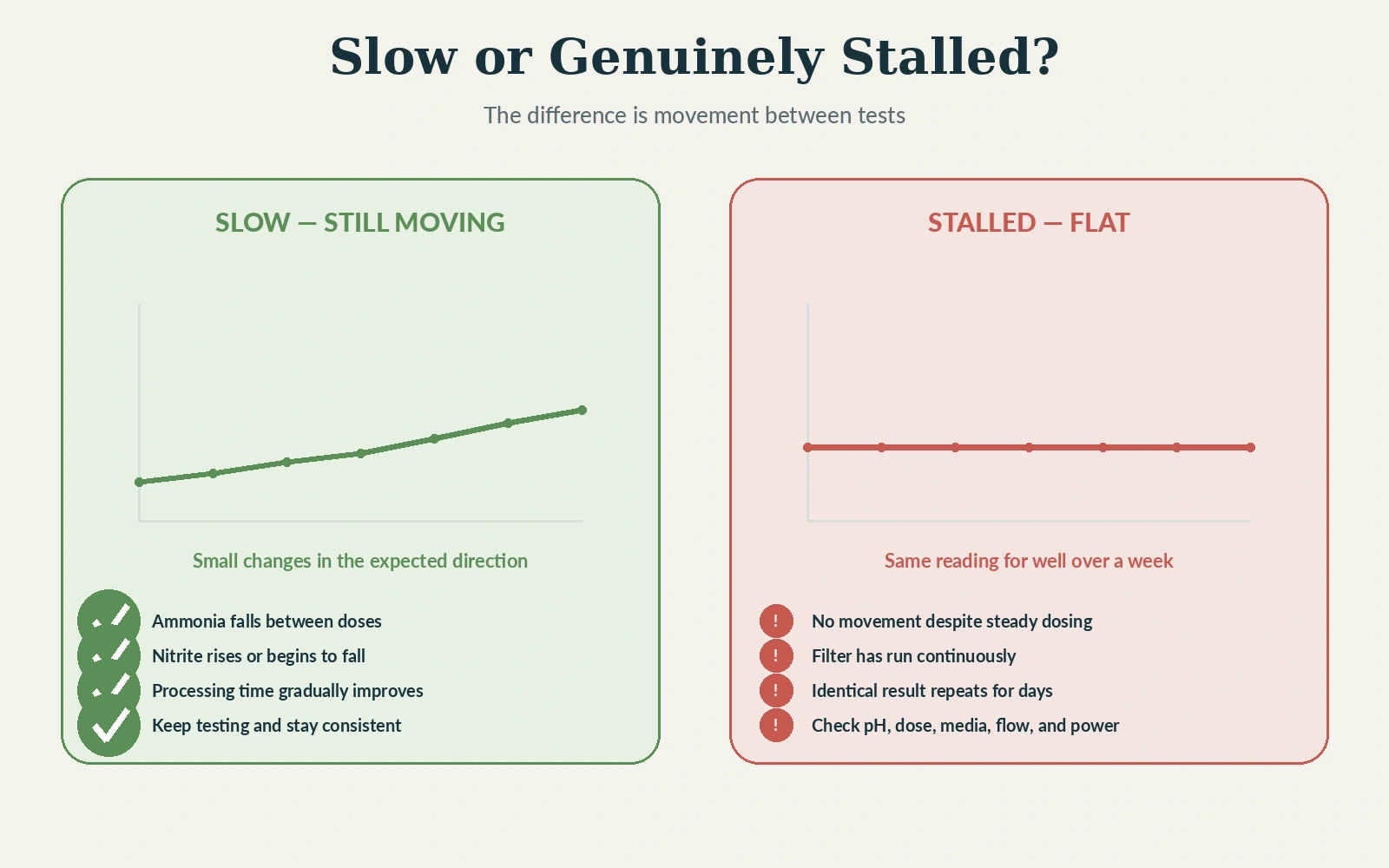
There is a real difference between a cycle that is simply slow and one that has genuinely stalled, and it matters because the fix is different. A cycle that is slow is still showing movement between tests, even small movement, in the direction you expect. A cycle that has stalled shows the same reading, test after test, with no trend in either direction for well over a week, despite consistent dosing and a running filter. If ammonia specifically will not move at all, this guide to a stalled cycle walks through the most common causes. If ammonia is fine but nitrite is the one refusing to budge, this guide to stuck nitrite is the more specific next step.
FAQ
How long does it take to cycle a fish tank?
Most fishless cycles finish in roughly four to six weeks, with a commonly reported range of two to eight weeks depending on temperature, seeding, and how consistently ammonia is dosed. Go by the completion test (ammonia and nitrite both zero, nitrate present, 24 hours after dosing), not by the calendar.
Can I speed up cycling?
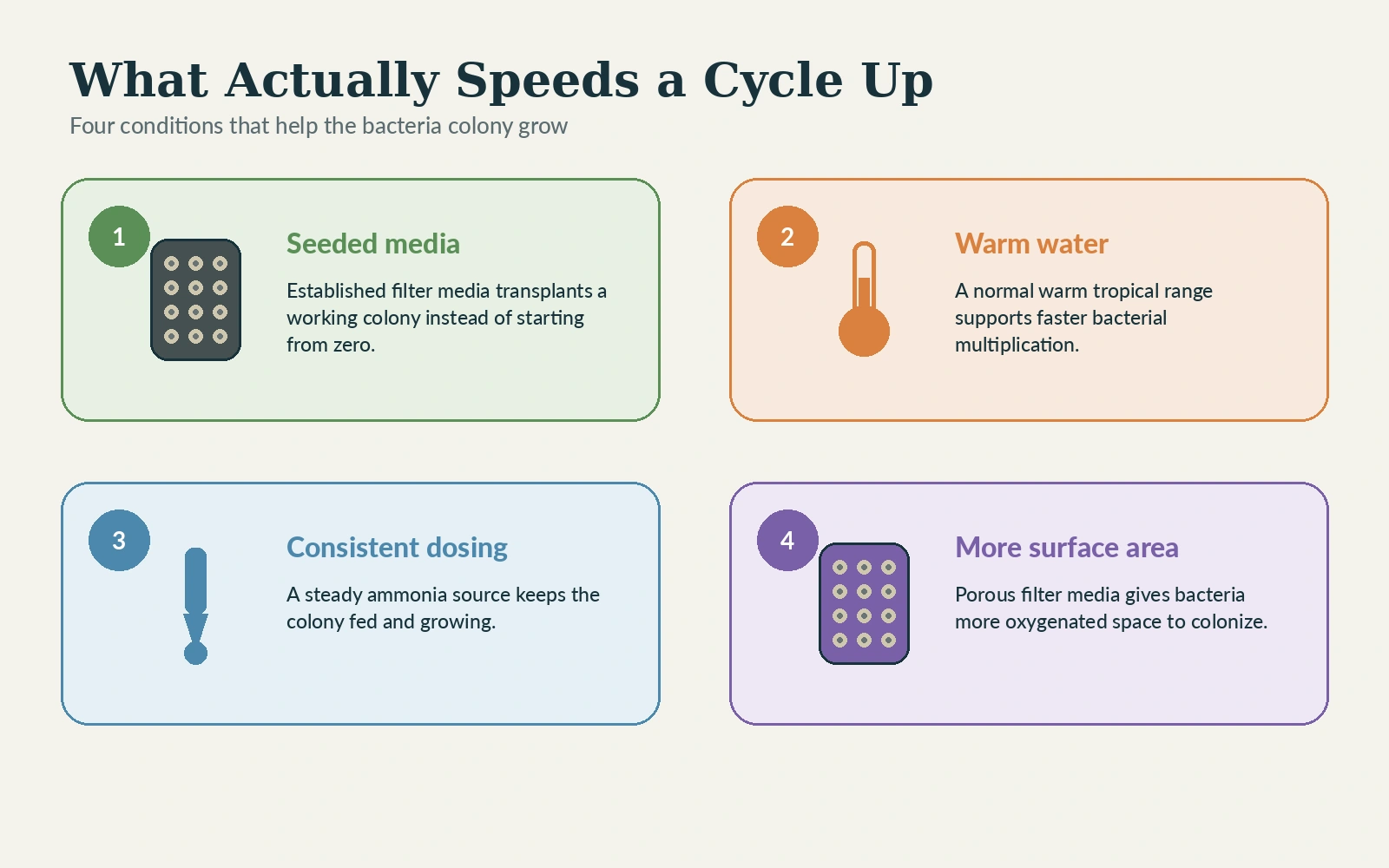
Yes, meaningfully. Seeding a new filter with media, gravel, or a sponge from an established, healthy tank is the most commonly cited accelerant. Running the heater toward the warmer end of a typical tropical range and dosing ammonia consistently also help.
Is it normal for nothing to change in the first week or two?
Yes. The first bacteria colony starts from essentially nothing and needs time to establish before you see any movement in the ammonia reading. A flat reading in week one is expected, not a sign of failure.
Does nitrite appearing mean something went wrong?
No, the opposite. Nitrite appearing for the first time means the ammonia-consuming bacteria are established and working. It is a genuine milestone, even though nitrite itself is toxic and the tank is not yet safe for fish.
How do I know if my cycle has actually stalled instead of just being slow?
A slow cycle still shows a trend between tests, even a small one. A stalled cycle shows the identical reading test after test for well over a week with no movement in either direction, despite consistent ammonia dosing and a continuously running filter. That is the point to check for a specific cause rather than simply waiting longer.