GH measures the dissolved minerals in your water, mainly calcium and magnesium, and it is what people mean by soft or hard water. KH measures carbonate and bicarbonate, and despite its name it is not really about hardness at all: it is the buffer that stops your pH from moving. For a standard community tank of hardy captive-bred fish, both are worth testing once so you know what your water is, and then rarely again. They stop being optional in three specific situations, listed below.

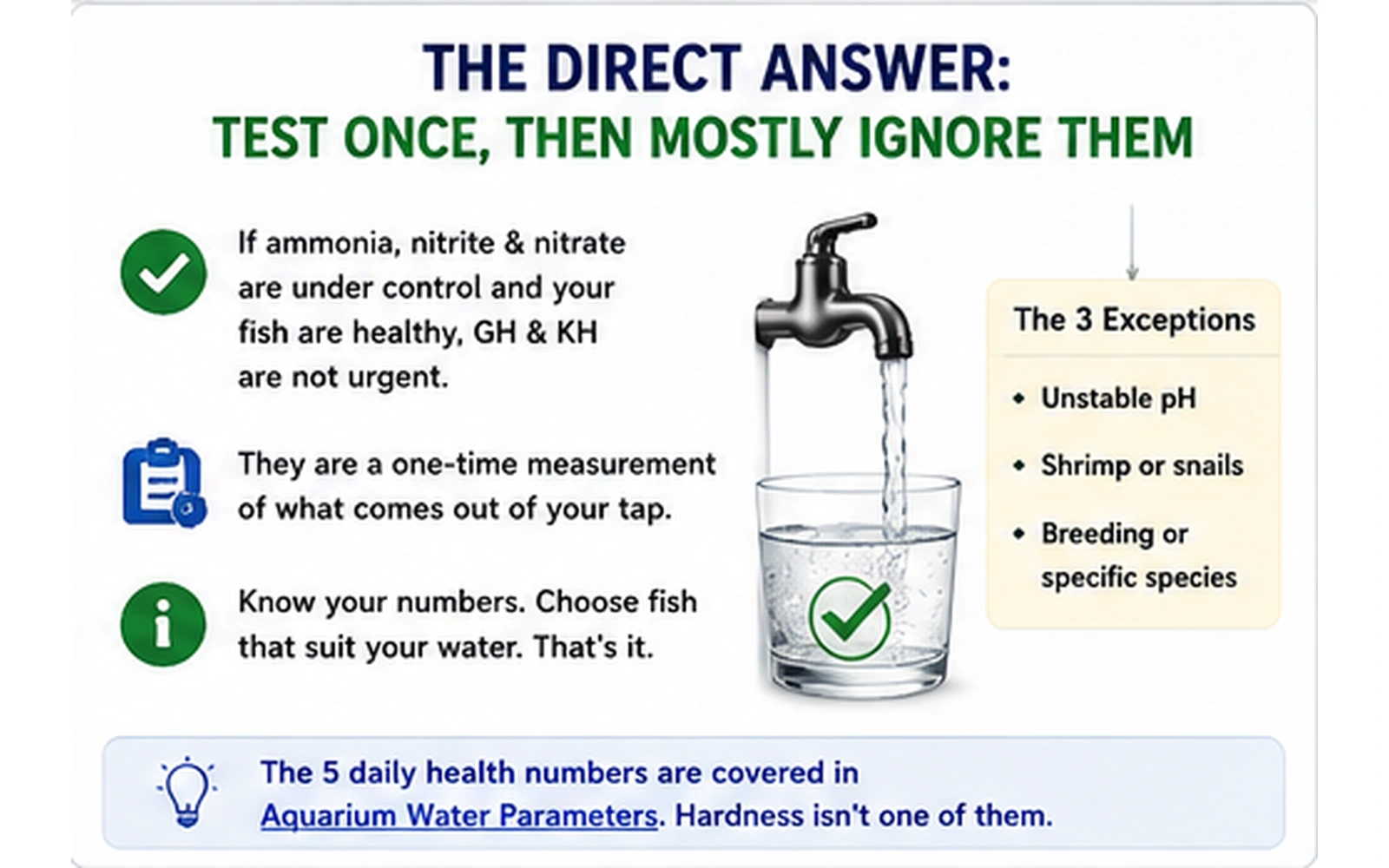
The Direct Answer: Test Once, Then Mostly Ignore Them
If you have ammonia, nitrite and nitrate under control and your fish are healthy, GH and KH are not the next thing you need to master. They are a one-time measurement of what comes out of your tap, and that measurement answers most hardness questions you will ever ask, including which fish suit your water and why your pH behaves the way it does.
That is genuine permission to deprioritize them, not a shortcut. The five numbers that carry daily tank health are covered in aquarium water parameters, and hardness is not among the urgent ones.
The three exceptions come further down, and if any of them applies to you, skip ahead.
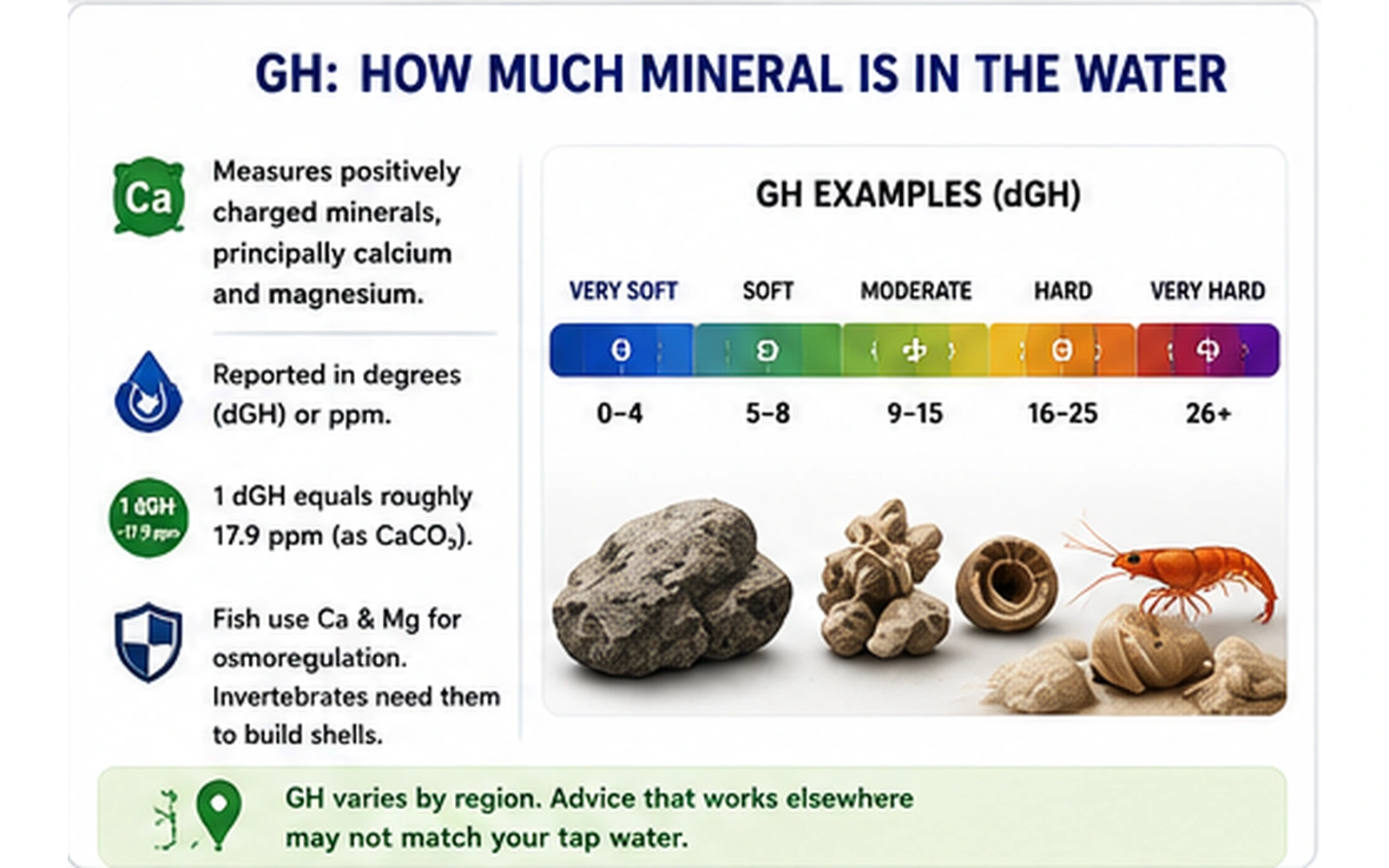
GH: How Much Mineral Is In the Water
General hardness measures positively charged minerals dissolved in the water, principally calcium and magnesium. This is the number behind everyday language about water: soft water is low in these minerals, hard water is high in them. It is also the number that varies enormously by region, which is why advice written for somebody else's tap water so often does not match your tank.
GH is usually reported in degrees, written dGH, and sometimes in ppm. The conversion commonly used is that 1 dGH equals roughly 17.9 ppm of calcium carbonate equivalent, so a kit reporting one unit can be translated into the other if you need to compare sources.
Why fish care: these minerals are not just passengers. Fish use calcium and magnesium in osmoregulation, the process by which they manage the balance of water and salts in their bodies, and invertebrates need calcium to build shells and exoskeletons. Very soft water is a real constraint for some animals rather than merely a number.
KH: Not Really Hardness At All, But Buffering
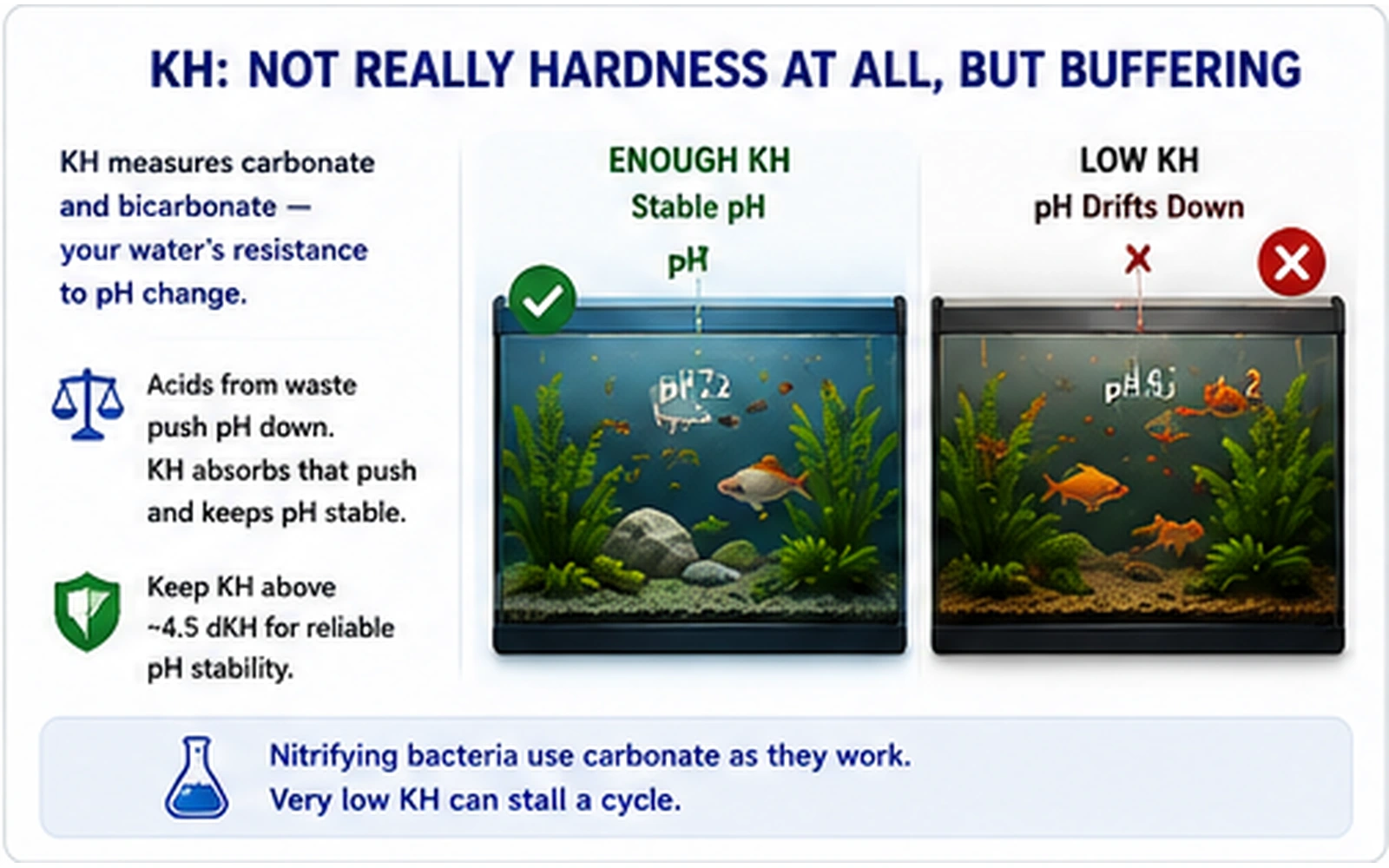
Carbonate hardness measures carbonate and bicarbonate. The name is the problem: it puts KH in the same family as GH in the reader's mind, when what it actually describes is your water's resistance to pH change.
Acids accumulate in every aquarium. Fish waste, decomposing food and the nitrogen cycle itself all push in the acidic direction. KH absorbs that push. With plenty of buffering, pH stays where it is. With very little, pH can fall steadily and, at the extreme, drop sharply once the buffer is exhausted.
That makes KH the answer to two of the most common frustrations in this hobby: why a pH adjustment rebounded within days, and why a pH that was stable for months suddenly moved. Published guidance commonly suggests keeping KH above roughly 4.5 degrees for reliable pH stability. pH in a freshwater tank covers the relationship from the other side.
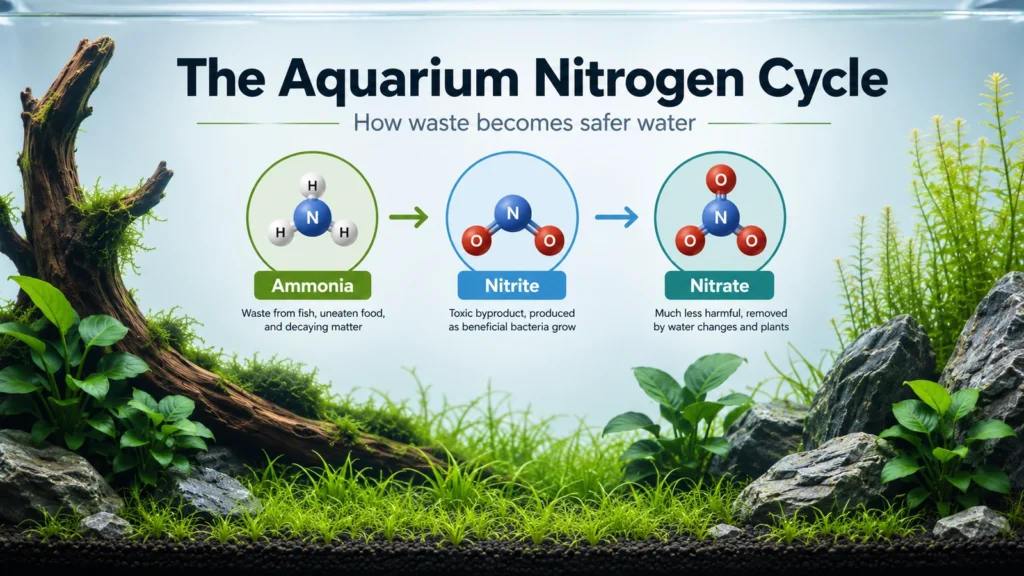
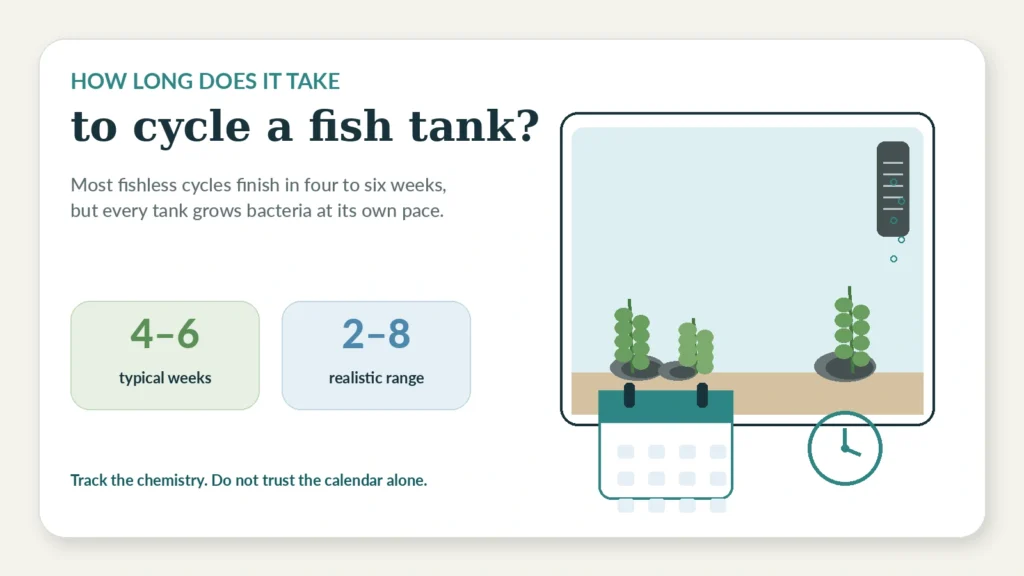
There is also a cycling connection worth knowing: the nitrifying bacteria that process ammonia and nitrite consume carbonate as they work, so a tank with very low KH can see its buffer drawn down during cycling, which is one reason a cycle sometimes stalls in very soft water.
The Three Times These Numbers Actually Matter
1. Your pH will not hold, or it is falling. This is the big one. If pH drifts down between water changes, rebounds after you adjust it, or moved suddenly, test KH before doing anything else. A low or exhausted buffer explains all three, and the fix is usually routine water changes with your normal source water rather than a product.
2. You keep, or want to keep, shrimp or snails. Invertebrates build shells and exoskeletons from minerals in the water, so GH is a genuine requirement for them rather than a preference. Snails kept in very soft water commonly show shell erosion or thin, pitted shells. If invertebrates are in your plans, hardness moves from optional to primary.
3. You are breeding, or keeping species with genuinely specific water needs. Some soft-water species spawn only within a narrow hardness range, and some hard-water species do poorly at the other end. This is a deliberate project, and if you are in it you already know these numbers matter.
Outside those three, a one-time reading is enough.

Test Your Tap Water Once and Write It Down
This is the whole practical exercise, and it takes ten minutes.
Test GH and KH straight from your tap, and again from the tank. Write both down somewhere you will still have them in a year, along with the date. That single pair of numbers tells you:
- Which fish suit your water without any adjustment, which is the most useful stocking information you can have and the one thing that removes hardness as an ongoing problem.
- Whether your pH has anything holding it up, which predicts how stable the tank will be.
- Whether invertebrates are straightforward or a project in your area.
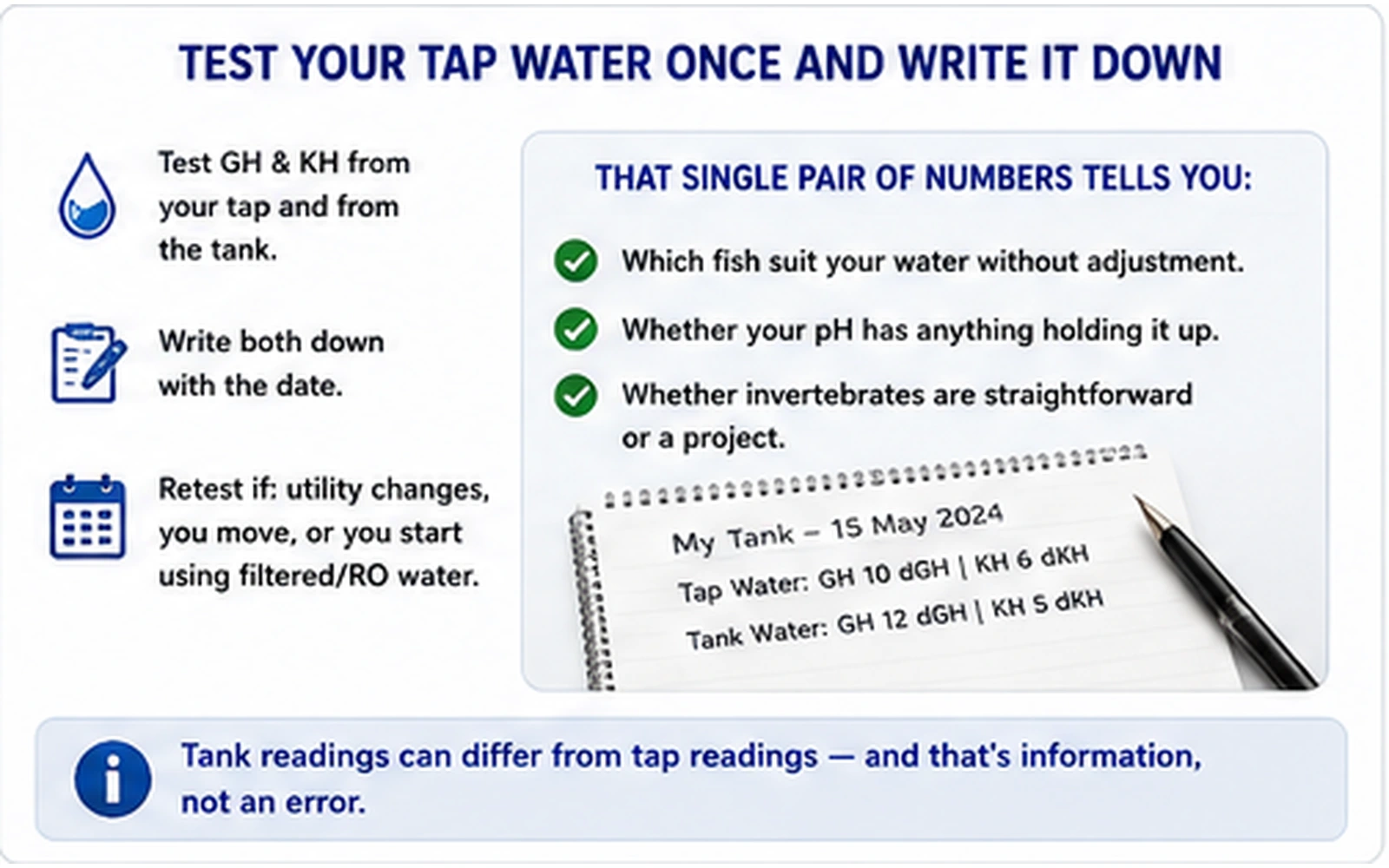
Retest if your water utility changes source, if you move, or if you start using filtered or RO water for changes. Otherwise this is not a routine test. How often should you test your water puts it in a schedule alongside the parameters that do need regular attention.
One caution: the tank reading can differ from the tap reading, and legitimately so. Rocks, shells and some substrates dissolve slowly and raise both numbers over time, while driftwood and accumulating acids can pull KH down. A gap between tap and tank is information, not an error.
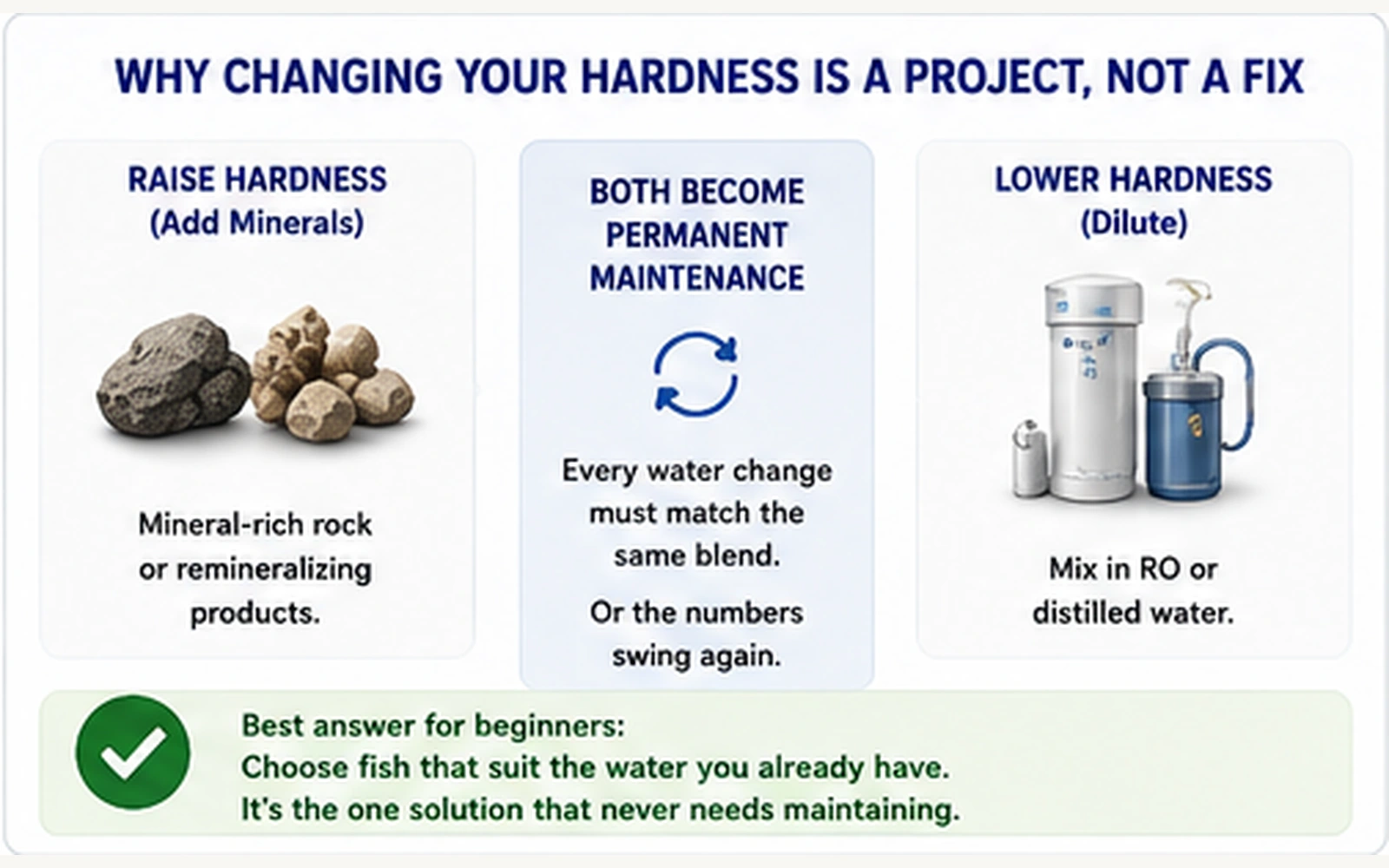
Why Changing Your Hardness Is a Project, Not a Fix
You can raise hardness with mineral-rich rock or a remineralizing product, and lower it by mixing in RO or distilled water. Both work. Both also become permanent maintenance, because every water change now has to reproduce the same blend or you reintroduce the swings you were trying to prevent, and a tank whose keeper is away for a fortnight drifts back.
For a beginner, the far better answer is to choose fish that suit the water you already have. Most fish sold in shops today are captive-bred and adapted to a broad range, and the local shop's stock is often kept in the same municipal water you have. Matching stock to water is the one solution that never needs maintaining.
Adjusting hardness is defensible when you are breeding a specific species or keeping invertebrates that need it. It is rarely worth it to move a community tank a couple of degrees closer to a chart.
FAQ
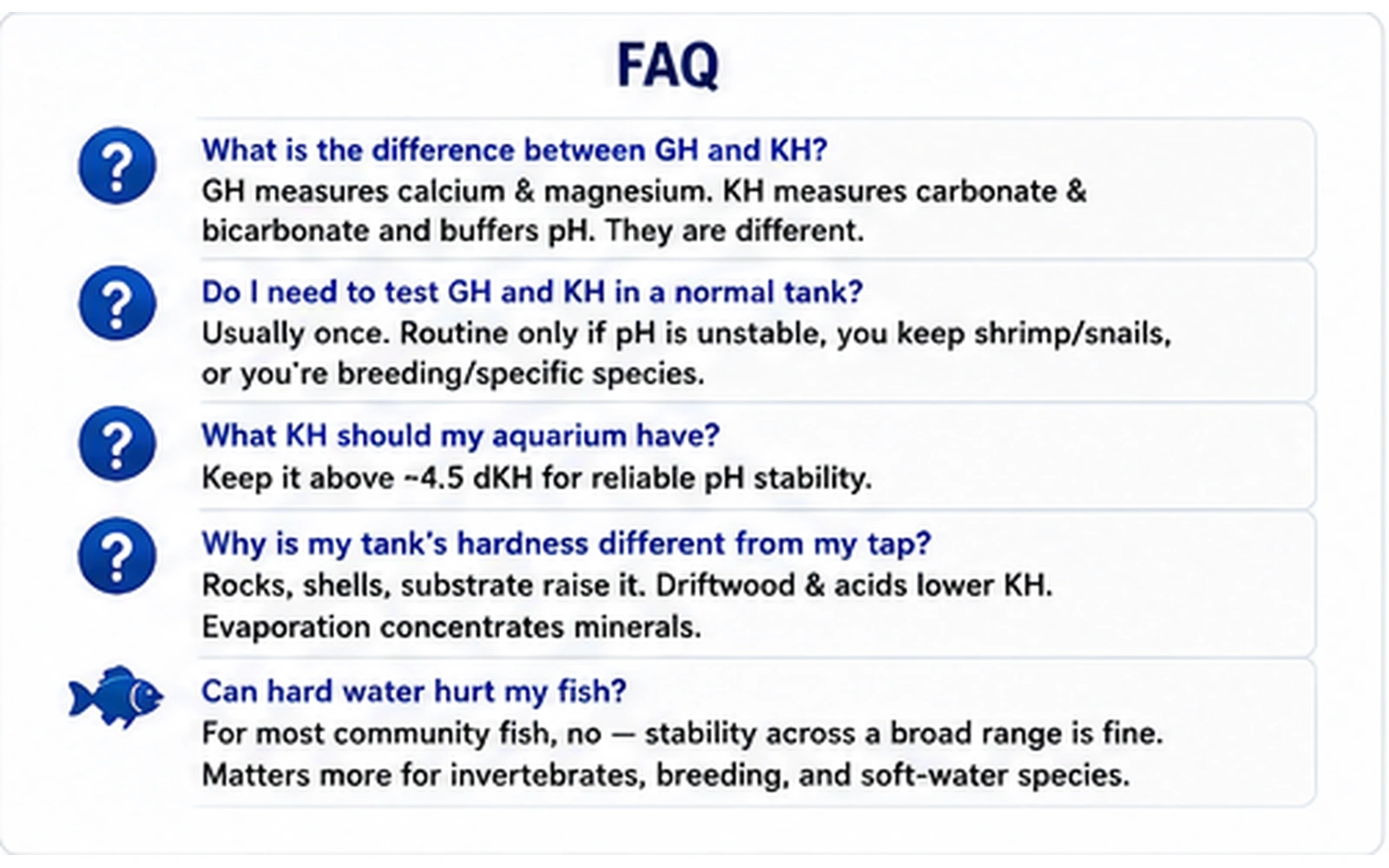
What is the difference between GH and KH?
GH measures dissolved minerals, mainly calcium and magnesium, and is what soft and hard water refer to. KH measures carbonate and bicarbonate and describes how strongly the water resists pH change. A tank can have high GH and low KH at the same time.
Do I need to test GH and KH in a normal community tank?
Usually once, to learn what your water is. They become routine only if your pH is unstable, if you keep shrimp or snails, or if you are breeding or keeping species with specific water requirements.
What KH should my aquarium have?
Published guidance commonly suggests staying above roughly 4.5 degrees for reliable pH stability. Below that, pH becomes easier to move and, if the buffer is exhausted, can fall sharply.
Why is my tank's hardness different from my tap water?
Rocks, shells and certain substrates dissolve slowly and raise both readings, while driftwood and accumulated acids draw KH down. Evaporation topped up with tap water also concentrates minerals over time, since the water leaves and the minerals do not.
Can hard water hurt my fish?
For most captive-bred community fish, a stable hardness across a broad range is fine. Hardness matters much more for invertebrates, for breeding, and for species genuinely adapted to soft water. Stability is more important than hitting a target.