Start with the sentence that most pages avoid, because everything useful follows from it.
Almost every fish will eat a baby shrimp. Not out of aggression, not because it is a predator, but because a newly hatched shrimp is a small moving thing and fish eat small moving things. A fish that completely ignores adult cherry shrimp will still take the young without hesitation.
So the question "which fish are shrimp-safe" is the wrong question. The right one is: can this colony produce young faster than this tank eats them? That is a question about the tank, not about a species list, and it is answerable.
The rule that replaces the species list
Two properties predict most of it.
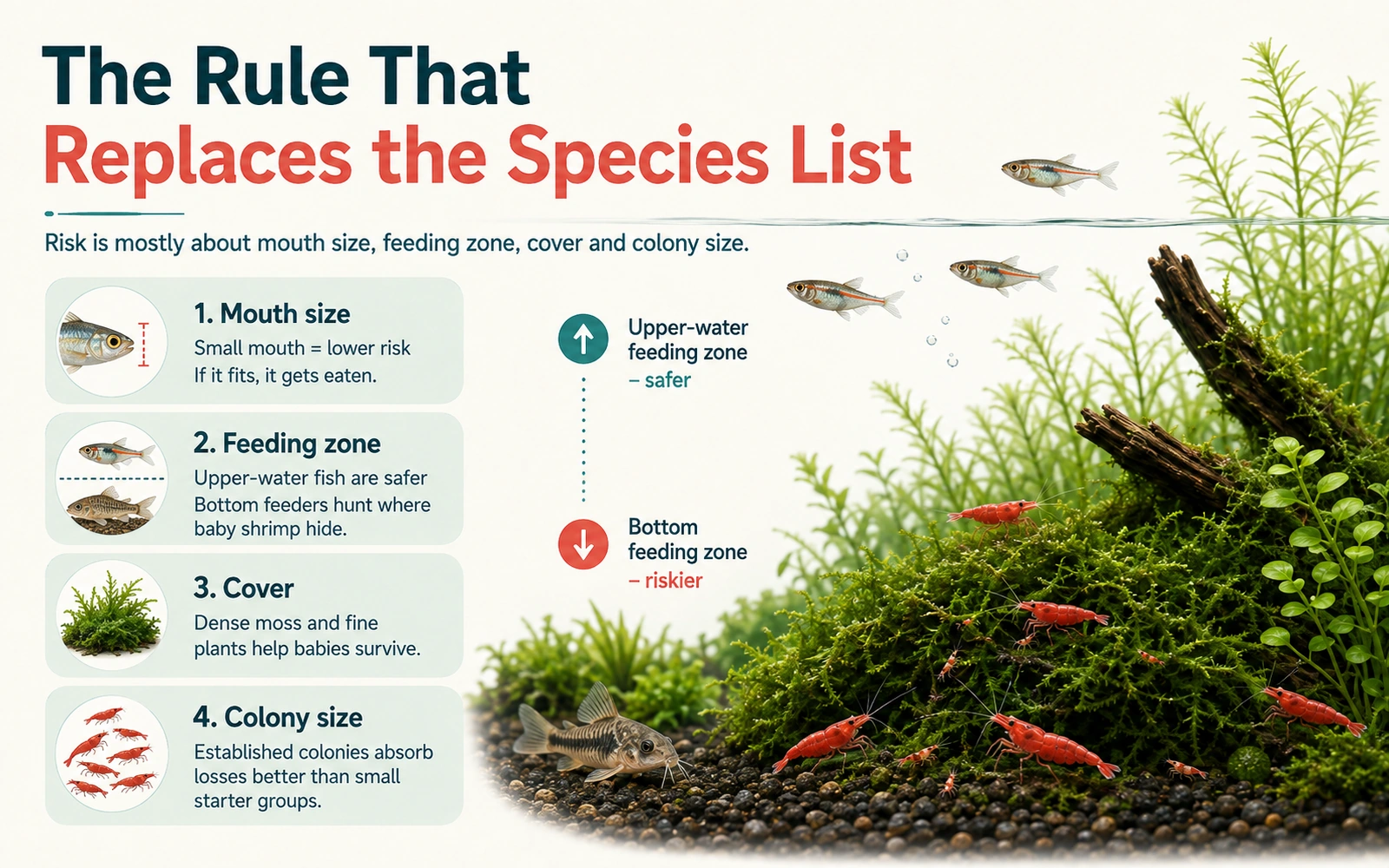
Mouth size. A fish cannot eat what does not fit. This is the single best predictor, better than temperament, better than reputation. A small-mouthed fish is a limited threat to adults and a real threat to young.
Where it feeds. A fish that works the substrate and the plant bases is hunting where baby shrimp live. A fish that feeds in the upper water column mostly is not, whatever its mouth is like.
Then the two conditions that decide whether the colony survives anyway:
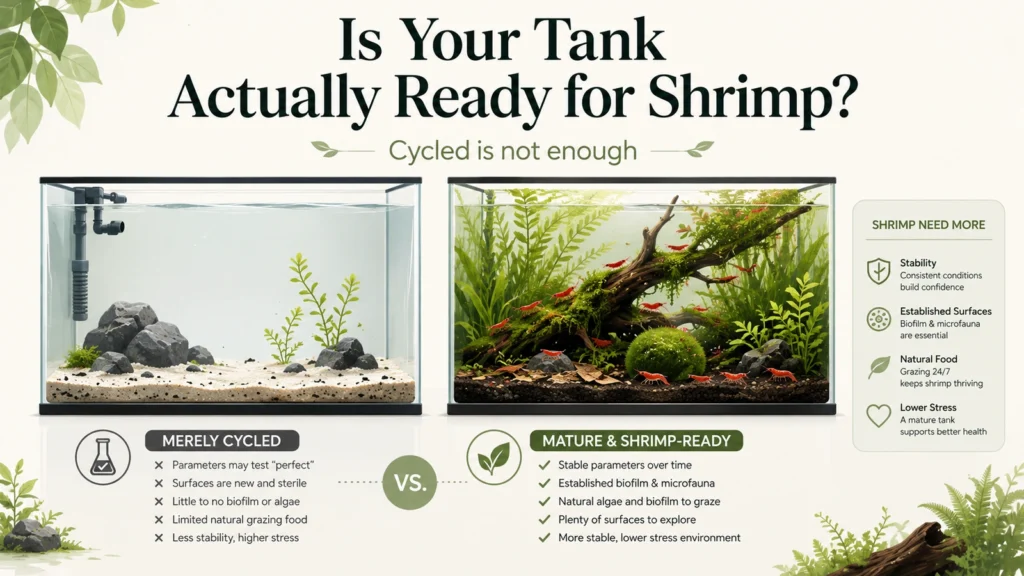
Cover. Dense moss, fine-leaved plants, a mature tank with surfaces and shadows. Baby shrimp survive by not being findable. A bare tank with three plastic plants gives them nowhere to be, and no fish choice compensates for that.
Population. A large, established colony absorbs predation. A handful of shrimp added to a tank with fish in it will be eaten faster than they reproduce, and the loss looks like a mystery. This is the most common way people lose a colony to fish: not a massacre, but arithmetic.
The honest tiers
No fish at all. This is the only setup where a colony grows at its natural rate, and it is what serious shrimp keepers do. A species-only shrimp tank is not a compromise; for most people it is the version that works.
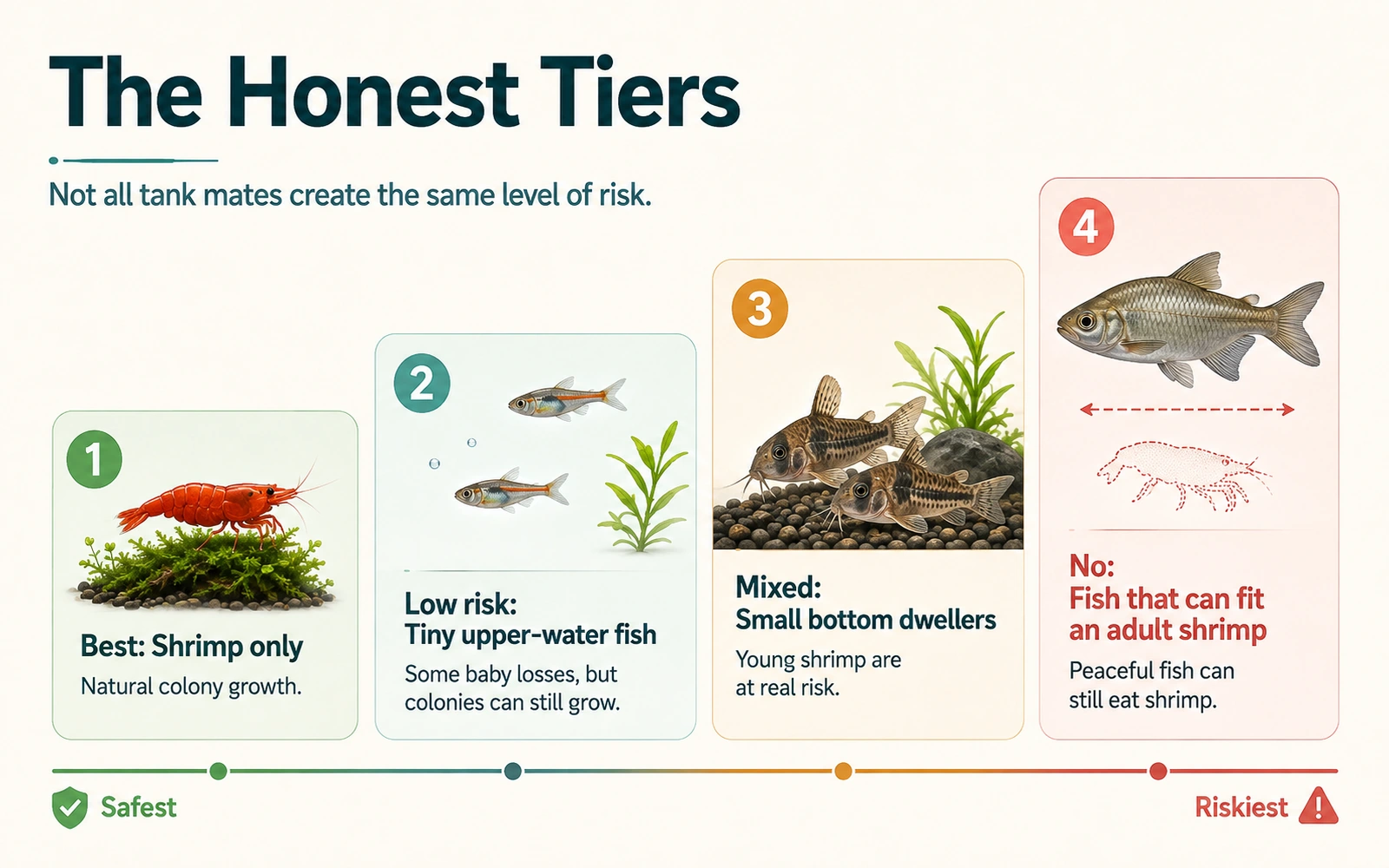
Very small, small-mouthed, upper-water fish. The lowest-risk group. Losses to predation still happen. A large colony in a heavily planted tank generally keeps growing anyway. This is the arrangement most people mean when they say fish and shrimp coexist, and it does work.
Small bottom dwellers. Genuinely mixed. They are not usually a threat to adults and they are hunting exactly where the young are. Colonies persist alongside them in well-planted tanks and grow more slowly than they otherwise would.
Anything with a mouth that fits an adult shrimp. No. This includes a great many fish sold as peaceful community fish, because peaceful describes their behavior toward other fish and says nothing about their view of invertebrates. Reputation is not the test; mouth size is.
Anything sold as a predator, and anything that eats snails. Obviously no, and worth saying because a fish bought to control pest snails will find shrimp indistinguishable from the job.
Notice that no species is named anywhere above. That is deliberate. A named list is what gets colonies eaten, because individuals vary, because tanks vary enormously in cover, and because a keeper who has read a name stops watching. What survives across all of that is the mouth-size rule, the feeding-zone rule, and the two conditions.
Snails are the easy answer
If you want other life in a shrimp tank and you want no risk at all, add snails.
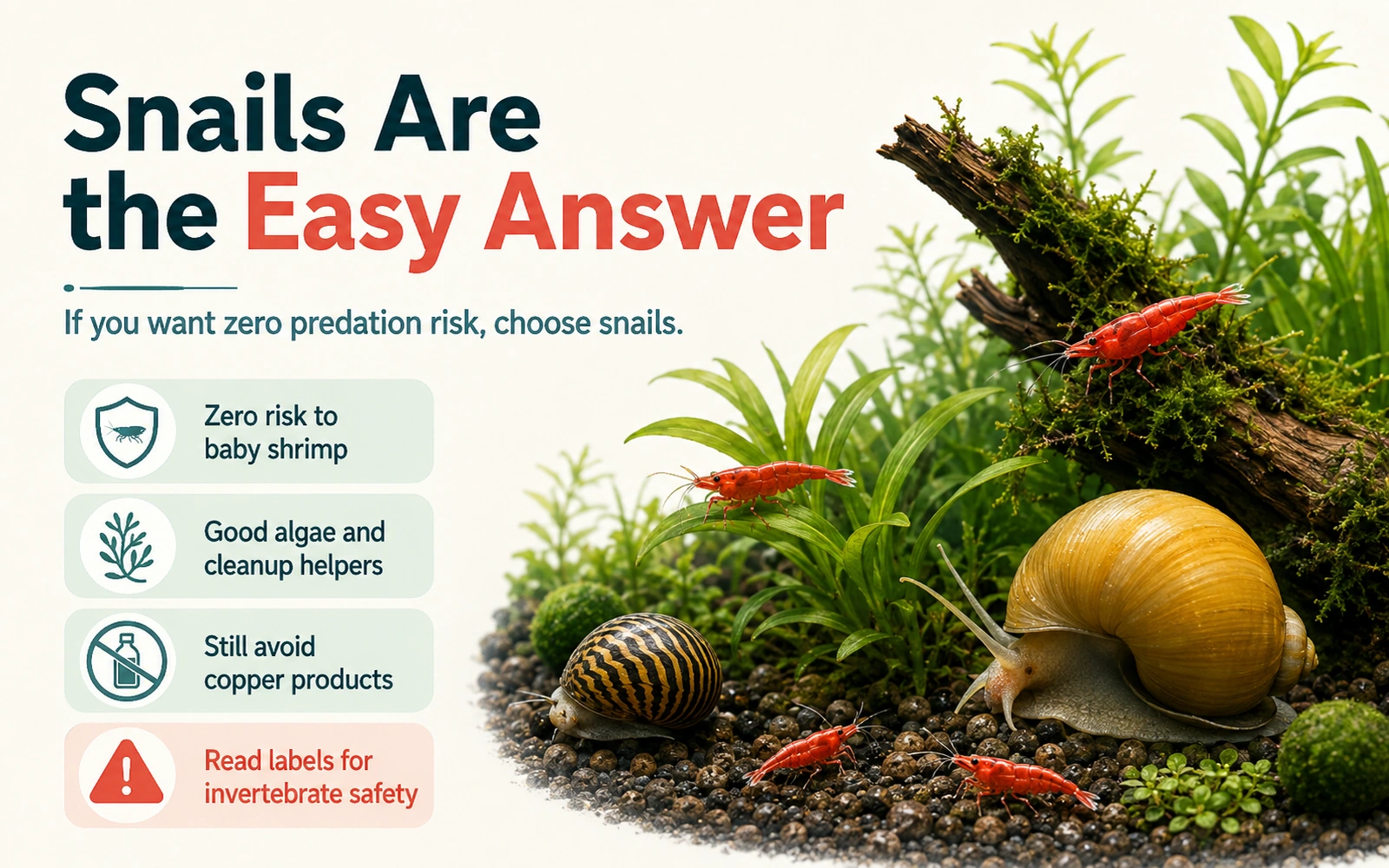
Nerites eat algae and cannot breed in fresh water, so they do not take over. Mystery snails are larger and more active. Neither has any interest in shrimp at any life stage, and neither competes for anything the shrimp need.
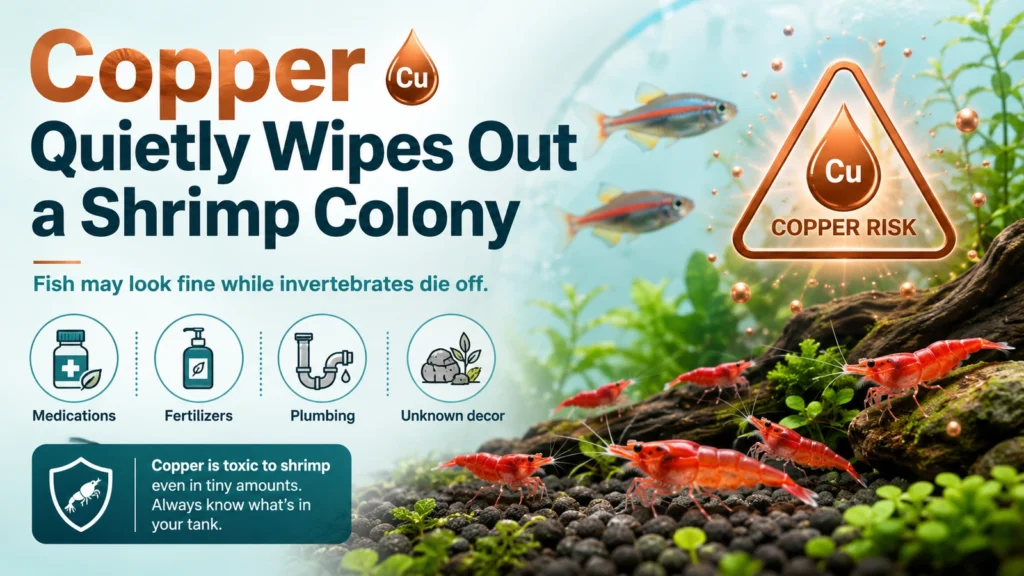
The one thing to watch is the same one that governs everything in this cluster: whatever you keep, you cannot medicate the tank. Copper is lethal to shrimp and snails alike at exposures fish do not react to, and it arrives in fish medications, snail treatments, some plant fertilizers and some foods. Read the label for what it says about invertebrates, and if it says nothing, assume the answer is bad.
Setting the tank up so it works
If you are going to mix, the tank does more work than the stocking choice does.
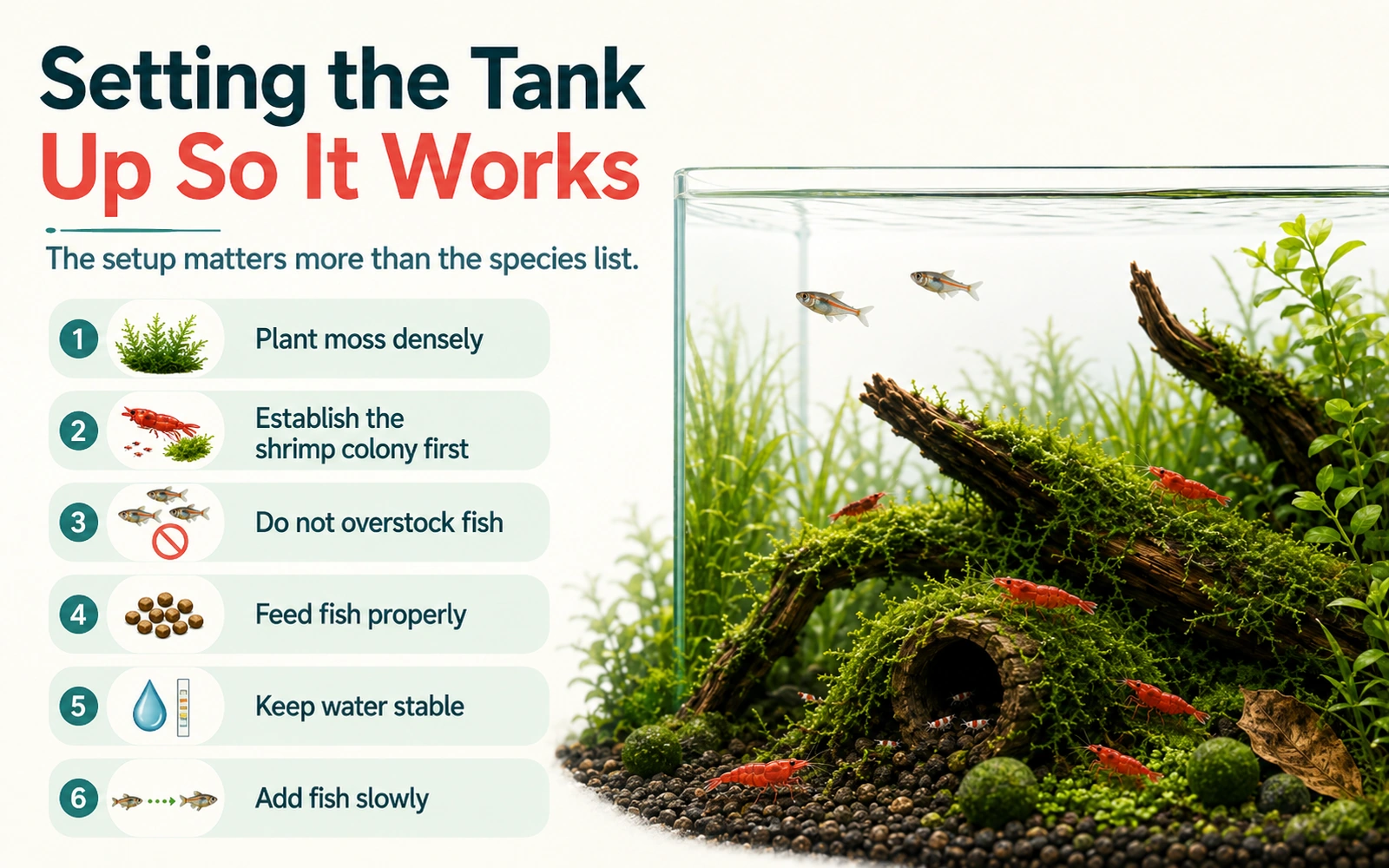
- Plant it densely before you add anything. Moss especially. This is the single highest-impact thing on the list, and it is a decision you make at setup rather than later.
- Establish the colony first. Shrimp in, months of breeding, then fish. Not the other way around. A colony with numbers absorbs losses; a starter group does not.
- Do not overstock. More fish is more mouths and more waste, and shrimp feel water quality problems before fish do.
- Feed the fish properly, so they are not hunting out of hunger, and remove what is uneaten so you are not feeding the tank's bioload as well. How much to feed aquarium fish covers the amount.
- Keep the water stable. Small, frequent, temperature-matched, conditioned water changes. How to do a water change is the method, and stability is what a colony actually needs from you.
- Add the fish slowly, which is a bioload question as much as a predation one. Adding fish to a new tank slowly covers why.
Reading what is happening
The failure mode is quiet, so it needs watching for deliberately.
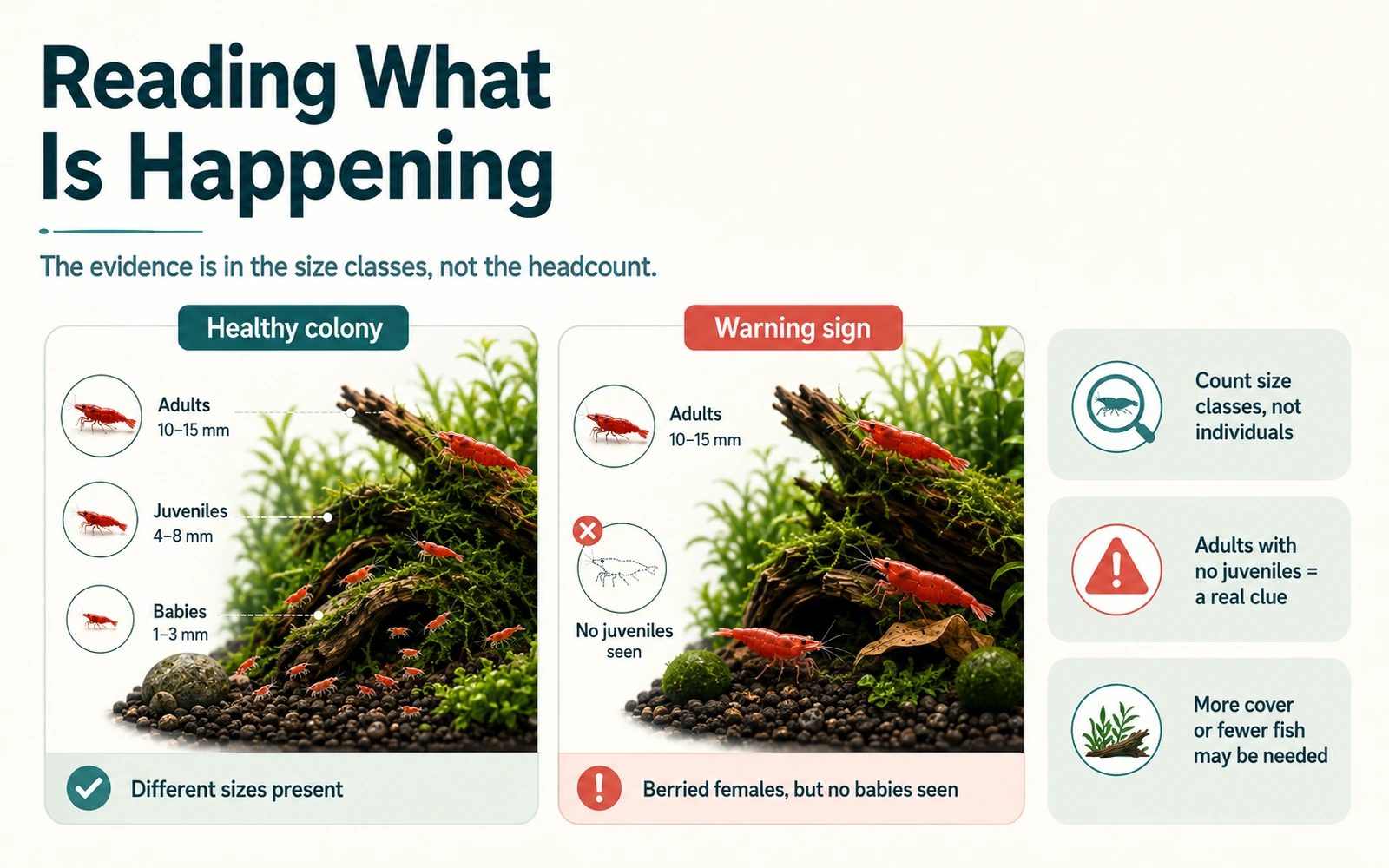
You will not see the predation. It happens at hatching, in cover, and it takes seconds. The evidence is the absence of juveniles, not a body.
Count size classes, not shrimp. A healthy colony has visibly different sizes present at once. A colony where every shrimp is adult-sized and there are never any small ones is a colony that is breeding and losing every generation. That is the diagnostic, and it is much more reliable than trying to count individuals that hide.
Berried females and no juveniles is the clearest signal there is. Eggs are being carried and hatched, and the young are going somewhere.
If that is what you see, the options are more cover, fewer fish, or accepting that this is a display tank with shrimp in it rather than a breeding colony. All three are legitimate. Pretending it is a breeding colony while it slowly empties is not.
When something else is wrong
Not every disappearance is predation. Before you blame the fish, check that the tank itself is not the problem, because shrimp show water quality trouble earlier than fish do. Test ammonia, nitrite and nitrate and write down what you get. Aquarium water parameters covers what each reading is telling you.
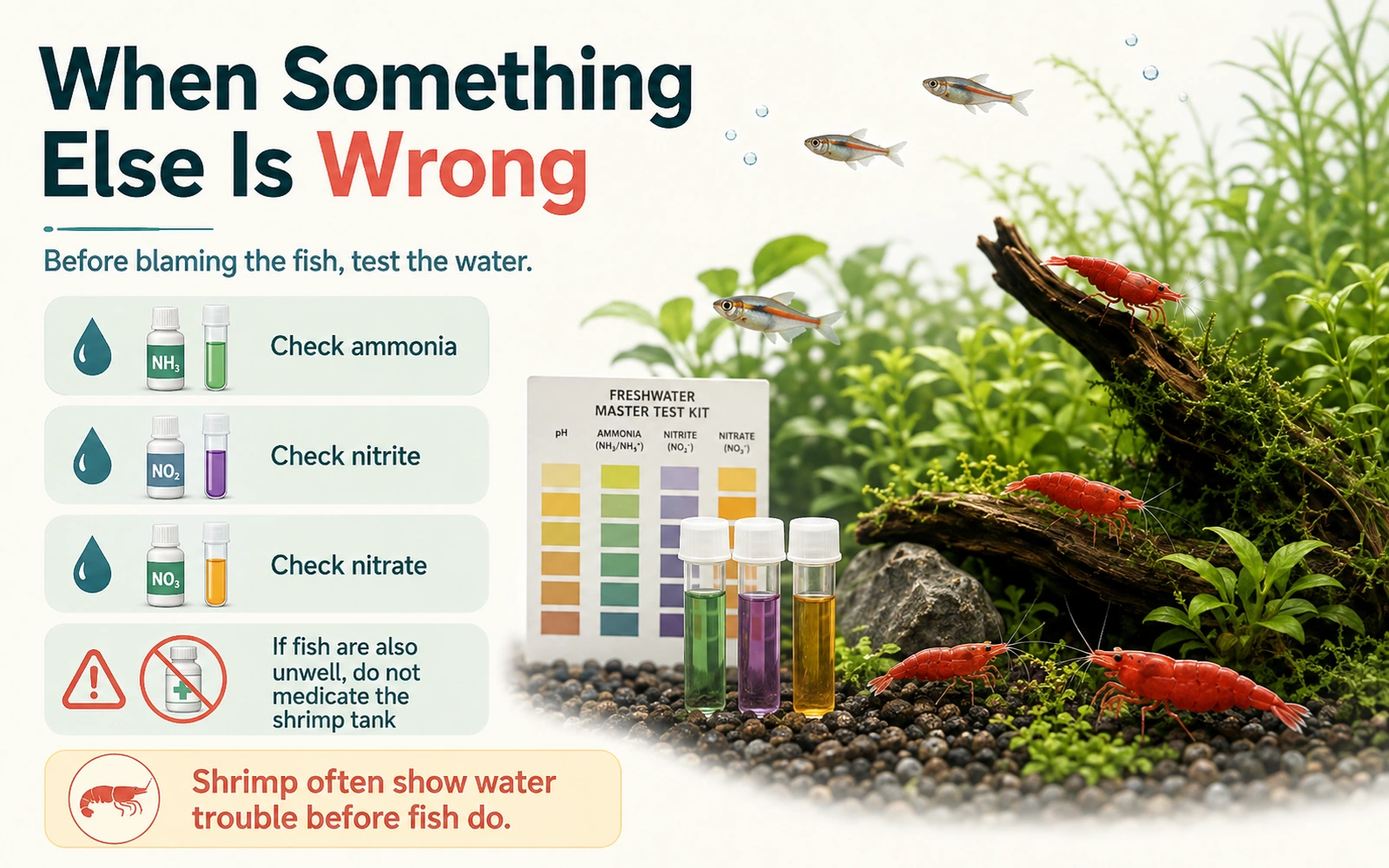
This site publishes no threshold at which shrimp begin to die, because ammonia toxicity depends on pH and temperature and one number would be misleading. What is reliable is that detectable ammonia or nitrite in a tank losing shrimp is the finding, whatever the number.
And if fish are also unwell, that is a different problem again, with a hard constraint attached: you cannot treat a shrimp tank. When to contact an aquatic veterinarian and how to find one covers who can answer a diagnosis question, which matters more here than in a fish-only tank because the wrong bottle ends the colony.
The short version
- Almost every fish eats baby shrimp. The question is arithmetic, not safety.
- Mouth size and feeding zone predict the risk. A species list does not.
- Cover and colony size decide the outcome more than the fish choice does.
- Establish the colony first, then add fish. Never the reverse.
- Snails are the zero-risk companions.
- Adults with no juveniles ever is the diagnostic. Count size classes.
FAQ
Which fish are completely safe with shrimp? No fish at all is the only setup where a colony grows at its natural rate. Almost every fish eats baby shrimp, not out of aggression but because a newly hatched shrimp is a small moving thing. The realistic question is whether the colony can produce young faster than the tank eats them.
Why does this page not name shrimp-safe species? Because a named list is what gets colonies eaten. Individuals vary, tanks vary enormously in cover, and a keeper who has read a name stops watching. Mouth size and feeding zone predict the risk better than temperament or reputation.
How do I know if my fish are eating the baby shrimp? You will not see the predation; the evidence is the absence of juveniles, not a body. Count size classes instead of individuals: a colony where every shrimp is adult-sized and there are never any small ones is breeding and losing every generation, and berried females with no juveniles is the clearest signal there is.
Should I add the shrimp or the fish first? The colony first. Shrimp in, months of breeding, then fish, never the other way around, because a colony with numbers absorbs losses while a starter group is eaten faster than it reproduces. Plant densely before adding anything, and do not overstock.
What tank mates carry no risk at all? Snails. Nerites eat algae and cannot breed in fresh water, mystery snails are larger and more active, and neither has any interest in shrimp at any life stage. The shared constraint is copper: never in the tank, in any amount, for any reason.