You look into the tank and one fish seems to have been sprinkled with salt. That picture is the classic description of ich, and it is worth getting right before anything goes into the water.
Ich (white spot disease, caused by the parasite Ichthyophthirius multifiliis) usually shows as small, bright white, evenly scattered spots about the size of a grain of salt on the body and fins. Only a microscope confirms it, several other conditions look similar, and the white spot you can see is the one stage no treatment reaches. So the order is: confirm, then treat exactly as the product label or an aquatic veterinarian directs.
This page covers recognition, the look-alikes, why the treatment advice online disagrees with itself, and what you can safely do in the first hour. It does not give a dose, a temperature or a schedule, and that is deliberate.
Is It Ich? What White Spot on Fish Actually Looks Like
The aquariumscience.org ich page (read September 11, 2026) describes it precisely: "very well defined, very white spots only the size of a grain of salt, no larger," evenly spread over the fins and body, embedded in the skin so they "only slightly protrude," and they "almost never occur on the eyes."
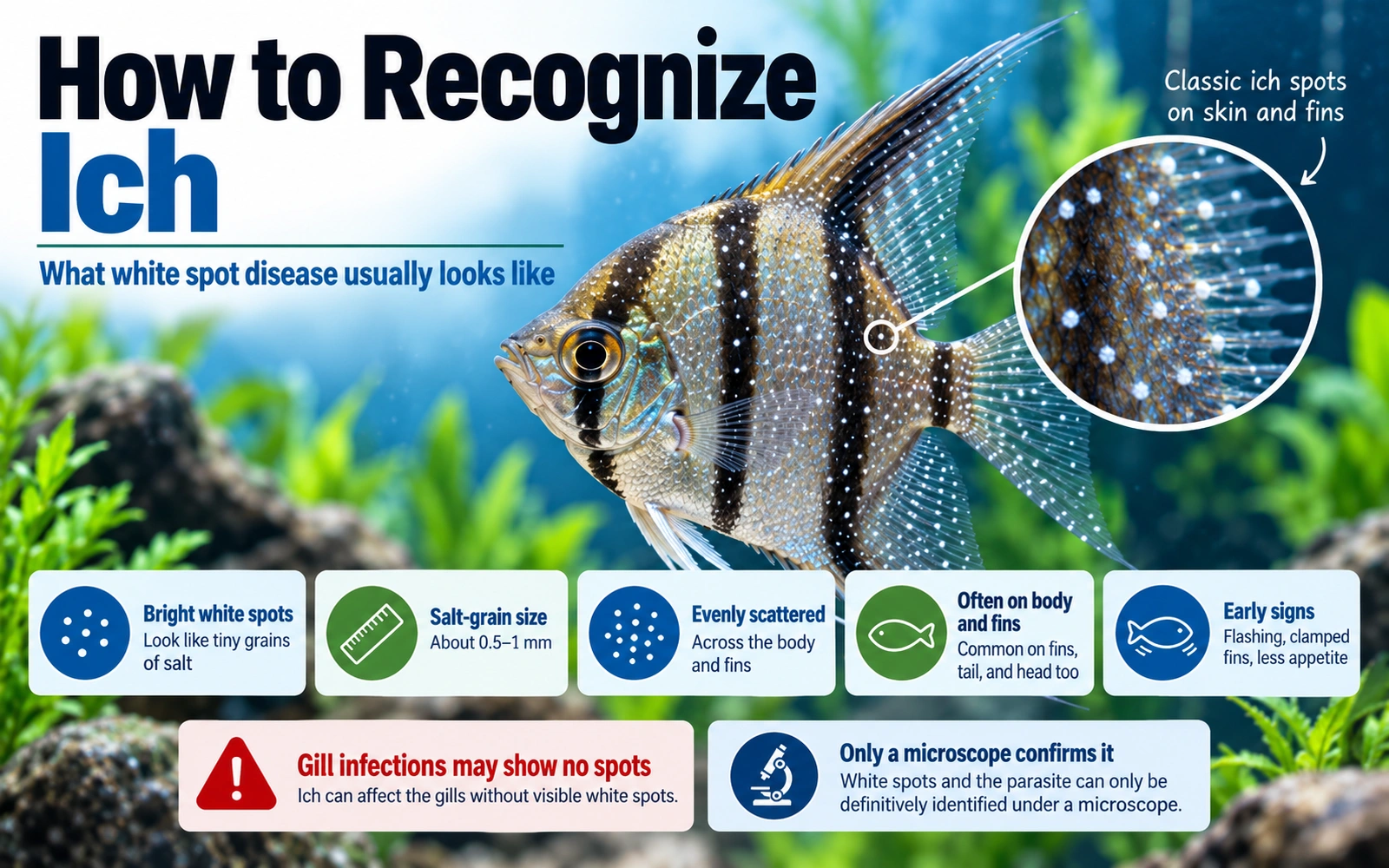
The spots are not always the first sign. The University of Florida IFAS Extension fact sheet on white spot infections (FA006, by Ruth Francis-Floyd, Roy Yanong and Deborah Pouder, read September 11, 2026) lists signs that can come before the spots: irritation, flashing (rubbing against objects), increased mucus, weakness, loss of appetite and decreased activity. The Merck Veterinary Manual's chapter on parasitic diseases of fish (reviewed May 2022, updated June 2026, read September 11, 2026) adds lethargy, clamped fins and dark coloration, with white dots "often visible on the skin."
One version shows no spots at all. UF/IFAS warns that when the parasite infects the gills, "white spots may not be seen at all, but fish will die in large numbers," and the gills are often pale and swollen. Fish breathing hard or dying without visible spots is an emergency, not a wait-and-see situation. Our aquarium emergency guide gives the order of checks for exactly that moment.
Things That Look Like Ich
The same aquariumscience.org page names the common imitators, and they matter because the wrong identification leads to the wrong bottle.
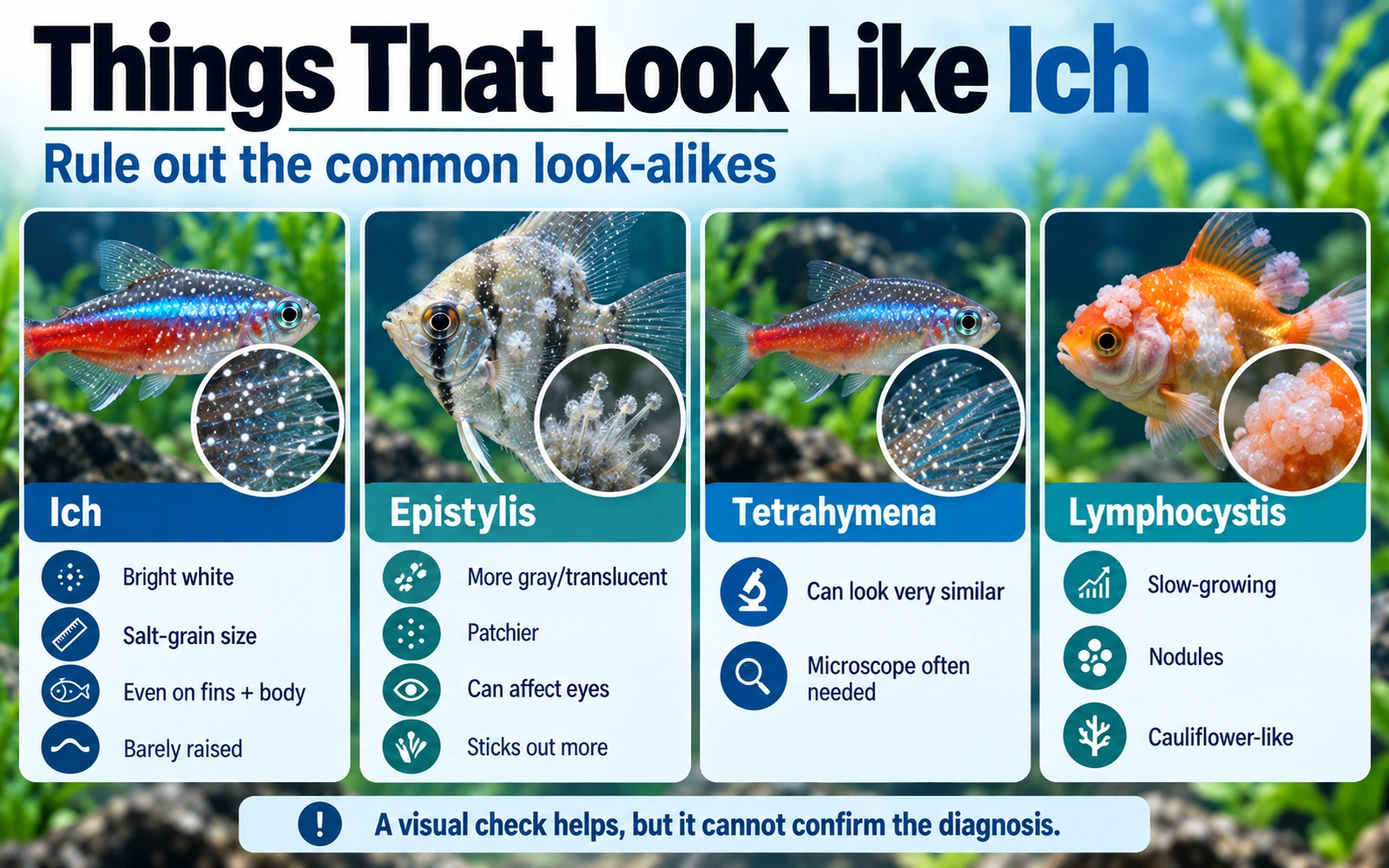
| What you see | Ich, as described by the sources | Look-alikes to rule out |
|---|---|---|
| Color | Bright, opaque white | Epistylis and Tetrahymena read more translucent or grayish |
| Size and shape | Salt-grain size, very round, no larger | Epistylis is patchier and more variable |
| Where | Evenly over body and fins, almost never the eyes | Epistylis can appear on the eyes |
| Profile | Embedded, barely raised | Epistylis spots stick out into the water |
| Over time | Spots come and go as the parasite cycles | Lymphocystis grows slowly into nodules and pink, cauliflower-like growths |
aquariumscience.org also notes that Tetrahymena, seen mainly in livebearers, "can look exactly like ich, needing a microscope to differentiate it." That is the practical point of the table. It helps you describe what you see accurately. It cannot tell you what it is.
Frayed or disappearing fin edges are a different question altogether, and fin rot vs fin nipping covers how to tell damage from disease.
How it is actually confirmed
UF/IFAS states that "a diagnosis requires confirmation by identification of the parasite in infected tissue using a compound microscope," using skin scrapes and gill or fin clips. The Merck manual describes the parasite under 40x and 100x magnification as large, round, covered with cilia, with a "characteristic horseshoe-shaped macronucleus." That is a veterinarian's or a trained fish-health professional's job, and it is the step most home advice skips.
Why the Spot You Can See Is the Stage Nothing Reaches
This is the single most useful fact about ich, and it explains most failed treatments.
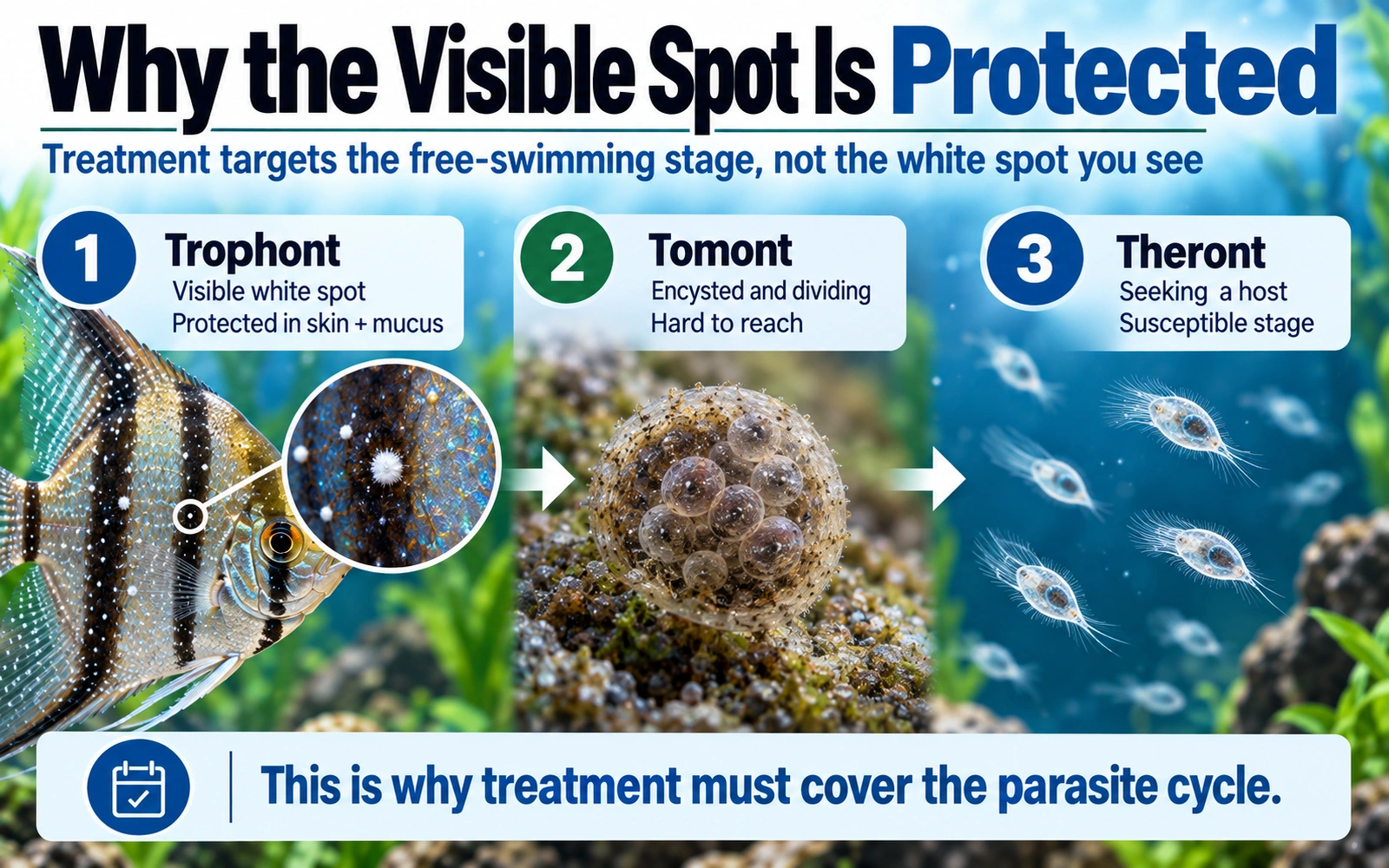
UF/IFAS describes three stages:
- Trophont, the feeding stage. It burrows between the thin outer layers of the fish's skin. This is the white spot. UF/IFAS says it is "protected from chemical treatment" because it is covered by the fish's tissue and mucus.
- Tomont, the reproducing stage. The mature parasite leaves the fish, settles on a surface and divides inside a cyst. Merck notes that "while encysted, parasitic life stages are refractory to chemical treatment, but cysts can be removed by thorough cleaning."
- Theront, the free-swimming stage that hatches out and looks for a new host. UF/IFAS calls this phase "unprotected and, therefore, highly susceptible to chemicals."
So a treatment only works on the parasites that are swimming at the time it is in the water. The spots on your fish were not killed by it and could not have been. That is why medication labels run over a period of time rather than once, and why stopping early because the spots faded is the classic way an outbreak returns.
Temperature changes the speed. UF/IFAS gives the life cycle as roughly 3 to 6 days at 75 to 79 °F and much longer in cooler water. That figure describes the parasite's biology. It is not a treatment instruction, and nothing on this page tells you to change your tank's temperature.
The Honest State of the Treatment Advice
Search this topic and you will find confident, specific instructions that contradict each other. That is not because some writers are careless. The evidence really is uneven, and it is worth knowing where the disagreements sit. Status as of September 2026:
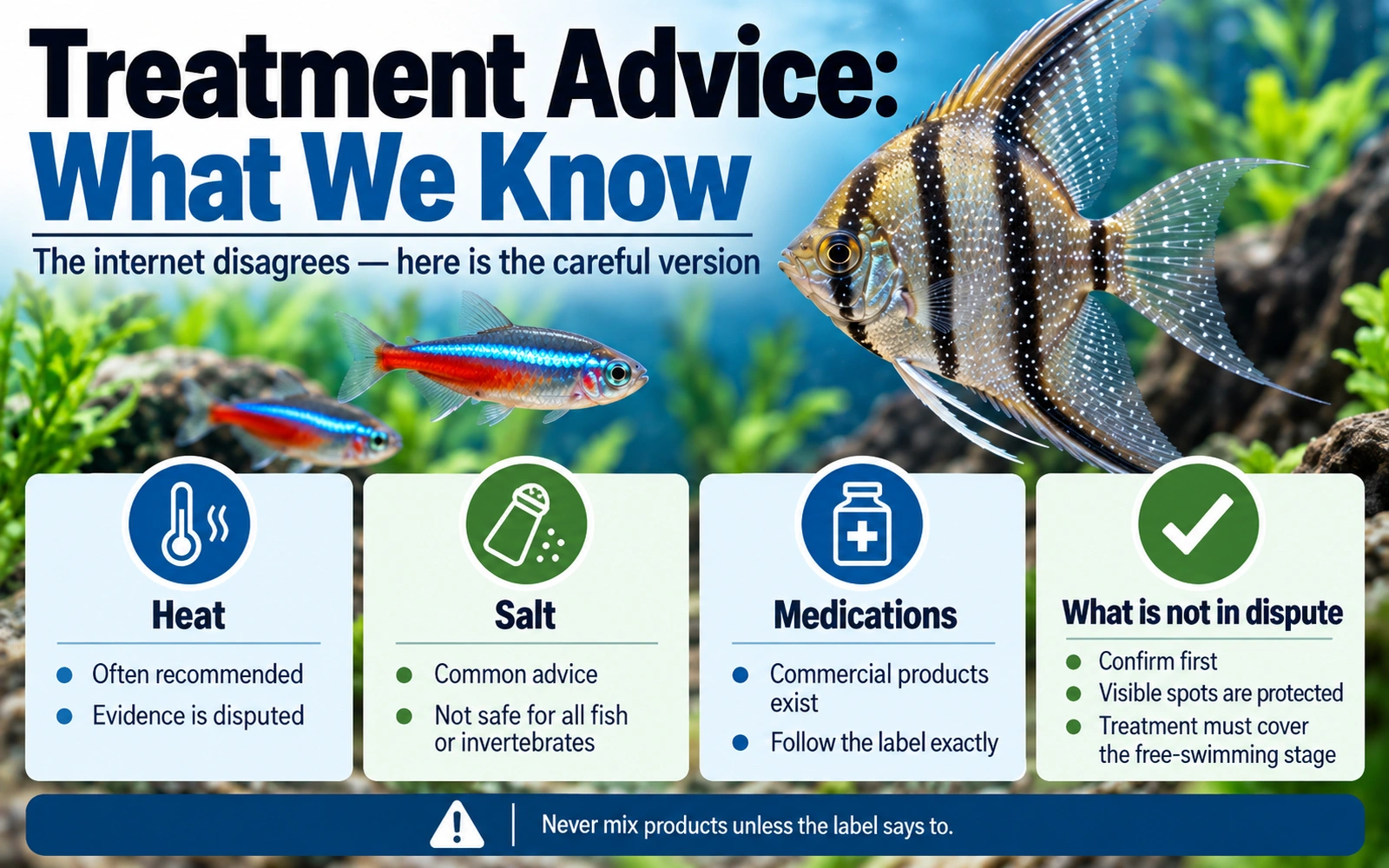
Heat. Much of the popular advice says to raise the temperature. aquariumscience.org's ich and heat page (read September 11, 2026) states that "there are several side by side scientific studies with controls which show heat is NOT effective," and argues that apparent success comes from other factors. We are not settling that argument, and we will not publish a heat protocol into it. Raising temperature also lowers the oxygen water can hold, which matters for fish whose gills are already under attack.
Salt. Widely recommended, and just as widely unsuitable for some animals. Several fish, and the shrimp and snails many people keep alongside them, react to salt concentrations other fish tolerate. This site publishes no salt amount for any purpose.
Medications. Commercial ich treatments exist and work on the free-swimming stage when used as labeled. The label is the authority: the amount, how long, what to do with chemical filter media, and above all which animals it is not safe for. Many ich products are not safe for invertebrates or for some sensitive fish. If the label does not address the animals in your tank, treat that silence as a no and ask before using it. Never combine products the label does not say can be combined.
What is not in dispute across every source read for this page: identification should be confirmed, the visible spot is protected, treatment has to cover the free-swimming stage, and prevention through quarantine beats all of it.
What You Can Safely Do in the First Hour
None of these steps is a treatment, and all of them help whoever treats.
- Look at every fish, not just the spotted one. Note which fish, where the spots are, and whether any fish is breathing hard, hanging at the surface or hiding.
- Test the water and write the numbers down. Ammonia, nitrite, nitrate, pH and temperature. Stress from poor water makes every parasite problem worse, and a vet will ask. Aquarium water parameters explains what each reading tells you.
- Take clear photos and a short video in good light, close to the glass. Spots are easier to judge on a screen than through a moving tank.
- Stop adding anything. No new fish, plants or decor, and do not move nets, siphons or buckets between tanks.
- Write down the timeline. When new fish or plants arrived, when the spots appeared, any recent changes. UF/IFAS notes that active disease often shows up one to three weeks after fish are shipped.
- Contact an aquatic veterinarian. Our guide to finding an aquatic veterinarian for fish covers what they do and how the visit works. The World Aquatic Veterinary Medical Association runs a Find a Fish Vet directory searchable by town and country (read September 11, 2026).
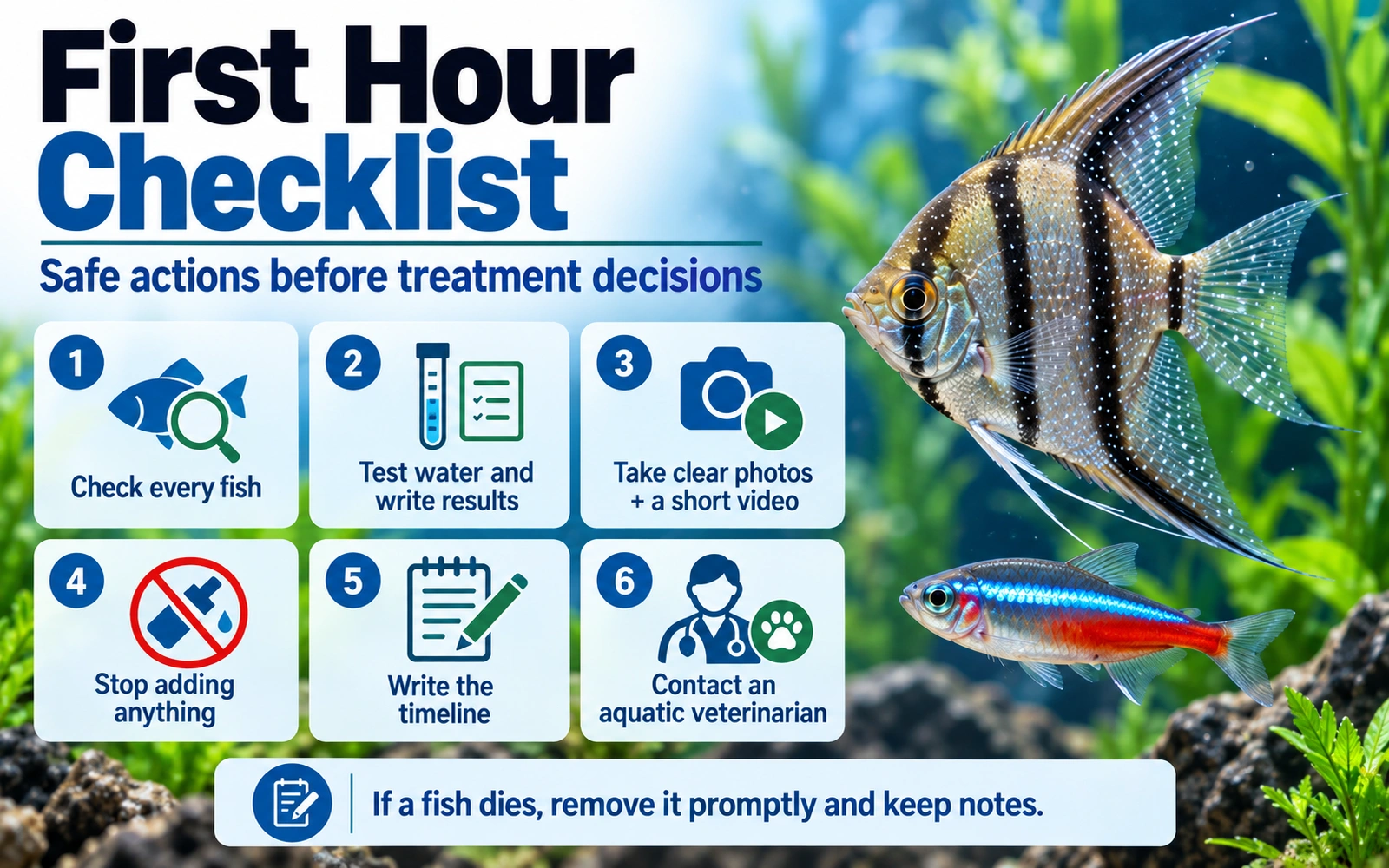
If a fish dies, remove it promptly and keep notes. It is useful evidence, not only a loss.
Preventing the Next Outbreak
Ich almost always arrives with something: a new fish, or water and plants carried over from another tank. The most effective control is keeping it out.
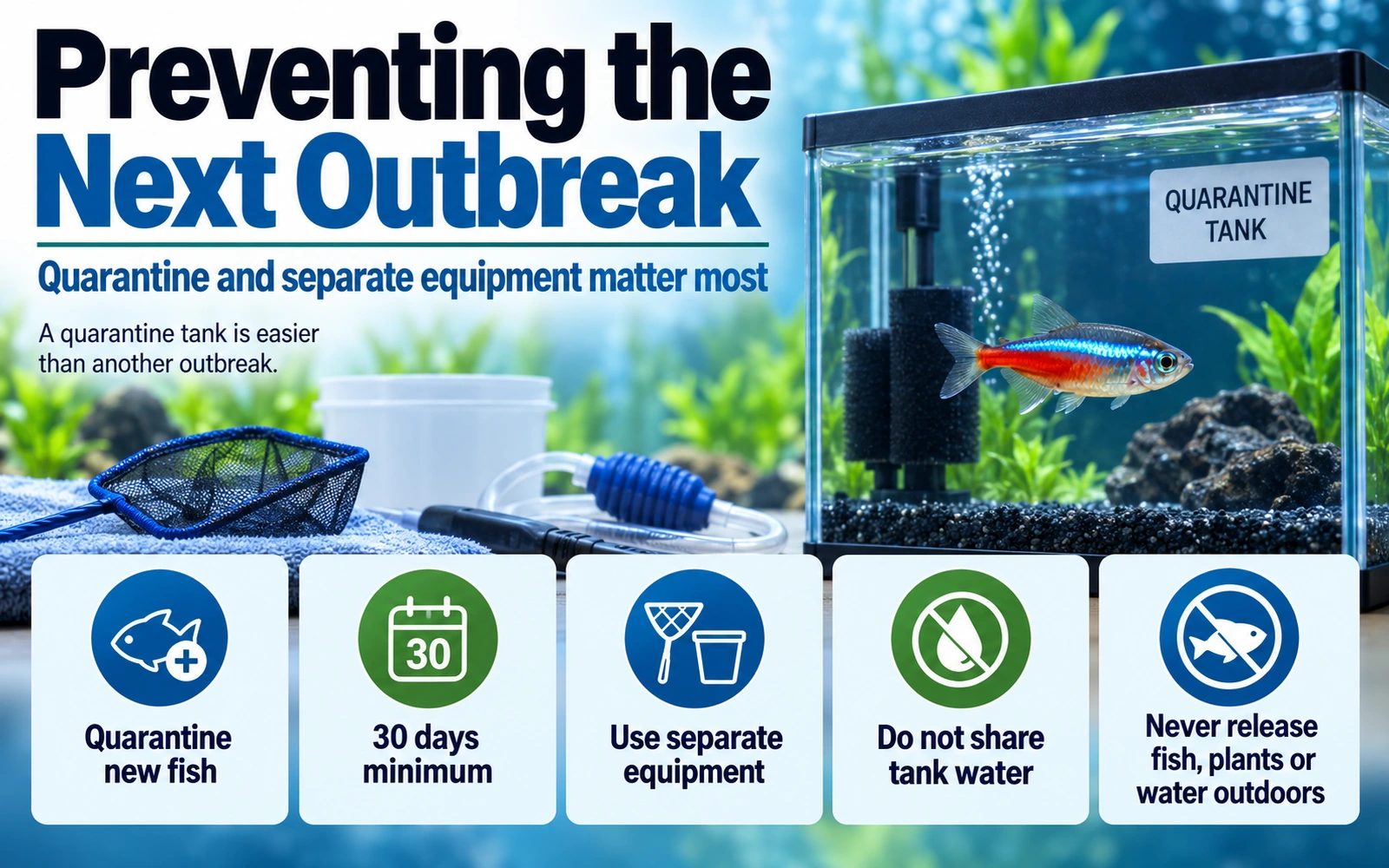
UF/IFAS recommends a minimum 30-day quarantine for new fish, and the Merck Veterinary Manual's management chapter calls 30 days "the minimum time for quarantine, but longer periods may be necessary" (both read September 11, 2026). That is a separate tank, separate equipment and patience. Our page on setting up a quarantine tank covers what that involves in practice.
Two rules that apply whatever you decide:
- Never release fish, plants or tank water into a pond, stream, lake or drain. Sick or unwanted aquarium animals and plants can carry disease to wild fish and can become invasive. Rehoming goes through a store, a club or a vet, never the outdoors.
- Keep equipment separate between a sick tank and a healthy one. Wet nets carry the free-swimming stage.
FAQ
Can I tell ich apart from other white spots just by looking? Only partly. Ich is typically bright white, salt-grain sized, round, evenly spread and almost never on the eyes, according to aquariumscience.org. But look-alikes such as Epistylis and Tetrahymena exist, and UF/IFAS says a diagnosis needs a compound microscope. A photo and a vet are the reliable route.
Why did the spots come back after they disappeared? Because the visible spot is the protected stage. UF/IFAS and the Merck Veterinary Manual both describe the stage on the fish and the cyst stage as resistant to chemical treatment; only the free-swimming stage is vulnerable. If treatment stops before the label's full course, parasites still on the fish or in cysts restart the cycle.
Does raising the temperature cure ich? The evidence is disputed. Much popular advice recommends it, while aquariumscience.org cites controlled studies that found no benefit. This site does not publish a heat protocol. Ask an aquatic veterinarian, and follow any product label exactly.
Is ich treatment safe for shrimp and snails? Often it is not. Many ich products and salt are harmful to invertebrates or some sensitive fish. Read the label for every animal in the tank, and if it does not say the product is safe for them, ask a vet before using it.
Ich is common and it is manageable, but it rewards patience over speed. Confirm what it is, let the label or a vet set the treatment, and put a quarantine tank between the next new fish and this one.