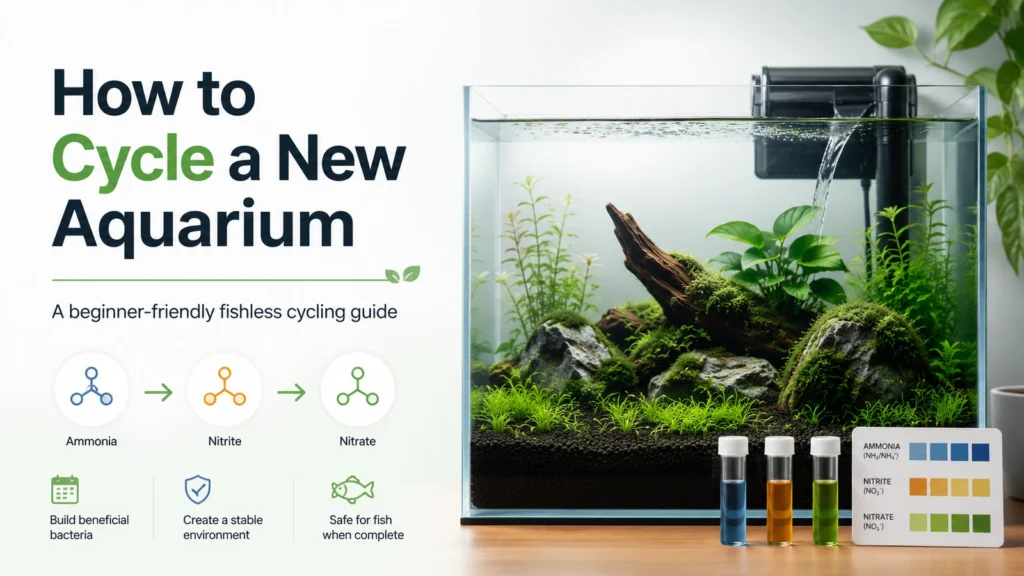
The freshwater aquarium water parameters that matter most are ammonia, nitrite, nitrate, pH, and temperature. Ammonia and nitrite should read 0 ppm, and any reading above zero is worth acting on the same day rather than watching. Commonly published hobby guidance puts the nitrate target under 20 ppm, with 40 ppm treated as the point most keepers would not let it pass. Keep pH stable in the 6.5 to 7.5 range for most community fish, and hold a steady temperature that suits your species, roughly 75 to 80°F for typical tropical fish. Water hardness (GH and KH) mostly matters because it keeps pH steady. Stability beats chasing a "perfect" number every time.
That short answer covers the decision most beginners actually need to make. The rest of this guide walks through each parameter one at a time: what it is, its safe range, why it matters, and how to test and fix it. My name is Hossain, and I built Aquarium Answers to give you the "why" behind the number, not just a chart to memorize.
The five numbers that actually matter (and what you can ignore for now)
Test kits and reference charts can list a dozen readings. For a beginner with a freshwater community tank, five carry almost all the weight:
- Ammonia (should be 0)
- Nitrite (should be 0)
- Nitrate (keep it low)
- pH (keep it stable)
- Temperature (steady, matched to your fish)
GH and KH (the two hardness readings) are worth understanding, but for most beginners they are supporting characters rather than daily worries. Everything else on a strip, such as chlorine or phosphate, is rarely your first problem. If your fish look stressed, start with ammonia and nitrite.
One honest note before the details: the single most useful habit is not hitting textbook numbers, it is keeping your numbers stable. A fish settled at a steady pH of 7.8 is healthier than one bounced between 6.8 and 7.6 while you chase an "ideal" reading. Keep that in mind as you read every range below.
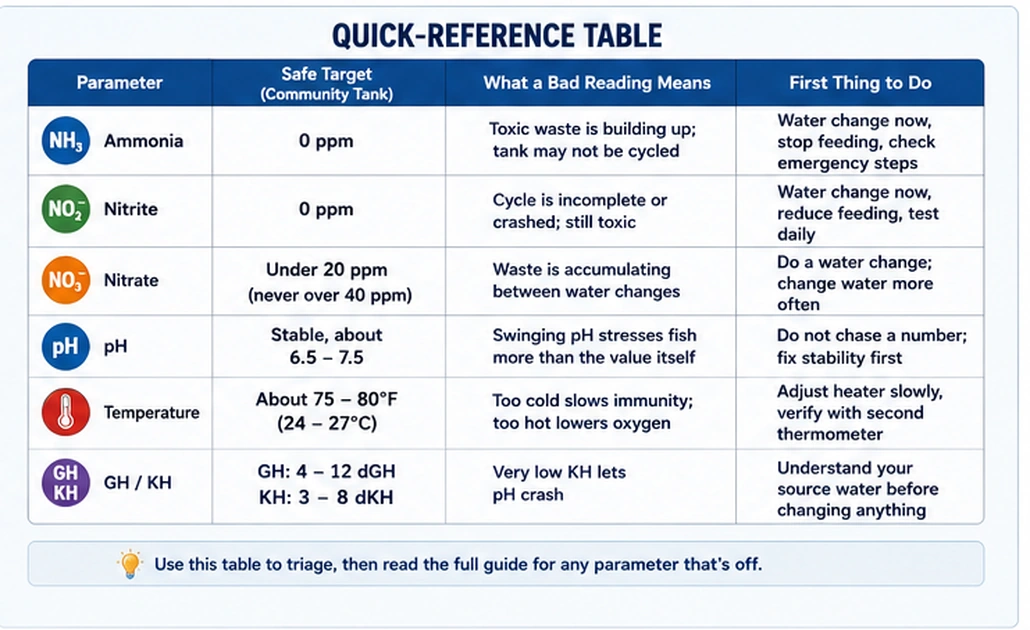
Quick-reference table
| Parameter | Safe target (community tank) | What a bad reading means | First thing to do |
|---|---|---|---|
| Ammonia | 0 ppm | Toxic waste is building up; tank may not be cycled | Water change now, stop feeding, check the emergency steps |
| Nitrite | 0 ppm | Cycle is incomplete or crashed; still toxic | Water change now, reduce feeding, keep testing daily |
| Nitrate | Under 20 ppm ideal, 40 ppm the commonly cited ceiling | Waste is accumulating between water changes | Do a water change; change water more often |
| pH | Stable, about 6.5 to 7.5 | Swinging pH stresses fish more than the value itself | Do not chase a number; fix stability first |
| Temperature | About 75 to 80°F for tropical | Too cold slows the immune system; too hot lowers oxygen | Adjust the heater slowly, verify with a second thermometer |
| GH / KH | GH 4 to 12 dGH, KH 3 to 8 dKH | Very low KH lets pH crash | Understand your source water before changing anything |
Use the table to triage, then read the section for whatever reading looks off.
Ammonia and nitrite: should always read zero
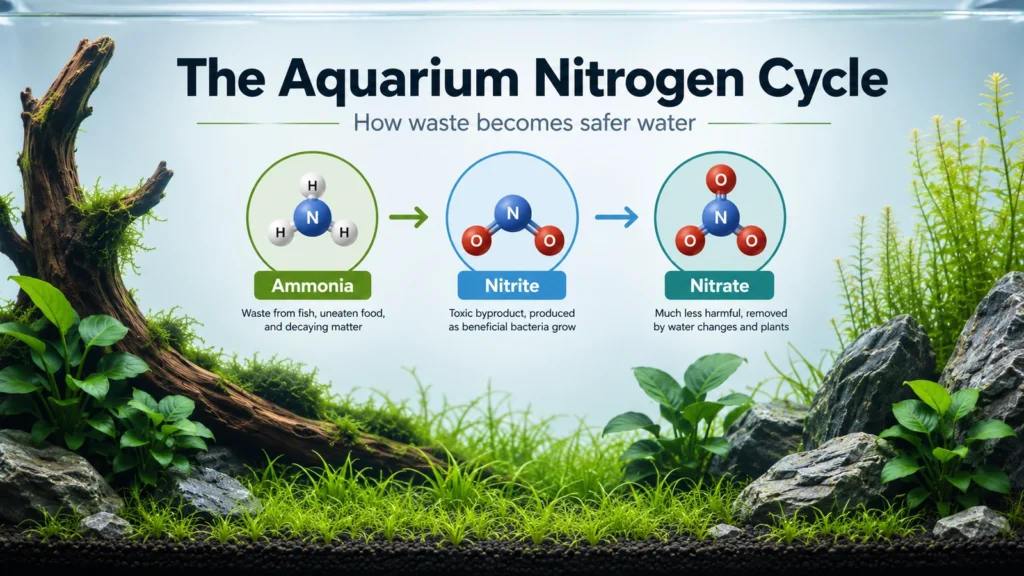
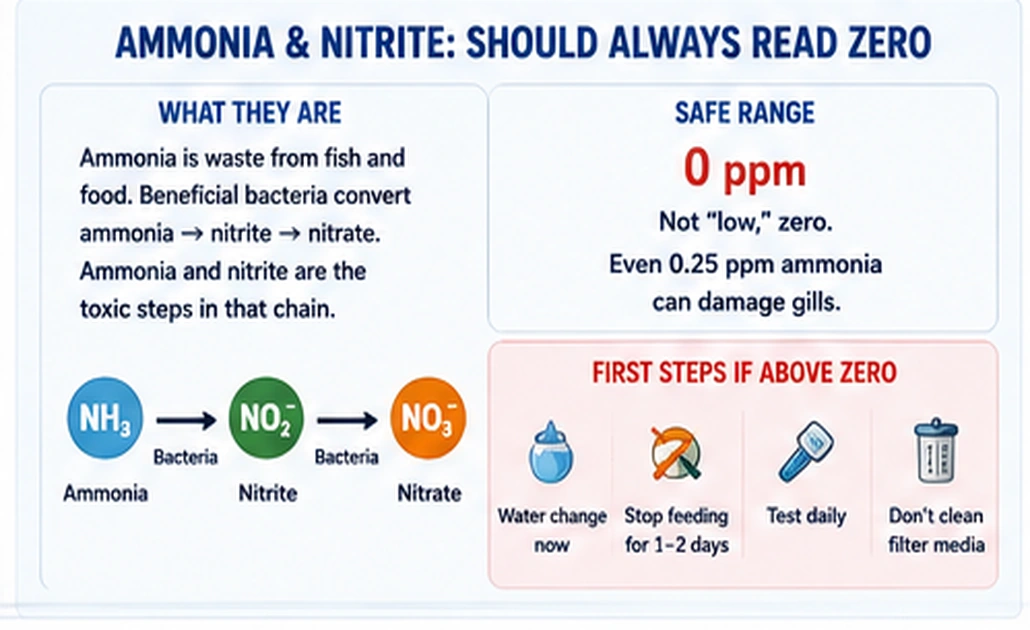
What they are. Ammonia is the waste your fish and leftover food produce. In a healthy, "cycled" tank, beneficial bacteria convert ammonia into nitrite, then convert nitrite into nitrate. Ammonia and nitrite are the two toxic steps in that chain.
Safe range. Zero. Not "low," zero. There is no single ppm figure at which ammonia turns harmful, because only the un-ionised form is toxic and how much of your total reading sits in that form climbs sharply with pH and, less steeply, with temperature. The same 0.25 ppm on your kit is a much heavier dose at pH 8.2 than at pH 6.8, which is why hobby charts quoting one universal danger number disagree with each other. Treat any reading above zero as something to act on rather than something to look up. Nitrite is just as dangerous because it stops fish from carrying oxygen in their blood.
Why it matters. This is the part competitors often bury in a chart. Any ammonia or nitrite above zero is not a "watch it" situation, it is an emergency happening right now. Fish gasping at the surface, clamped fins, or sudden lethargy often trace back to one of these two numbers. The most common cause is a tank that was stocked before it finished cycling, which is exactly why cycling comes first. If you have not done that yet, read how to cycle a new aquarium before adding fish.
How to test and fix. Test with a liquid kit if you can (more on why below). If either reads above zero with fish in the tank: do a partial water change with dechlorinated, temperature-matched water to dilute the toxin, stop feeding for a day or two so less waste is produced, and test again daily. Do not add more fish, and do not "clean" your filter media, since that is where your beneficial bacteria live. If a reading is dangerously high right now, follow the step-by-step aquarium emergency help page. I do not give medication dosing here on purpose; a sick fish is a job for a vet, not a guessed dose.
Nitrate: the one you manage, not eliminate
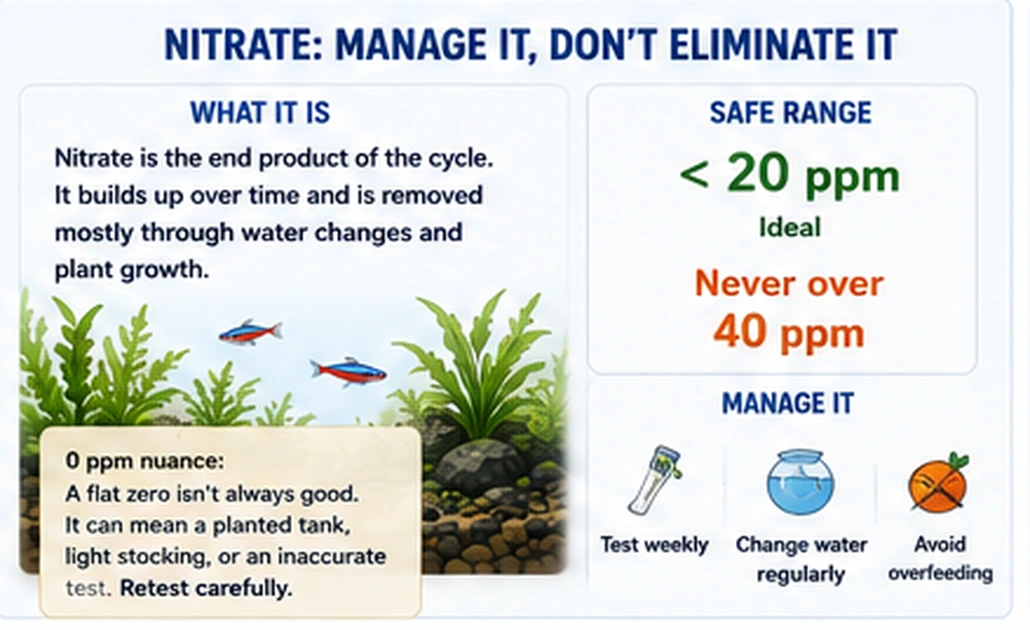
What it is. Nitrate is the end product of the cycle. Your bacteria cannot break it down further, so it accumulates until you remove it, mainly through water changes and, in planted tanks, through plant growth.
Safe range. Keep it low. Under 20 ppm is a good target for a community tank, and you generally want to stay under 40 ppm. Unlike ammonia and nitrite, a small amount of nitrate is normal and expected in any running tank.
Why it matters. Chronically high nitrate stresses fish, slows growth, and fuels nuisance algae. Rising nitrate between water changes is also a useful signal: it tells you how fast waste is building, which helps you set your water-change schedule. If your nitrate climbs quickly, see how often to change aquarium water to dial in a routine.
The 0 ppm nuance most guides skip. A nitrate reading of exactly zero is not automatically good news, and this trips up a lot of beginners. In a healthy stocked tank, some nitrate should be present. A flat zero can mean one of three things: a heavily planted tank where fast-growing plants are consuming nitrate as fertilizer (usually fine), a tank that is barely stocked, or, most commonly for beginners, a test that is not reading correctly. Nitrate liquid tests in particular need vigorous shaking of the second reagent bottle or they under-read. If you see zero and your tank is stocked and unplanted, retest carefully before you trust it.
How to test and fix. Test weekly. To lower nitrate, do a partial water change; to keep it low, change water on a schedule and avoid overfeeding, which is the number one hidden source of waste.
pH, GH, and KH: why stability beats hitting an "ideal" number
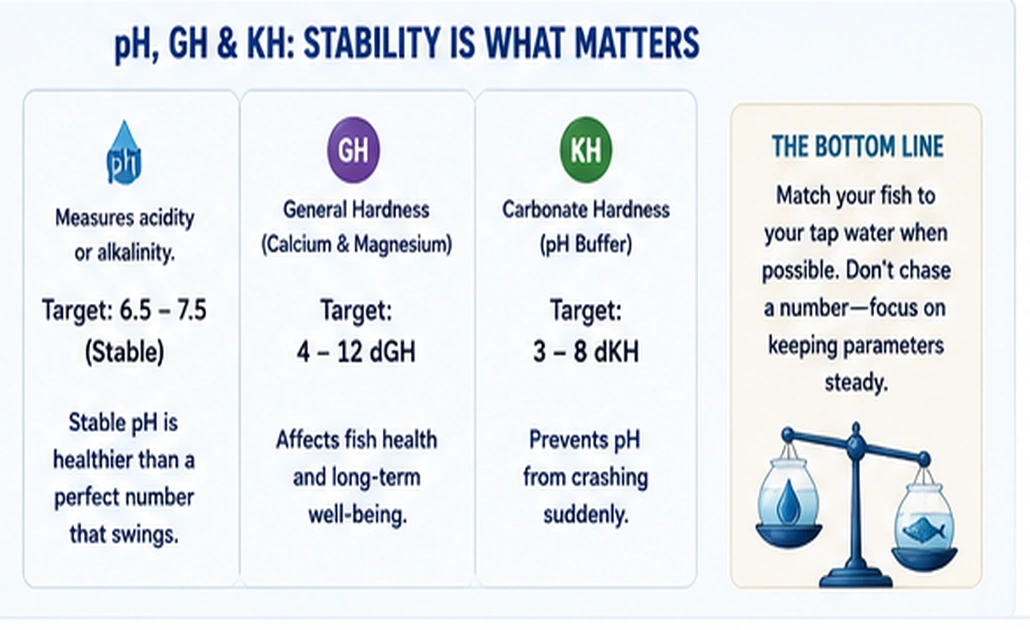
What they are. pH measures how acidic or basic your water is. GH (general hardness) measures dissolved minerals like calcium and magnesium. KH (carbonate hardness) measures the water's ability to resist pH swings, so it acts like a buffer.
Safe ranges. For a general community tank, pH around 6.5 to 7.5 works well, GH of roughly 4 to 12 dGH, and KH of about 3 to 8 dKH. Species vary: soft-water fish such as many tetras prefer lower pH and hardness, while African cichlids want harder, more alkaline water. There is no single number that is correct for every tank.
Why stability matters more. This is the honest part. Most fish adapt to a pH that sits slightly outside the "ideal" range as long as it is steady. What they do not tolerate is a pH that swings up and down. That is where KH earns its keep: a very low KH lets pH crash suddenly, which is far more dangerous than a stable pH that happens to read 7.8 instead of 7.0. Chasing a "perfect" pH with chemical adjusters usually causes the exact swings you are trying to avoid. For most beginners, the better move is to match your fish to your tap water rather than fight your water chemistry every week.
How to test and fix. Know your source water first: test your tap water's pH, GH, and KH so you understand your starting point. If pH is stable, leave it alone even if it is not "textbook." If pH is crashing, look at KH before reaching for any product, and change water consistently with a source of matched parameters.
Temperature: match it to your fish, keep it steady
Temperature is a water parameter too, and an unstable one causes as much harm as a bad chemical reading. Too cold and a fish's immune system slows down; too warm and the water holds less oxygen.
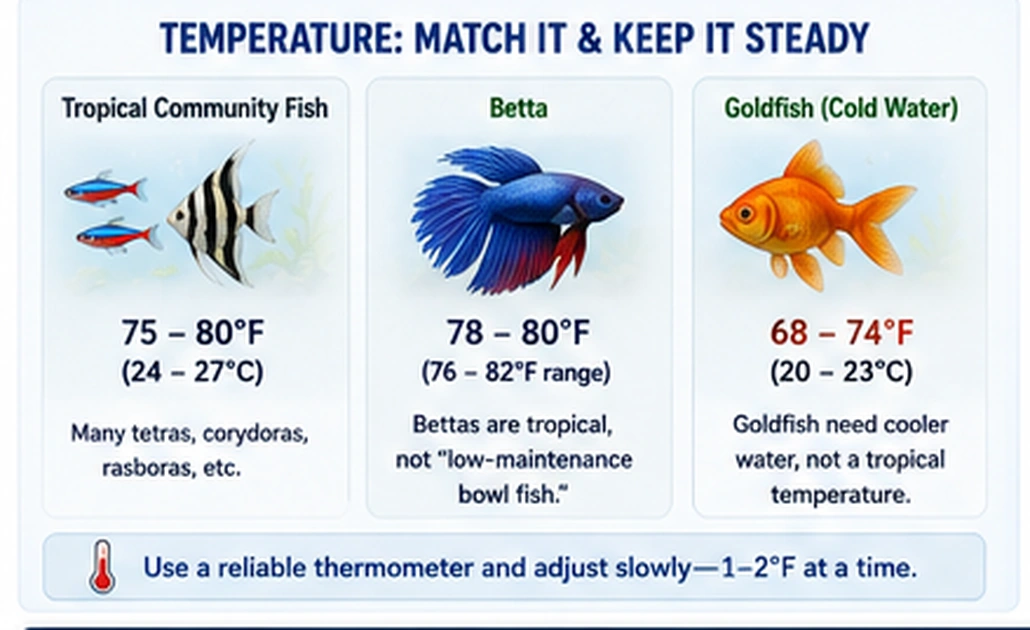
- General tropical community (many tetras, corydoras, rasboras): about 75 to 80°F (24 to 27°C).
- Betta: ideal around 78 to 80°F, with a workable range of 76 to 82°F. Bettas are tropical and are not "low-maintenance bowl fish" that can live at room temperature.
- Goldfish: these are cold-water fish, not tropical. They do best around 68 to 74°F and should not share a heated tropical tank, since the temperature needs conflict.
How to test and fix. Use a reliable thermometer, and verify a new heater with a second thermometer for the first week. Adjust temperature slowly, a degree or two at a time, rather than in big jumps.
A simple testing schedule: new tanks vs. established tanks
You do not need to test daily forever. Match your effort to the stage your tank is in.
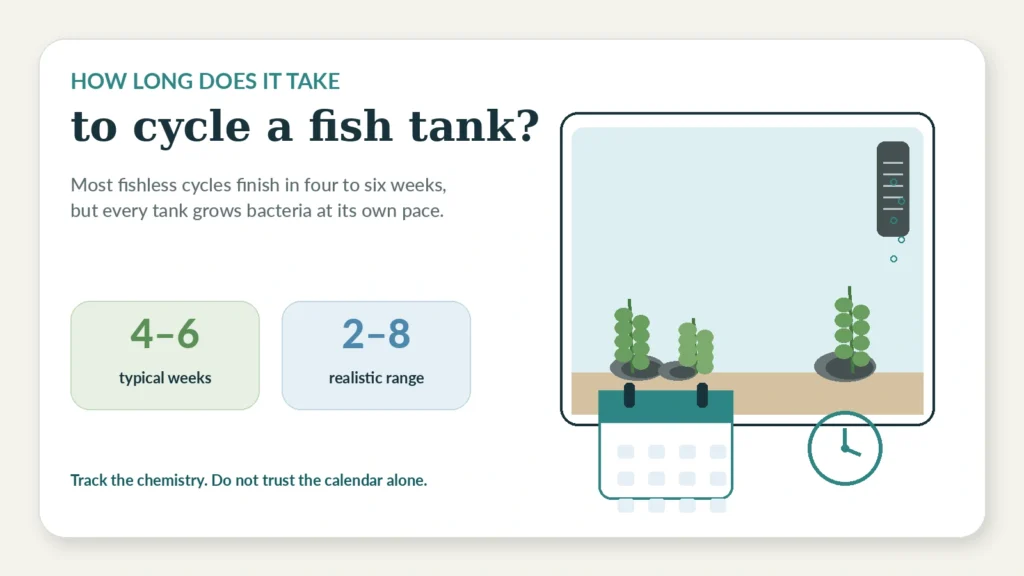
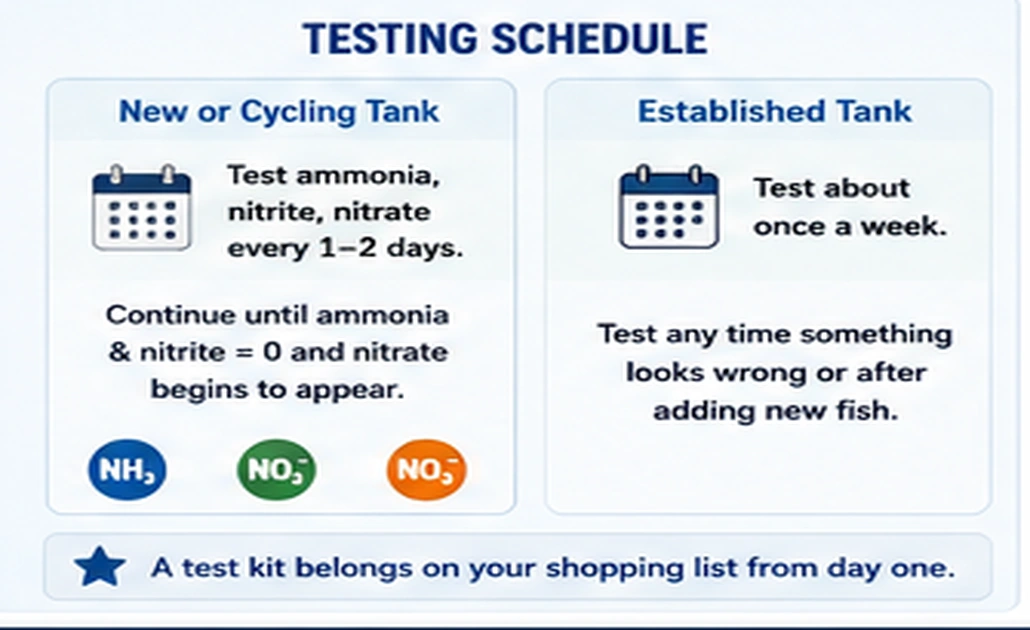
- New or cycling tank: test ammonia, nitrite, and nitrate every day or two until ammonia and nitrite hold at zero and nitrate begins to appear. That pattern is how you know the cycle is finished.
- Established, stable tank: test roughly once a week, plus any time something looks wrong (fish gasping, cloudy water, a new fish added, or after treating illness).
A test kit belongs on your shopping list from day one, right alongside the heater and filter. If you are still gathering gear, the first aquarium setup checklist covers what to buy before the fish arrive.
Test strips vs. liquid kits: an honest word on accuracy
Most reference pages tell you to "test regularly" without telling you that your testing tool changes what you can trust. Here is the honest version.
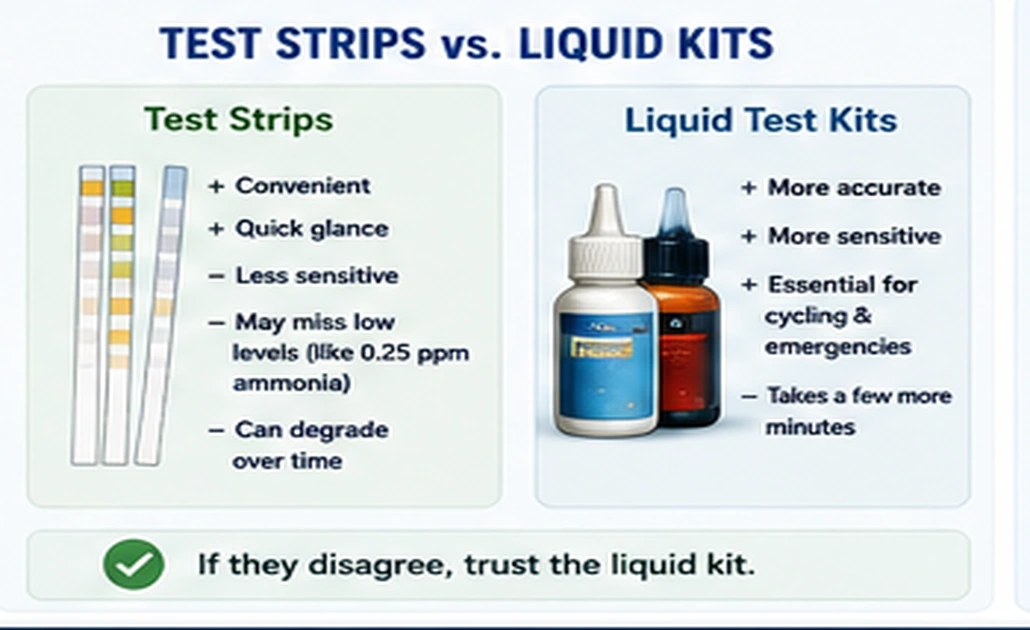
Test strips are convenient and fine for a quick weekly glance in a stable tank. But they are less sensitive than liquid reagent kits, especially for ammonia. Strips tend to catch clearly dangerous levels while missing the low-but-still-harmful readings, such as 0.25 ppm ammonia, that a liquid kit will show. Many multi-parameter strips do not test ammonia at all. Strips also degrade if the bottle is left open or stored somewhere humid, which makes them read wrong.
The practical rule: when the numbers really matter, such as during the first weeks of cycling or during any emergency, use a liquid kit. If a strip and a liquid kit ever disagree, trust the liquid kit.
A guide for each number
This page is the router. When you have one reading in your hand and want the full answer for it, go straight to its own guide.
- Ammonia above zero: what it means and what comes first
- Nitrite above zero: why it is more urgent than a high nitrate
- Nitrate: the one you manage, not the one you eliminate
- A nitrate reading of zero is not automatically good news
- Liquid test kit vs test strips: which reading can you actually trust?
- pH in a freshwater tank: stability beats chasing a number
- GH and KH without the chemistry lecture
- Aquarium temperature: why "tropical" is not one number
- How often should you test your water?
- Why two test kits disagree, and which one to believe
FAQ
What are the ideal water parameters for a freshwater aquarium?
For a general community tank: ammonia 0 ppm, nitrite 0 ppm, nitrate under 20 ppm (never over 40 ppm), pH stable around 6.5 to 7.5, temperature about 75 to 80°F for tropical fish, GH 4 to 12 dGH, and KH 3 to 8 dKH. Your specific species may prefer a narrower range.
Why is my ammonia not zero?
The most common reason is a tank that is not fully cycled, meaning the beneficial bacteria have not built up enough to process waste. Overfeeding, overstocking, or a disturbed filter can also cause it. Any ammonia above zero with fish present needs a water change right away.
Is a nitrate reading of 0 ppm good?
Not always. In a stocked, unplanted tank some nitrate should be present. A flat zero can mean a heavily planted tank consuming it, a very lightly stocked tank, or, most often, a test that is not reading correctly. Retest carefully before trusting a zero.
Are aquarium test strips accurate?
They are convenient but less sensitive than liquid kits, especially for ammonia, and they degrade with poor storage. Use them for quick checks in a stable tank, and use a liquid kit when it matters most, such as during cycling or an emergency.
Should I adjust my pH to a "perfect" number?
Usually no. A stable pH slightly outside the ideal range is healthier than one that swings while you try to correct it. Match your fish to your tap water where you can, and focus on keeping pH steady rather than exact.