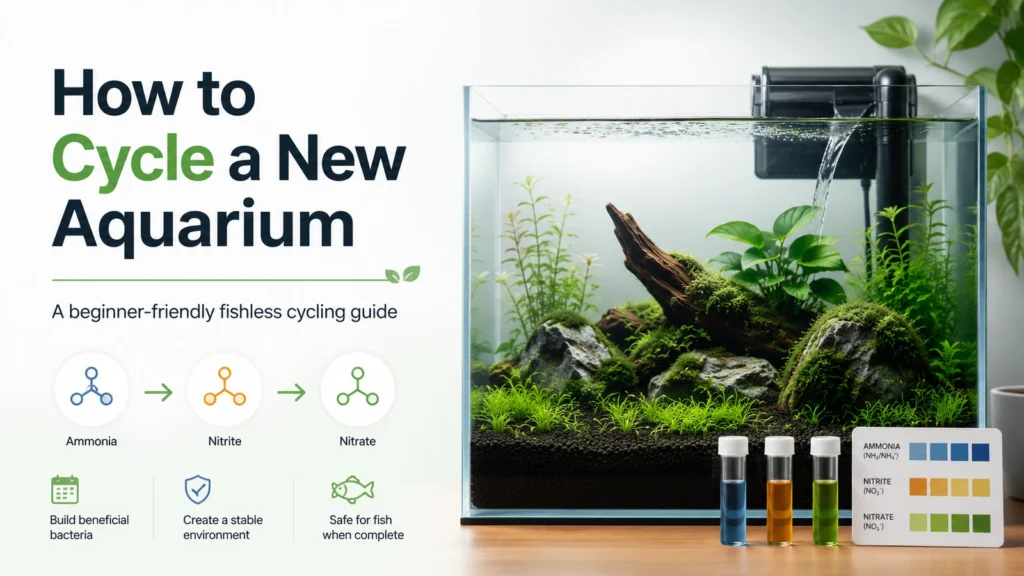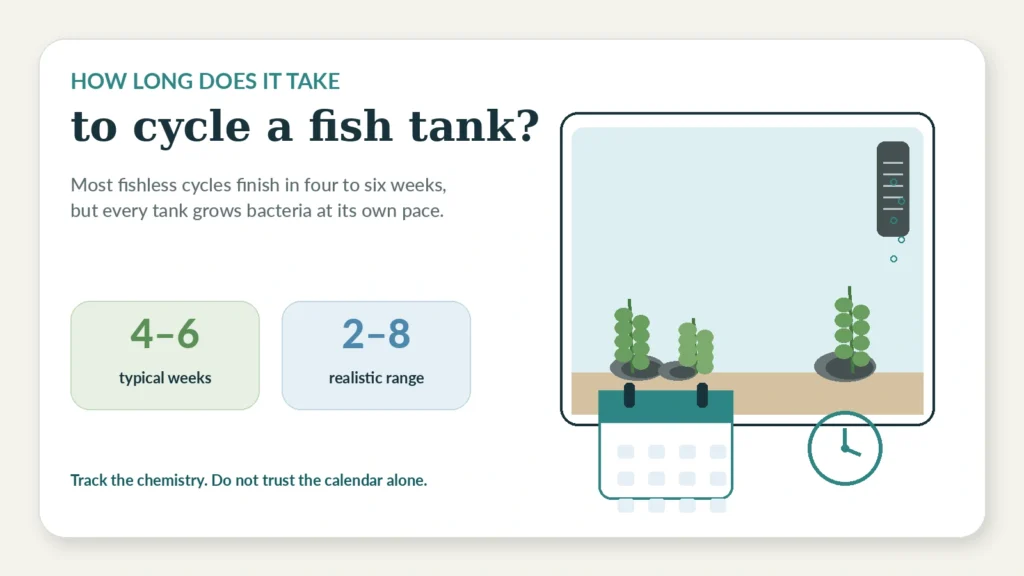
There is no single answer, because a tank that is cycling, a tank stocked last month and a tank running for two years carry three different levels of risk. While cycling, test daily or close to it. In the first couple of months with fish, test weekly. In a mature, stable tank, published guidance ranges from weekly to monthly, and the more useful habit at that stage is testing when something happens rather than when the calendar says. Splitting the job by parameter is what makes any of these sustainable.
The Direct Answer: Three Schedules, Not One
| Situation | Frequency | What you are watching for |
|---|---|---|
| Cycling, no fish | Daily or near it | The ammonia and nitrite curve, so you know where you are |
| Cycling with fish, or newly stocked | Daily to every other day, then weekly | Any ammonia or nitrite at all, because fish are exposed |
| First two months, stocked | Weekly | The tank settling, and mini-cycles after additions |
| Established and stable | Weekly to monthly, plus event-driven | Nitrate trend, and early warning of change |

The disagreement between sources is real. Some publish weekly for established tanks, others monthly or before each water change. Both are defensible, because the right frequency depends on how heavily stocked the tank is and how stable it has proven to be. What follows is how to place yourself.
While the Tank Is Cycling: Daily or Near It
During cycling, testing is not monitoring. It is the only way to see the process at all, because nothing visible happens in the tank while it is going on.
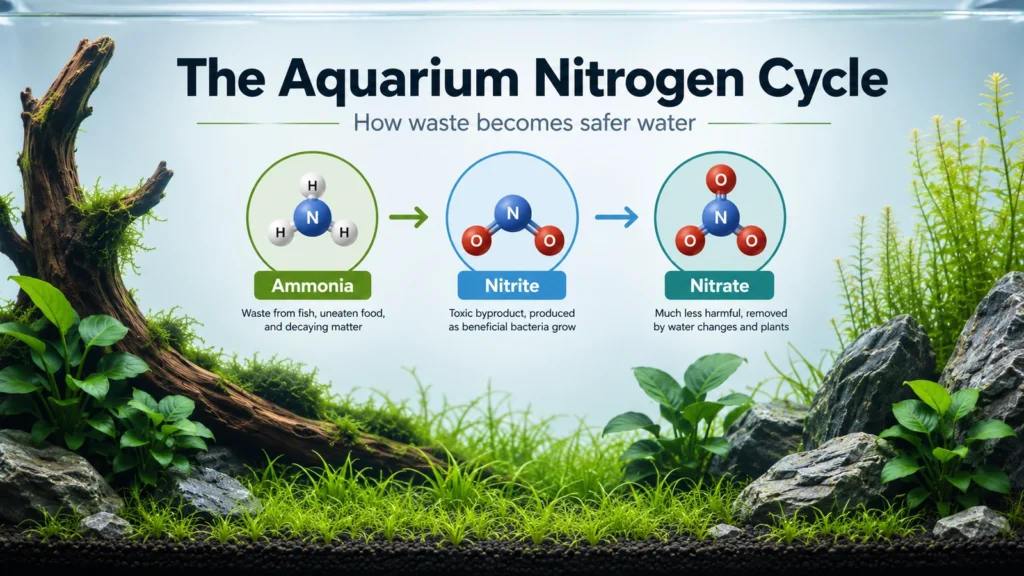
Daily testing tells you which stage you are in: ammonia climbing, ammonia falling as nitrite appears, nitrite falling as nitrate appears. Without that sequence you cannot tell a tank that is progressing from one that has stalled, and you cannot tell either from a tank where nothing ever started. How to cycle a new aquarium covers the sequence and the completion test.
Ammonia and nitrite are the two you need daily here. Nitrate every few days is enough, since its job is to confirm the chain is finishing.

A New Tank With Fish In It: The First Two Months
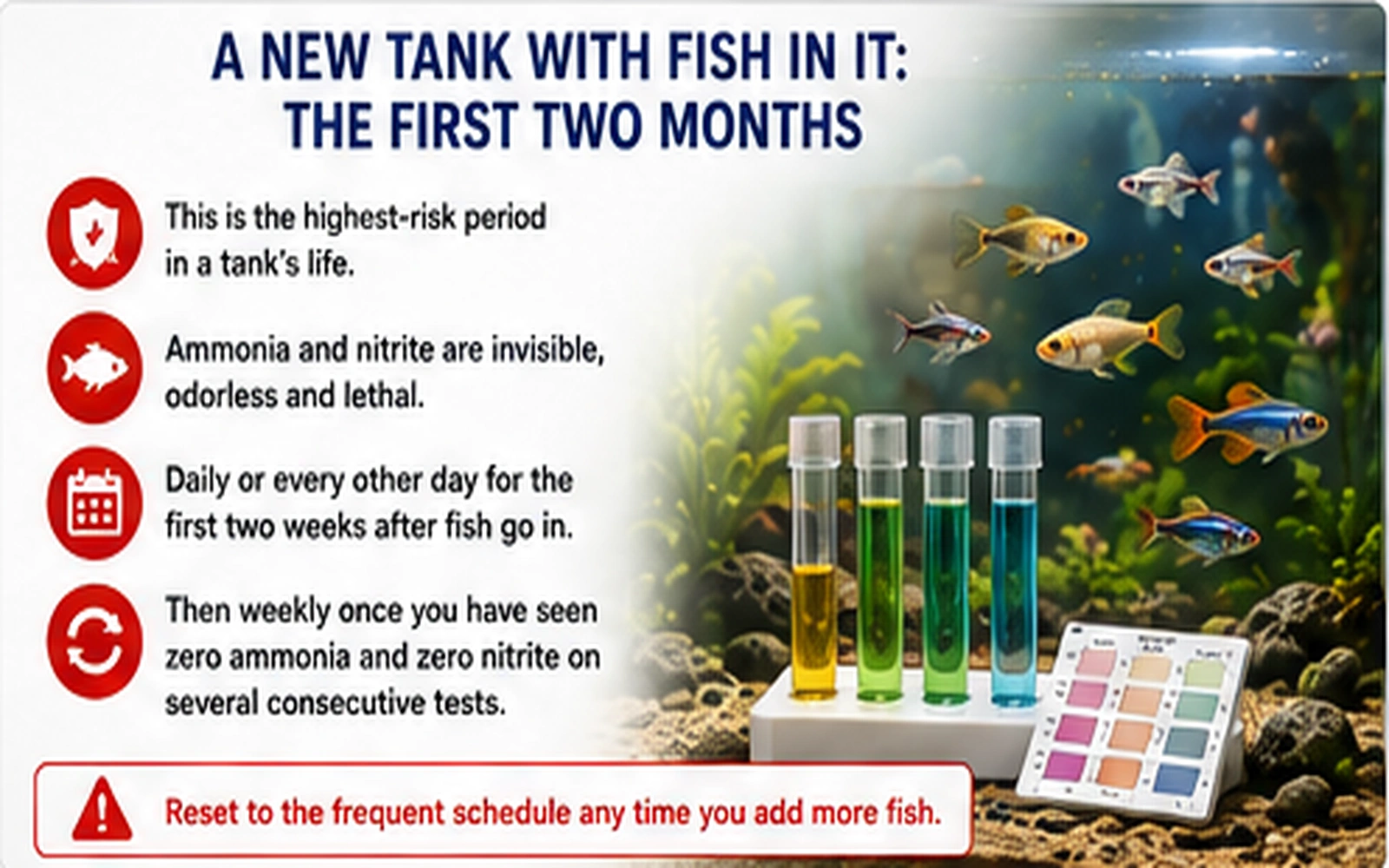
This is the highest-risk period in a tank's life, and the one where testing frequency genuinely saves fish.
Aqueon's guidance for the first 60 days and the common advice to test daily for the first weeks both target the same thing: new tank syndrome, where fish are lost in water that looks completely clean. Ammonia and nitrite are invisible, odorless and lethal, and by the time behavior changes the exposure has already happened. New tank syndrome covers what that looks like.
A workable pattern: daily or every other day for the first two weeks after fish go in, then weekly once you have seen zero ammonia and zero nitrite on several consecutive tests. Reset to the frequent schedule any time you add more fish, because each addition is a step change in waste production that the bacterial colony has to grow to meet.
An Established Tank: Weekly, and Less Than You Think
Once a tank has been stable for months, the value of routine testing changes. You are no longer watching a process; you are watching for a deviation.
A weekly test paired with your water change is the easy habit, and pairing them matters: you are already at the tank with a bucket, so the marginal effort is a few minutes. How often to change aquarium water covers setting that schedule, and the nitrate reading is what actually sets it. If nitrate is comfortably controlled by your current routine, the routine is right. If it climbs faster than the change removes it, either the change or the input needs adjusting, which aquarium nitrate levels covers.
Monthly is defensible for a lightly stocked, long-stable, planted tank whose keeper knows it well. It is not defensible for a heavily stocked tank, or one whose owner has not yet learned what normal looks like.

Which Parameters Need Which Frequency
Testing everything every time is why people stop testing. Most kits contain tests that measure things which barely move.
| Parameter | How often | Why |
|---|---|---|
| Temperature | Every time you look at the tank | No kit needed, and a failed heater moves fastest of anything |
| Ammonia | Daily while cycling or newly stocked, weekly in an established tank | Acutely harmful, invisible, and the first sign of most failures |
| Nitrite | Same as ammonia | The other half of the safety pair |
| Nitrate | Weekly to fortnightly | A trend rather than an alarm; it sets your maintenance schedule |
| pH | Monthly, or when something changes | Stable in most tanks; the swing matters, not the value |
| GH and KH | Once at setup, then rarely | Close to one-time information, unless pH is unstable or you keep invertebrates |

That reduces a weekly test to ammonia, nitrite and nitrate, which is three tests, not seven. GH and KH explained covers why those two are the ones you can safely set aside, and aquarium water parameters covers what each result means.
Test When Something Happens, Not Just When the Calendar Says
In a mature tank this is worth more than any schedule, because problems arrive on their own timetable. Test when:
- You add fish, and again a few days later.
- You clean or change filter media, which is the classic trigger for a mini-cycle.
- The power has been out for more than a short while, or a filter has stopped and restarted.
- Anything has been added to the water, including medication.
- The weather turned hot, or the room got cold.
- A fish died, or something is missing and you have not found it.
- Any fish behaves oddly: hanging at the surface, sitting on the bottom, refusing food, clamped fins. Test first, because water quality is both the most common cause and the fastest to check. If fish are in acute distress, work through something is wrong with my tank rather than waiting on results.

A keeper who tests on triggers and monthly otherwise is better protected than one who tests every Sunday and never in between.
Making It a Routine You Will Actually Keep
An over-ambitious schedule produces no data, because it gets abandoned. A few things that make the habit survive:
- Attach it to something you already do. Testing while the water change bucket fills costs almost nothing extra.
- Test at the same time of day. pH in particular varies over a lit day, so comparable readings need comparable timing.
- Write the numbers down. Trends carry the information; single readings mostly do not, and nobody remembers last month's nitrate accurately.
- Watch the reagents. Liquid reagents are commonly described as good for about a year after opening, strips for around six months, and expired reagents produce plausible wrong answers rather than obvious ones.
- Test the same way every time, so that differences mean something. Why two test kits disagree covers what to do when they do not.

FAQ
How often should I test my aquarium water? Daily or near it while cycling, daily to weekly for the first couple of months with fish, and weekly to monthly once the tank is established and stable, plus a test whenever something changes.
Do I need to test everything every time? No. Ammonia, nitrite and nitrate carry the routine. pH is periodic, GH and KH are close to one-time, and temperature is a glance rather than a test.
How often should an established tank be tested? Published guidance ranges from weekly to monthly, and both are defensible depending on stocking and how stable the tank has proven. Pairing a test with your water change is the habit most people can sustain.
When should I test outside my normal schedule? After adding fish, after cleaning or replacing filter media, after a power cut, after adding anything to the water, during hot or cold spells, after a death, and whenever a fish behaves abnormally.
Is testing daily excessive for a normal tank? In a mature, stable tank, generally yes, and a schedule nobody keeps is worse than a modest one that survives. While cycling or in the first weeks with fish, daily testing is the point rather than excessive.