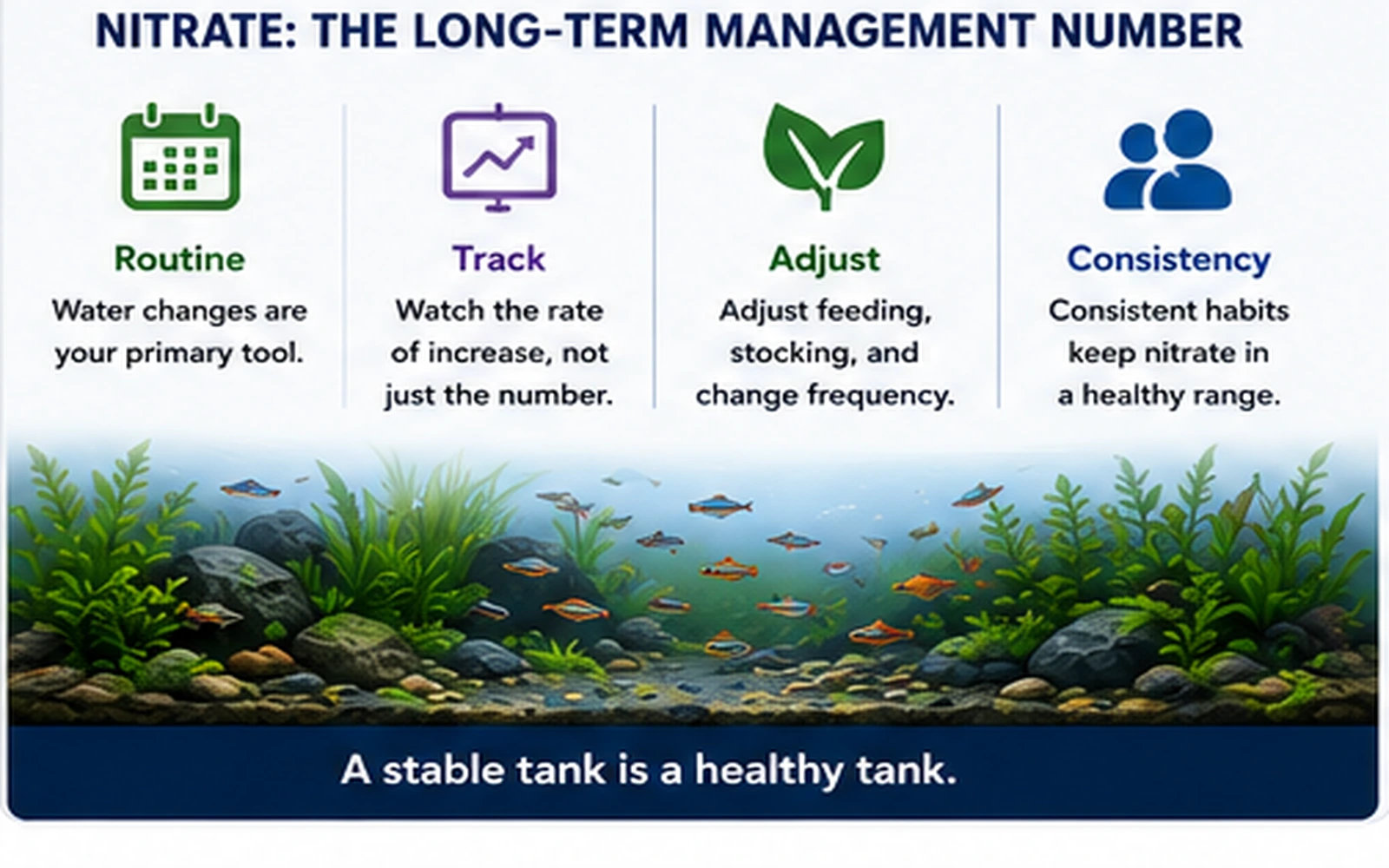
Nitrate is the end product of a working aquarium, so its presence is a sign the tank is doing its job rather than failing at it. Unlike ammonia and nitrite, which should read zero, nitrate is expected to accumulate between water changes and is removed by those water changes. What matters is keeping it from climbing and staying high, not driving it to zero. And the reading that tells you the most is not the number itself but how fast it rises between one water change and the next.
The Direct Answer: A Number You Manage, Not One You Zero Out
Most people arrive at this question having just learned the ammonia and nitrite rule, which is simple: zero, always, no exceptions. Applying that same rule to nitrate is the natural mistake and it leads to a lot of unnecessary worry and some genuinely counterproductive behavior.
Nitrate is different in kind. Ammonia and nitrite are acutely toxic at low concentrations, so they are emergencies. Nitrate is a chronic-exposure problem, which means the concern is about a tank that stays high for weeks or months rather than a reading on a Tuesday. That difference is why nitrate is the parameter your maintenance routine exists to control, and it is why how often to change aquarium water is effectively an article about nitrate.
For the contrast with the urgent one, see nitrite above zero.
Where Nitrate Comes From, in One Paragraph
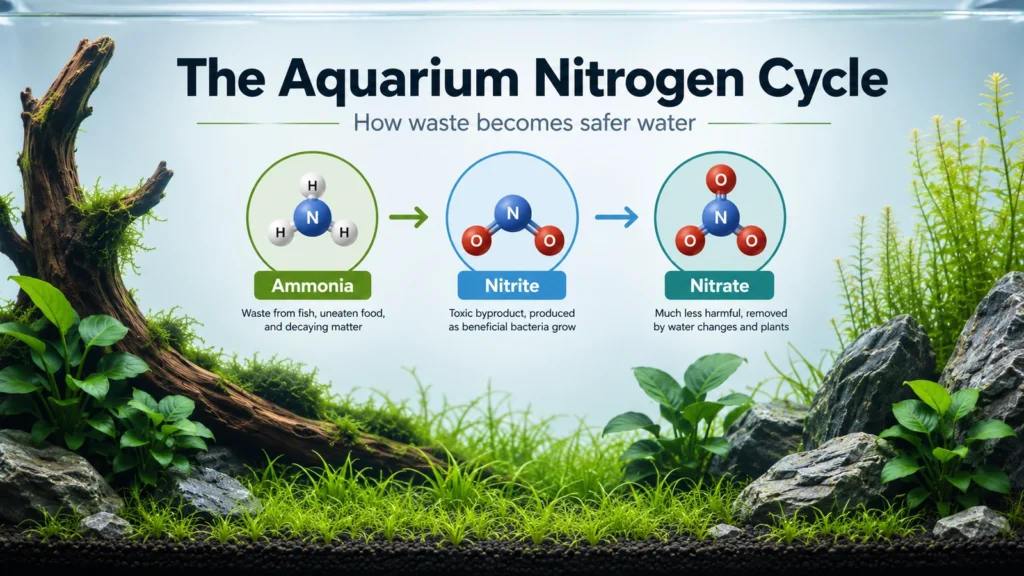
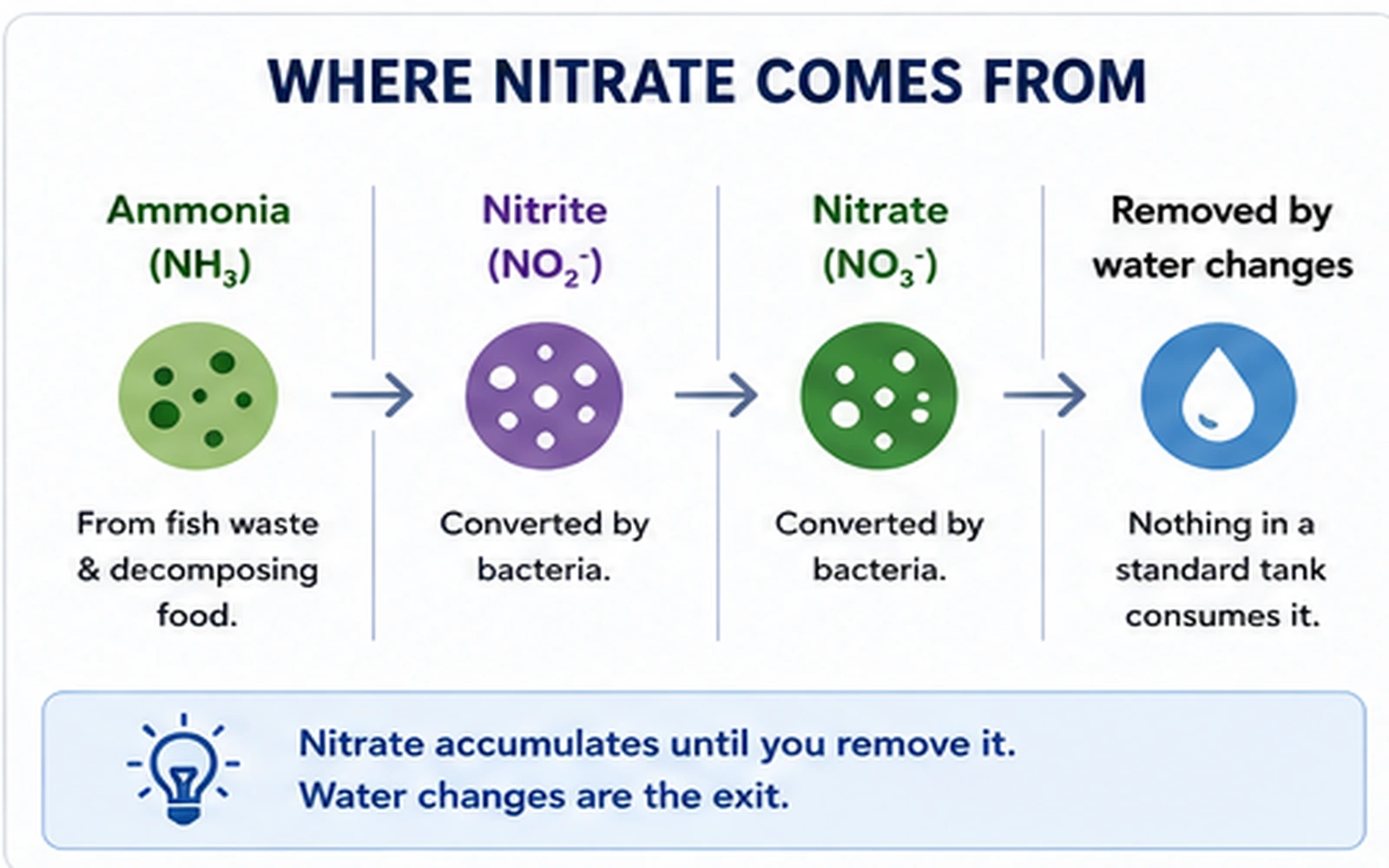
Fish waste and decomposing food release ammonia. One group of bacteria converts ammonia into nitrite. A second group converts nitrite into nitrate. Nothing in a standard freshwater aquarium consumes nitrate at any meaningful rate, so it accumulates until you remove it. The nitrogen cycle explained covers the full sequence. The short version, and the point of this article, is that nitrate is where the chain ends and water changes are the exit.
How High Is Too High? The Sources Disagree, and Here Is Why
You will find confident numbers everywhere, and they do not match. That is worth showing rather than hiding.
- TFH Magazine advises not letting nitrate build far above around 40 mg/L, and notes freshwater tanks sit at the higher end of the acceptable range compared with marine systems.
- Other freshwater-focused sources emphasize that most freshwater fish tolerate considerably more, with figures around 100 mg/L cited as survivable for short periods without obvious harm.
- Aquarium Science's treatment of safe levels is more permissive still for many freshwater fish than the numbers commonly repeated in the hobby.
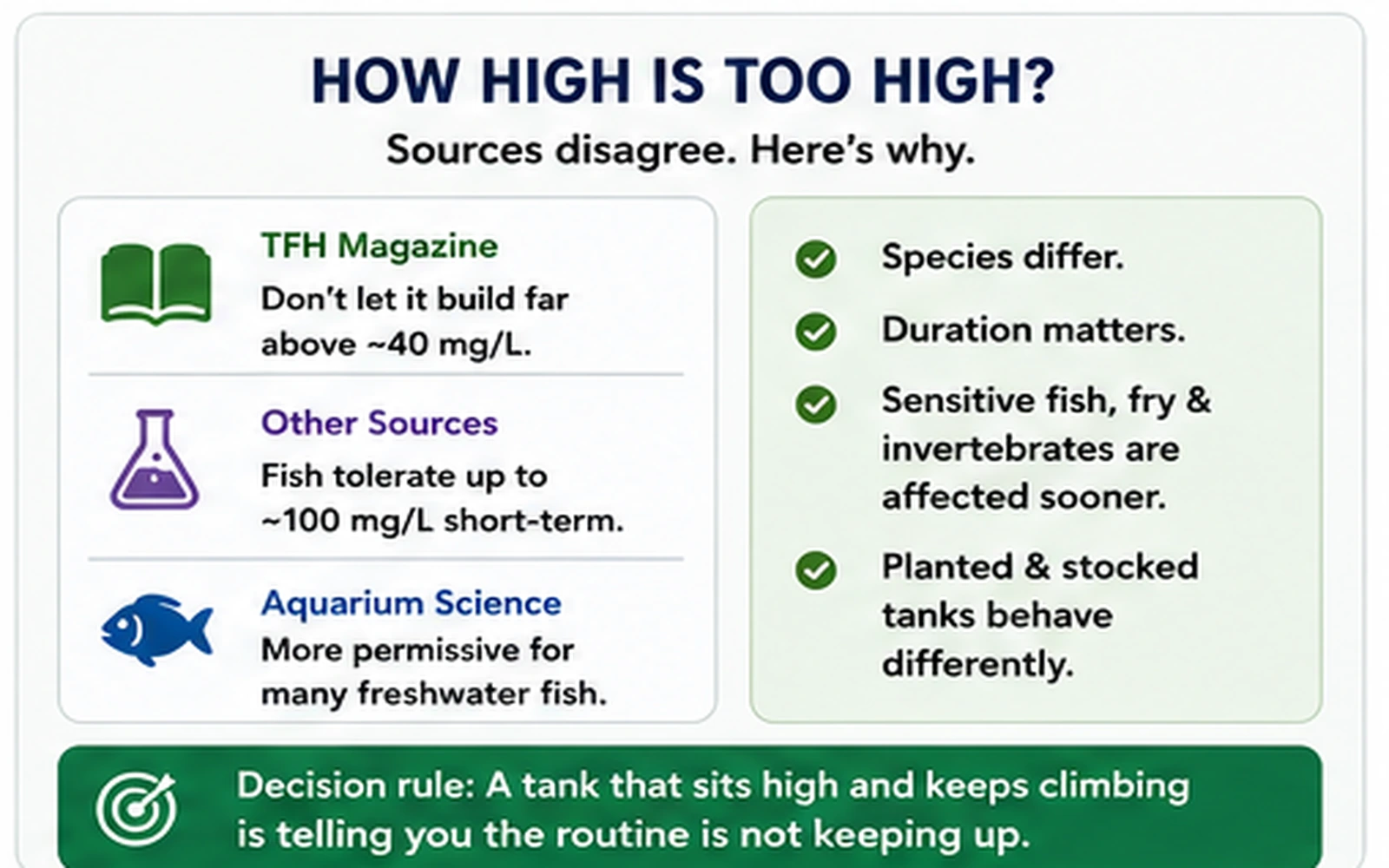
They are not all wrong. They are answering slightly different questions. A figure meant as a welfare target for long-term health is lower than a figure describing what fish survive. Species differ, and sensitive fish, fry and invertebrates are affected at lower concentrations than hardy adult community fish. Duration matters, since a week at a high reading is a different exposure from a year. Planted and heavily stocked tanks behave differently again.
The decision rule that survives the disagreement: a tank sitting persistently in the tens of mg/L and climbing is telling you the maintenance routine is not keeping up, regardless of whose ceiling you use. That is actionable. Picking one published number and treating it as a bright line is not.
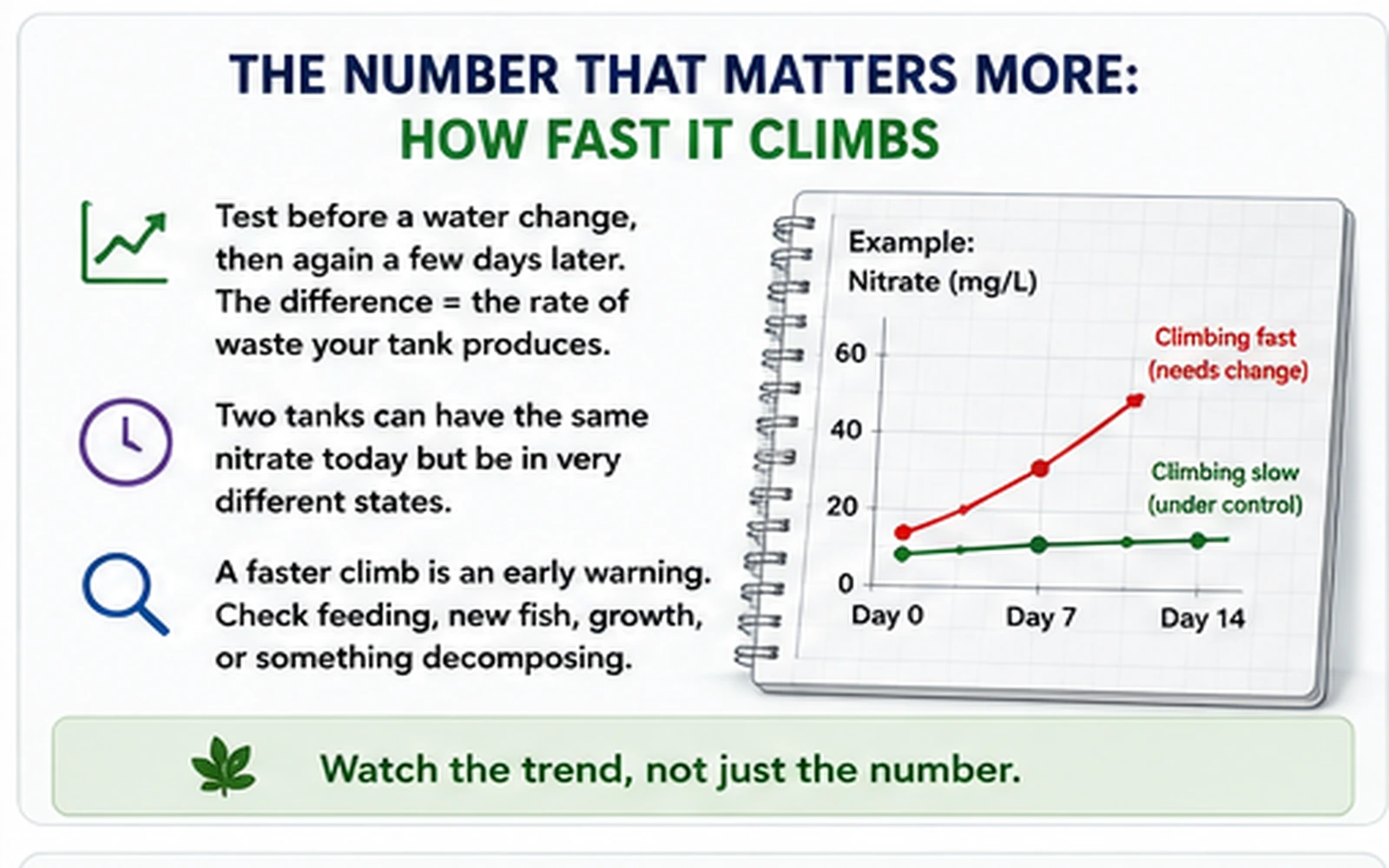
The Number That Matters More: How Fast It Climbs
Here is the reframe that makes this parameter useful instead of anxiety-producing.
Test right before a water change, and again a few days later. The difference tells you how quickly your tank produces waste relative to its volume, and that is what actually sets your schedule. Two tanks reading the same number on the same day can be in completely different states: one climbing slowly and comfortably controlled by a fortnightly change, the other climbing fast and only briefly held down by an aggressive routine.
Watching the rate also gives you an early warning system for free. If the climb accelerates without anything else changing, something increased on the input side. The usual candidates are feeding, a new fish, a fish that has grown, or something decomposing out of sight. How much and how often to feed covers the most common of those.
What High Nitrate Actually Does
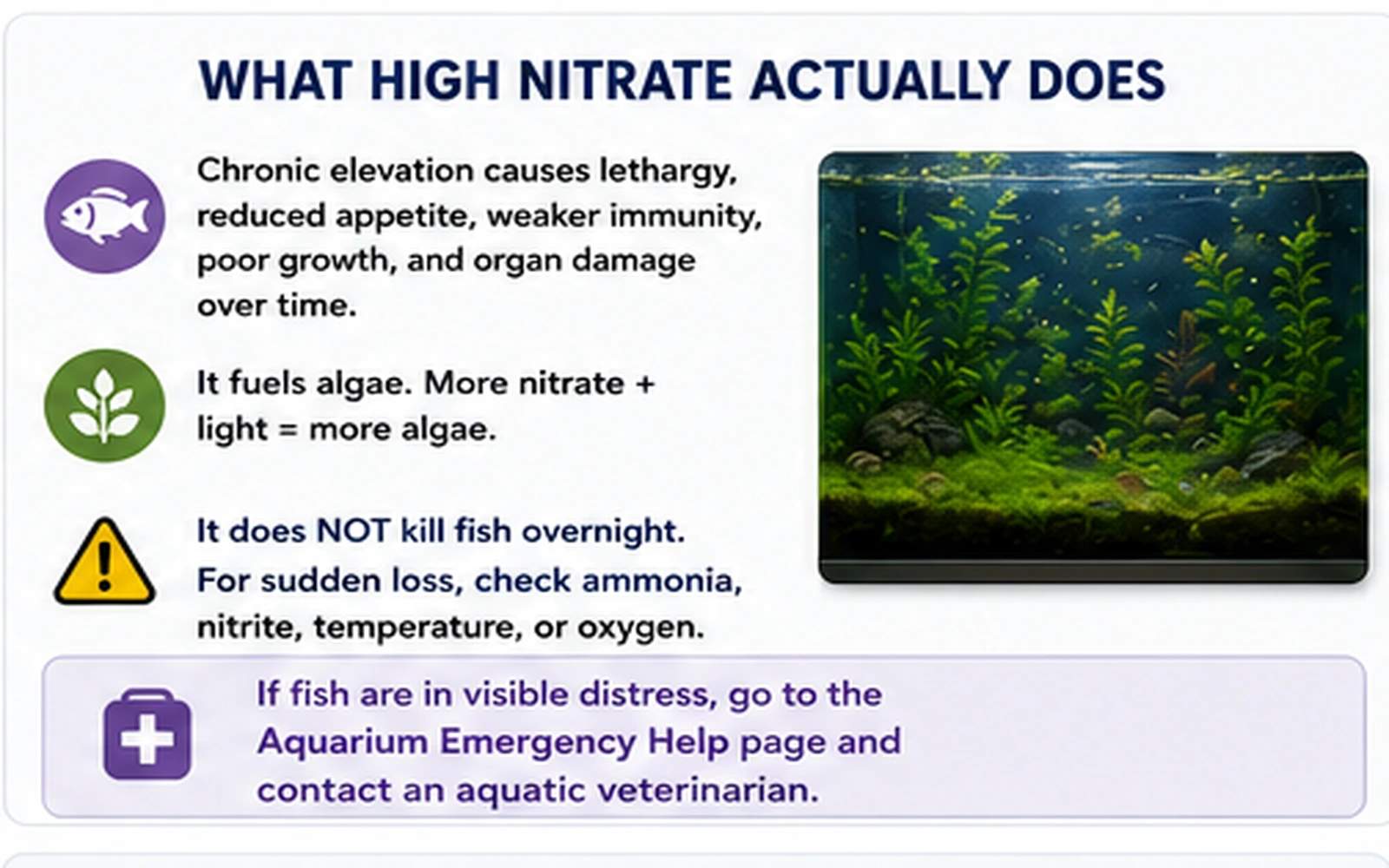
Chronic elevation is described in the literature and by aquarium sources as producing lethargy, reduced appetite, weakened immune response, poor growth in young fish, and, at sustained high concentrations, organ damage. Sensitive species, fry and invertebrates such as shrimp are affected at lower concentrations than hardy adult fish.
There is also a visible consequence that arrives sooner than any of that: nitrate is a nutrient, and a tank with plenty of it and plenty of light grows algae. Persistent algae in a tank whose lighting has not changed is often the first sign that nitrate has been high for a while.
What high nitrate does not do is kill fish overnight. If fish die suddenly, nitrate is unlikely to be the reason and ammonia, nitrite, temperature or oxygen are more likely places to look. Sudden loss with fish in visible distress is a job for the aquarium emergency help page and an aquatic veterinarian rather than a nitrate test.
Check Your Tap Water Before You Blame the Tank
This is the step that saves people weeks of pointless water changes, and it takes five minutes.
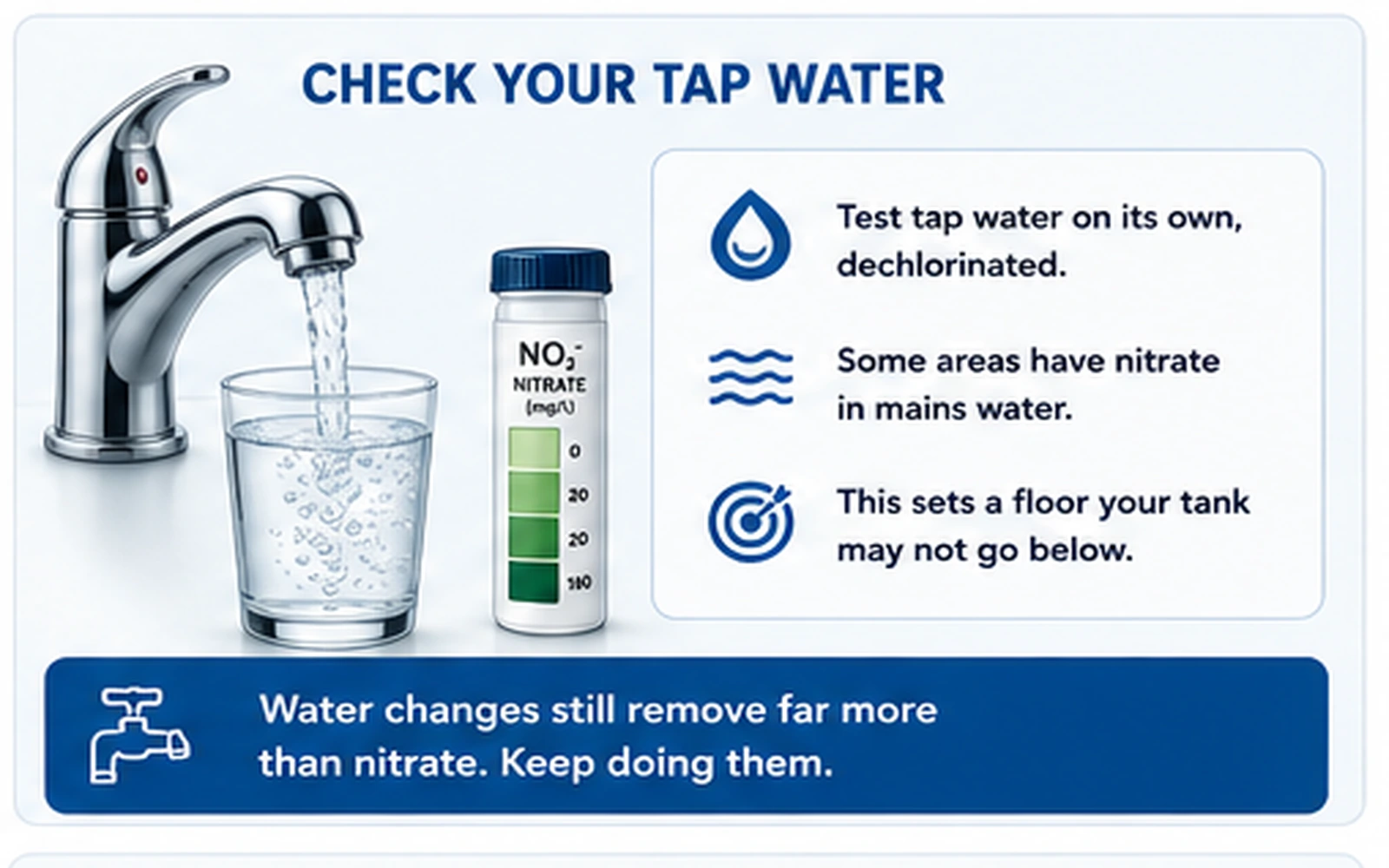
Test your tap water on its own, straight from the tap and dechlorinated as you would for the tank. In some areas, mains water carries measurable nitrate from agricultural runoff. If it does, then every water change you perform is partly refilling with what you are trying to remove, and there is a floor below which your tank simply cannot go by dilution.
That changes what "good" looks like for your tank, and it changes the strategy: reducing input and adding plant uptake matter more when dilution has a floor. It is not a reason to stop doing water changes, since they remove far more than nitrate.
How to Bring It Down, in Order of How Reliably It Works
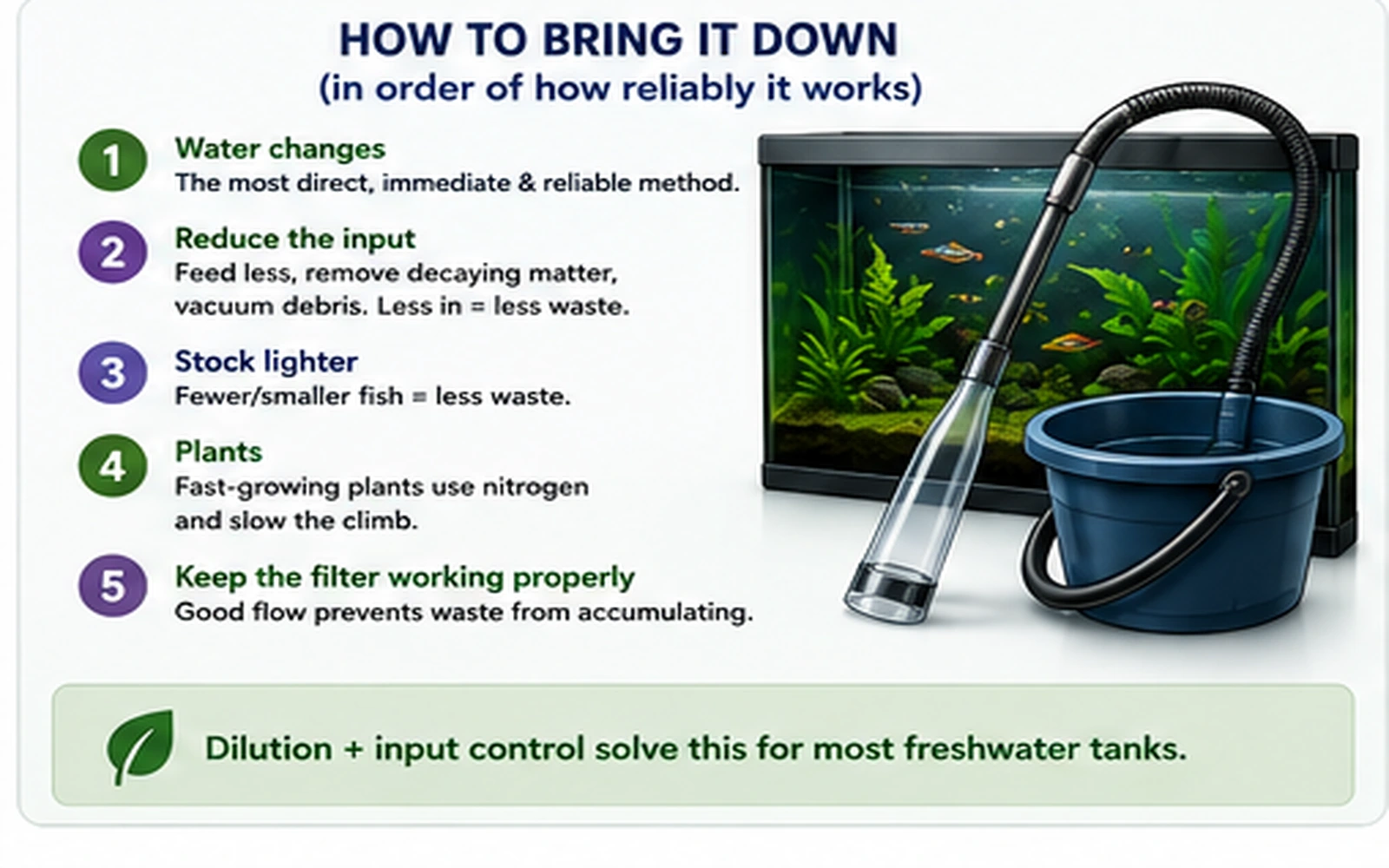
- Water changes. Dilution is the direct, immediate and reliable method, and it is what every source leads with. Partial changes with dechlorinated, temperature-matched water, done more often rather than more dramatically, avoid swinging the tank's chemistry. How to do a water change without stressing your fish covers the technique.
- Reduce the input. Feed less, or feed the same amount more carefully so less of it goes uneaten. Remove decaying plant matter. Clear the debris traps under decor, which gravel vacuuming covers.
- Stock lighter, or grow into the tank more slowly. Fewer or smaller fish produce less waste. This is the structural fix and the least popular one.
- Plants. Fast-growing plants take up nitrogen and can measurably slow the climb in a well-lit tank, which is why heavily planted tanks often read lower. Cycling a tank that already has live plants covers how plants participate in the nitrogen chain. Plants reduce the rate; they rarely replace water changes.
- Keep the filter working properly. A filter that is clogged or under-maintained is not a nitrate remover, but poor flow means more debris settling and decomposing where you cannot see it.
Notice what is not on this list: any product this site recommends by name. The monetization gate here is shut until the affiliate disclosure is live, and in any case dilution and input control solve this for the overwhelming majority of freshwater tanks.
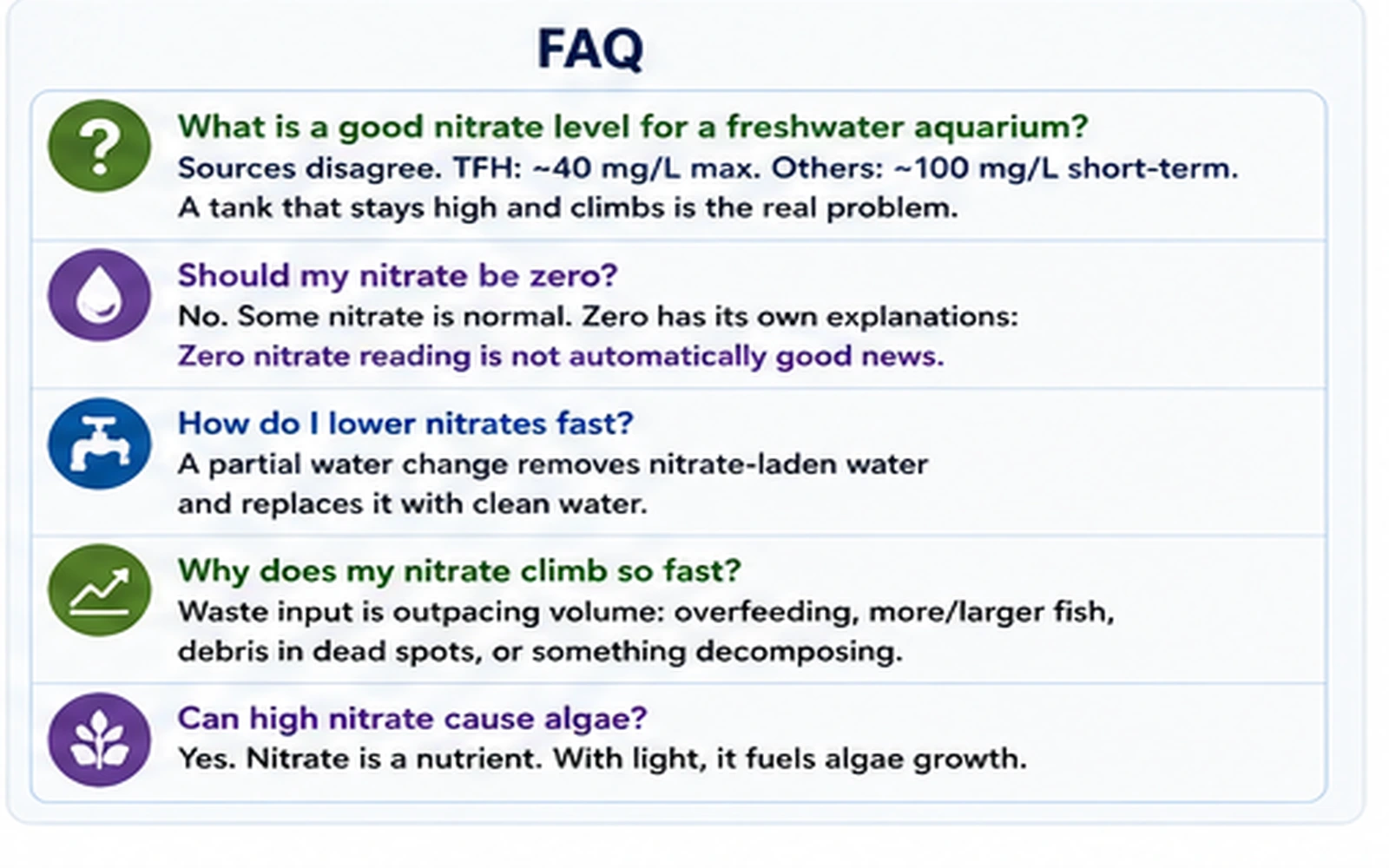
FAQ
What is a good nitrate level for a freshwater aquarium?
Published guidance genuinely disagrees. TFH Magazine suggests not letting it build far above around 40 mg/L, while other sources note freshwater fish tolerate considerably more for short periods. The practical rule that survives the disagreement: a tank that sits high and keeps climbing is telling you the routine is not keeping up.
Should my nitrate be zero?
No. In a normally stocked freshwater tank, some nitrate is the expected end product of a working nitrogen cycle. A zero reading has its own set of explanations, covered in a nitrate reading of zero is not automatically good news.
How do I lower nitrates fast?
A partial water change, which physically removes nitrate-laden water and replaces it with clean water. Everything else works more slowly or works on the input side.
Why does my nitrate climb so fast between water changes?
Waste input is outpacing the tank's volume. The usual causes are feeding more than the fish finish, more or larger fish than when you set the schedule, debris accumulating in dead spots, or something decomposing unnoticed.
Can high nitrate cause algae?
It contributes. Algae need nutrients and light, and nitrate is one of the nutrients. A tank with persistent algae and unchanged lighting is often one that has been running high for a while.