When two tests give you different answers, act on the one that implies the safer action while you work out which is right. If a strip says zero ammonia and a liquid kit says there is some, do the water change. Diluting a tank that did not need it costs you twenty minutes; ignoring a real ammonia reading costs fish. Then resolve the disagreement properly, starting with a test on water whose answer you already know.
The Direct Answer: Act on the Safer Reading, Then Resolve It
The two halves of that sentence are both necessary.
Act on the safer reading because the cost of the two possible mistakes is wildly asymmetric. Treating a false alarm means an unnecessary partial water change, a day of not feeding, and some wasted time. Dismissing a real reading means fish sitting in something harmful while you feel reassured. When those are the options, you take the cheap mistake every time.
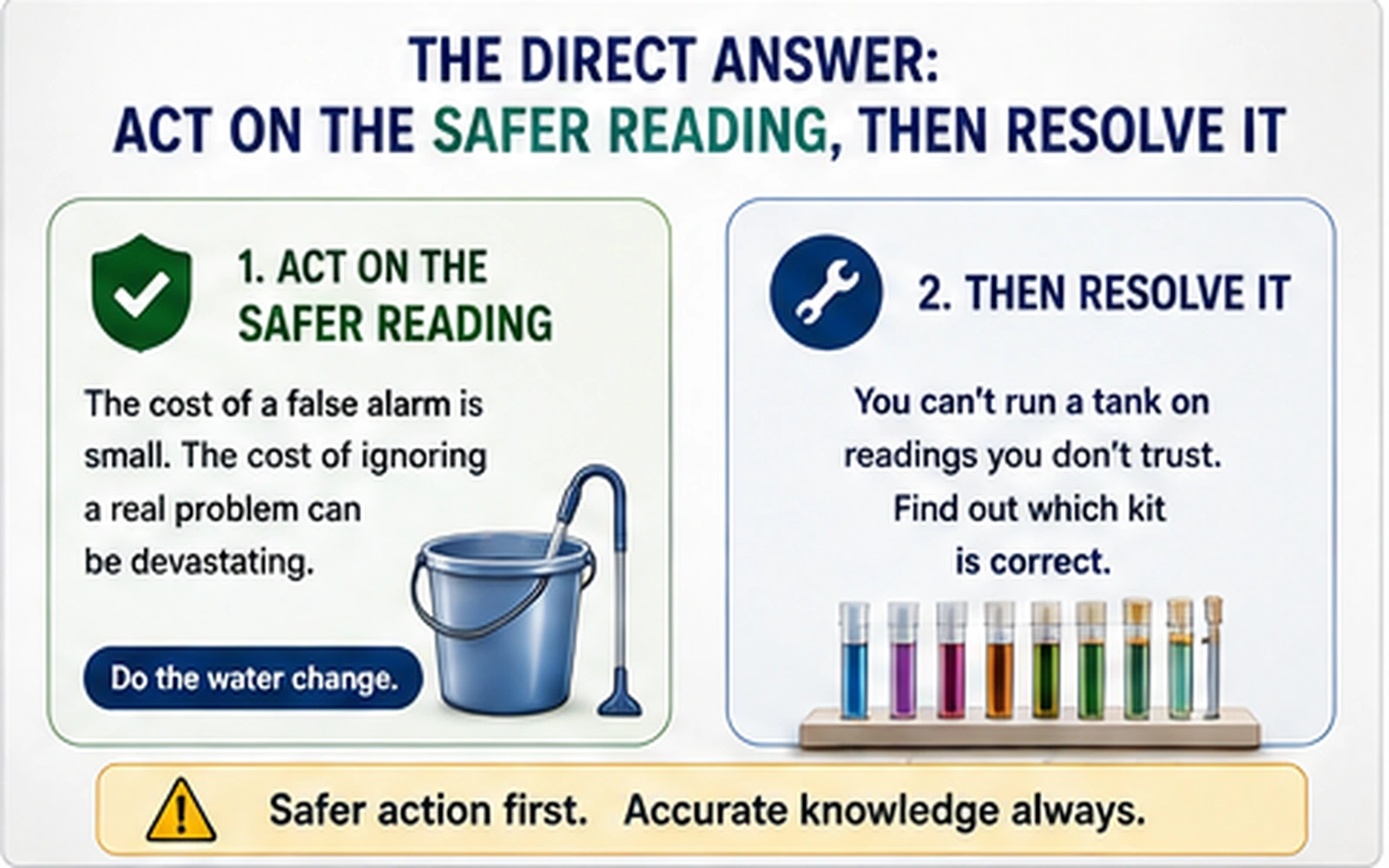
Then resolve it because you cannot run a tank on readings you do not trust. A kit you have decided to half-believe is worse than no kit, since it lets you talk yourself into whichever answer is more convenient. The rest of this page is how to settle it.
Step One: Test Water You Already Know the Answer For
This is the single most useful thing in this article, and almost nobody does it.
Buy or borrow a small amount of distilled or RO water. It should contain no ammonia, no nitrite and no nitrate. Run it through both of your kits exactly as you would tank water.
- A kit that reports something in clean water is the faulty one. You now know which reading to discard, and you did not have to guess.
- If both read clean, both kits work, and the difference is coming from procedure or from the sample rather than from the reagents. Move to the next section.
- If both report something, suspect the water you used or the way you are reading the color, not two simultaneous kit failures.
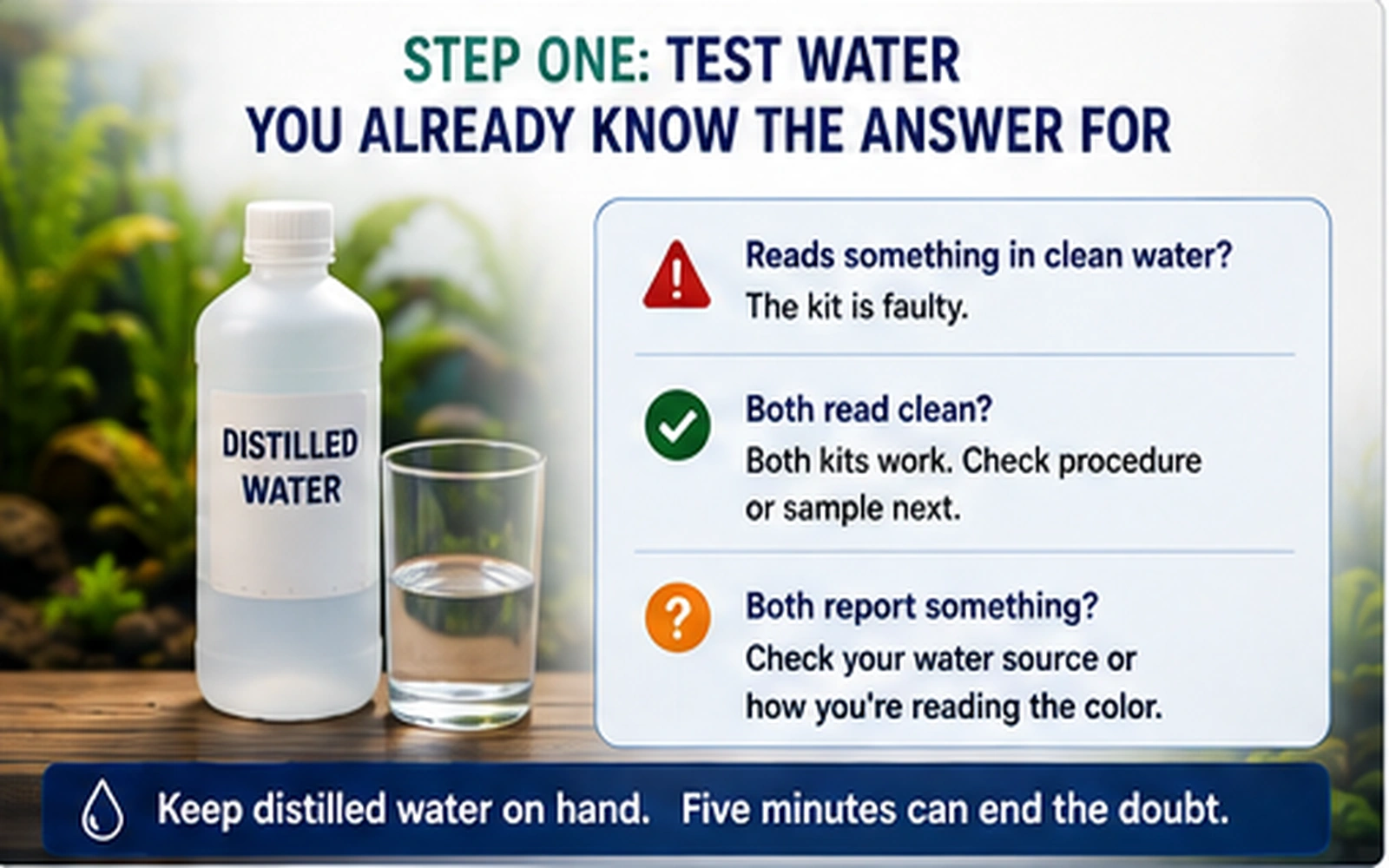
Keeping a small bottle of distilled water beside the test kit is a habit worth forming. It turns "is my kit lying" from an argument into a five-minute check, and it is the same method did my cycle crash, or is my test kit lying uses for the cycling version of this doubt.
The Mechanical Causes, and the Fix for Each
Most disagreements come from one of these, and each has a specific remedy.
- A cold sample. Liquid tests are chemical reactions and they run more slowly in cold water, which can produce a falsely low reading. Let the sample sit for a few minutes to reach room temperature before adding reagents. This one catches people testing a tank in an unheated room in winter.
- The nitrate reagent that has to be shaken hard. The second bottle in a liquid nitrate test contains particles that settle, and it needs vigorous shaking, commonly stated as around 30 seconds, before use, followed by shaking the sample itself for the stated time. Under-shaking is the most common cause of a nitrate result that reads zero in a tank that certainly produces nitrate. A nitrate reading of zero covers this in its own right.
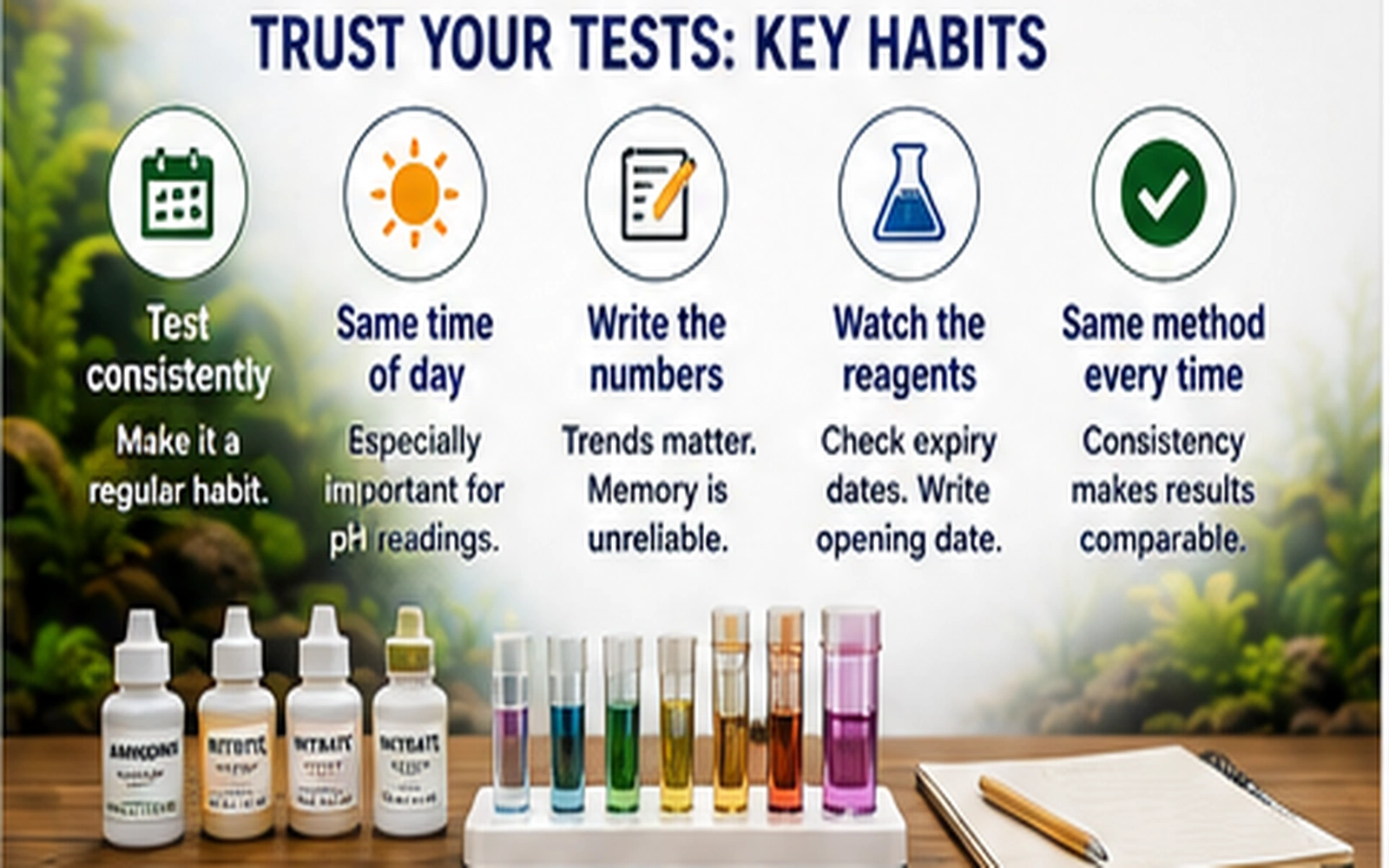
- Degraded reagents. Liquid kits are commonly described as good for around a year after opening and strips for around six months, since humidity gets into the container. Expired reagents do not fail loudly; they give a plausible number that happens to be wrong. Check dates, and write the opening date on the bottle.
- Reading the color badly. Match against the chart in daylight, against a white background, at the timing the instructions specify. Warm indoor light shifts every color chart in this hobby, and reading a strip early or late shifts the result.
- Where the sample came from. Water taken from directly beside the filter outflow, from the surface, or from a bucket that has been standing is not the same as mid-tank water tested promptly.
- Cross-contamination. A test tube rinsed in tap water and not dried, or reagent caps swapped between bottles, produces results nobody can explain afterwards.

Strips and Liquid Kits Will Not Agree, and That Is Expected
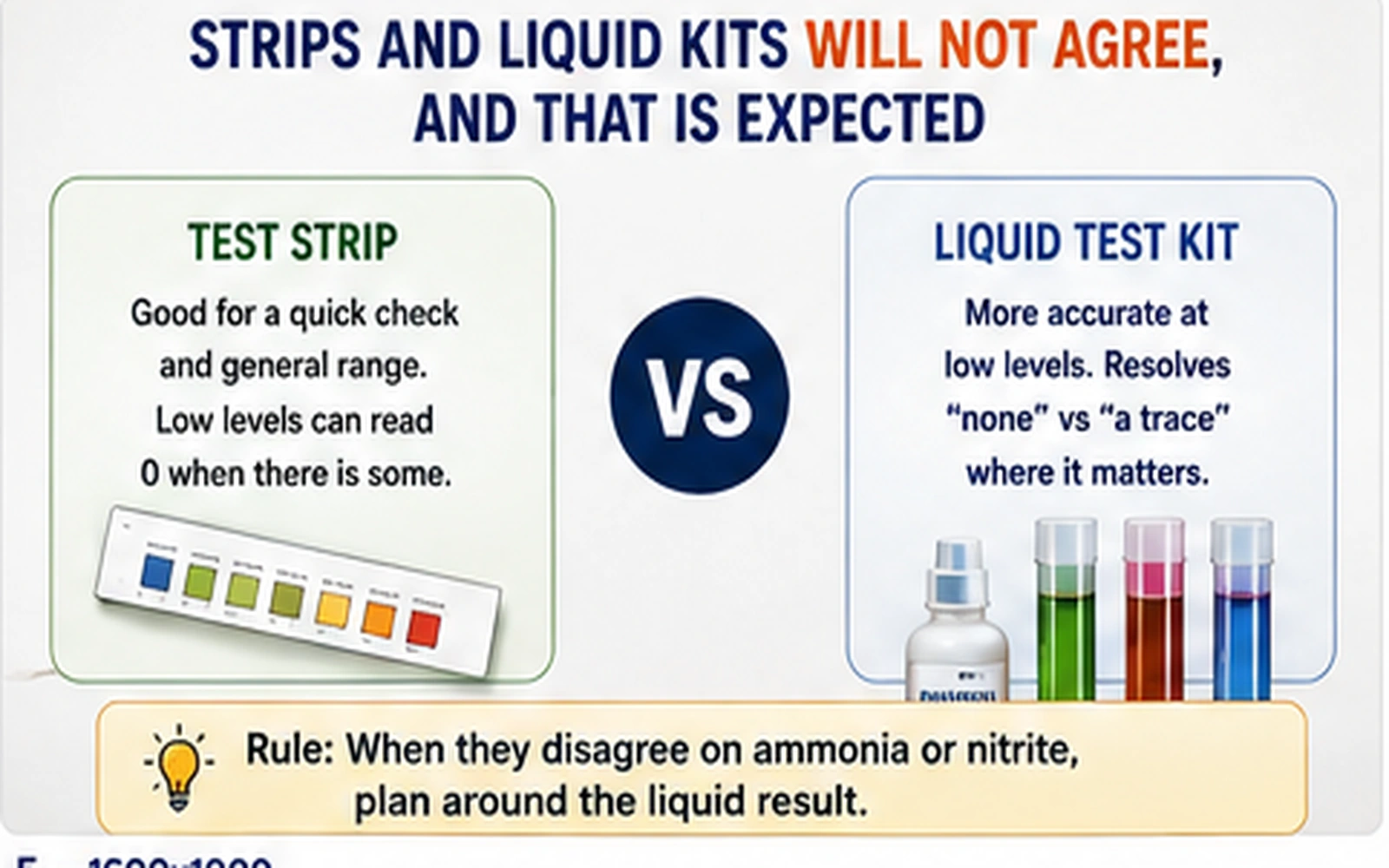
If your two tests are a dip strip and a liquid kit, some disagreement is normal rather than a fault, and it is largest exactly where it matters most.
Strips read a color developed on a small paper pad; liquid tests develop color through a whole water sample. At the low end of the ammonia and nitrite scales, where the difference between "none" and "a trace" decides whether fish are safe, the liquid method resolves what the strip cannot. That is a difference in what the tools can see, not a defect in one of them. Test strips vs liquid test kits covers where each is reliable.
The practical rule: when a strip and a liquid kit disagree on ammonia or nitrite, the liquid reading is the one to plan around, and the safer-action rule applies until you have confirmed it.
When the Test and the Fish Disagree, Believe the Fish
This is the case the forums get right and the review articles miss entirely.
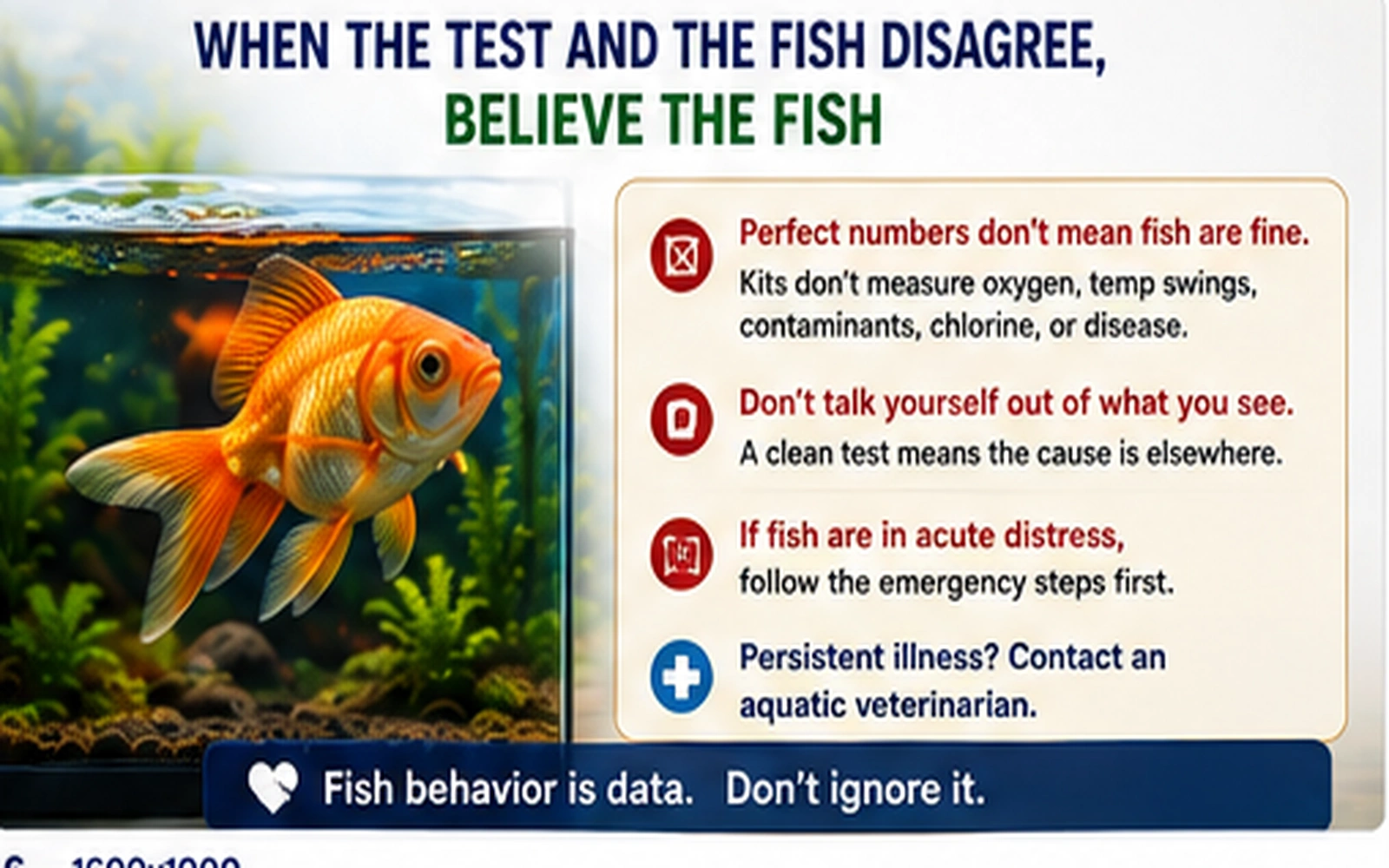
If every number reads perfect and your fish are hanging at the surface, sitting on the bottom, refusing food or breathing hard, the conclusion is not that the fish are mistaken. It is that something real is happening which your tests do not measure. Home kits cover a handful of parameters; they say nothing about dissolved oxygen, temperature swings overnight, chlorine that was never neutralized, a contaminant that got into the tank, or a disease.
So do not use a clean test result to talk yourself out of what you can see. Treat it as evidence that the cause is elsewhere and keep looking. If the fish are in acute distress right now, my fish are gasping at the surface and something is wrong with my tank are the pages to work through, and persistent unexplained illness is a reason to contact an aquatic veterinarian rather than to buy a third test kit.
Getting a Third Opinion
When two of your own tests disagree and the control check has not settled it, a third independent result usually does.
Most local aquarium shops will test a water sample, often free, and comparing their result against both of yours identifies the odd one out. Take the sample in a clean container, fill it from mid-tank, keep the lid on, and get it there promptly rather than letting it stand for hours. Ask them which method they used, because a shop testing with strips and you testing with liquid is not an independent comparison of methods.
Borrowing a fellow keeper's kit works the same way, and has the advantage that you can run both kits side by side on the same sample within minutes of each other.

Once you know which of your kits is wrong, replace that one rather than second-guessing every reading from then on.
FAQ
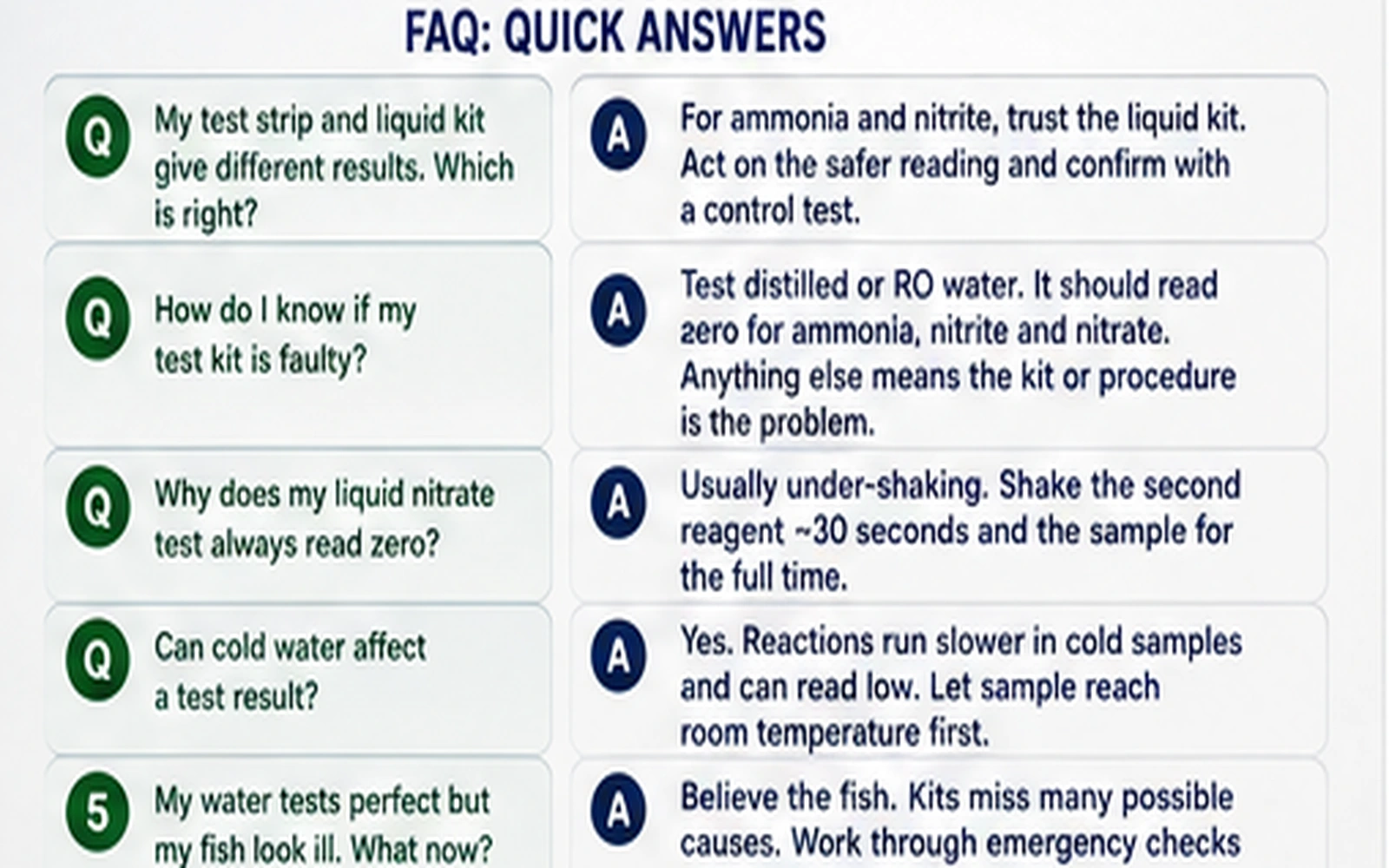
My test strip and liquid kit give different results. Which is right? For ammonia and nitrite, plan around the liquid reading, since it resolves low concentrations better. In the meantime act on whichever result implies the safer action, then confirm with a control test on distilled or RO water.
How do I know if my test kit is faulty? Test distilled or RO water with it. It should read zero for ammonia, nitrite and nitrate. Anything else means the kit or the procedure is producing the number, not your tank.
Why does my liquid nitrate test always read zero? Almost always because the second reagent bottle and the sample were not shaken long enough. The particles settle and the reaction stays incomplete. Shake the bottle vigorously for the full stated time before testing.
Can cold water affect a test result? Yes. The reactions in liquid kits run more slowly in cold samples and can read low. Let the sample reach room temperature for a few minutes before adding reagents.
My water tests perfect but my fish look ill. What now? Believe the fish. Home kits measure a few parameters and miss many possible causes, including oxygen, temperature swings, contaminants and disease. Work through the emergency checks and contact an aquatic veterinarian if the fish remain unwell.