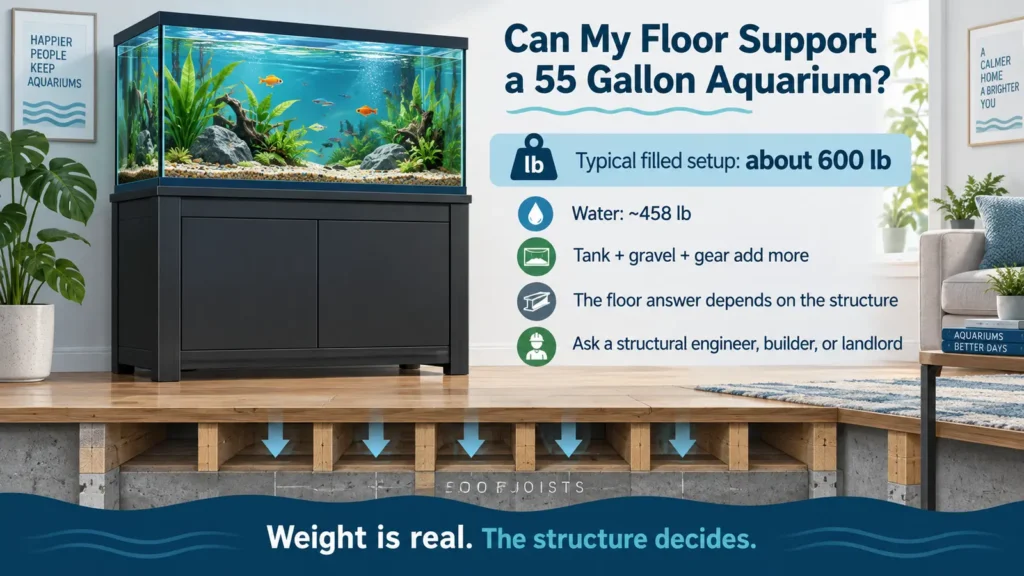
Water is the whole answer. A US gallon of fresh water weighs about 8.33 pounds (a liter weighs about 1 kilogram), so a filled aquarium weighs roughly its empty weight plus 8.33 pounds for every gallon it holds, plus everything you put inside it. A 55 gallon tank carries about 458 pounds of water on its own. Add a common glass tank body at 78 pounds and 50 pounds of gravel and you are near 590 pounds, about a quarter of a metric ton, standing on a footprint the size of a coffee table.
The number is not the hard part. Working out whether the floor under it can take that load is a structural question, and this article does not answer it. It gives you the weight, honestly sourced, so that the person who can answer it has something real to work with.
How Much Does a Fish Tank Weigh? The Formula
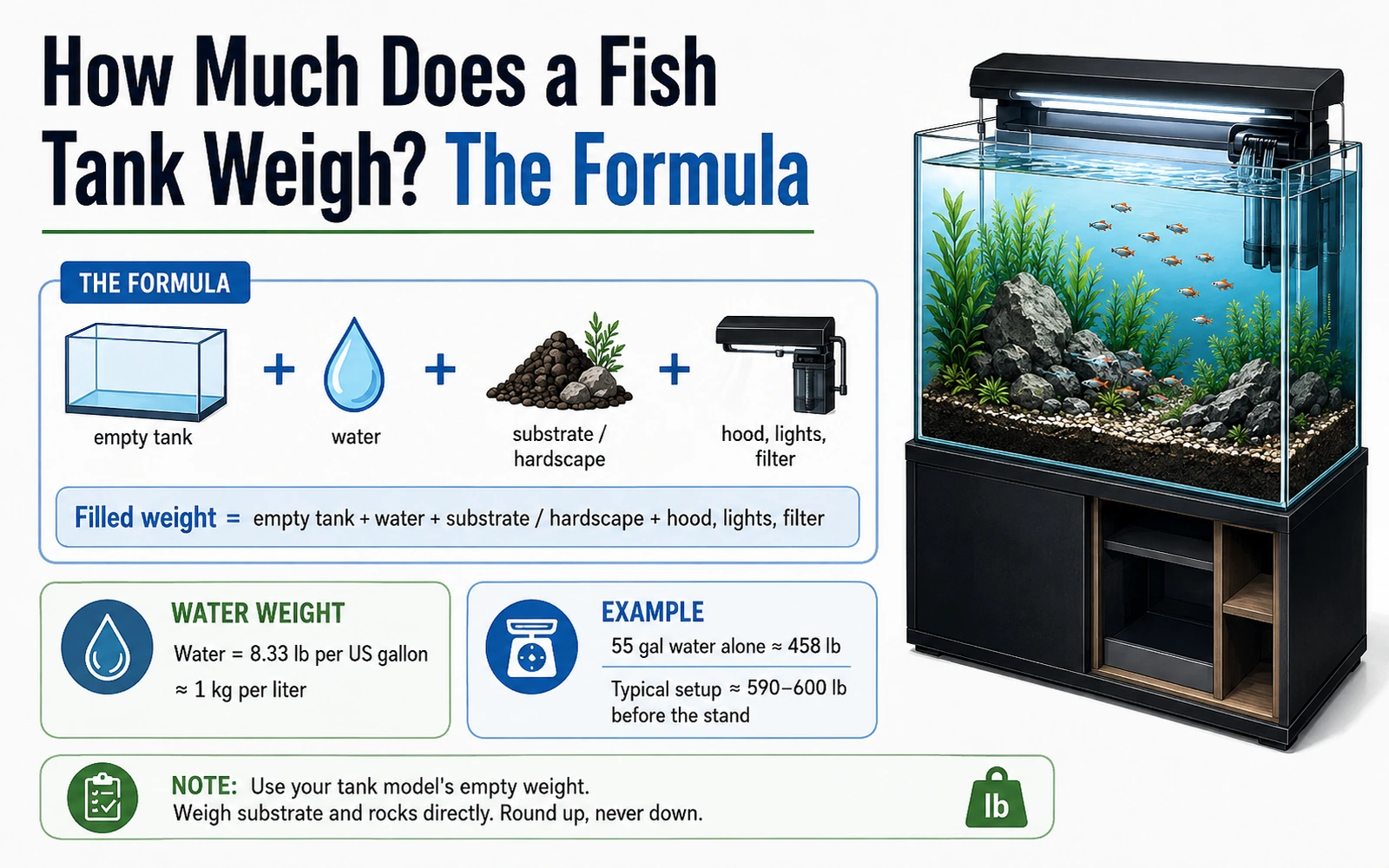
Filled weight = empty tank weight
              + (water volume x weight per unit volume)
              + substrate, rock and hardscape
              + hood, lights, filter and the water inside the filter
Every term needs its own number, and only one of them is a constant. Here is where each comes from.
What water weighs, and why 8.33
Two published figures do all the work.
The U.S. Geological Survey's Water Science School publishes a density table for pure water: at 70 °F (21 °C) the density is 0.99802 g/cm³, which is 62.30 pounds per cubic foot (read September 2, 2026). NIST Handbook 44, Appendix C, gives the volume definition: one US gallon is exactly 231 cubic inches, about 3.785 liters (read September 2, 2026).
The rest is arithmetic you can repeat:
- One cubic foot is 1,728 cubic inches. 1,728 ÷ 231 = 7.48 US gallons per cubic foot.
- 62.30 lb per cubic foot ÷ 7.48 gallons = 8.33 pounds per US gallon at 70 °F.
- In metric, 0.99802 g/cm³ means a liter of water weighs 998 grams, so 1 kilogram per liter is accurate to within about two grams.
- Converting the gallon figure: 8.33 lb x 0.4536 = 3.78 kg per US gallon.
Temperature moves this a little and never enough to matter. Warmer water is slightly less dense, so a tropical tank held in the low 80s F is a fraction lighter per gallon than the same tank at room temperature. If you keep an eye on aquarium water temperature you already know the range you run, and across that range the difference is a rounding error next to the weight of the substrate. Salt water is heavier than fresh; every figure on this page is fresh water.
Use 8.33 lb per gallon, or 1 kg per liter. Round up, never down.
The empty tank: use your model's number
This is where generic charts start lying to you, because glass thickness, frame design and bracing differ by maker and by model.
Aqueon publishes a size chart for its standard glass aquariums. It lists the 55 gallon at 78 pounds empty, the 20 gallon long at 25 pounds, the 10 gallon leader at 11 pounds, the 29 gallon at 40 pounds, the 40 gallon breeder at 58 pounds, the 75 gallon at 98 pounds and the 125 gallon at 177 pounds (read September 2, 2026). Those are that maker's numbers for that maker's tanks.
Listings for a Marineland 55 gallon quote around 62 pounds empty (read September 2, 2026). Same nominal size, same hobby, 16 pounds apart. Neither is wrong. They are different tanks.
So the honest instruction is: find the empty weight for the tank you actually own, on the box, in the manual, or on the manufacturer's spec page. If you cannot find it, use the heaviest published figure you can find for that nominal size and treat it as a floor, not a ceiling.
Substrate, rock and wood: weigh them, do not guess
Substrate weight per gallon is not a constant. Fine sand, coarse gravel, aqua soil and crushed coral all have different bulk densities, and two bags of "aquarium gravel" from different suppliers are not interchangeable by volume.
You do not need a table for this, because the number is already printed on the bag. Substrate is sold by weight. Add up what you bought. If you put two 20 pound bags of gravel in a 20 gallon tank, that is 40 pounds, and you know it exactly.
Rock and driftwood work the same way. Put them on a bathroom scale before they go in the tank and write the number down. Stone density varies enormously between lava rock, slate and limestone, so any single figure printed as though it applied to all of them would be invented.
One physical detail people ask about: does submerged rock still count, since it displaces water? The strict answer is that a submerged object adds its own weight to the system and displaces an equal volume of water, so the tank holds less water than its rating suggests. The practical answer for a load estimate is to ignore the displacement, count the full dry weight of the rock, and treat the tank as full of water anyway. That deliberately over-counts by a few pounds. On a safety-critical number, over-counting is the direction you want to be wrong in.
Worked examples
A 20 gallon long, glass, with gravel.
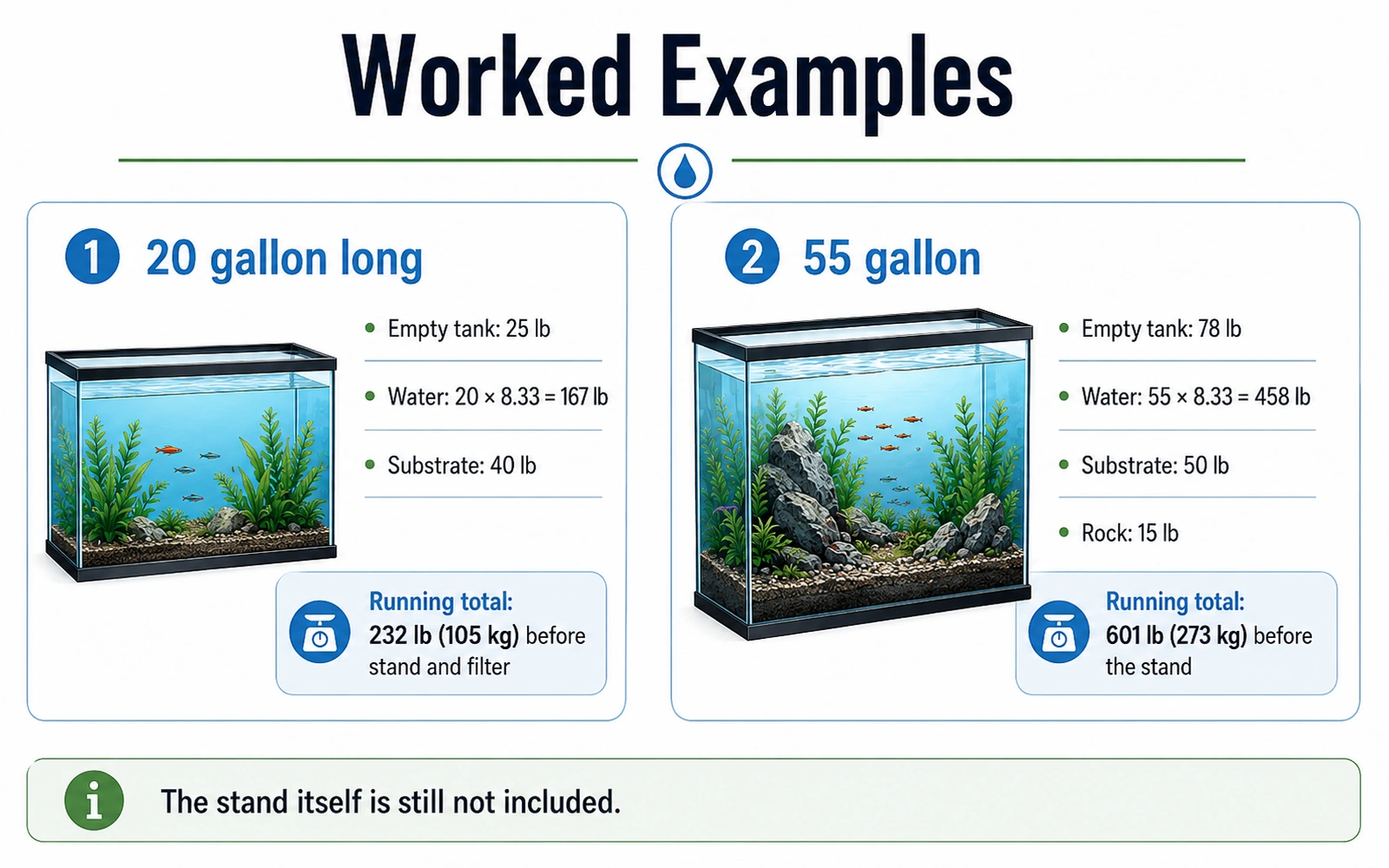
- Empty tank: 25 lb (maker's published figure)
- Water: 20 x 8.33 = 166.6, call it 167 lb
- Substrate: two 20 lb bags = 40 lb
- Running total: 232 lb, about 105 kg, before the stand, the hood or the filter
A 55 gallon, glass, with gravel and some rock.
- Empty tank: 78 lb (maker's published figure)
- Water: 55 x 8.33 = 458.15, call it 458 lb
- Substrate: 50 lb
- Rock, weighed on the bathroom scale: 15 lb
- Running total: 601 lb, about 273 kg, and the stand itself is still not in the number
That 601 pounds sits on a footprint of roughly 48 by 13 inches. The concentration is the point, not the total.
What the size charts leave out
Here is the part almost no ranking page for this query says out loud, and it is checkable with the numbers above.
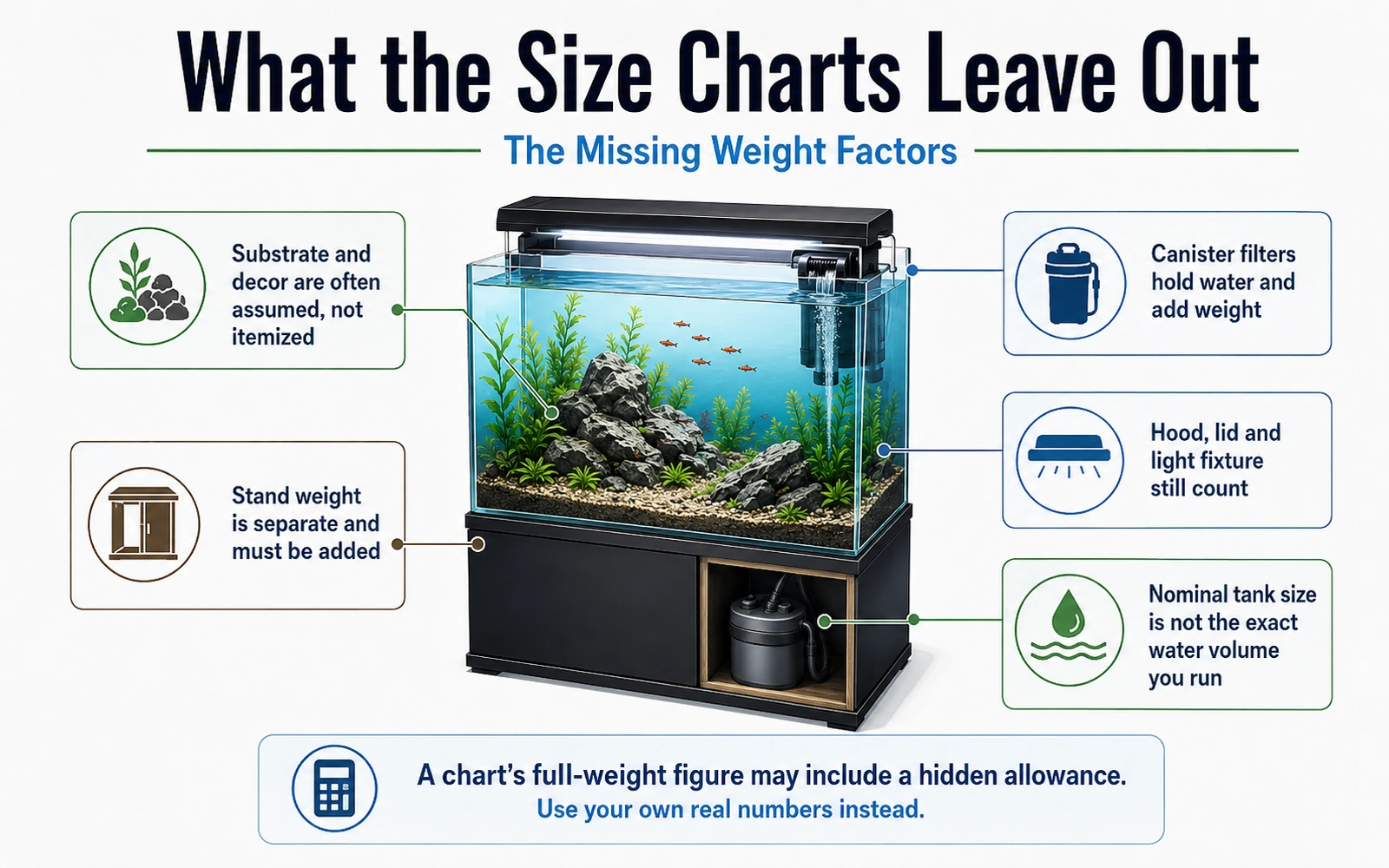
Take Aqueon's own chart. It lists the 55 gallon at 78 lb empty and 625 lb full. But 78 plus the nominal 458 pounds of water is 536 pounds. The chart's "full" figure is 89 pounds higher than tank plus rated water. The 20 long shows the same pattern: 25 lb empty plus 167 lb of water is 192, and the chart says 225. The 10 gallon: 11 plus 83 is 94, and the chart says 111.
The maker's "full" column carries an allowance the chart does not itemize, presumably for substrate and decor. That is a sensible thing for a maker to do and a poor thing for you to rely on, because the allowance is not your substrate. If you use a chart's full-weight column as your number, you are trusting somebody else's guess about what is in your tank.
Four more things the charts routinely omit:
- The stand. It is under the load and it is part of it. Stand weights vary by model and material, from light steel frames to solid wood cabinets, so read the maker's spec for the stand you own rather than accept a number from anywhere else.
- A canister filter full of water. It sits beside or under the tank, and it is heavy when primed.
- Hood, glass lid and light fixture. Individually minor, collectively real on a large tank.
- The nominal rating is not the water you will run. A 55 gallon measures about 48.25 x 12.75 x 21 inches on the outside, which is 12,919 cubic inches, or 55.9 gallons brim full before you subtract the glass thickness and the inch or two of air below the rim. Your actual water volume is under the label. Estimating with the label included is another deliberate over-count.
Where this article stops: the floor
You now have a defensible weight. What you do not have, and cannot get from any article, is permission to load it onto a specific floor.
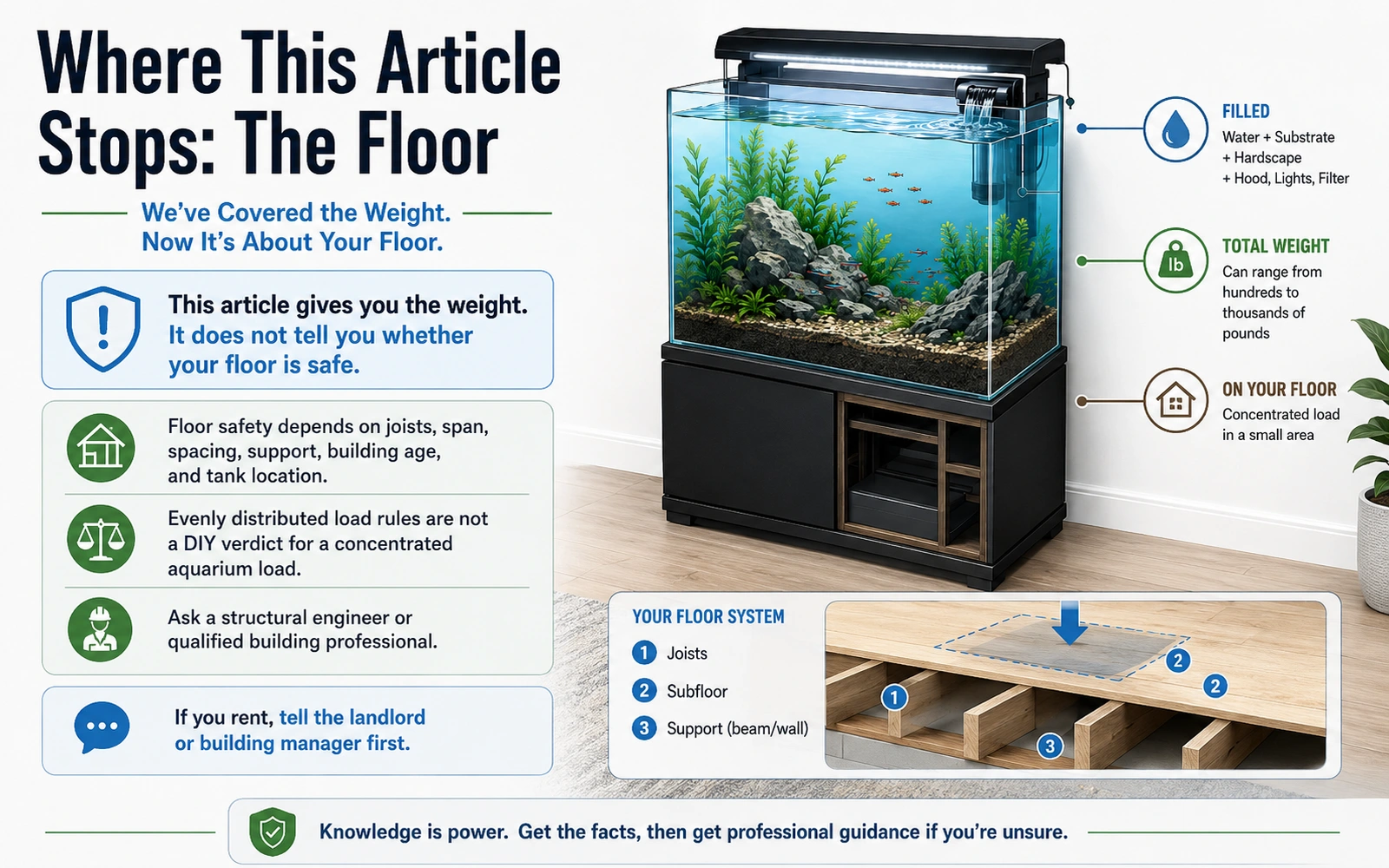
Whether a floor carries a given aquarium depends on the structure itself: how the joists run, how far they span, their size, spacing, species and grade, what is underneath them, whether the tank sits along a bearing wall or in the middle of a room, the age and condition of the building, and any alteration a previous owner made that you cannot see. Two apartments with identical layouts can differ because of what happens below.
Residential floor loading figures do exist in building codes, and you will see them quoted in hobby forums as a pounds per square foot test any homeowner can apply. Do not use them that way, and this site will not print one for you to apply. Those values are design assumptions about evenly distributed loads, and turning them into a verdict about your floor with a concentrated load standing on it is professional judgment, not arithmetic.
The people who answer this are a structural engineer or a qualified building professional, and the visit is short and specific. If you rent, your landlord or building manager needs to be told before the tank arrives, not after. In some places an alteration or a very large tank brings a permit or an inspection with it.
We will not tell you your floor is fine. Nobody who has not looked at your building can.
The rules that follow from the weight
The weight changes how you handle the tank long before it becomes a floor question.
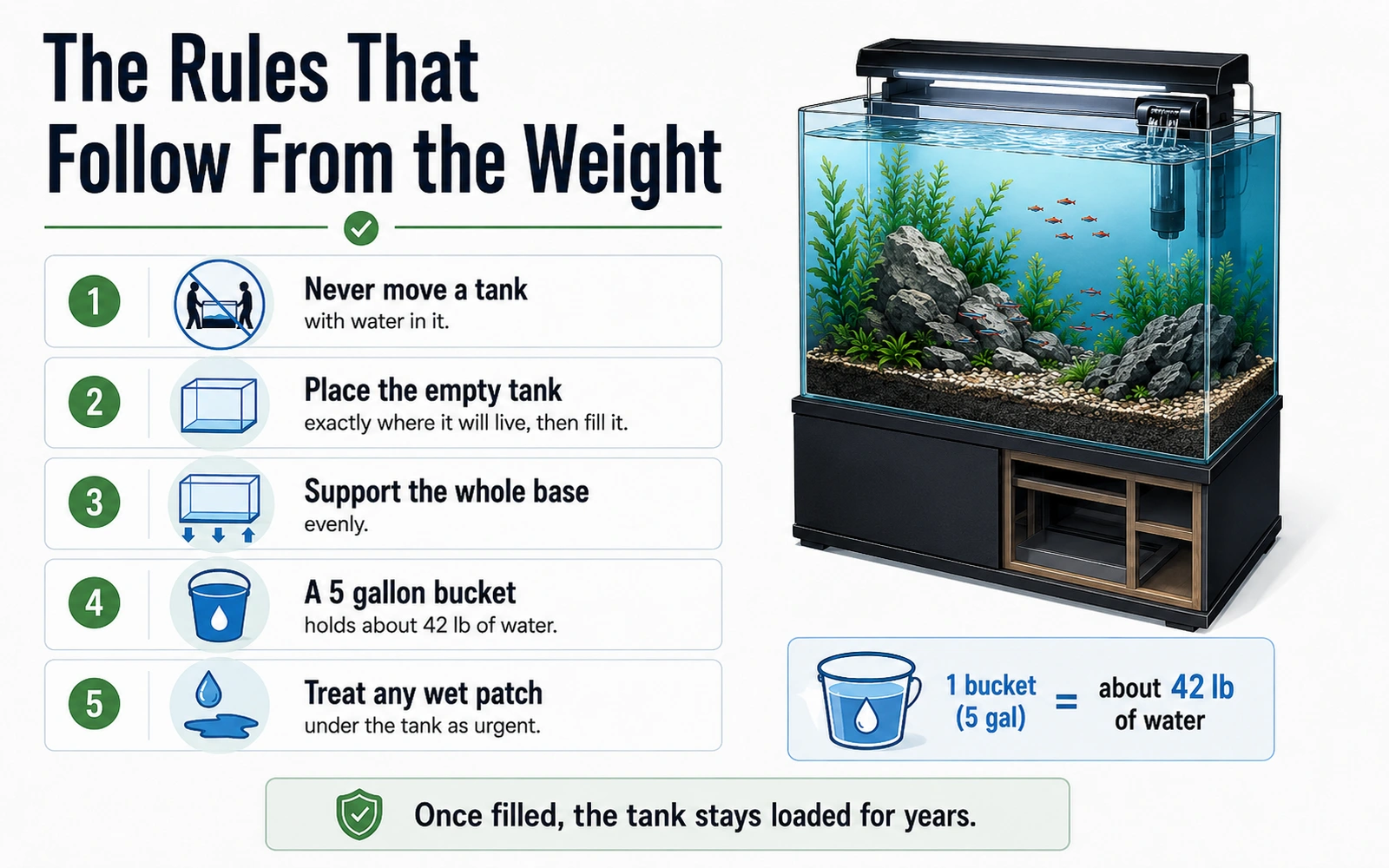
Never move a tank with water in it. Not an inch, not to slide it straight. A partly filled tank flexes in ways an empty one does not, and the load rides on whatever corner you tip it toward. Drain it completely, remove the substrate, then move it.
Place the empty tank exactly where it will live, then fill it. This is why the placement step comes before the filling step in the first aquarium setup checklist, and why the decision is effectively permanent once water goes in.
Support the whole base. A rimmed glass tank needs continuous, level support around its full perimeter, and a rimless tank needs a level, even surface across the entire base. An unsupported corner or a slight rock is a stress point in glass, and glass fails at stress points.
Respect the buckets. Water changes are the weight arriving in installments. A 5 gallon bucket holds about 42 pounds of water (5 x 8.33), which is why the water change routine is built around a siphon and a hose rather than carrying full buckets across a room. Wet floors and heavy buckets are the everyday injury in this hobby, not the dramatic collapse.
Understand that the tank stays loaded. Once you fill it and start cycling the tank, that load is continuous for weeks before a fish ever arrives, and then for years. A stand that merely survives the first day is not a stand that passed.
Treat any wet patch under the tank as urgent. A seam that weeps is carrying the same load as a seam that holds. If you find water where it should not be, our aquarium emergency guide covers the calm first steps, and the tank comes down in volume before anything else happens.
Quick reference: common tank sizes
Water weight is derived at 8.33 lb per US gallon from the sources above. Empty weights are Aqueon's published figures for its standard glass tanks (read September 2, 2026) and apply to those models only. Substrate, rock, hood, lights, filter and stand are not included in any column.
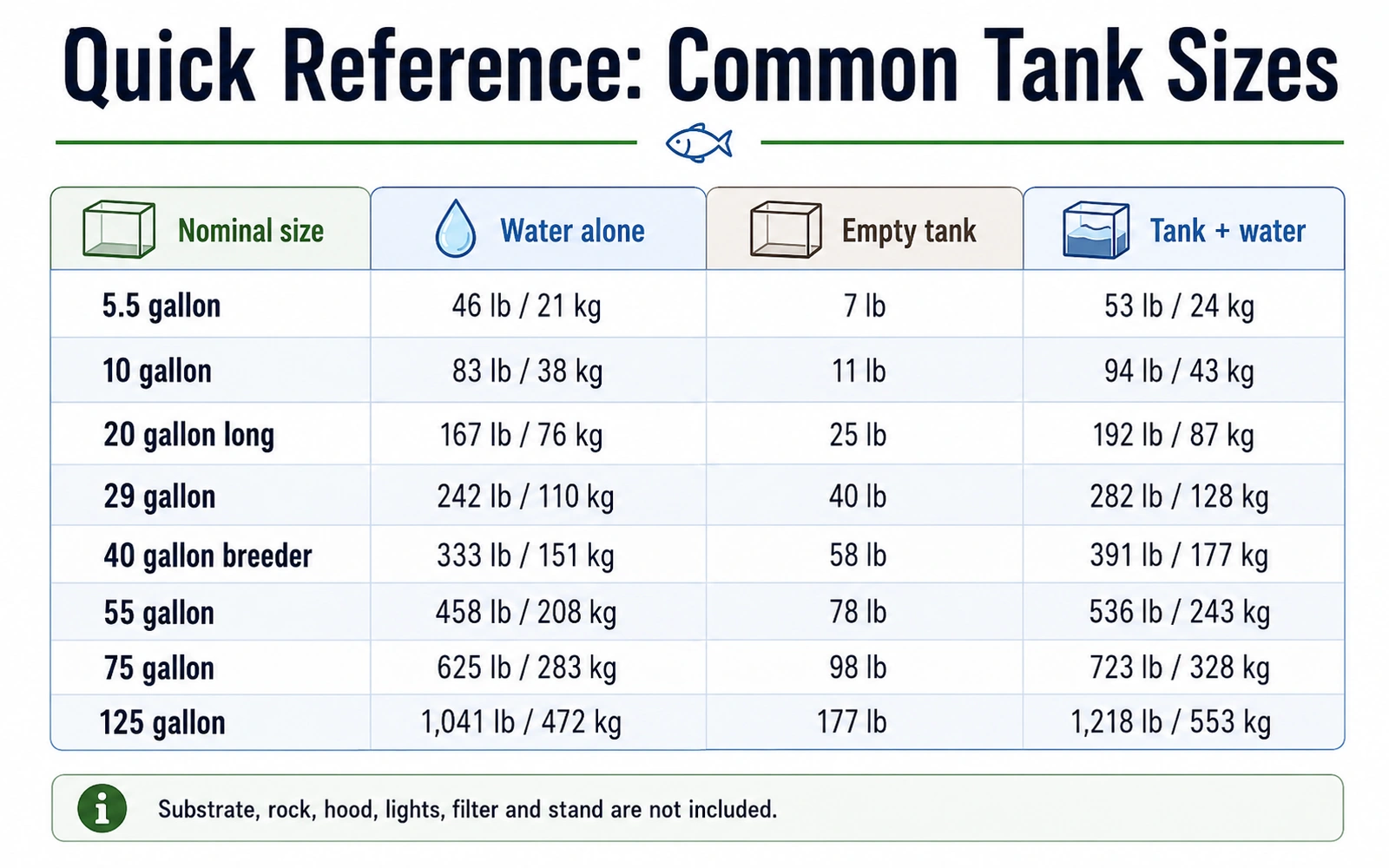
| Nominal size | Water alone (derived) | Empty tank (Aqueon published) | Tank plus water |
|---|---|---|---|
| 5.5 gallon | 46 lb / 21 kg | 7 lb | 53 lb / 24 kg |
| 10 gallon | 83 lb / 38 kg | 11 lb | 94 lb / 43 kg |
| 20 gallon long | 167 lb / 76 kg | 25 lb | 192 lb / 87 kg |
| 29 gallon | 242 lb / 110 kg | 40 lb | 282 lb / 128 kg |
| 40 gallon breeder | 333 lb / 151 kg | 58 lb | 391 lb / 177 kg |
| 55 gallon | 458 lb / 208 kg | 78 lb | 536 lb / 243 kg |
| 75 gallon | 625 lb / 283 kg | 98 lb | 723 lb / 328 kg |
| 125 gallon | 1,041 lb / 472 kg | 177 lb | 1,218 lb / 553 kg |
Read the table as a starting figure, then add your own substrate and hardscape weights, which you can know exactly.
FAQ
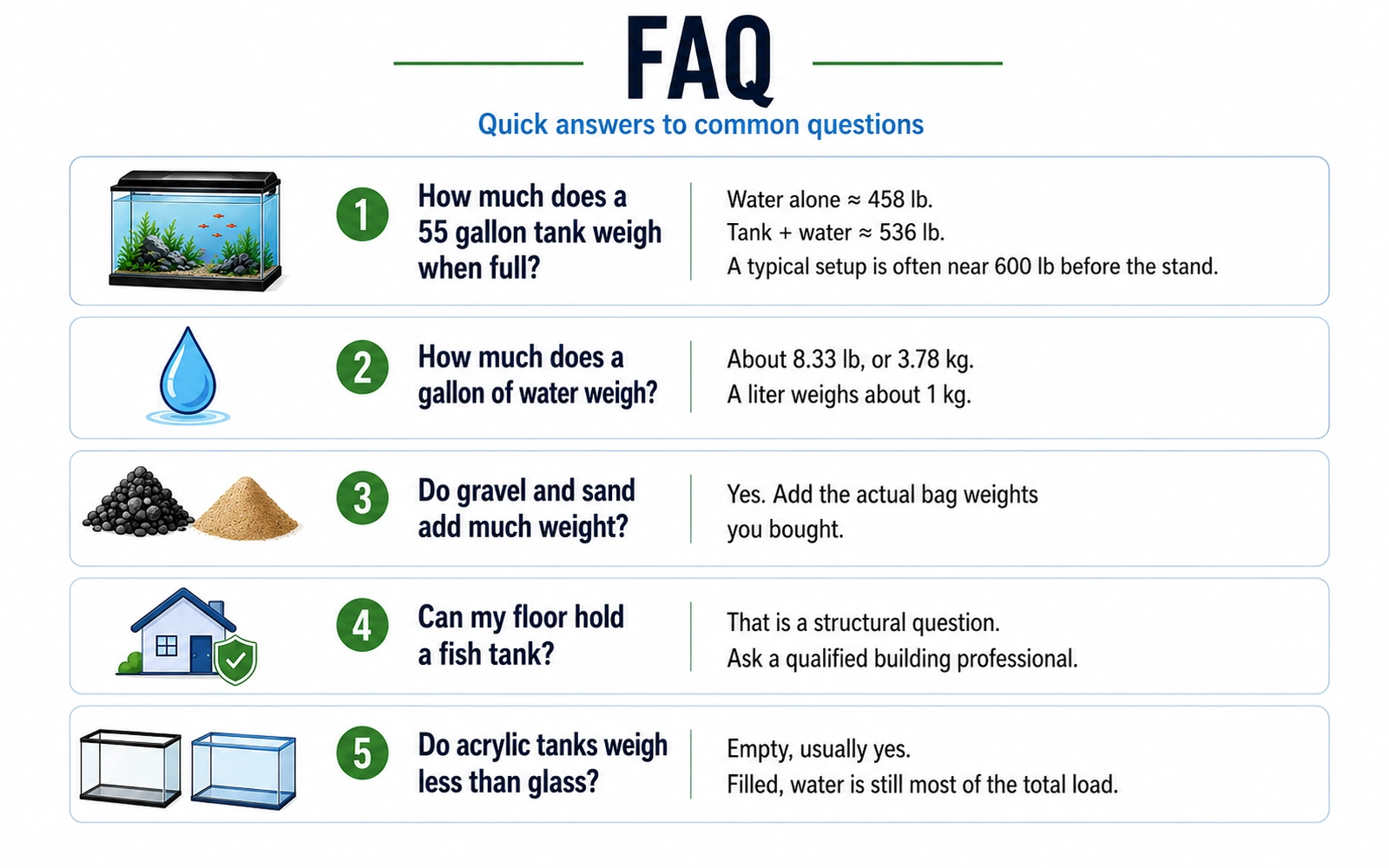
How much does a 55 gallon fish tank weigh when full? The water alone is about 458 pounds (55 x 8.33 lb per gallon, roughly 208 kg). Aqueon publishes 78 pounds for its 55 gallon glass tank empty, giving about 536 pounds for tank plus water. Add your substrate, rock, hood and filter, and a typical setup lands somewhere near 600 pounds before the stand.
How much does a gallon of water weigh? About 8.33 pounds, or 3.78 kg. That comes from the USGS figure of 62.30 pounds per cubic foot at 70 °F divided by 7.48 gallons per cubic foot. In metric it is simpler: a liter of fresh water weighs almost exactly 1 kilogram, so a 200 liter tank holds about 200 kg of water.
Does gravel and sand add much weight? Yes, and the amount depends on the material, so do not use a per gallon rule. Substrate is sold by weight, so add up the bag weights you bought. In a 20 gallon tank, 40 pounds of gravel is roughly a quarter of the water weight, which is not a rounding error.
Can my floor hold a fish tank? That is a structural question, not a weight question, and no article can answer it for your building. It depends on joist size, span and direction, what supports them, the age and condition of the structure, and where in the room the tank sits. Ask a structural engineer or a qualified building professional, and tell your landlord or building manager first if you rent.
Do acrylic tanks weigh less than glass? Empty, yes. Acrylic panels are lighter than glass panels for the same tank, so the shell weighs less and is less awkward to carry. Filled, the difference is only the shell, because the water is identical and the water is most of the load. Check the maker's published empty weight for the specific model rather than assuming a fixed percentage.