One scratches, one is heavy. That is the usual summary, and it is roughly right. What it leaves out is which of those problems a beginner is more likely to run into.
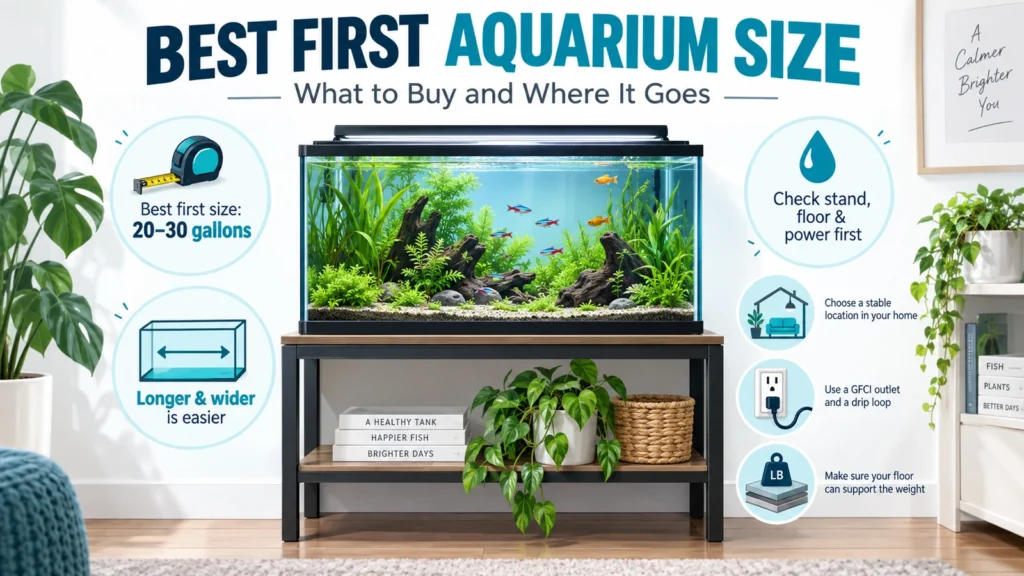
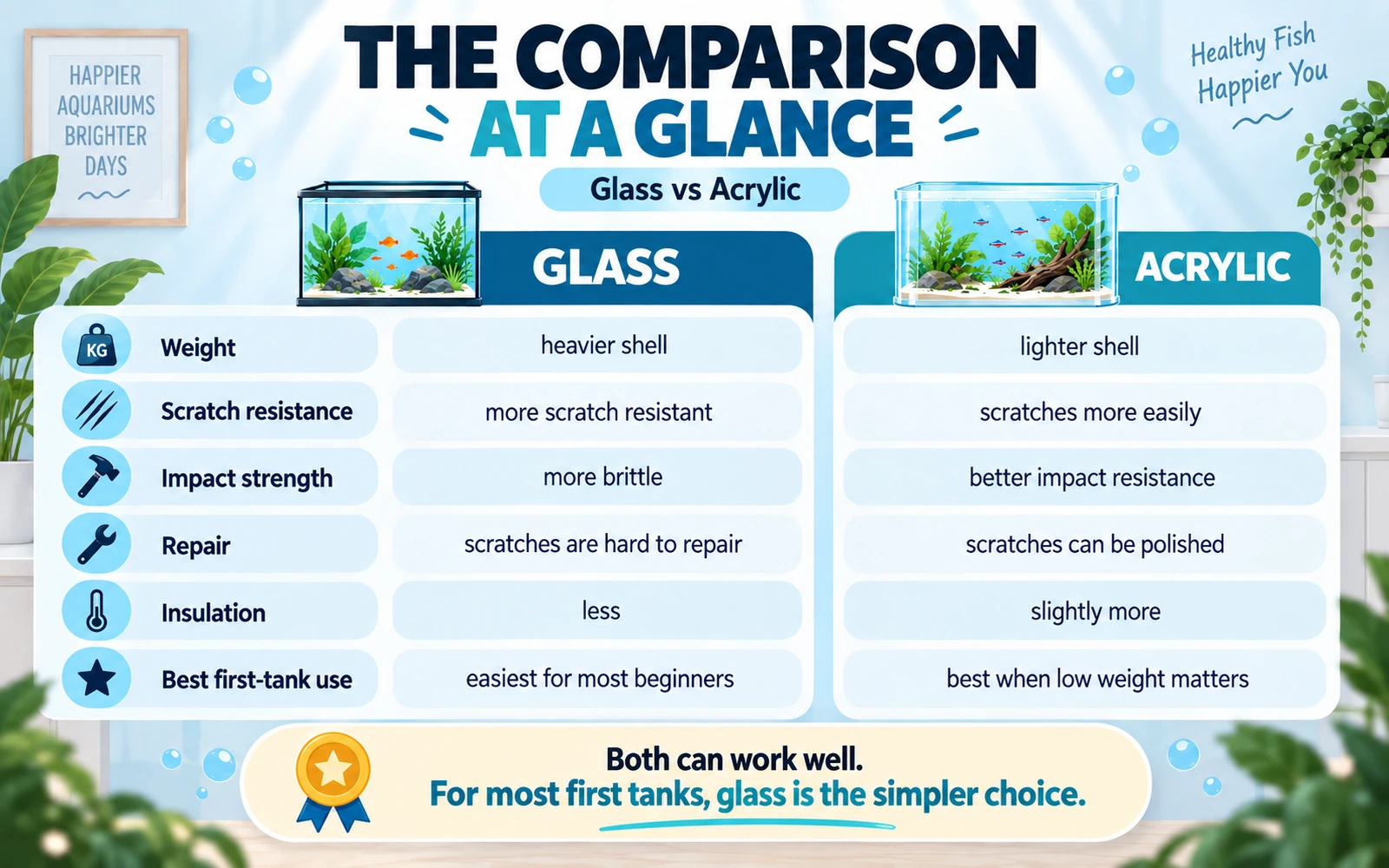
For most first tanks, glass is the simpler choice. It resists scratching, which matters while you are learning to clean the inside, and standard glass sizes are easy to match with stands. Acrylic is roughly half the weight of glass as a material and has higher impact strength, but it is "softer and more easily scratched than glass," according to Wikipedia's article on the material, though acrylic scratches can be polished out.
Neither is wrong. They trade different weaknesses, and the right one depends on the tank's size, where it goes, and how you will clean it.
The Comparison at a Glance
| Property | Glass (soda-lime) | Acrylic (PMMA) | Source, read September 11, 2026 |
|---|---|---|---|
| Density | About 2.52 g/cm³ | 1.17 to 1.20 g/cm³, "approximately half that of glass" | Wikipedia, Soda-lime glass; Poly(methyl methacrylate) |
| Impact strength | Brittle | "Higher than both glass and polystyrene" | Wikipedia, Poly(methyl methacrylate) |
| Scratch resistance | More scratch resistant (Mohs hardness 6) | "Softer and more easily scratched" | Wikipedia, Aquarium; Soda-lime glass; PMMA |
| Scratch repair | Difficult | "Can be polished out" | Wikipedia, Aquarium |
| Refractive index | About 1.52 | About 1.49 | Wikipedia, Soda-lime glass; PMMA |
| Insulation | Less | "A certain amount of temperature insulation" | Wikipedia, Aquarium |
| Use at scale | Standard for home tanks up to roughly 1,000 liters | Used for large public aquarium windows | Wikipedia, Aquarium; PMMA |
Weight: Lighter Shell, Same Water
Acrylic's weight advantage is real. For the same panel size, it weighs roughly half as much as glass, which makes an empty tank far easier to carry, position and lift onto a stand.
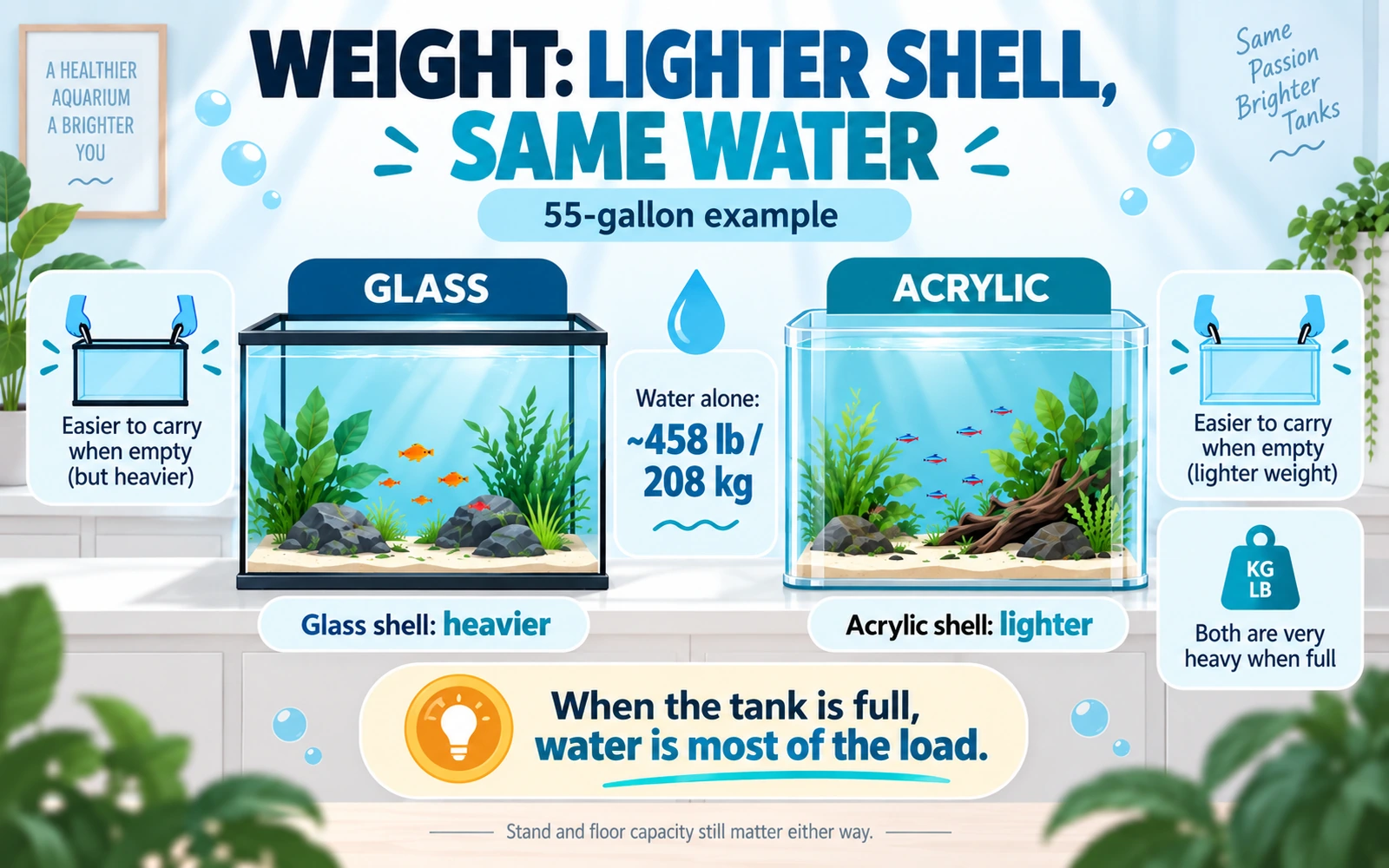
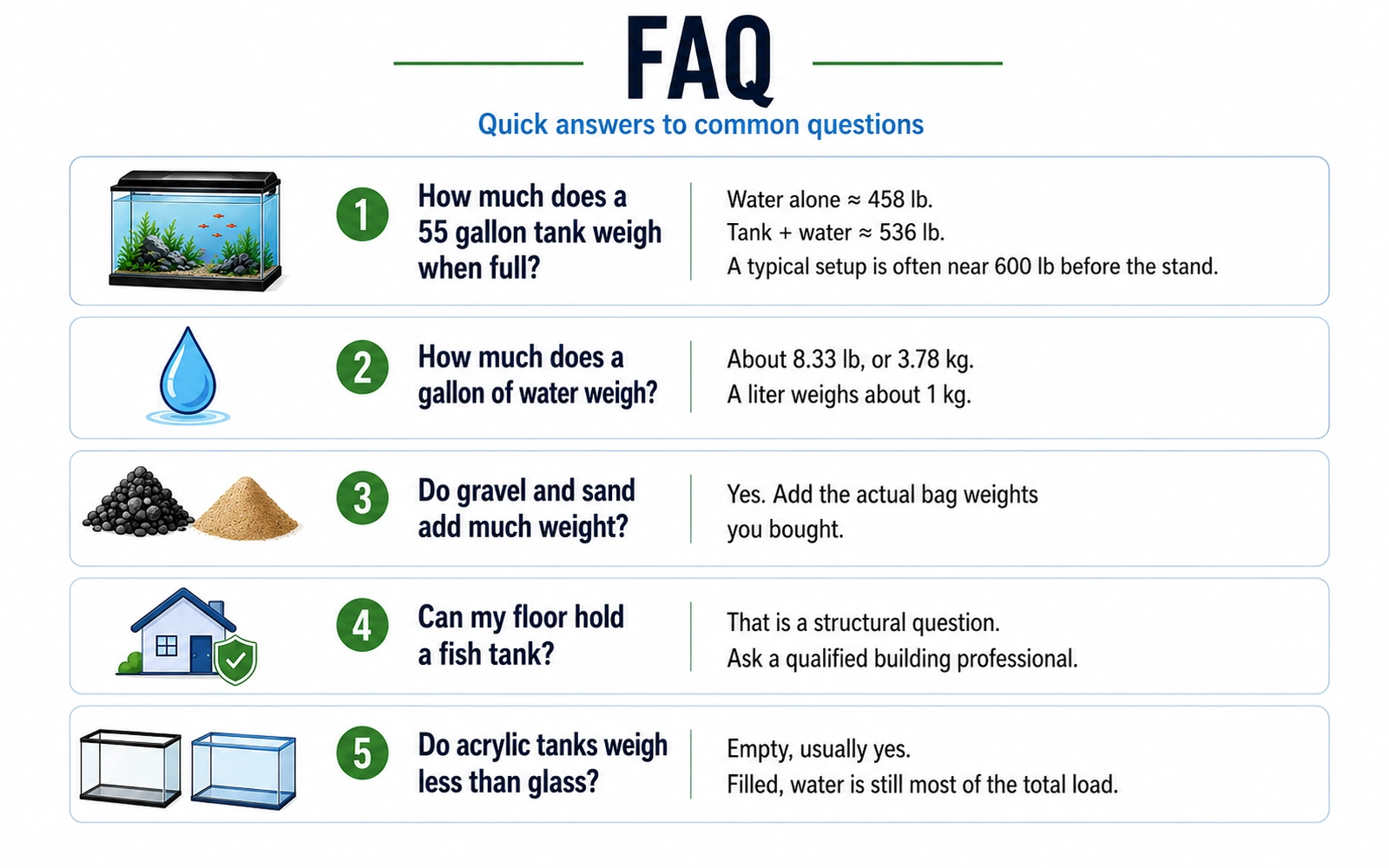
Once the tank is full, though, the difference shrinks to the shell alone. The water is the same weight whichever material holds it, and water is most of the load. Our article on how much a fish tank weighs shows that for a 55 gallon, the water alone is about 458 pounds while the published empty glass tank is 78. A lighter shell helps you on moving day. It does not change the question of whether your stand and floor can carry the filled tank, which is a question for a structural engineer or builder if the tank is large or on an upper floor.
Strength: Acrylic Takes Knocks Better
Wikipedia's PMMA article describes acrylic's impact strength as higher than glass. In a home, that means acrylic is less likely to crack from a knock, which is one reason it is used for large and unusually shaped tanks. The same article notes that public aquariums use very thick acrylic windows for deep exhibits.
Glass is strong under the steady pressure of water when it is thick enough and properly supported, but it is brittle. A sharp knock, a dropped rock or a stress point from uneven support can crack it.
How the Two Are Built
Most glass aquariums are panes joined at the seams. Wikipedia's aquarium article describes modern glass tanks as "glass panes bonded together by 100% silicone sealant," often with plastic frames on the top and bottom edges. The silicone seams are the part that ages, so how a glass tank has been treated (level, supported, not moved while full) matters over its life.
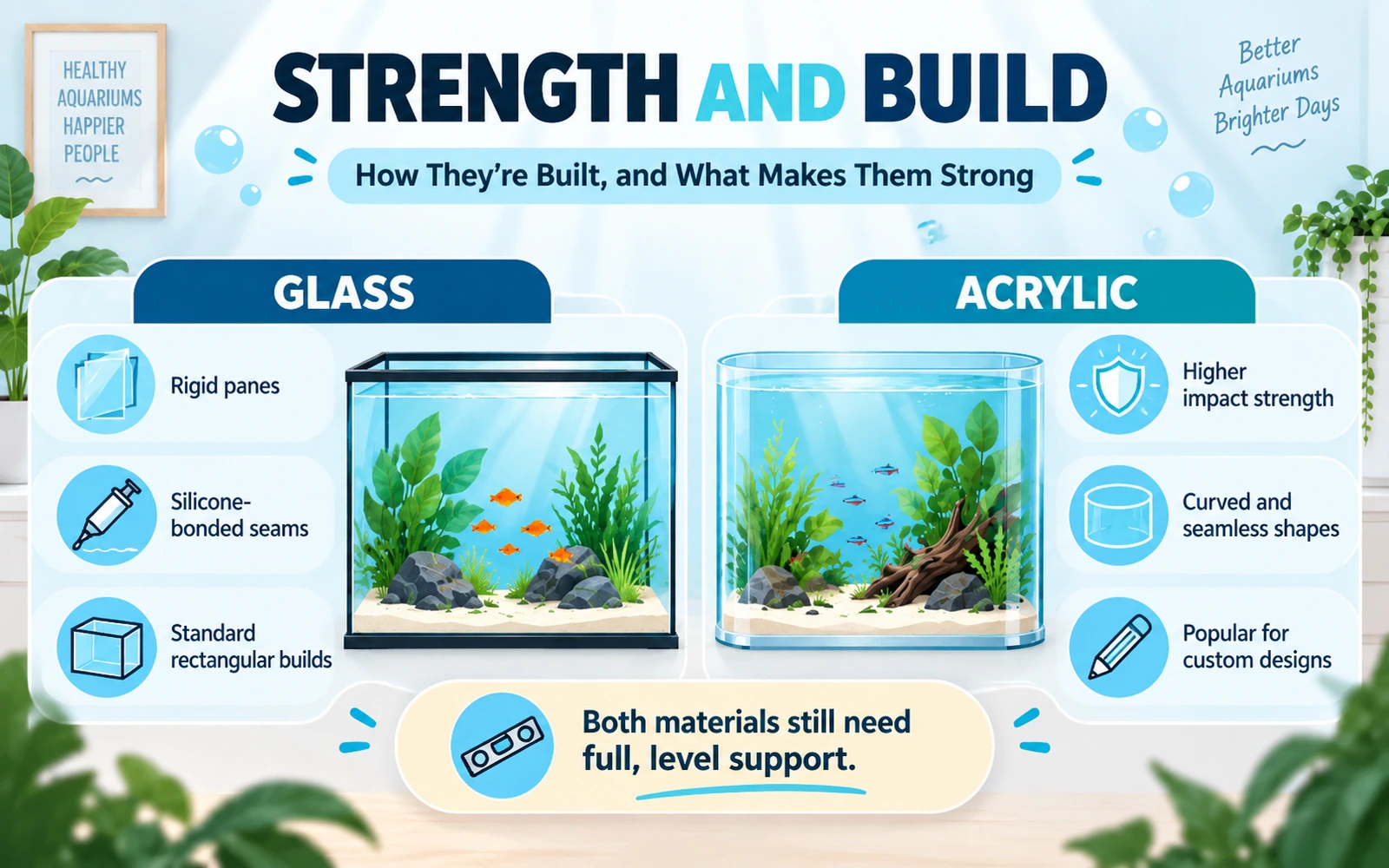
Acrylic tanks are joined differently and can be formed into curves and seamless shapes that glass cannot. That design freedom is part of why acrylic appears in custom and large builds.
For either material, the seams and joints carry the most stress when support is uneven, which is why the stand matters as much as the tank.
Scratching: The Beginner's Real Issue
This is where the choice usually gets made, because cleaning is constant.
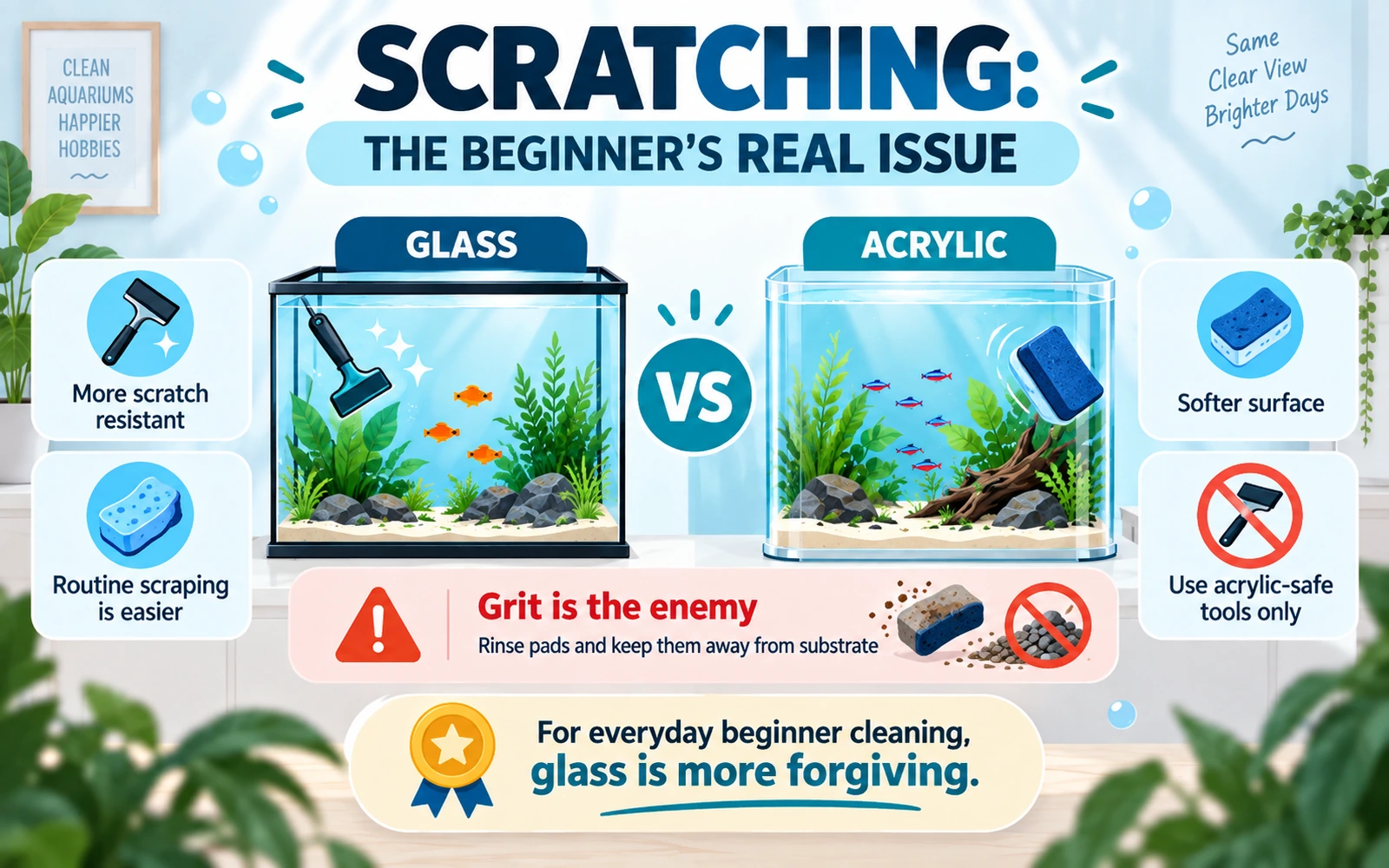
Every tank gets algae on the inside of the front panel. You wipe or scrape it off, often weekly. On glass, that is forgiving. Glass sits at 6 on the Mohs hardness scale, and most cleaning tools are made for it. On acrylic, the same routine needs care: a scraper or pad made for glass, a grain of sand caught in a sponge, or gravel dragged along the panel can leave marks.
Two practical points for either material:
- Grit is the enemy. A cleaning pad that has picked up substrate will scratch acrylic and can mark glass too. Rinse it and keep it off the bottom.
- Use tools made for your material. Tools sold for acrylic say so. If a tool does not state it is acrylic-safe, do not use it on acrylic.
Tough algae such as the hard green dots described in our page on green spot algae on aquarium glass usually needs scraping. That is simple on glass and needs more caution on acrylic.
The upside for acrylic: Wikipedia's aquarium article notes that "unlike glass, scratches in acrylic can be polished out." It is extra work, and on the inside of a filled tank it is not simple, but it is possible.
Clarity and Look
Both materials are clear. Wikipedia gives PMMA's refractive index as about 1.49 and soda-lime glass as about 1.52, and notes that PMMA transmits up to 92 percent of visible light at 3 mm thickness. In a home tank, both look good when clean.
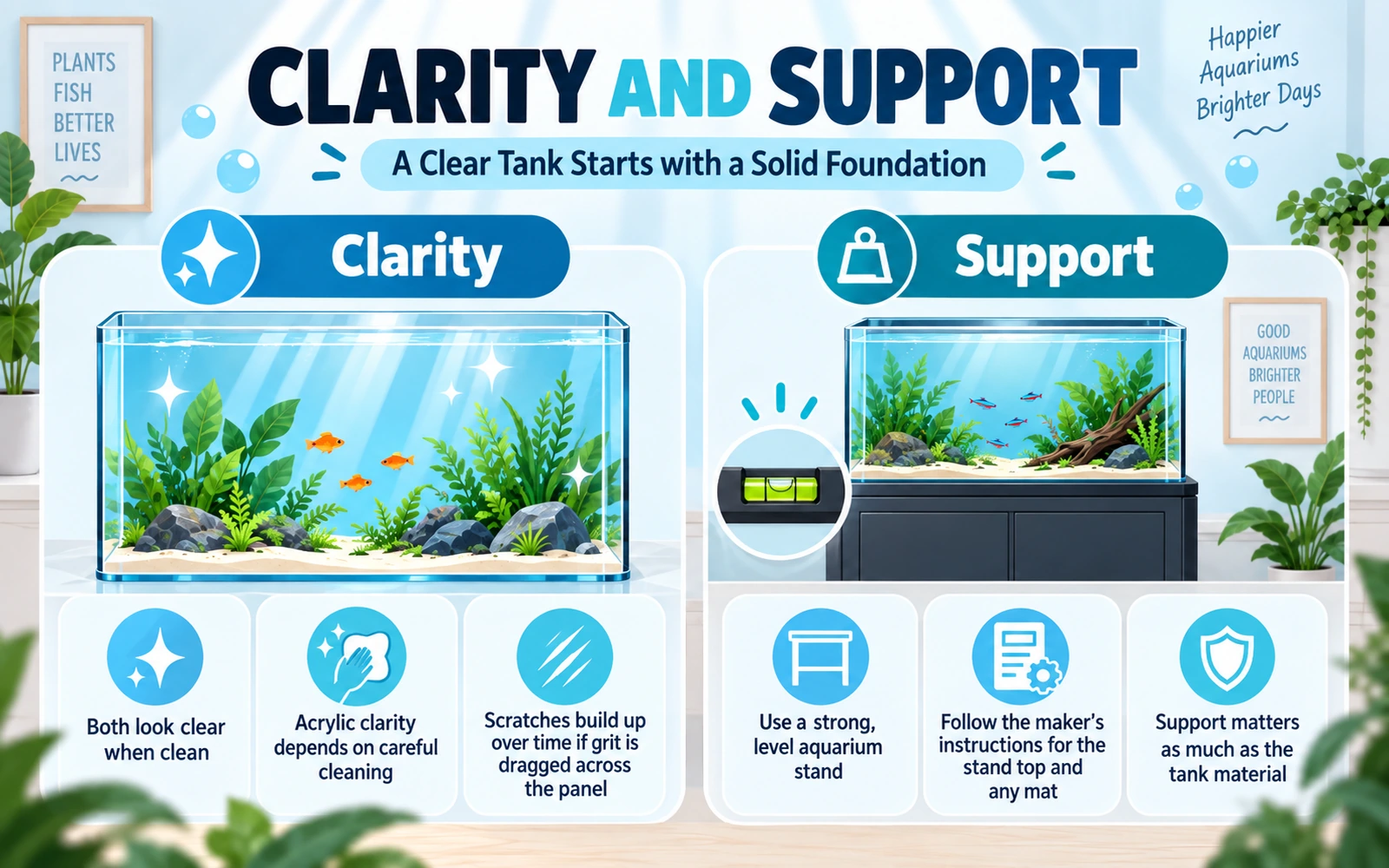
The bigger difference over the years is care. An acrylic tank's clarity depends heavily on how carefully it has been cleaned, because scratches build up where grit has been dragged across it.
Support: Read the Maker's Requirement
Both materials need a strong, level stand, and Wikipedia's aquarium article states that "a tank that is not level may distort, leak, or crack." How each tank must be supported differs by design. Some rest on a frame around the bottom edge, others need even support across the whole base, and acrylic tanks in particular vary in what they require.
Follow the tank maker's instructions on the stand top and any mat, and use a stand made for aquariums rather than furniture. The first aquarium setup checklist puts stand and placement first for this reason.
Temperature and Equipment
Wikipedia's aquarium article says acrylic provides "a certain amount of temperature insulation." In a room that swings in temperature, that can help slightly, but it does not replace a correctly sized heater for a tropical tank, and it does not change the range your fish need. Our page on aquarium water temperature covers why that range depends on the species.
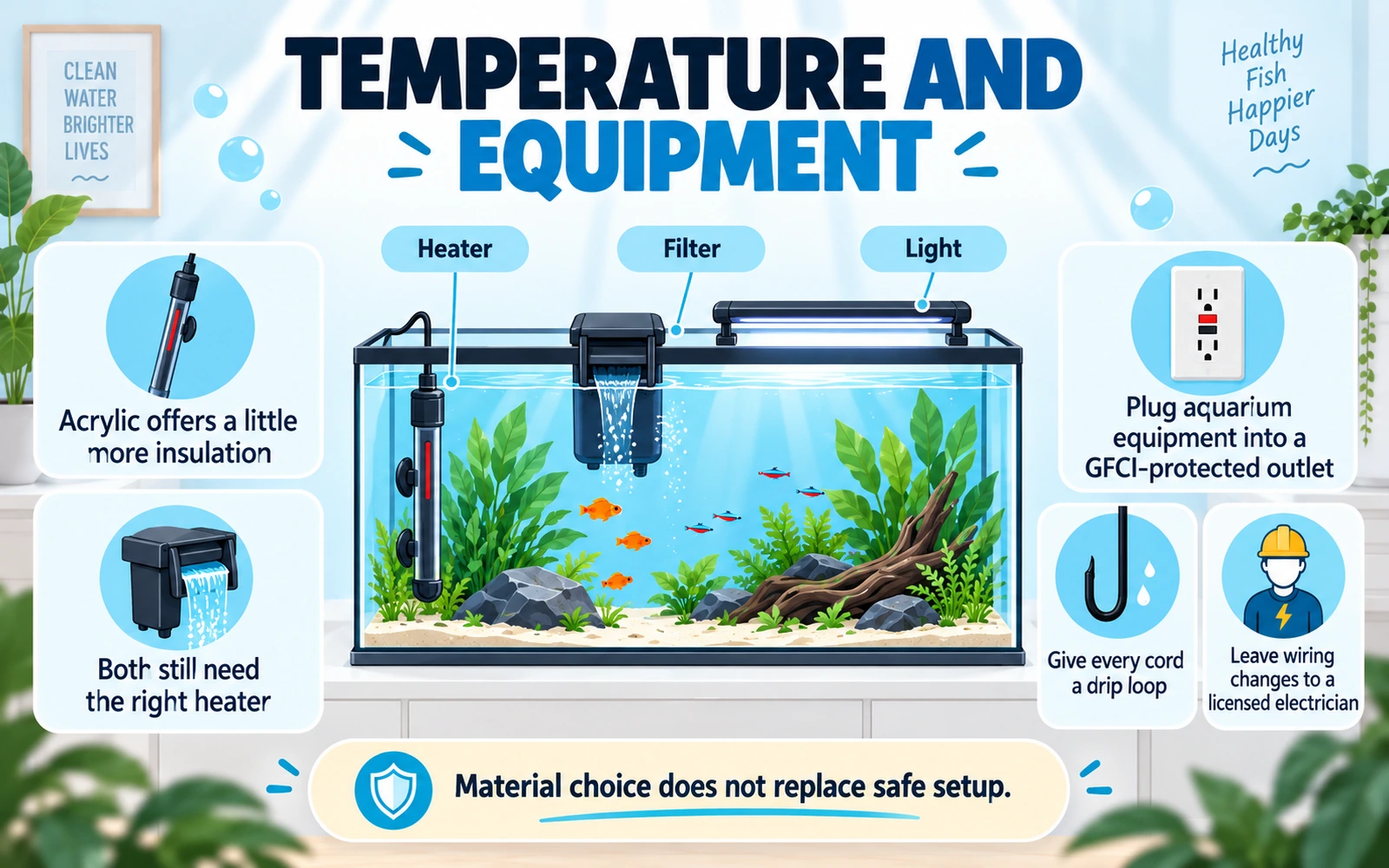
Whichever you choose, heaters, filters and lights sit next to water. Plug them into a GFCI-protected outlet; the Electrical Safety Foundation International says a GFCI "should be used in any indoor or outdoor area where water may come into contact with electrical products" (read September 11, 2026). Give every cord a drip loop so water drips off before reaching the plug, and leave any wiring changes to a licensed electrician.
Price, Honestly
This site does not quote prices, because they change constantly and vary by maker. What can be said from the sources: Wikipedia's aquarium article notes that price is one of the main considerations and that "for very large tanks, the price difference tends to disappear." At the small and mid sizes most first tanks come in, glass is widely available in standard sizes, which also makes matching stands and lids easier to find.
So Which for a First Tank?
Choose glass if:
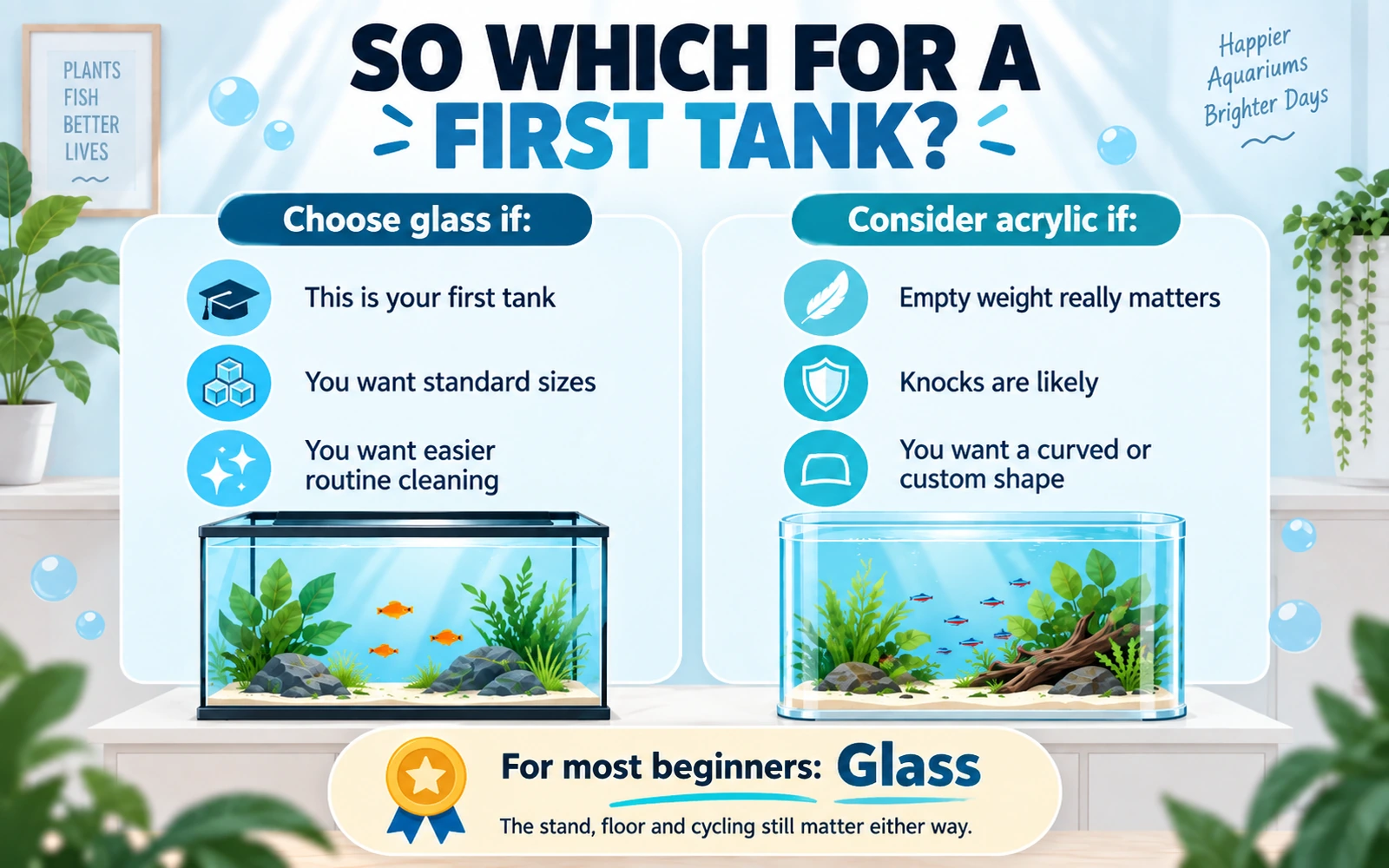
- This is your first tank and you are still learning to clean it.
- You want a standard rectangular size with easy-to-find stands and lids.
- The tank will not need to be moved often.
Consider acrylic if:
- Weight when moving the empty tank is a real constraint.
- The tank is in a spot where knocks are likely.
- You want a shape glass cannot provide, and you are prepared to clean carefully.
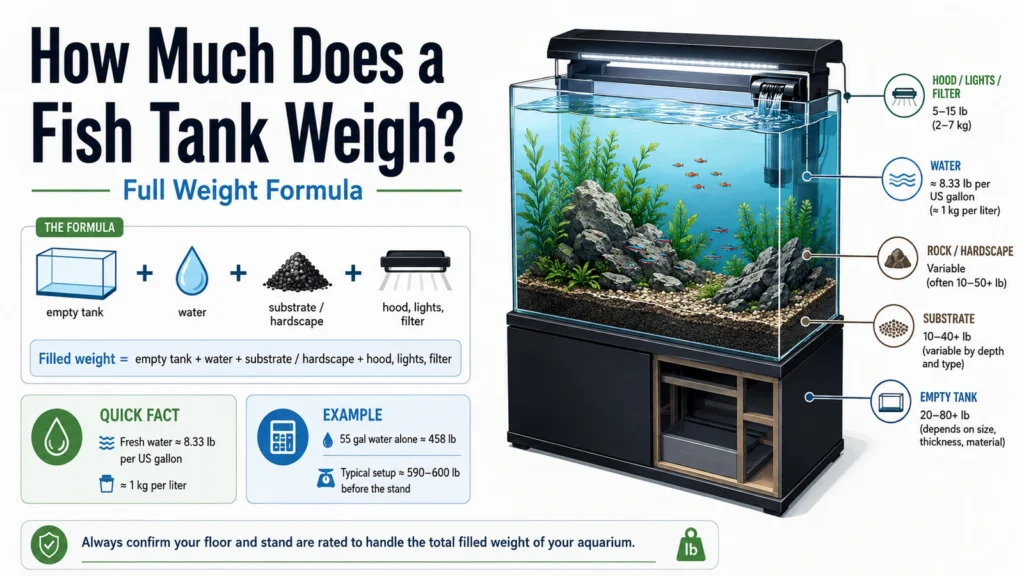
Either way, the material does not change the size, the stand, the floor or the need to cycle the tank before fish go in. Those questions come first.
FAQ
Is glass or acrylic better for a beginner aquarium? For most first tanks, glass. It resists scratching during everyday cleaning and comes in standard sizes with matching stands. Acrylic is lighter and tougher against knocks, but it scratches more easily, so it rewards more careful maintenance.
Does acrylic scratch easily? More easily than glass. Wikipedia's article on PMMA describes it as softer and more easily scratched than glass. Use cleaning tools labeled as acrylic-safe and keep grit out of your sponge. Acrylic scratches can be polished out, unlike glass scratches.
Is an acrylic aquarium much lighter when full? Only by the difference in the shell. Acrylic is roughly half the density of glass, so the empty tank is much lighter, but the water is the same weight either way and makes up most of the load.
Does acrylic yellow over time? It has a reputation for it, but this page could not confirm a current, sourced figure for modern aquarium acrylic. Check the maker's own statement for the specific tank before you buy.
For a first tank, the material matters less than the stand under it and the patience before the fish go in.