The best answer to where to place an aquarium in a room is an interior wall, out of direct sunlight, away from heating and cooling vents or exterior doors, on a level and adequately supported floor, near a grounded outlet with a drip loop, and away from heavy foot traffic or loud speakers. Get those five things right and most of the placement problems that ruin a new tank never happen. Get one of them wrong and you spend months fighting algae, temperature swings, or a wobble in the stand that you cannot explain.
Placement is not a cosmetic decision. It sets the temperature stability, the light exposure, and the physical load the tank experiences every single day, and none of those are things you can fix later with an additive.
Why Placement Matters More Than It Looks
An aquarium is a closed, glass-walled column of water sitting on a floor that was built for furniture weight, not a fish habitat. Every placement mistake traces back to one of four forces: light, temperature, vibration, or weight.
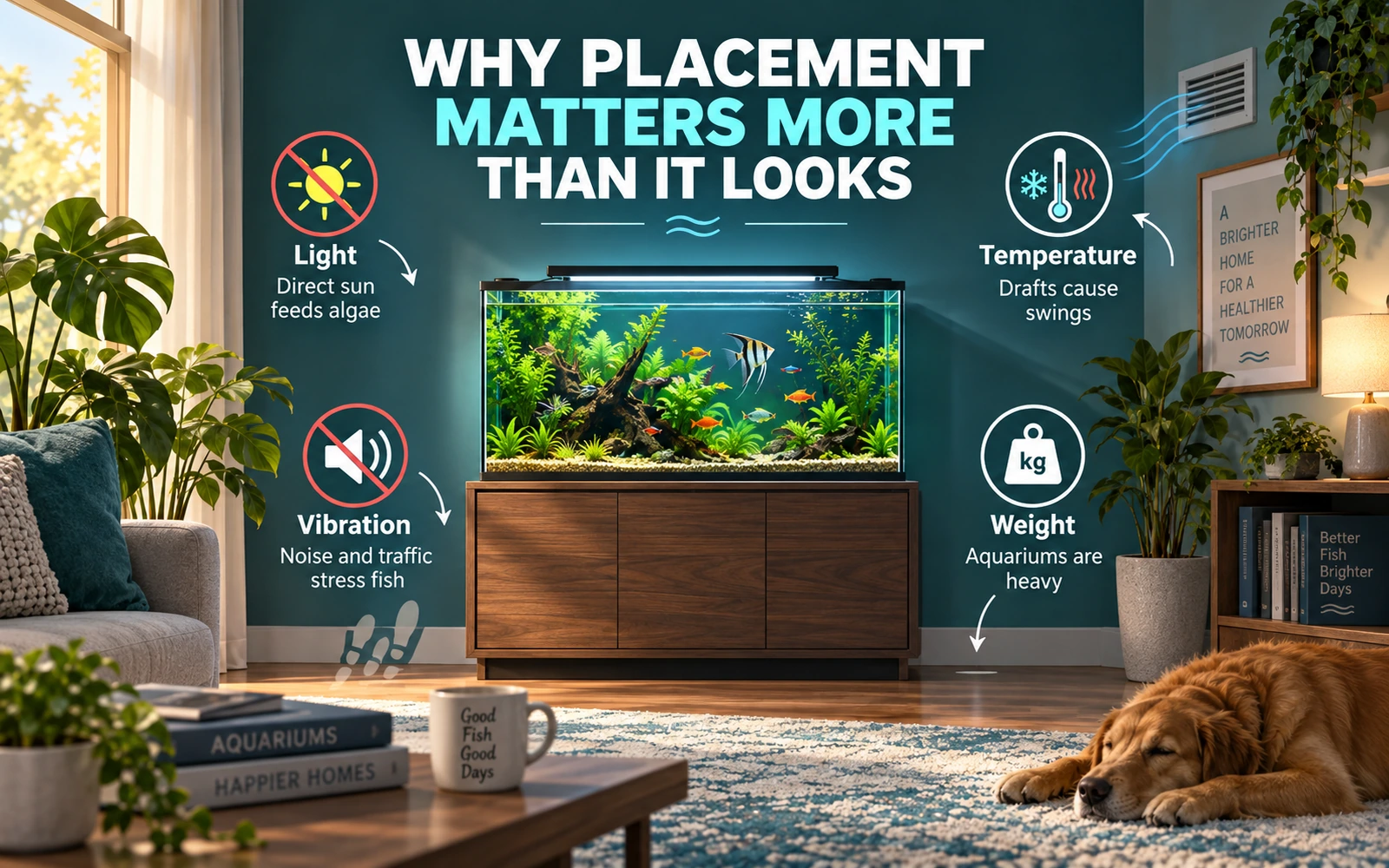
Direct sunlight through a window does two things at once. It heats the water unevenly through the day, and it feeds algae with far more light energy than any aquarium light fixture delivers. A tank that looks clean in October can turn green within weeks once spring sun starts hitting the glass for even two or three hours a day.
Temperature swings work the same way from the other direction. A tank pushed up against an exterior door, a window draft, or a heating or cooling vent experiences small but repeated temperature shifts that a heater or the room's ambient air cannot fully smooth out. Fish tolerate a stable temperature far better than they tolerate a swinging one, even if the swing stays within a range that looks fine on a thermometer.
Vibration and constant foot traffic add a stress load that is easy to dismiss because you cannot see it. Water carries sound and vibration efficiently, and a tank near a front door, a stairwell, or a subwoofer is under more acoustic stress than a tank on a quiet interior wall.
Weight is the force people forget until it is too late. A fully stocked aquarium, water, gravel, rock and stand included, is one of the heaviest single objects most households ever put on a floor.
Where to Place an Aquarium in a Room: The Best Spot
Walk the room and score each candidate spot against this list before you commit:

- An interior wall, not an exterior one. Interior walls run a more stable temperature year-round because they are not directly exposed to outdoor heat or cold.
- No direct sun for any part of the day. North- or east-facing rooms are usually safer than south- or west-facing ones; if a window cannot be avoided, blinds or curtains that stay closed during peak sun hours are a real fix.
- A level, structurally sound floor. Check level front-to-back and side-to-side with a spirit level before the stand goes down, and shim the stand rather than the floor if it is off by a small margin.
- A grounded outlet within easy reach, so cords are not stretched across a doorway or run through an extension cord.
- A room you actually spend time in. A tank in a rarely used spare room gets checked less often, and small problems, a clogged filter, a heater stuck on, get caught later.
- Enough clearance on the access side for water changes, filter maintenance, and lifting equipment in and out without leaning over the glass.
Where Not to Put a Fish Tank
A few specific spots come up again and again as the reason a tank never quite settles down.
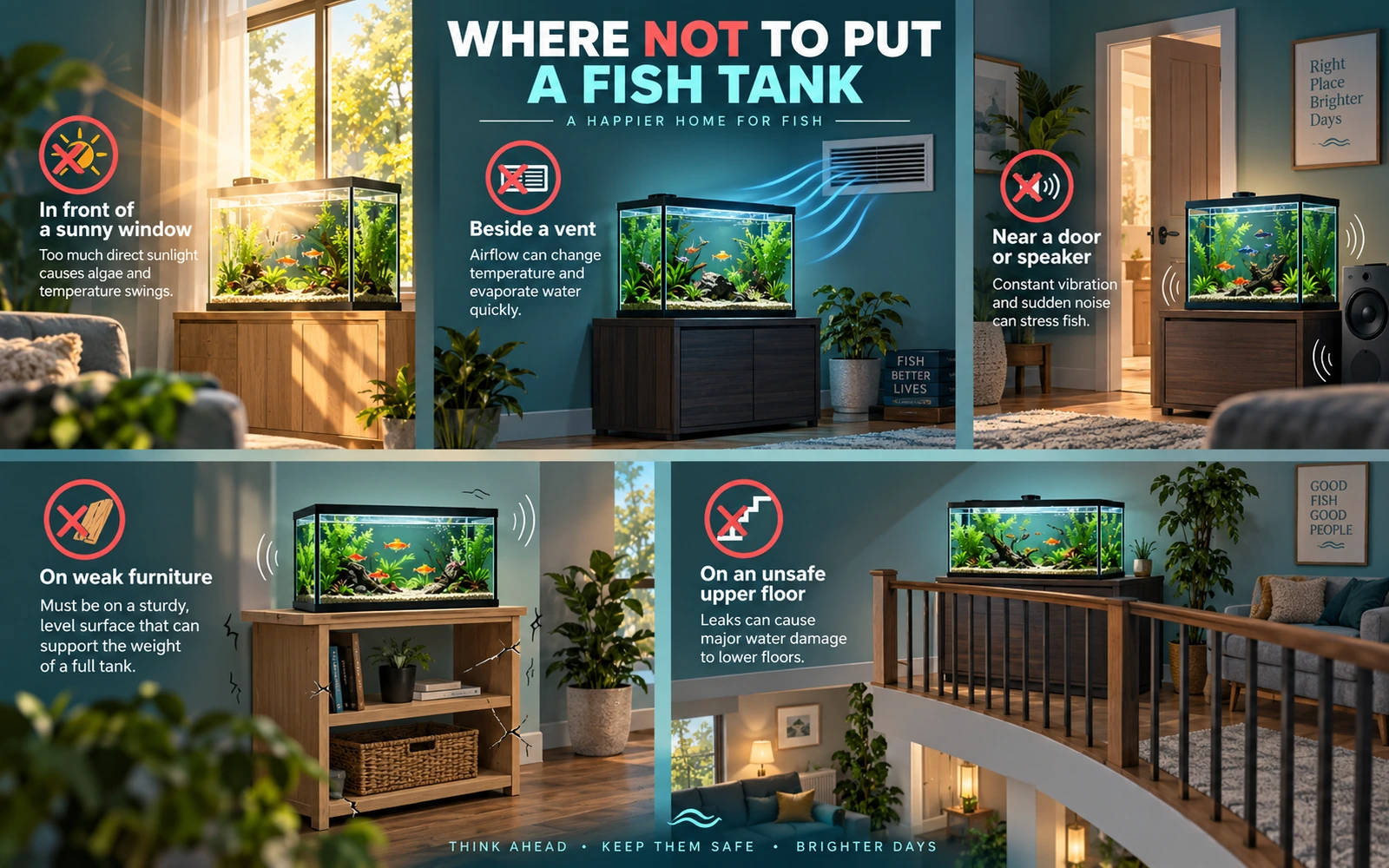
In front of, or beside, a sun-facing window. This is the single most common placement mistake. Beyond the temperature swings already covered, a south-facing window that floods the tank with direct light for even part of the day is one of the fastest ways to trigger green spot algae on the aquarium glass, and light that swings between bright and shaded through the day can just as easily feed black beard algae, which is considerably harder to clear once it takes hold.
Directly under or beside a heating or cooling vent. The blast of warm or cold air changes the surface temperature of the tank on a cycle the heater has to fight constantly. Fish that suddenly cluster in one corner or start listing to one side after the HVAC kicks on nearby are showing signs covered in A Fish Is Floating, Sinking or Swimming Sideways, and the fix in that situation usually starts with moving the tank away from the draft, not adding medication.
Against an exterior door, in a hallway, or right by a speaker. Every open door is a temperature and draft event, and every slammed door or bass-heavy speaker is a vibration event. Vibration is not just an aesthetic nuisance either: a study on goldfish published in the Journal of Experimental Biology found that noise and vibration exposure produced measurable hearing-threshold shifts and physiological stress responses in the fish (read 2026-09-18), which is one more reason a quiet interior wall beats a spot by the front door.
On unlevel flooring, on furniture not rated for the load, or on an upper floor without checking the joists. This is covered in detail below because it is the placement mistake with the highest cost if it goes wrong.
Weight and Floor Support (Read This Before You Fill the Tank)
This is a safety-critical step, not a preference. A large aquarium that outweighs what the floor beneath it can support is a real flooding and structural hazard, not a hypothetical one. Weight climbs fast once you count the water, the substrate, the rockwork and the stand together, and the number is almost always bigger than it looks from the empty glass box in the store. Before choosing a spot, especially on an upper floor or over an unsupported span, work through the full math in How Much Does a Fish Tank Weigh? Full Weight Formula rather than guessing.
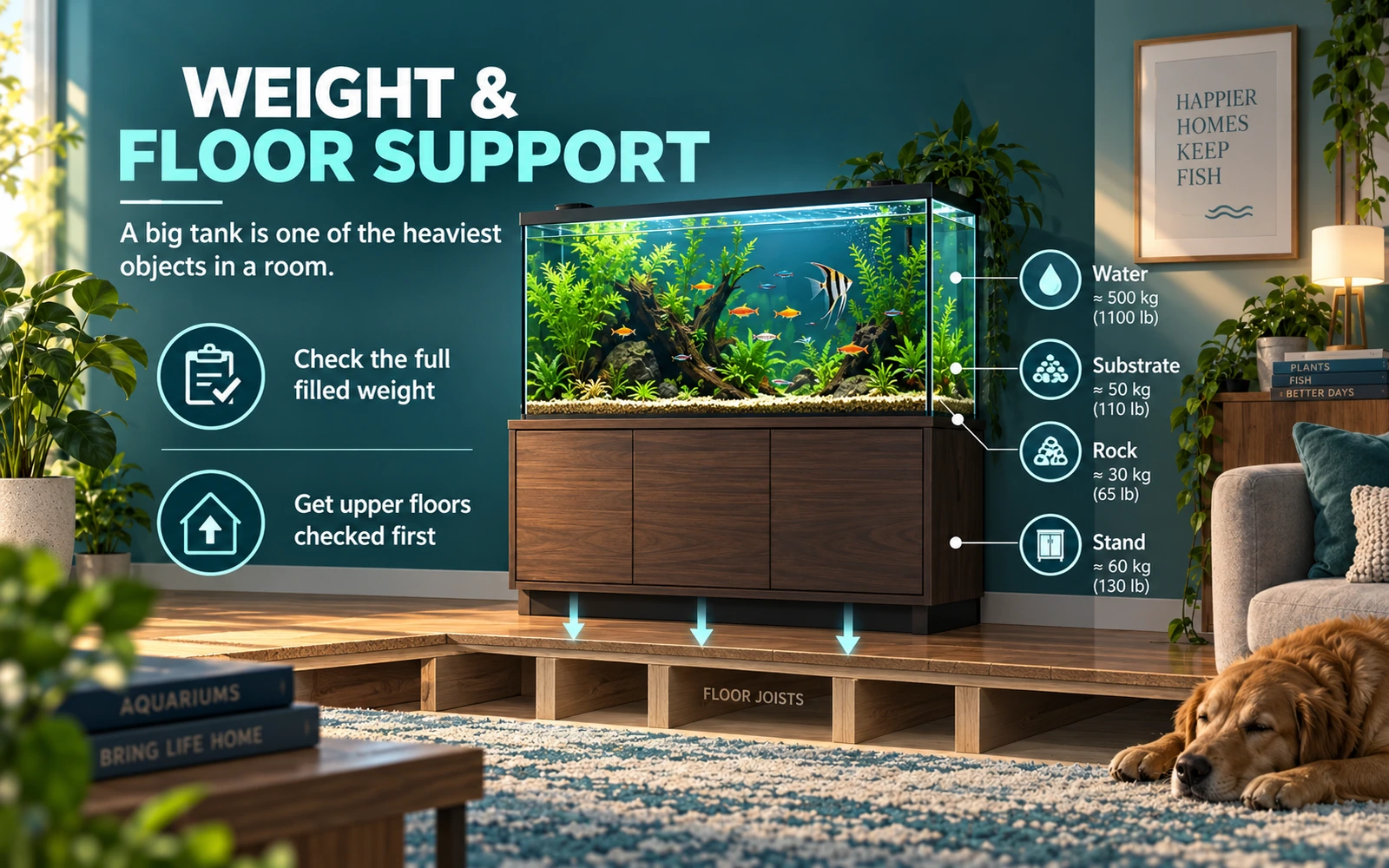
For anything beyond a small tank on a ground-floor slab, get the floor checked by a qualified professional, such as a structural engineer or a contractor familiar with residential floor loads, before the tank goes in, not after a stand starts to creak. This is not a job to solve with more furniture pads or a thicker rug. If the floor is already unlevel, sagging, or bouncy underfoot, that is a stop condition: address the structural issue first, or choose a different spot entirely.
Seal and Glass Safety at Setup
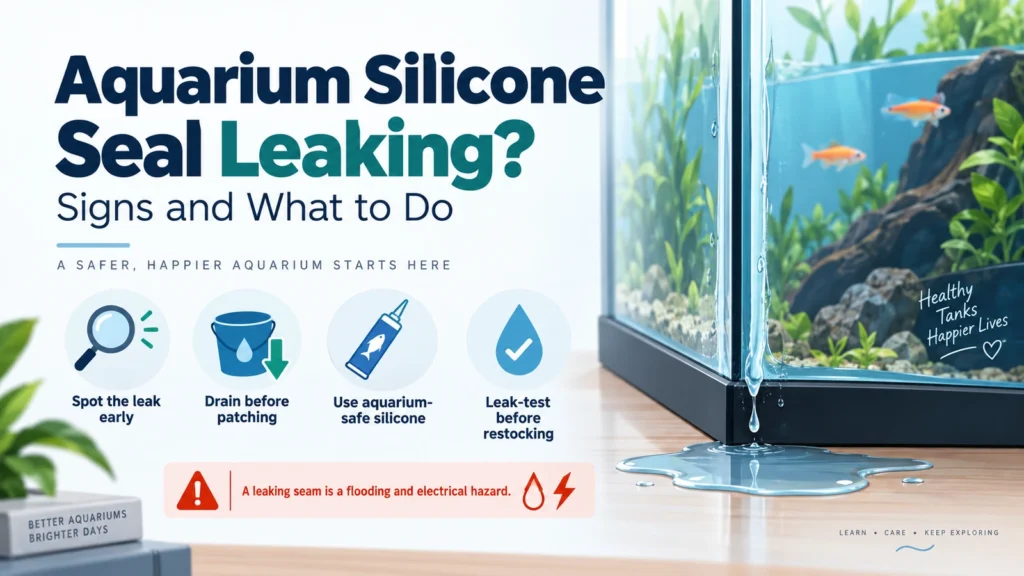
Aquarium seams are built to hold water permanently once cured correctly, but placement stress can shorten that lifespan. Manufacturers of aquarium-safe sealant design specifically for this job: Pentair AES states that its 100% silicone aquarium sealant is fish safe after a 48-hour cure and is built for continuous submersion without breaking down or losing adhesion (read 2026-09-18). That engineering assumes a level, stable stand underneath it, not one that rocks, twists slightly on an uneven floor, or bakes in direct sun that cycles the glass and seal through repeated heating and cooling.
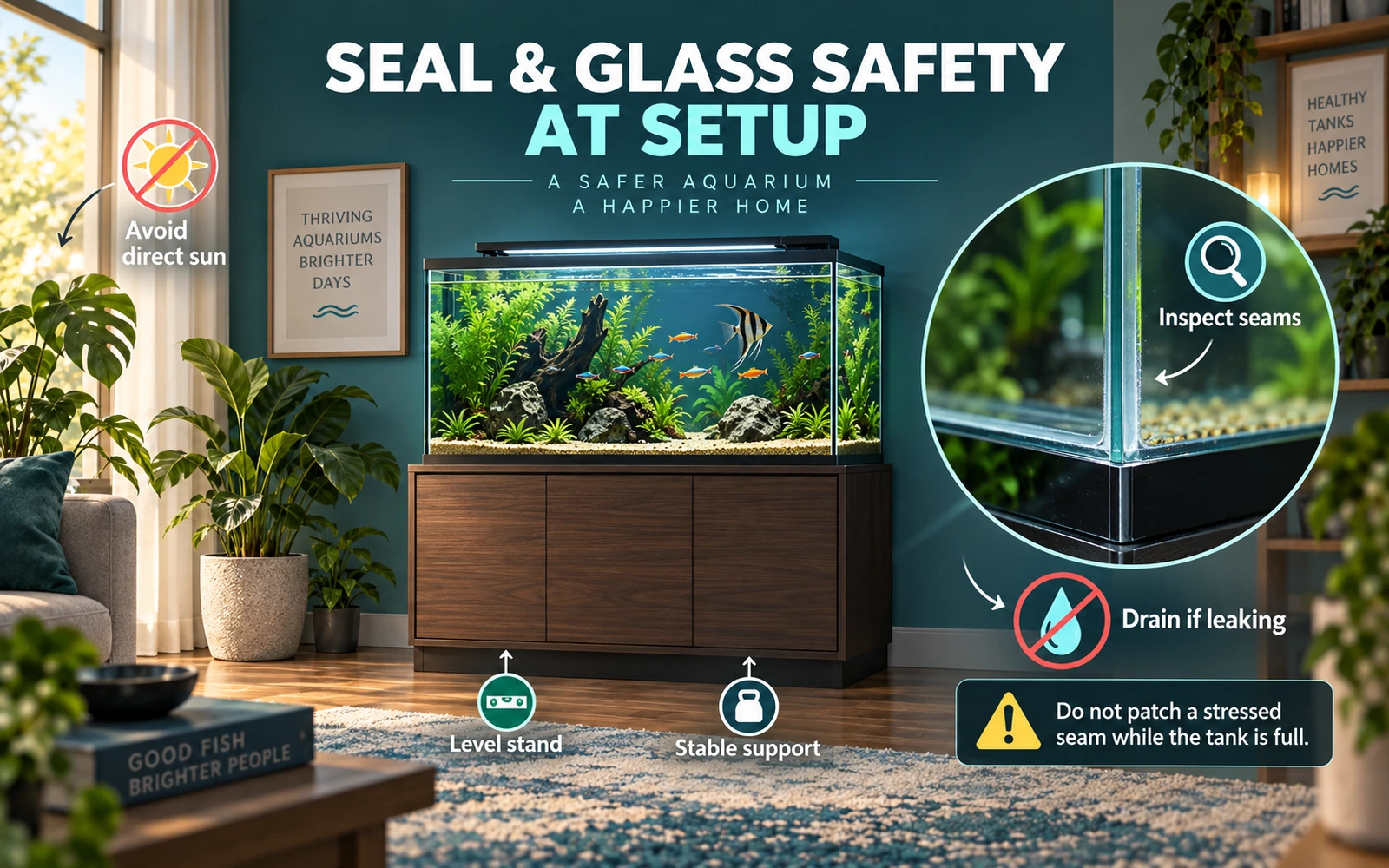
If you ever notice a bulging seam, a slow drip along a bottom edge, or a fast leak, that is a flooding and glass-failure hazard. A large or actively worsening leak needs the tank drained immediately and a professional glass or seal inspection, not a DIY attempt to resilicone a seam while the tank is still full. Trying to patch a stressed seal under load can make a slow leak into a sudden failure.
Electrical Safety Near Water
Any spot you choose has to work for the cords, not just the tank. Water and household electricity share the same short list of hazards regardless of tank size, so treat this as a fixed requirement of the spot, not an afterthought.
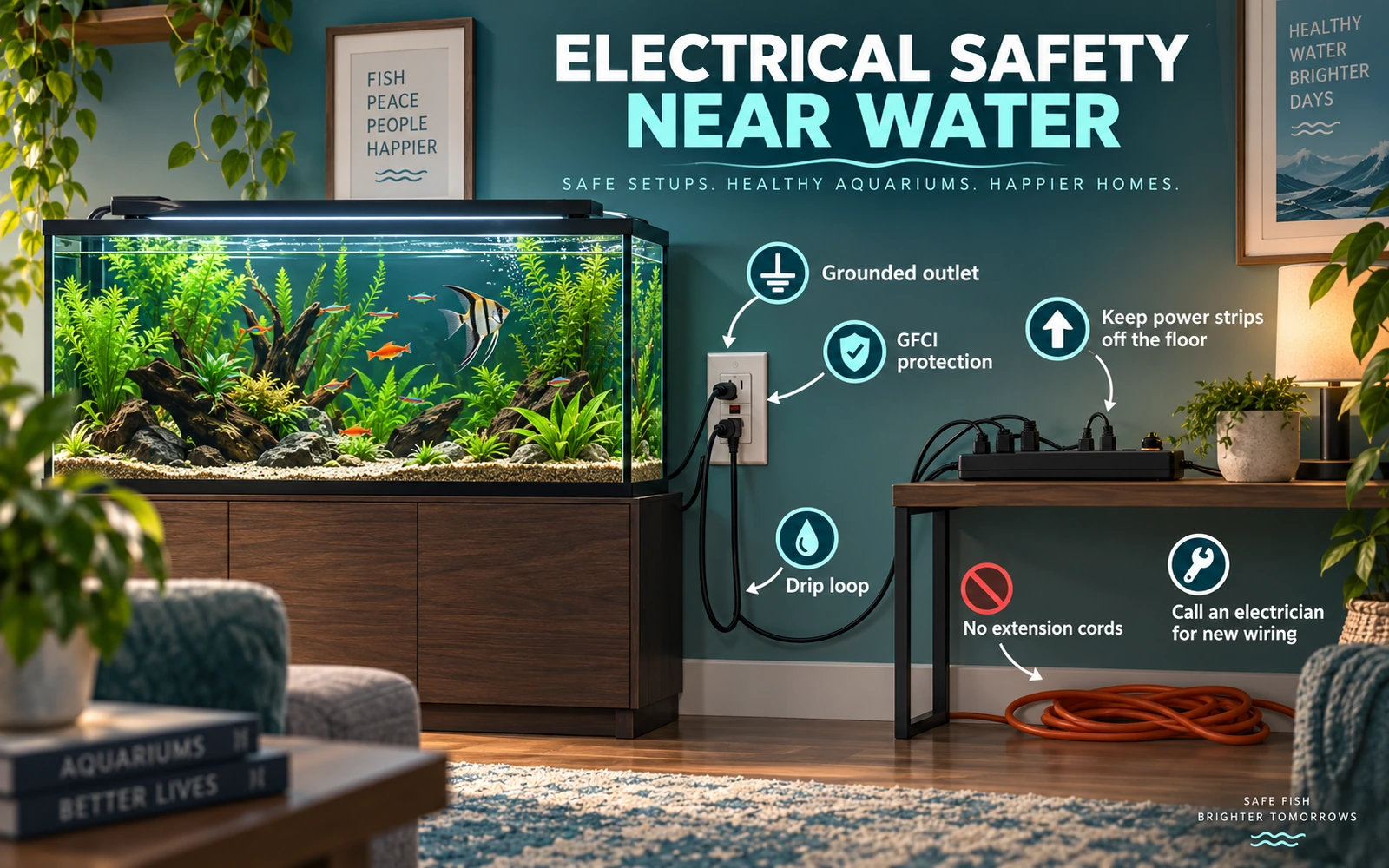
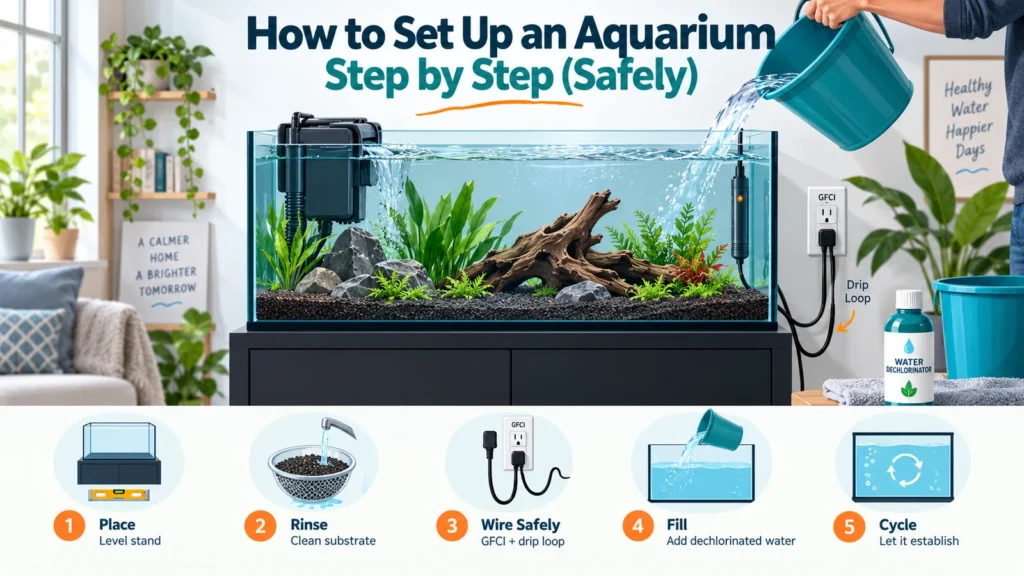
- Use a grounded outlet, ideally one protected by a ground-fault circuit interrupter (GFCI), which is designed to cut power quickly if water reaches a live connection.
- Build a drip loop into every cord, letting the cable dip below the outlet before it rises to the plug, so any water that runs down the cord drips off before it reaches the socket.
- Avoid extension cords and overloaded power strips; a dedicated outlet or a purpose-built aquarium power center is the safer choice.
- Never open a breaker panel or run new household wiring yourself. If the room needs a new circuit or an outlet moved, that is work for a licensed electrician, not a DIY placement fix.
None of this changes with tank size. A five-gallon betta bowl and a 75-gallon community tank both sit next to the same outlet risk, and the drip loop and GFCI habit costs nothing to build in from day one.
A Quick Placement Checklist
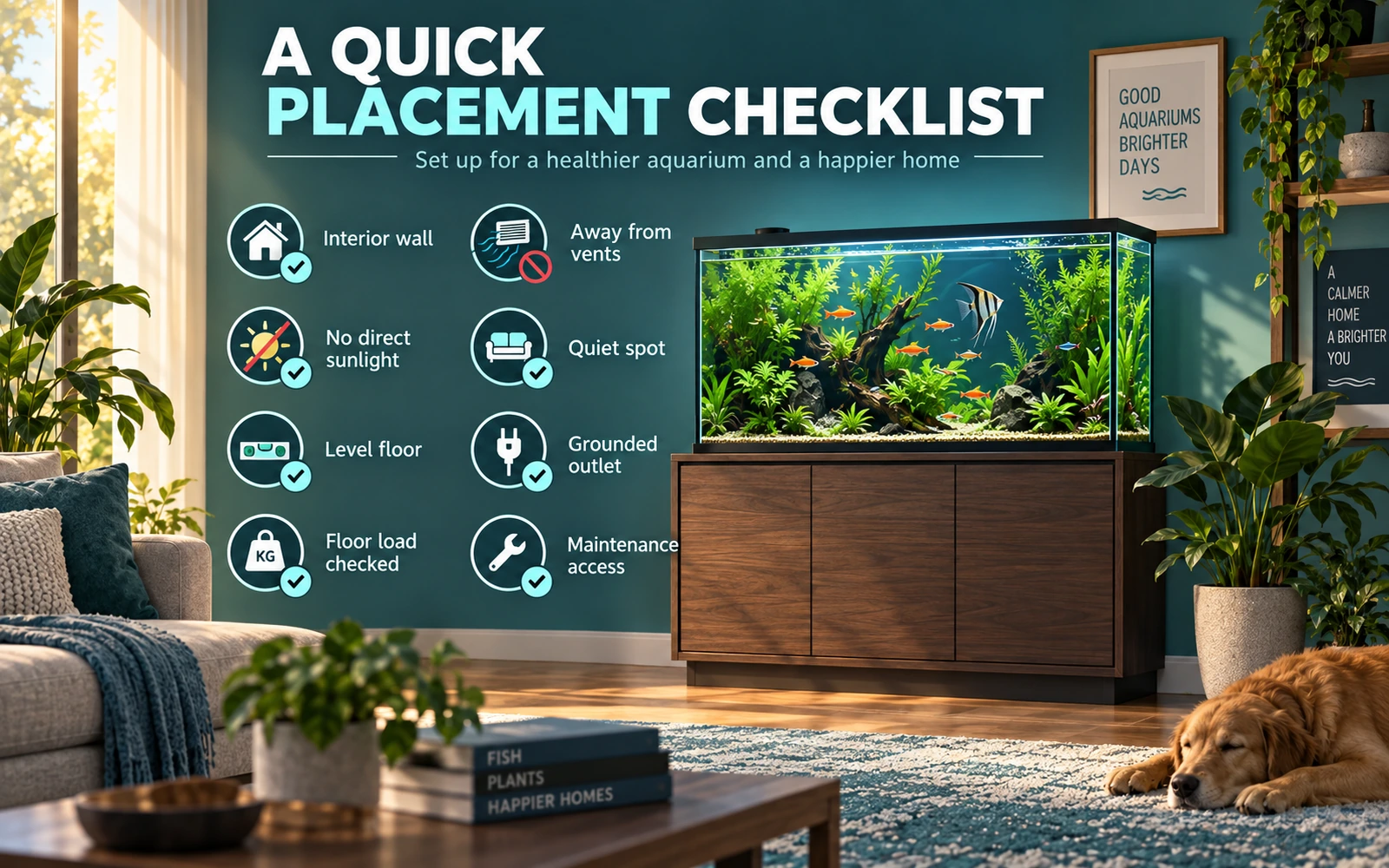
- Interior wall, not against an exterior wall or door
- No direct sunlight at any point in the day
- Level floor, confirmed with a spirit level, not by eye
- Floor load checked against the tank's full filled weight, especially upstairs
- No heating or cooling vent within the tank's direct airflow
- Quiet spot, away from speakers, stairwells, or a front door
- Grounded outlet nearby with room for a proper drip loop
- Clear access on at least one side for maintenance
FAQ
Can I place an aquarium near a window if I use blinds? It can work if the blinds or curtains stay closed during the hours the sun actually reaches the tank, but it is a compromise, not a fix. Even filtered light through thin curtains can be enough to encourage algae over weeks, so an interior wall with no window involved is still the more reliable choice.
Does a fish tank have to be on the ground floor? Not always, but larger tanks need the floor checked first. A small tank on a normal residential floor is rarely an issue; a large tank on an upper floor, especially over an unsupported span, should be reviewed by a qualified professional before setup, as covered in the weight and floor support section above.
Can I put an aquarium on carpet? Carpet itself is not the hazard; what is underneath it is. The floor structure below the carpet still needs to meet the same load and level requirements as any other flooring, and a stand needs a firm, flat base, so a thick or uneven rug pad under the stand should be avoided.
How far should a tank be from a heating vent or radiator? Far enough that the airflow or radiant heat never hits the glass directly. There is no fixed distance because vents and rooms vary, so the practical test is whether you can feel a temperature difference at the tank's surface when the heating or cooling is running; if you can, move the tank.
What size tank is safe on a normal floor? Most standard residential floors handle small to mid-sized tanks without special reinforcement, but "safe" depends on the specific floor, the span, and where the tank sits relative to the joists, not just the gallon number. Work out the actual filled weight first, then get a professional opinion for anything sizable rather than assuming the floor is fine.