A fish whose tail is fraying looks the same to a worried owner whatever caused it, and the internet's answer is almost always the same too: it is fin rot, here is what to buy.
That answer is wrong often enough to matter, because at least three different things produce a damaged fin and only one of them is an infection. Treating the tank for a disease it does not have means medicating healthy fish, and often means harming the filter bacteria as well, while the actual cause carries on doing what it was doing.
So the useful question is not "what medicine", it is "what is the shape of the damage, and what else is in the tank".
Look at the edge, not the amount
How much fin is missing tells you very little. What the missing edge looks like tells you a great deal.
| What you see | What it usually points at |
|---|---|
| A clean, straight tear or a wedge missing, edges otherwise healthy | Physical damage. Something tore it. |
| Fraying that starts at the outer edge and works inward, often with a pale, cloudy or discolored margin | An infection process. This is what people mean by fin rot. |
| Small crescent bites out of the trailing edge, several of them, on one fish more than others | Nipping by a tankmate. |
| Fins clamped tight to the body but not actually damaged | Not a fin problem at all. A stressed or unwell fish holding its fins in. |
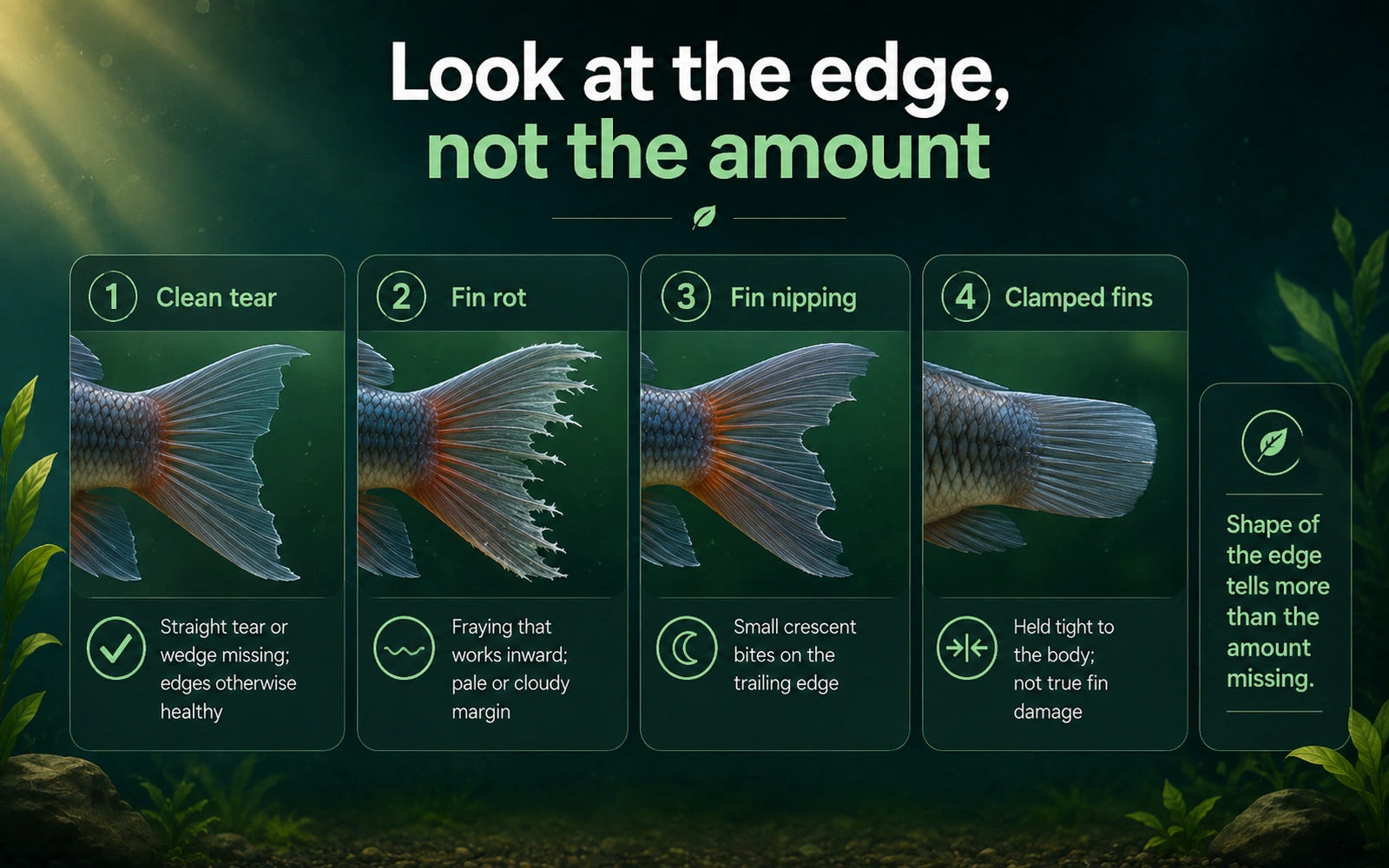
Two more observations sharpen it further.
Is it one fish or several? Damage confined to one long-finned individual in a mixed tank points hard at nipping or at decor. Damage appearing across several fish at once points at the water.
Is it getting worse day to day? Take a photograph today and another in two days from the same angle. A tear that is unchanged, or that is visibly rebuilding a slightly ragged new edge, is healing. A margin that is creeping steadily toward the body is not.
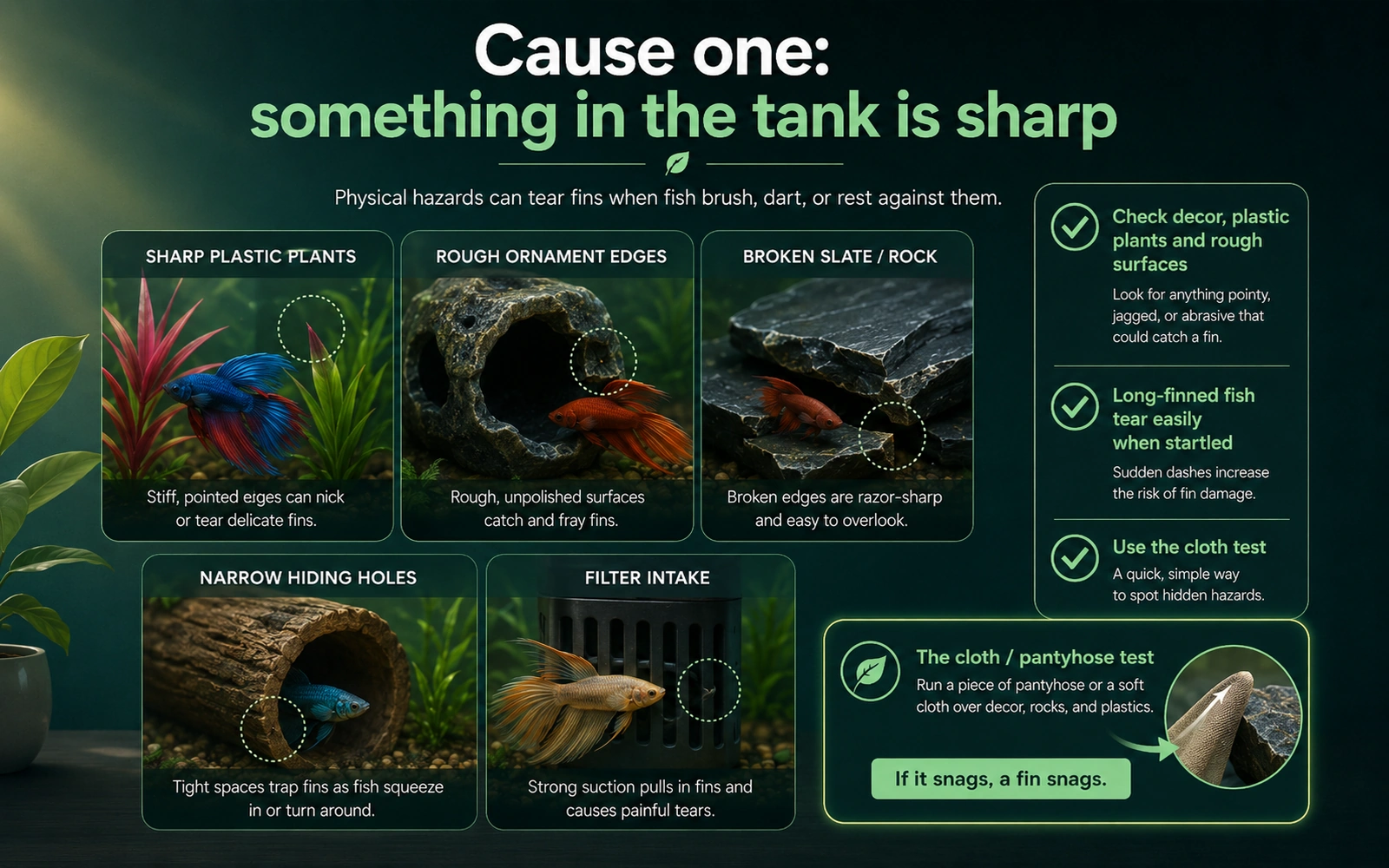
Cause one: something in the tank is sharp
This is the most under-diagnosed of the three and the easiest to fix.
Run a check on everything hard in the tank. Plastic plants with molded seams. Rough or holed decorative ornaments. Broken slate. Anything the fish squeezes through or hides inside. Filter intakes that a long fin can be pulled against.
The classic test is a length of pantyhose or a fine cloth drawn over the surface. If it snags, a fin snags.
Long-finned fish and fish that startle easily are at much higher risk, because the damage happens in a fraction of a second when something spooks them at night.
Cause two: a tankmate is biting
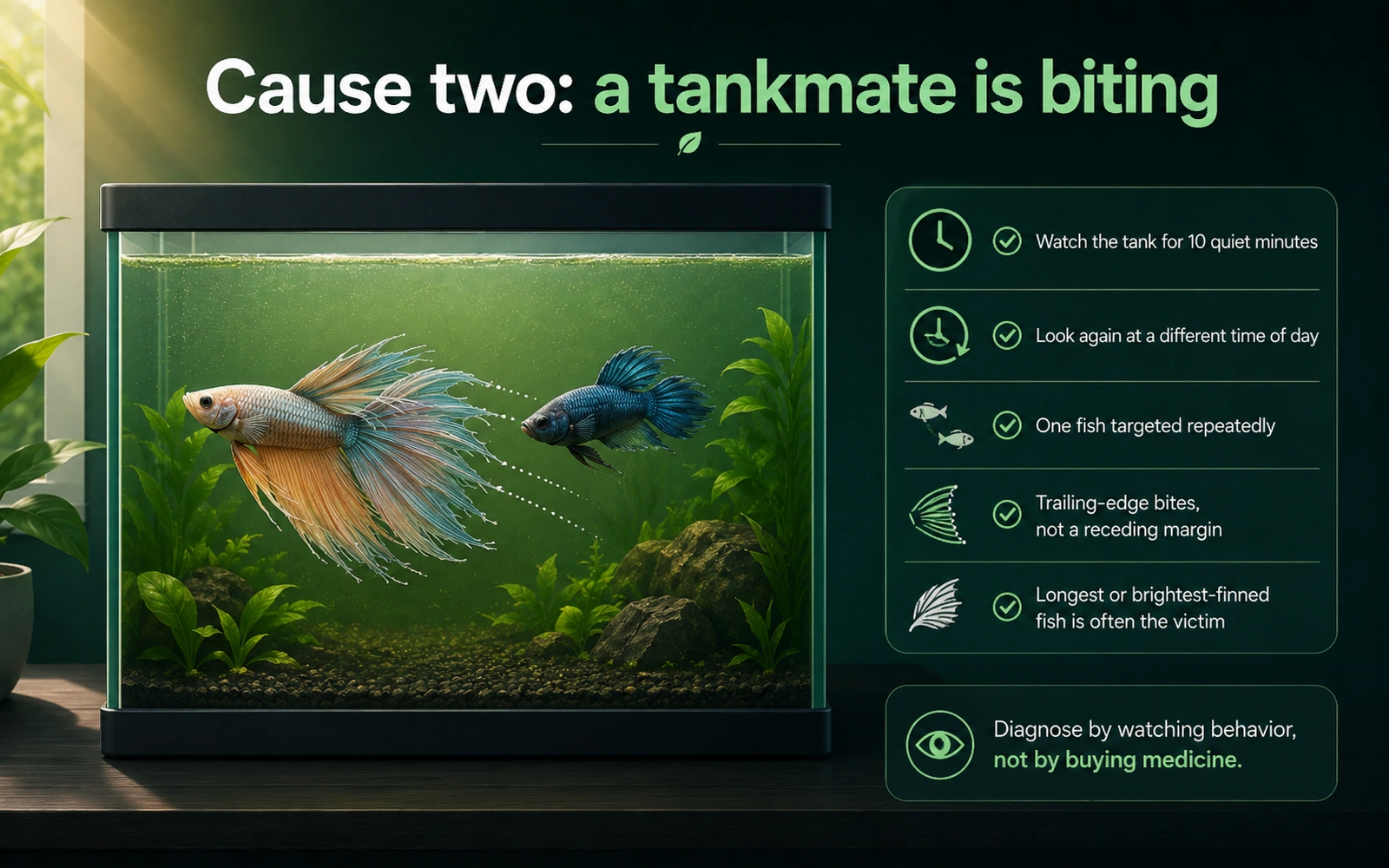
Nipping is behavior, so you diagnose it by watching rather than by inspecting.
Watch the tank for ten quiet minutes with the room lights low and yourself out of view, twice, at different times of day. Feeding time and the hour before lights-out are when it usually happens.
Signs that point this way:
- One fish is targeted repeatedly and the others are untouched.
- The damage is on the trailing edges, in bites rather than in a receding margin.
- The victim has the longest or most colorful fins in the tank.
- You can see the chasing. Nipping is not usually subtle once you are looking for it.
Fixing it is a stocking question, not a medicine question. A group that is too small, a tank that is too crowded, a species combination that was never going to work, or too little cover for the fish being harassed. The tankmate compatibility question is a subject in its own right and it deserves more room than this page has.
Cause three: water quality, which is what fin rot really is
The infection people call fin rot is usually opportunistic. The bacteria involved are ordinary residents of an ordinary tank, and a healthy fish's immune system handles them. What lets them get a foothold is a fish that is already under pressure, and the most common source of that pressure by a wide margin is the water.
So before anything else, test it. Ammonia, nitrite, nitrate, temperature, and note what the readings actually are rather than whether they feel acceptable. If you are unsure what to test or how often, how often to test aquarium water covers the routine, and aquarium water parameters covers what each reading is telling you.
This site does not publish a threshold at which fin damage begins, and that is deliberate. The toxicity of a given ammonia reading depends on pH and temperature, so the same number on two tanks is not the same dose to two fish. What is reliable is the direction: any detectable ammonia or nitrite in a tank with a damaged fish is a finding, and it is the first thing to correct, whatever the number is. Ammonia reading above zero is the page for that.
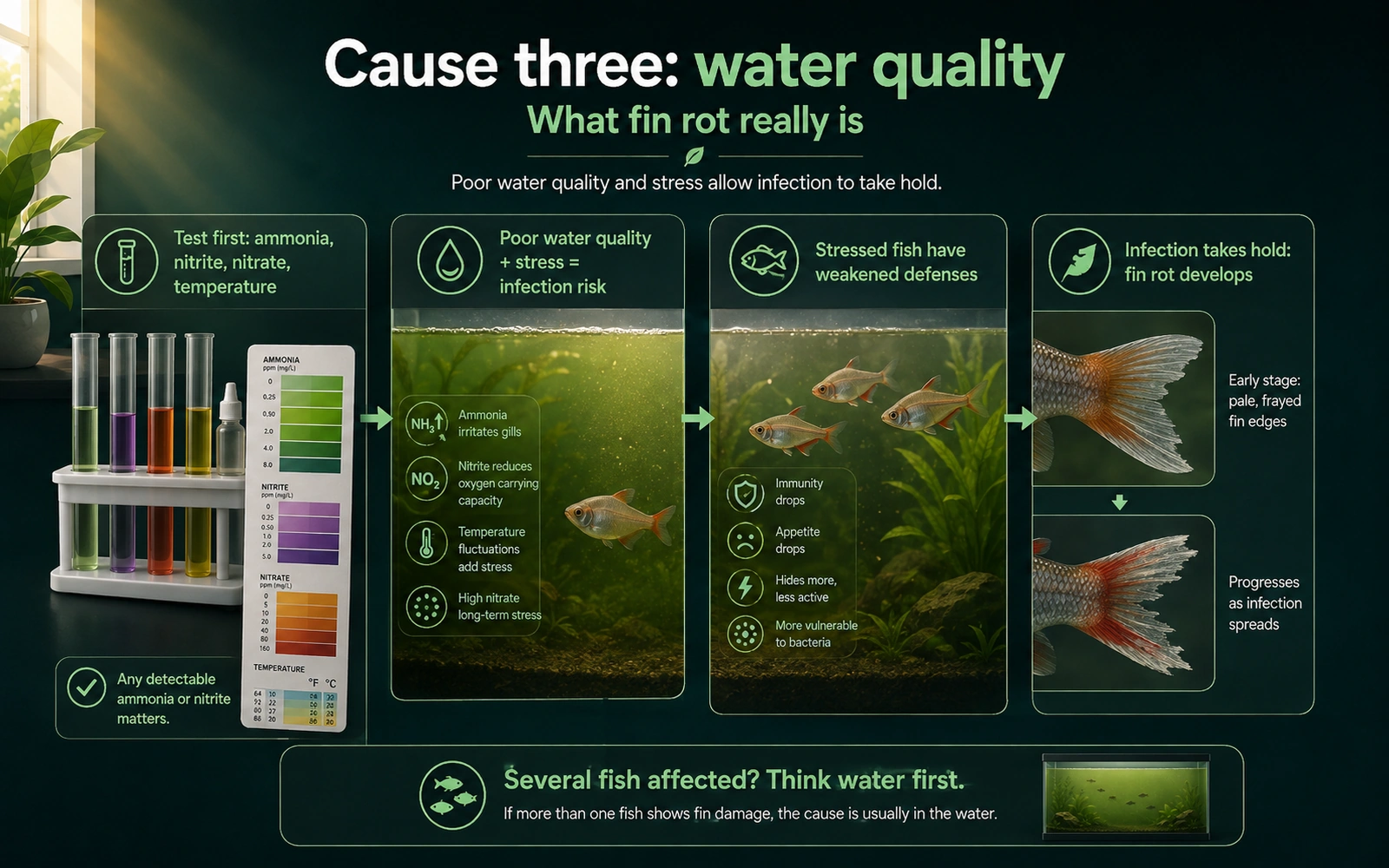
Other pressures that stack on top of water quality: a temperature that swings, a tank that never gets a water change, overfeeding and the decay that follows, and a recent move or a recent addition of new fish.
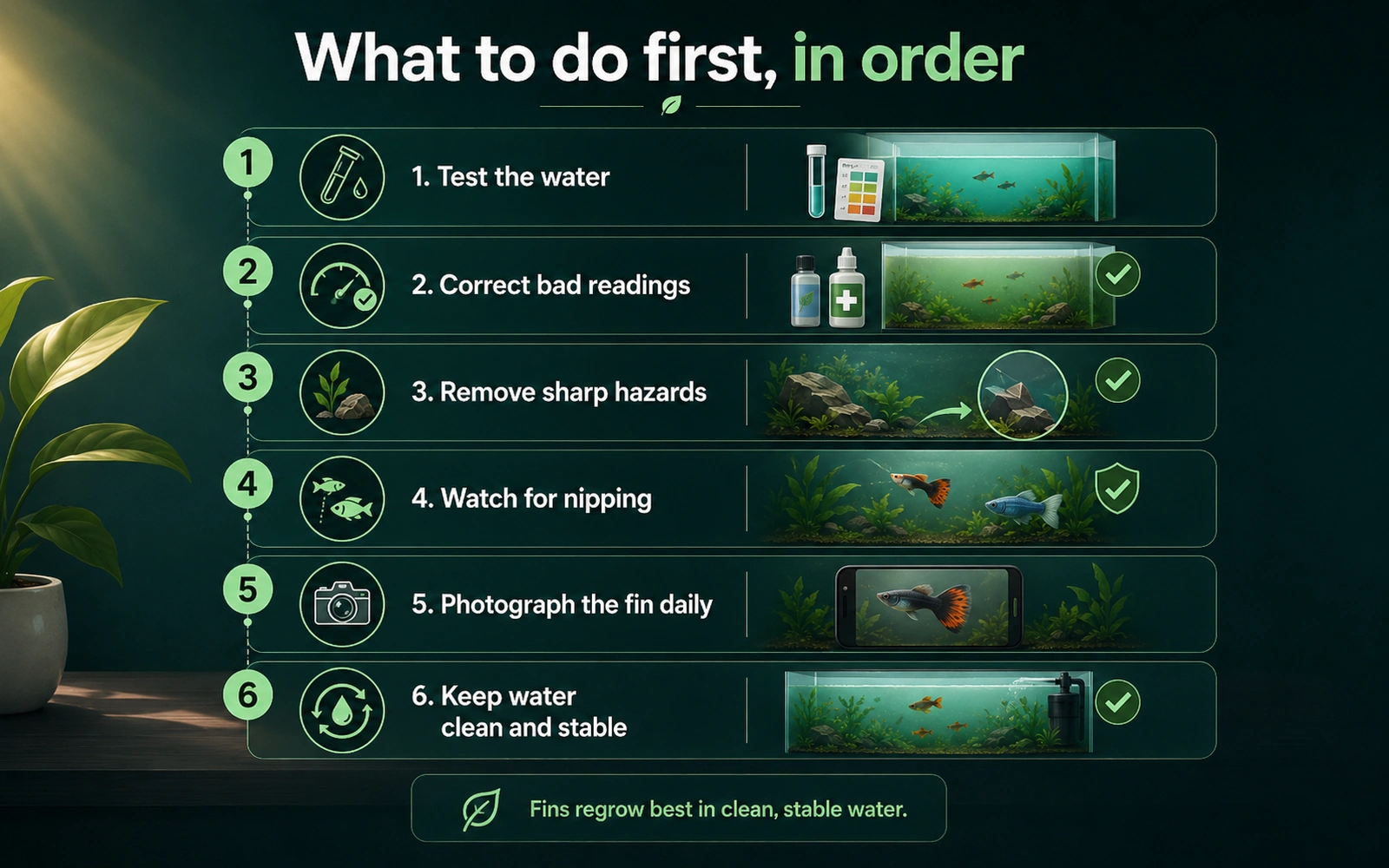
What to do first, in order
- Test the water. Ammonia, nitrite, nitrate, temperature. Write down what you get.
- Correct anything the test found, starting with a water change if ammonia or nitrite is detectable. How to do a water change is the method.
- Find and remove anything sharp. The cloth test.
- Watch the tank twice for ten minutes with yourself out of sight, and note who chases whom.
- Photograph the fin from the same angle each day so you have evidence rather than an impression.
- Keep the routine steady. Clean, stable water is the condition a fin heals in. Fins regrow, though the color and the shape of the regrown tissue may not match what was there.
If the water is clean, nothing is sharp, nobody is biting, and the margin is still receding, that is the point at which this stops being something to solve from a web page.
The treatment this site does not publish, and why
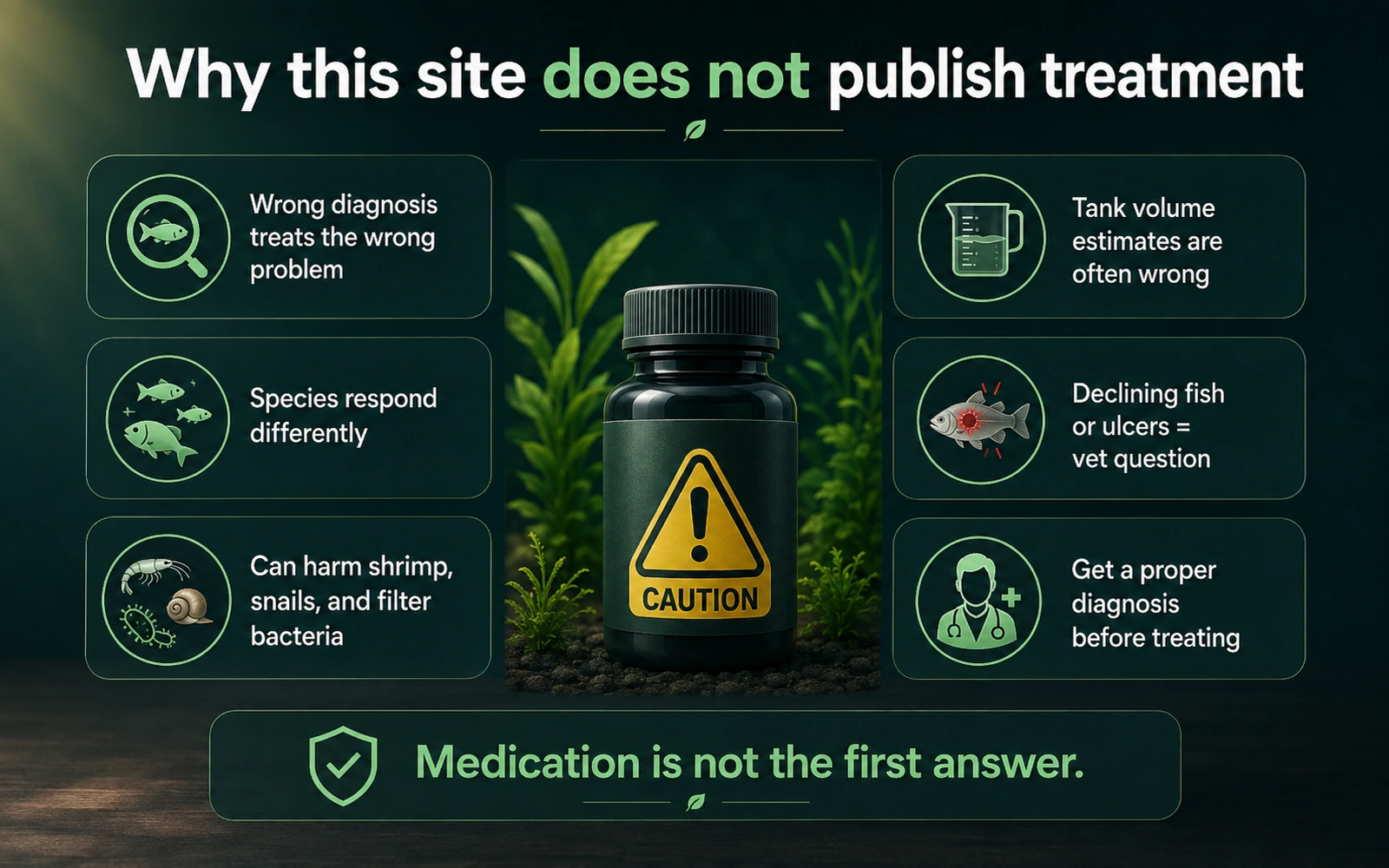
You will not find a medication name, a dose, a salt concentration or a treatment schedule here, and not because the information is hard to find. It is because publishing it would be irresponsible in a way that is easy to miss.
Aquarium medications are dosed by water volume, and a dose is only as accurate as the volume estimate behind it, which for most tanks is the number printed on the box rather than the actual water in the glass. The same compound that is routine for one species is dangerous to another. Several common treatments are lethal to shrimp and snails, and several harm the filter bacteria the whole tank depends on, which converts a fin problem into an ammonia problem within a week.
Most importantly, the fin is a symptom. If the cause is a sharp ornament or a nipping tankmate, the medication treats nothing at all while the damage continues.
When the water is clean and the fish is still declining, or when there is an ulcer, a growth, a wound that is not healing, or fungus-like tufting, that is a veterinary question. When to contact an aquatic veterinarian and how to find one covers who to call, how to find one near you, and what to have ready before you do. A great deal of fish veterinary work is done remotely, so distance is less of an obstacle than people assume.
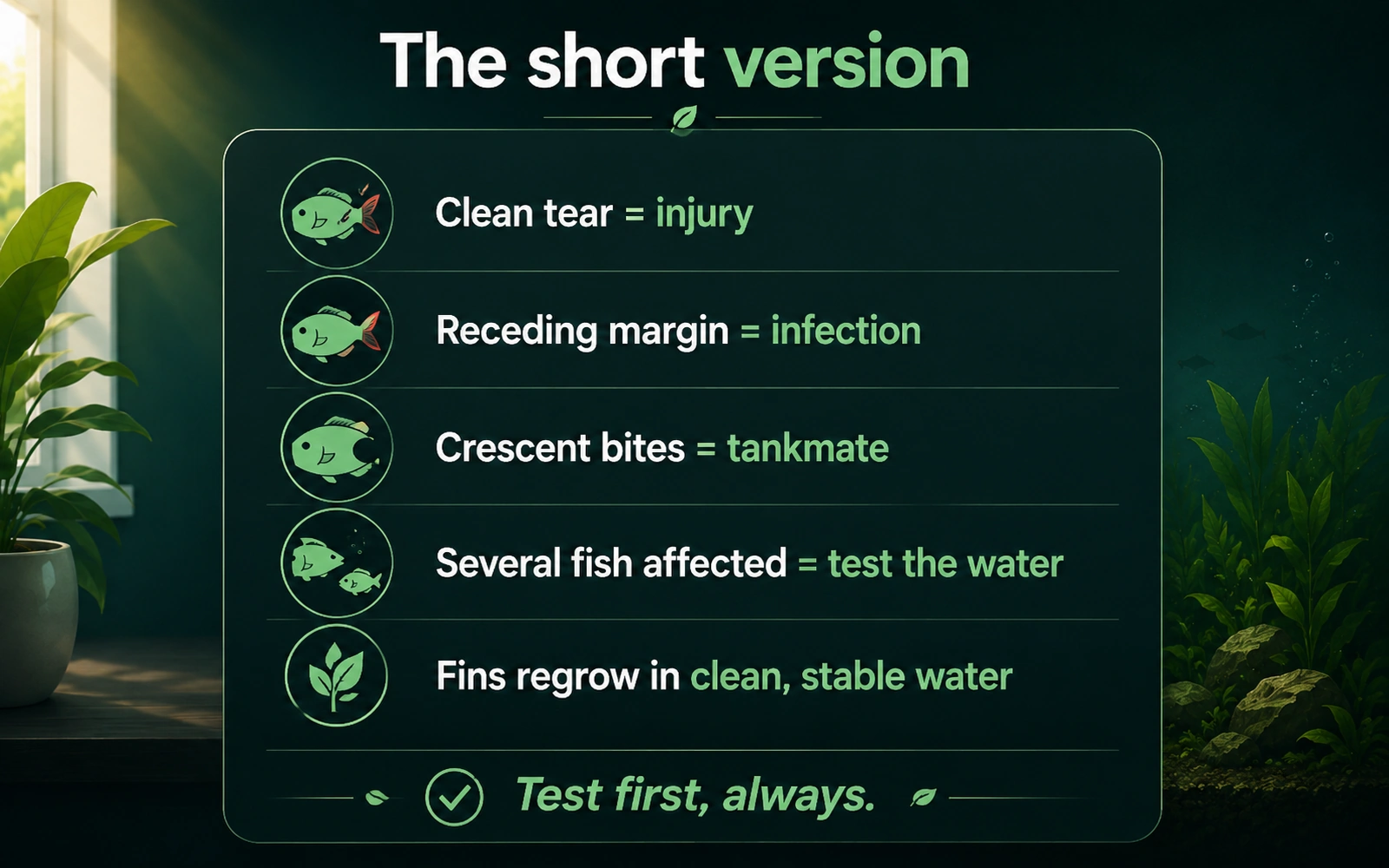
The short version
- The shape of the edge tells you the cause. A clean tear is injury, a receding margin is infection, crescent bites are a tankmate.
- One fish means decor or a tankmate. Several fish means the water.
- Test first, always. Correct what the test finds before you consider anything else.
- Fins regrow in clean, stable water.
- No page can tell you what to medicate for. A vet can.
FAQ
How can I tell fin rot from fin nipping? Look at the edge, not the amount. Fraying that starts at the outer edge and works inward, often with a pale, cloudy or discolored margin, points at an infection process. Small crescent bites out of the trailing edge, usually on one fish more than others, point at a tankmate. A clean, straight tear with otherwise healthy edges points at physical damage from something sharp.
Do damaged fins grow back? Yes. Clean, stable water is the condition a fin heals in, though the color and the shape of the regrown tissue may not match what was there before.
Should I medicate for fin rot straight away? No. Test the water first and correct anything the test finds, check the tank for anything sharp, and watch for nipping. Medications are dosed by water volume, several are lethal to shrimp and snails or harm the filter bacteria, and if the cause is an ornament or a tankmate the medication treats nothing while the damage continues.
Why does damage on several fish at once point at the water? Because the causes that target one fish are individual: a tankmate nips a specific victim, and decor injures the fish that swims through it. Damage appearing across several fish at once points at something they all share, which is the water.
When is a damaged fin a question for a vet? When the water is clean, nothing is sharp, nobody is biting and the margin is still receding, or when there is an ulcer, a growth, a wound that is not healing, or fungus-like tufting. An aquatic veterinarian can diagnose what a page cannot, and a great deal of that work is done remotely.