Green water is a bloom of single-celled algae suspended in the water column, not a film on any surface, and that single fact explains why scrubbing, filter floss and water changes all disappoint you. The things that reliably work are the ones that act on the water itself: a UV sterilizer, or a complete blackout, backed up by removing whatever caused it (usually too much light, often direct sun, plus available nutrients). It is also worth knowing before you panic that green water does not harm fish. It is ugly, and it is a signal, but it is not an emergency. If your fish are actually in distress, that is a separate problem and something is wrong with my tank is the page to start from.
What Green Water Actually Is
Free-floating algae are microscopic, they reproduce in open water, and there can be an enormous number of them in a small volume. That is why the tank looks like weak pea soup rather than like something growing on the glass.
Two consequences follow, and they govern everything else on this page:
- You cannot remove it by cleaning surfaces. There is nothing on the surfaces. The algae is in the water you are looking through.
- Ordinary mechanical filtration mostly does not catch it. The cells are far smaller than the pore size of standard filter floss and sponge. This is why a perfectly good filter runs all day and the water stays green.
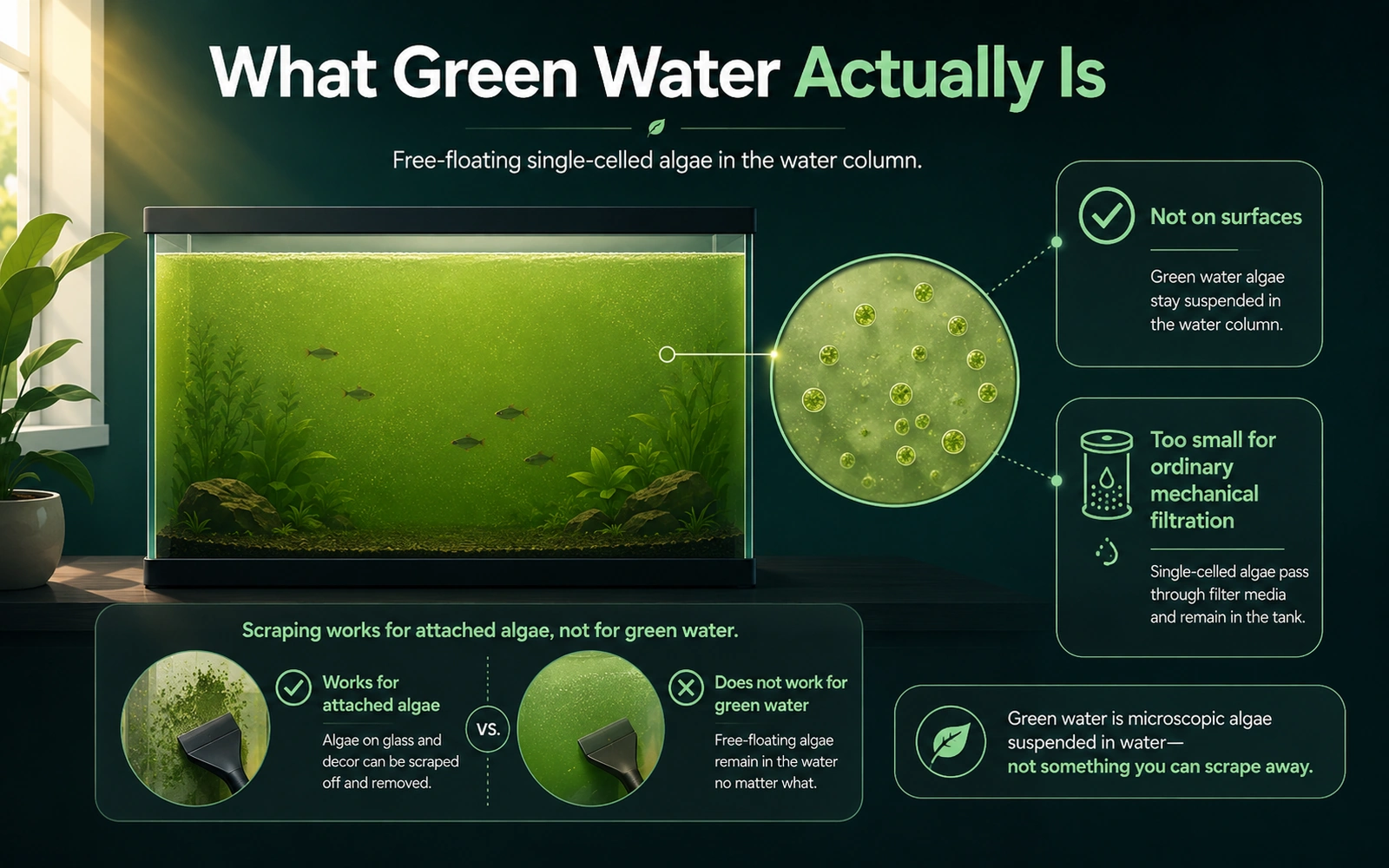
That makes green water fundamentally different from the attached algae most guides lump it in with. Scraping works on green spot algae on the glass because that algae is stuck to something. There is nothing to scrape here.
Why It Started
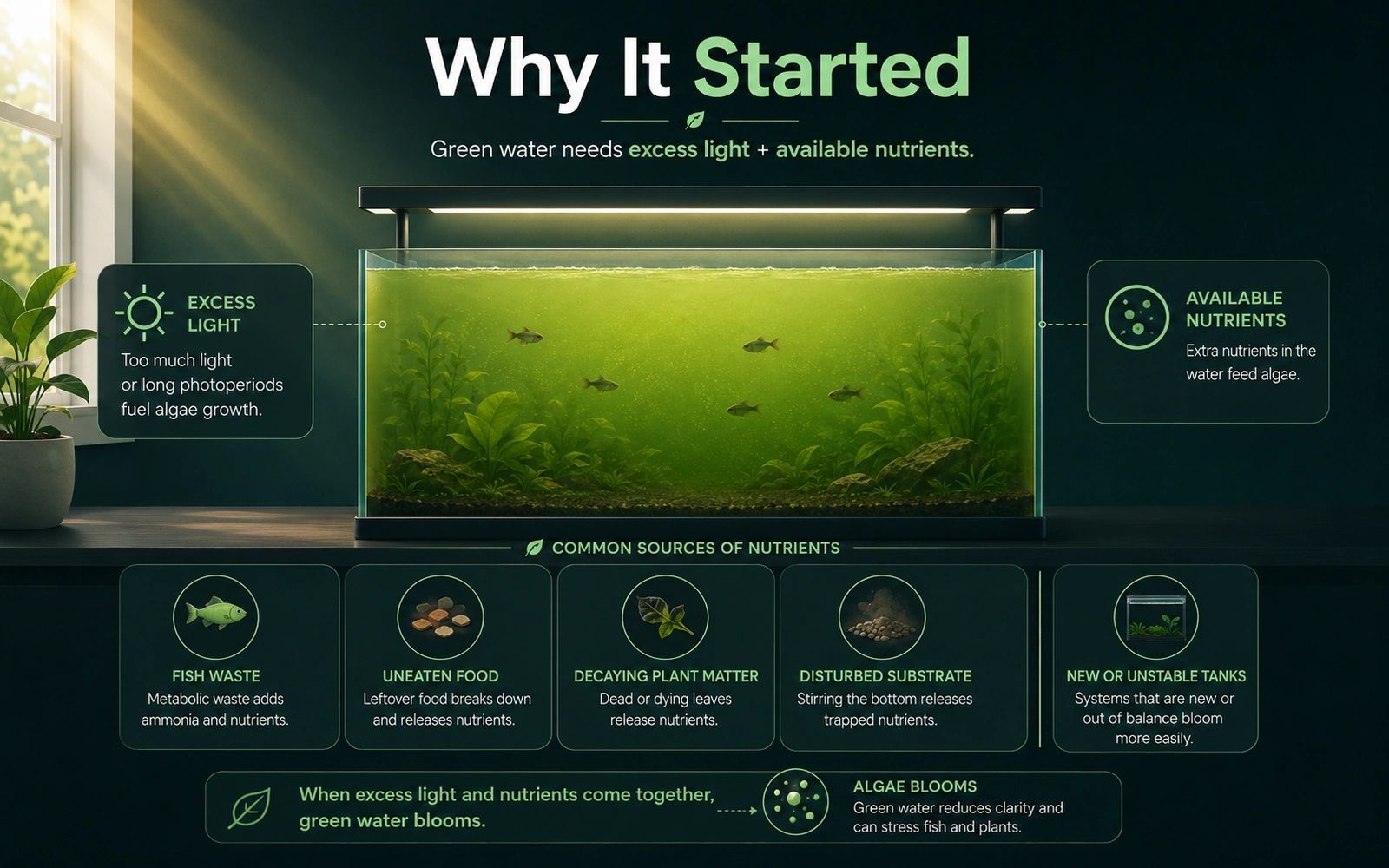
Green water needs the same two things every algae needs: light and nutrients. A bloom means both were available in excess of what the plants and the rest of the system could take up.
Light is usually the dominant factor, and direct or reflected sunlight on the tank is the single most common trigger I see reported. A tank near a window can receive far more light than any aquarium fixture provides, at intensities plants cannot compete with. A long photoperiod on an aquarium light does the same thing more slowly.
Nutrients come from the usual sources: fish waste, uneaten food, decomposing plant matter, and disturbed substrate releasing what has been stored in it. Blooms often follow an event that released a lot of nutrients at once, such as a rescape, a deep substrate clean, or an ammonia spike in an immature tank. A tank that runs persistently high on nitrate is a tank with the fuel in place, and aquarium nitrate levels covers keeping that in a sensible range.
Instability matters too. New tanks bloom more readily than mature ones because the competing biology (plants, established bacteria, other microorganisms) has not built up yet.
Why Water Changes Do Not Fix It
This is the honest part, and it is the part people find hardest to accept because water changes fix so much else.
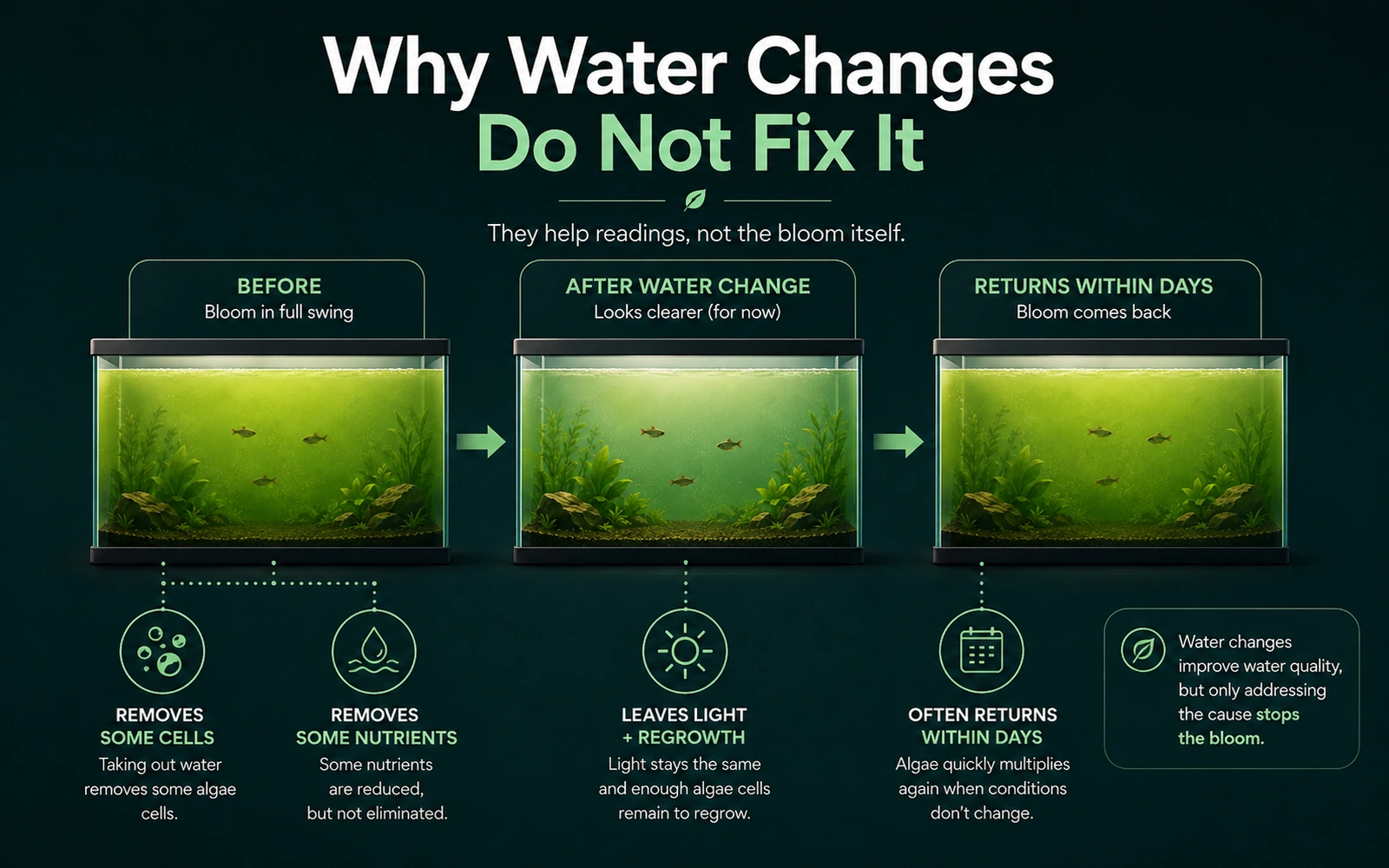
A water change removes a proportion of the algae cells and a proportion of the dissolved nutrients. What it leaves behind is a smaller population in clearer water, with the same light and enough nutrients to regrow. Clearer water also means light penetrates better. Blooms frequently come back stronger within days.
This does not mean water changes are wrong. If nitrate is high, or if something died, a water change is correct for those reasons and it removes fuel. Just do not expect the water to stay clear because of it, and do the change properly with temperature-matched, dechlorinated water: how to do a water change covers the mechanics.
What Actually Clears It
UV sterilizer
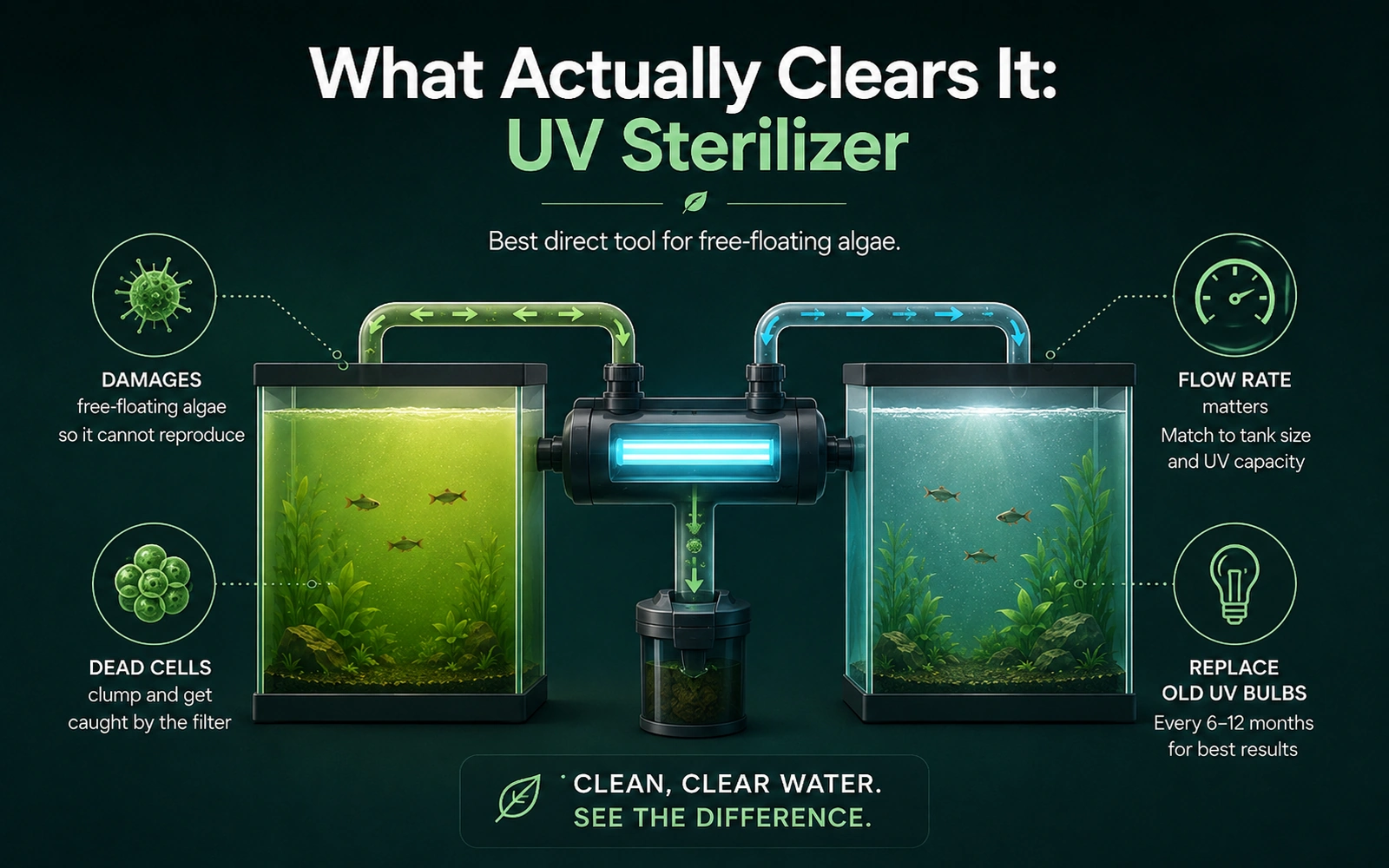
A UV sterilizer passes water through a chamber where ultraviolet light damages the DNA of free-floating organisms so they cannot reproduce. Because green water algae is free-floating by definition, this is close to a purpose-built solution, and it is the method most commonly recommended by retailers and experienced keepers alike. The dead cells clump and get caught by the filter, so the water clears.
Practical notes rather than promises:
- Reports of how quickly it clears vary from a few days upward depending on the unit, the flow rate and the severity of the bloom. I am not going to quote a fixed number of days, because the honest answer is that it depends on all three.
- Flow rate matters. Water has to spend enough time in the chamber. Plumbing it on the output of a canister filter is the usual arrangement.
- UV bulbs lose output long before they stop lighting up, so an old unit that "does not work" often just needs a bulb.
- A UV unit treats the symptom permanently and the cause not at all. If the tank still sits in direct sun, the bloom returns when the unit is off.
Blackout
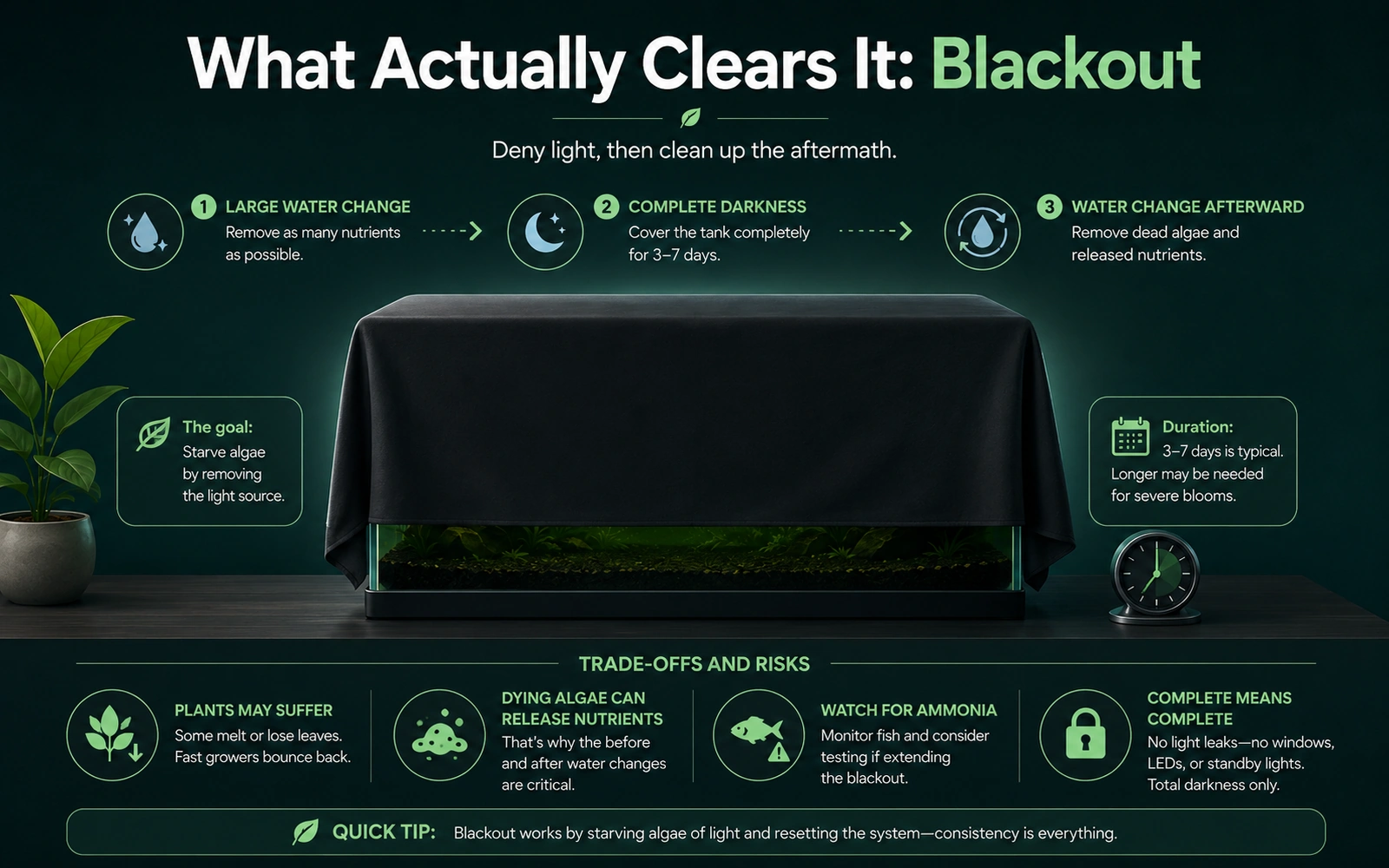
Denying the algae light kills it. Aquarium Co-Op describes the blackout approach as doing a large water change, then covering the tank completely so that no light gets in for a period of days (their description is seven to ten), then doing another large water change afterward.
The trade-offs are real and worth stating plainly:
- Plants suffer. Most aquarium plants survive several days of darkness, but some melt, and a heavily planted tank pays a price.
- Dying algae releases nutrients. A large mass of algae dying at once can produce an ammonia spike, which is dangerous to fish and can feed the next bloom. That is why the water change afterward is not optional.
- Complete means complete. Partial darkness gives a partial result. Any light leak keeps the bloom going.
- Fish are fine in the dark for that period. They are not fine in an ammonia spike.
Fine mechanical filtration
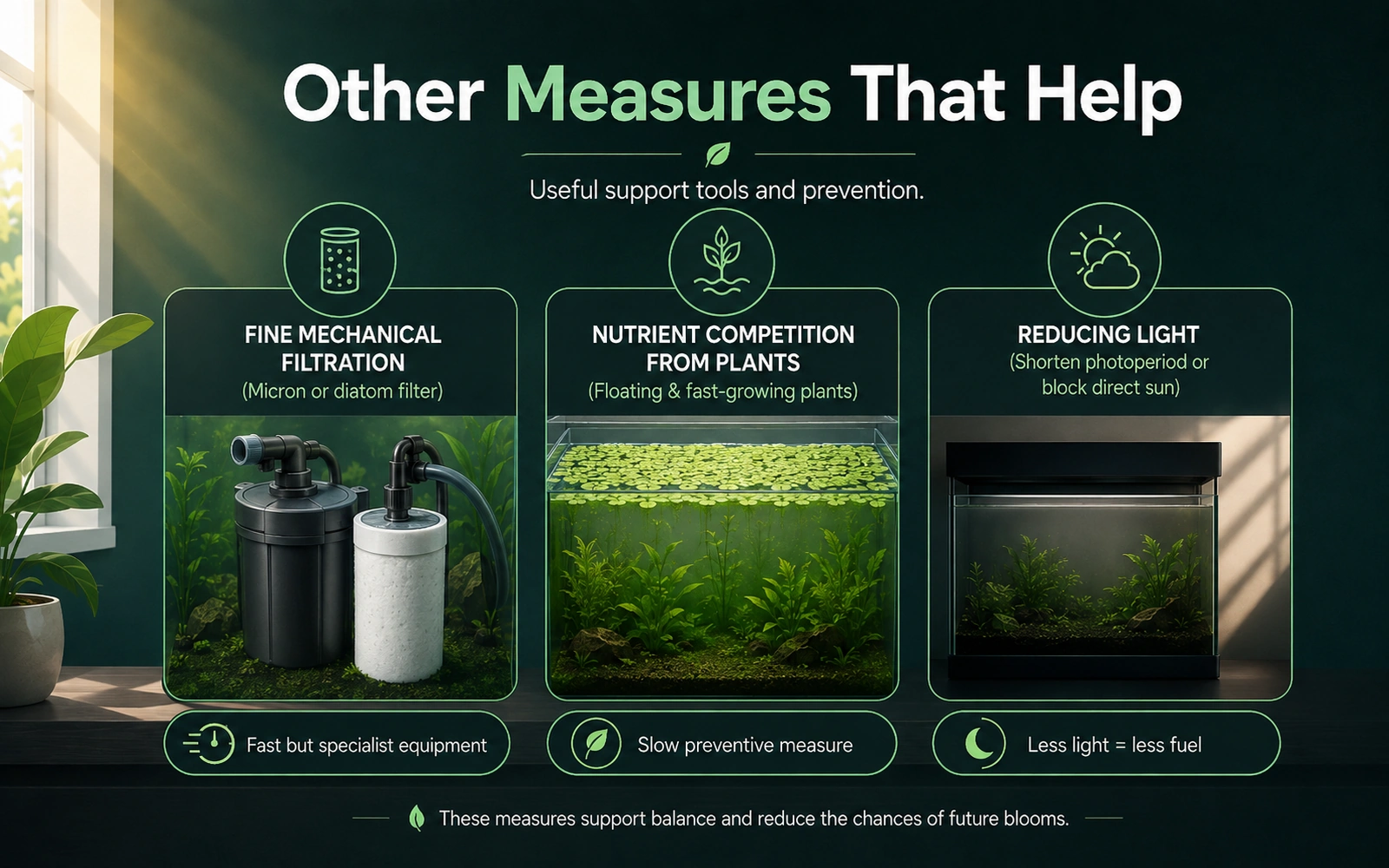
A diatom filter or a very fine micron cartridge can physically strip the cells out. It works, it is fast, and it is equipment most beginners do not own. Worth knowing about, rarely worth buying for one bloom.
Nutrient competition
Fast-growing and floating plants compete with algae for the same nutrients and shade the water at the same time. This is a slow, preventative measure rather than a cure for an active bloom, and it works best as part of how the tank is run rather than as a response.
Reducing light
Move the tank out of direct sunlight if you can, or block the window side. Shorten the photoperiod on the aquarium light. I will not give you a target number of hours, because the right photoperiod depends on your fixture's intensity, your plant load and your tank, and any specific figure I quoted would be a guess dressed up as a rule. The principle is sound even when the number is not knowable from here: less light for less time is less fuel.
What Does Not Work
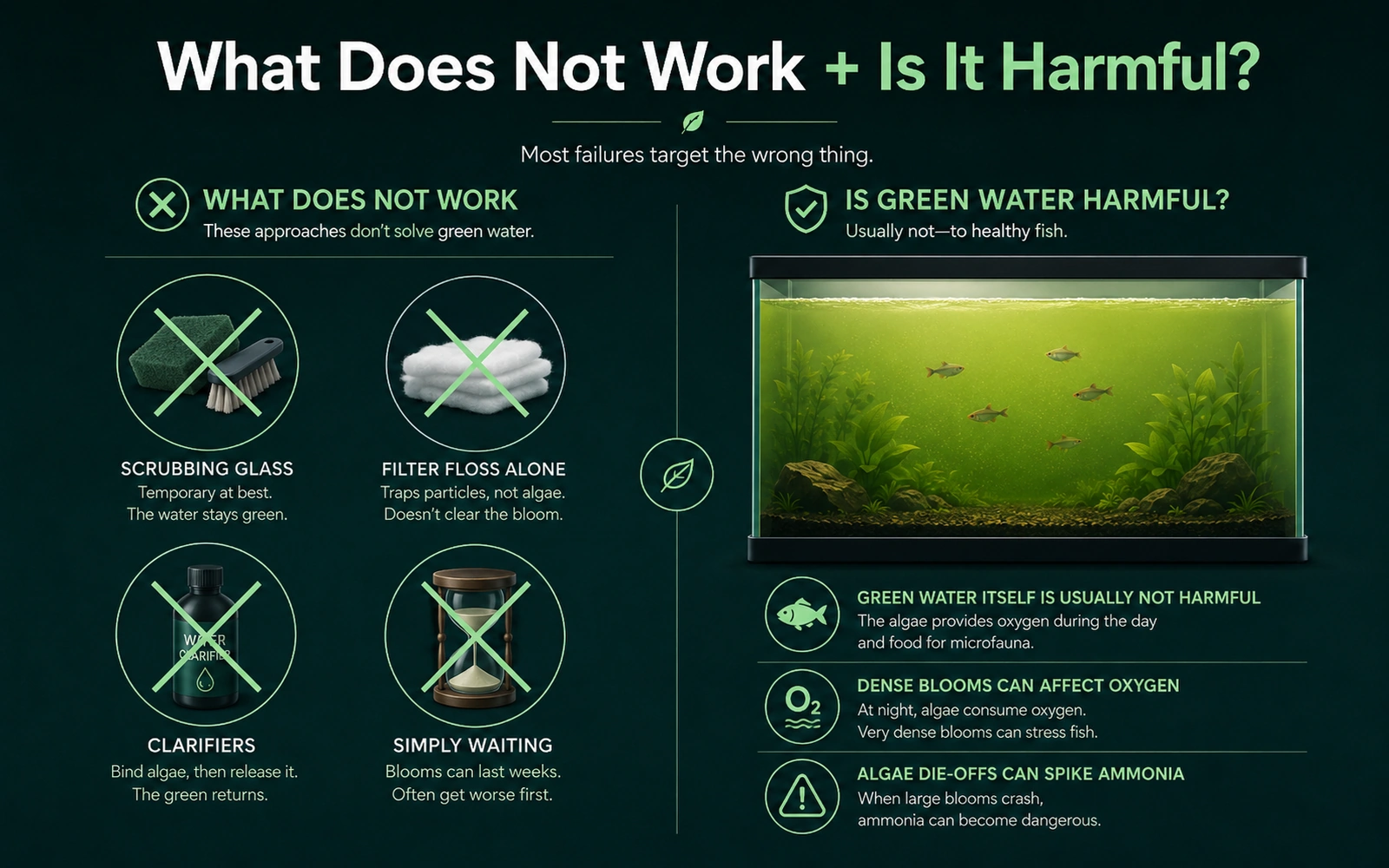
- Scrubbing and scraping. Nothing is attached.
- Filter floss alone. The cells are too small.
- Clarifiers. They clump particles; they do not stop algae reproducing.
- Doing nothing. Unlike a bacterial bloom in a new tank, which starves itself out, green water has a renewable food supply as long as the light is on. It can persist for a very long time.
That last contrast is worth holding on to. Milky white haze in a new tank clears itself: see cloudy water in a brand new tank. Green haze does not.
Is Green Water Harmful?
Not to healthy fish. It is cultured deliberately as a first food for fry, which tells you something about its toxicity. The genuine risks around it are secondary: a very dense bloom can swing oxygen levels between day and night, and a large algae die-off can spike ammonia. Fish that look ill during a bloom are usually reacting to those, or to something unrelated. Algae does not cause disease, and if your fish have visible symptoms rather than stress behavior, when to contact an aquatic veterinarian is the honest next step.
FAQ
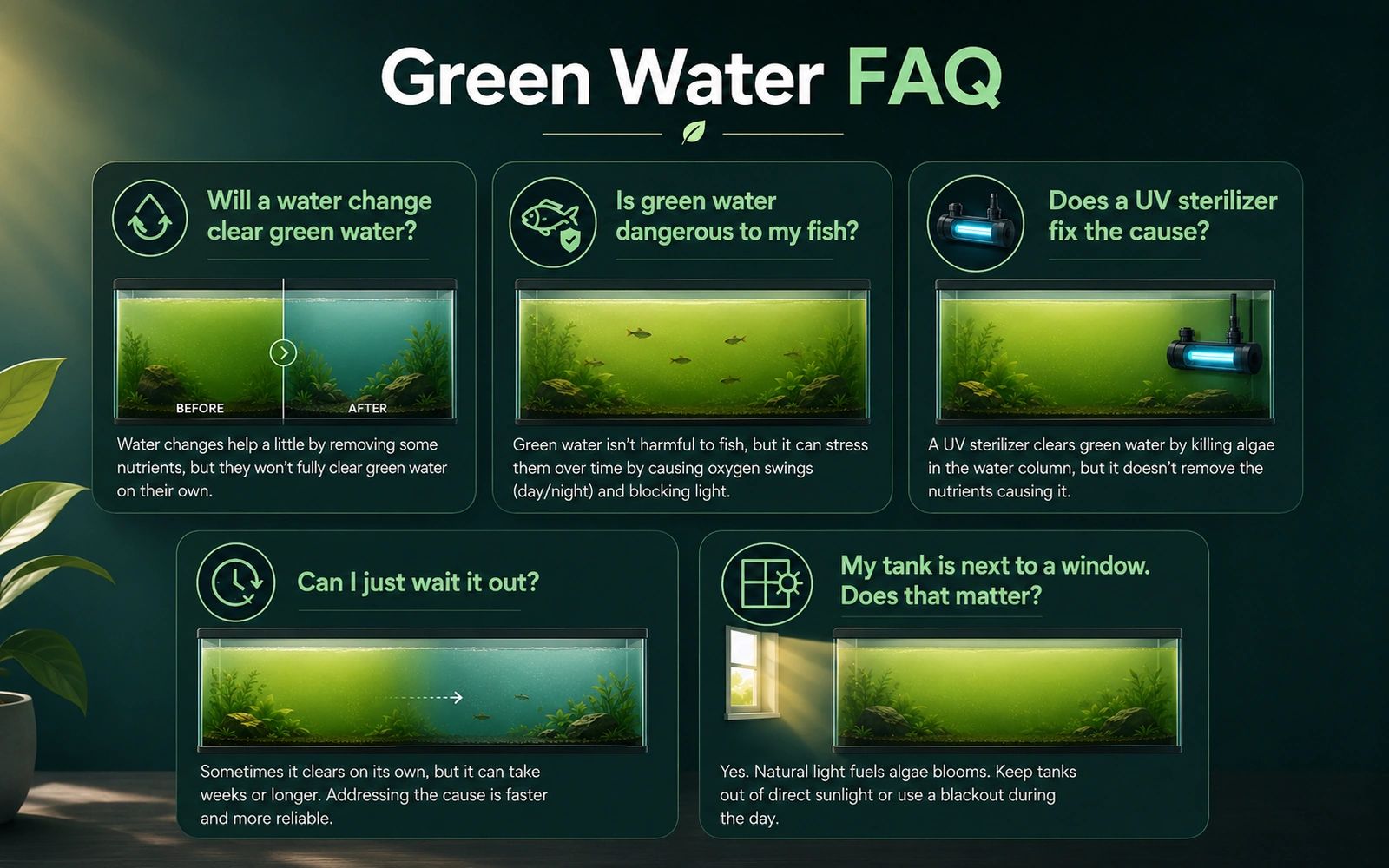
Will a water change clear green water? Temporarily at best. It removes cells and nutrients but leaves the light and enough population to regrow, often within days. Do water changes for your test readings, not for the color.
Is green water dangerous to my fish? Not in itself. It is used as fry food. Watch for oxygen swings in a very dense bloom, and for an ammonia spike if a large amount of algae dies at once.
Does a UV sterilizer fix the cause? No. It removes free-floating algae extremely effectively and does nothing about the light and nutrients that produced the bloom. Treat it as a tool, not a solution.
Can I just wait it out? Usually not. A bacterial bloom starves itself out; green water has light and nutrients renewing continuously, so it can persist indefinitely.
My tank is next to a window. Does that matter? Very likely yes. Direct sunlight is the most commonly reported trigger, and it delivers far more light than any aquarium fixture. Blocking it or moving the tank is the cheapest intervention available.