Short answer: if you are asking what size heater for 10 gallon tank, the most common published answer is about 50 watts. That figure comes from Aqueon's rule of 5 watts per gallon for tanks of 55 gallons or smaller. But that rule quietly assumes an ordinary, lidded tank in a room that is not far below the water temperature you want. If your room is cold, sources say to size up or add a second heater. And one independent source argues that a 50 watt heater is more power than a 10 gallon tank should have, because of what happens when a heater sticks on.
So the honest answer is not one number. It is one number plus two questions: how cold does your room get, and what happens to your fish if the heater fails? This article walks through both, and tells you why, because if I cannot tell you why, I will not tell you to do it.
Where the "50 watts for 10 gallons" figure comes from
Almost every chart you will find for a 10 gallon tank lands on 50 watts. It is worth knowing where that number starts, because it tells you what it does and does not cover.
Aqueon's heater guidance, which I read on September 23, 2026, states: "A good rule of thumb for aquarium heaters is 5 watts per gallon for aquariums 55 gallons or smaller, and 3 watts per gallon for those over 60 gallons." Multiply 5 by 10 and you get the familiar 50 watts.
Notice the phrase "rule of thumb." Aqueon, a heater manufacturer, does not present it as a law of physics. It is a starting point for a typical setup, and Aqueon adds the exception in the same guide: "Use a larger size or a second heater if your aquarium is in an especially cold room or is located on an exterior wall or near an outside door."
Aquarium Co-Op, a US aquarium retailer, spells out the conditions more precisely in its heater guide (also read September 23, 2026). It gives the same 5 watts per gallon, but only "if a) you need to heat the water up to 10 degrees above room temperature and b) you're using an aquarium lid to retain warmth and prevent evaporative cooling."
That second condition matters more than most charts admit. A 50 watt figure is a figure for a covered tank sitting in a reasonably warm room. Change either one and the number changes with it.
Why your room matters as much as your tank
A heater does not "heat a tank" in the abstract. It replaces heat that the water is losing to the room, through the glass, the lid and the surface. The colder the room, the faster the water loses heat, and the harder the heater has to work to keep up.
That is why the useful measurement is not the tank size. It is the gap: the difference between the coldest temperature your room reaches and the temperature your fish need.
- A small gap means the heater only has to top up a little heat. A modest heater copes.
- A large gap means the heater runs almost constantly. An undersized one may run flat out and still fall behind on the coldest night.
A 10 gallon tank has a particular weakness here. Small tanks have a lot of glass for the amount of water they hold, so they lose heat faster, relative to their volume, than big tanks do. AquariumScience.org makes exactly this point when explaining why its recommended wattage per gallon is higher for a 10 gallon tank than for a 100 gallon one, attributing it to "the ratio of the surface area (all six sides) to the volume."
The other thing that changes the gap is where the tank sits. Aqueon names three risk spots in its guide: an especially cold room, an exterior wall, and a spot near an outside door. A tank in a basement or in a spare room with the heating off belongs in the same conversation.
What size heater for 10 gallon tank in a cold room?
This is the question the charts skip. Here is how I would work it out, step by step, without guessing.
- Find your room's real low. Put a thermometer near the tank (not in it) and check it first thing in the morning over a few cold days. The overnight low is what the heater has to beat, not the daytime reading.
- Know your fish's target temperature. This comes from a reliable care sheet for your species, not from a heater box. Different fish need different ranges.
- Work out the gap. Subtract the room's low from the target.
- Compare the gap to the condition behind the rule. Aquarium Co-Op's 5 watts per gallon assumes a lift of up to 10 degrees with a lid on. If your gap is inside that, the standard figure is what the sources describe. If it is bigger, you are outside what the rule was written for.
- If you are outside it, follow the sources' two options. Aqueon says a larger heater or a second heater. Aquarium Co-Op gives the example of a home that runs at 65°F where the water needs a 15 degree lift, and suggests considering a second heater as a supplement.
You may notice I have not given you a "cold room wattage" number. That is deliberate. No source I could verify publishes a reliable wattage for every room temperature and every 10 gallon tank, and a made-up chart on a page about keeping animals alive is worse than no chart. What the sources agree on is the direction: a colder room needs more heating capacity, and the safer way to add capacity is often a second heater rather than one larger one.
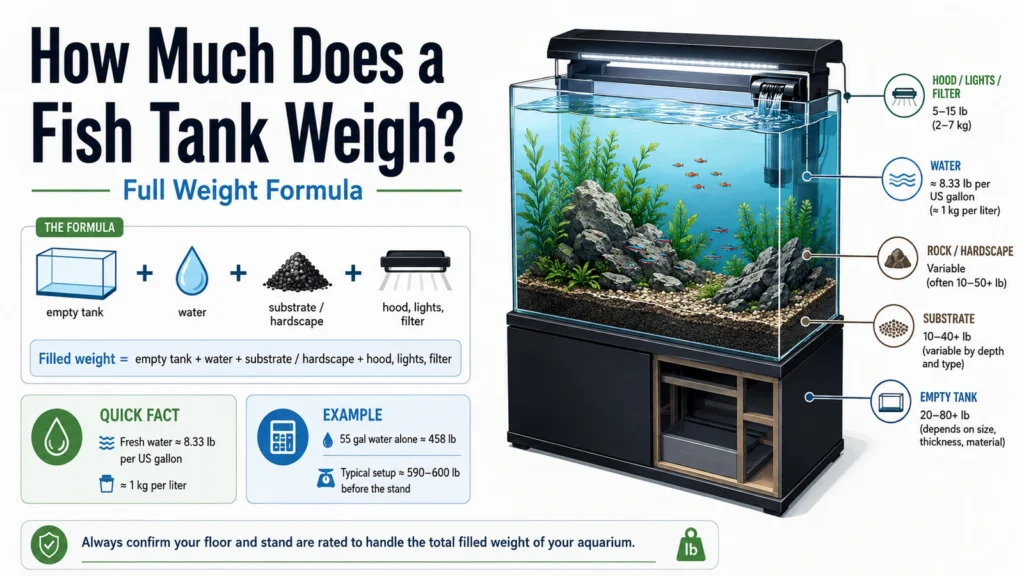
One more step people skip: check how much water is really in the tank. A "10 gallon" tank holds less than 10 gallons of water once you add gravel, rock and wood, which is why working out how much your tank really holds and weighs is a useful habit before buying any equipment rated by the gallon.
The disagreement nobody puts on the box: is 50 watts too much?
This is the part most "heater size chart" pages leave out, and it is the reason this article exists.
AquariumScience.org, an independent site that states it has no links to profit-making sites, disagrees sharply with the 5 watts per gallon rule. AquariumScience.org's page on aquarium heaters (read September 23, 2026) warns: "Five watts of power per gallon can raise the temperature of the water by 30 to 50 degrees Fahrenheit (17 to 28 degrees Celsius) and cook the fish when the heater sticks in the 'on' position."
Its argument is about the worst case, not the normal case. A heater's thermostat is supposed to switch it off when the water reaches the set temperature. If that switch fails in the "on" position, the heater keeps heating. A heater with plenty of power to spare can then push the water far past what fish can tolerate. The page states that heaters "usually fail in the 'on' position."
For a 10 gallon tank, AquariumScience.org's own table lists one 25 watt heater plus one 10 watt heater, which it describes as 3.5 watts per gallon. It also calls redundancy a "REQUIREMENT," achieved either with two smaller heaters or with a separate electronic controller in addition to the heater's own thermostat.
So you have credible positions that point in different directions:
| Source (read September 23, 2026) | What it says for a 10 gallon tank | What it is optimizing for |
|---|---|---|
| Aqueon (heater manufacturer) | 5 watts per gallon for tanks 55 gallons or smaller; larger or second heater in a cold room | Enough heat to hold temperature in typical conditions |
| Aquarium Co-Op (retailer) | 5 watts per gallon if the lift is up to 10 degrees and the tank has a lid; consider a second heater for a bigger lift | Enough heat, with a stated condition |
| AquariumScience.org (independent) | One 25 watt plus one 10 watt heater, 3.5 watts per gallon, with redundancy required | Limiting the damage when a heater sticks on |
You do not have to pick a side blindly. Notice where they overlap: all three point toward two smaller heaters when conditions get demanding. Aquarium Co-Op says it plainly: "If one of the heaters gets too hot, it's likely not powerful enough on its own to overheat the whole aquarium." Splitting the load gives you enough total heat for a cold room while keeping each single heater's worst case smaller. That is the reasoning I would follow for a 10 gallon tank in a cold space.
Placement and handling, the safe way
A correctly sized heater in the wrong spot still heats unevenly, and a heater handled carelessly is an electrical device sitting in water. The manufacturer's instructions for your specific heater come first. Aqueon's general guidance adds three points worth copying:
- Put it where the water moves. Aqueon advises positioning the heater "near a filter inlet/outlet or a circulation pump to ensure even heat distribution." Aquarium Co-Op gives the same advice about the filter output.
- Wait before plugging in. "After installing your heater in the aquarium, allow at least 30 minutes before plugging it in," according to Aqueon. If your heater's own manual gives a different waiting time, follow the manual.
- Unplug before it comes out. "Always unplug your heater and let it cool for at least 30 minutes before removing it from the water," Aqueon says. Keeping hands out of the tank while a heater is plugged in is a habit worth forming from day one.
Put the thermometer on the far side of the tank from the heater. Aquarium Co-Op suggests a corner opposite the heater, which tells you whether heat is actually reaching the whole tank rather than just the water beside the heater.
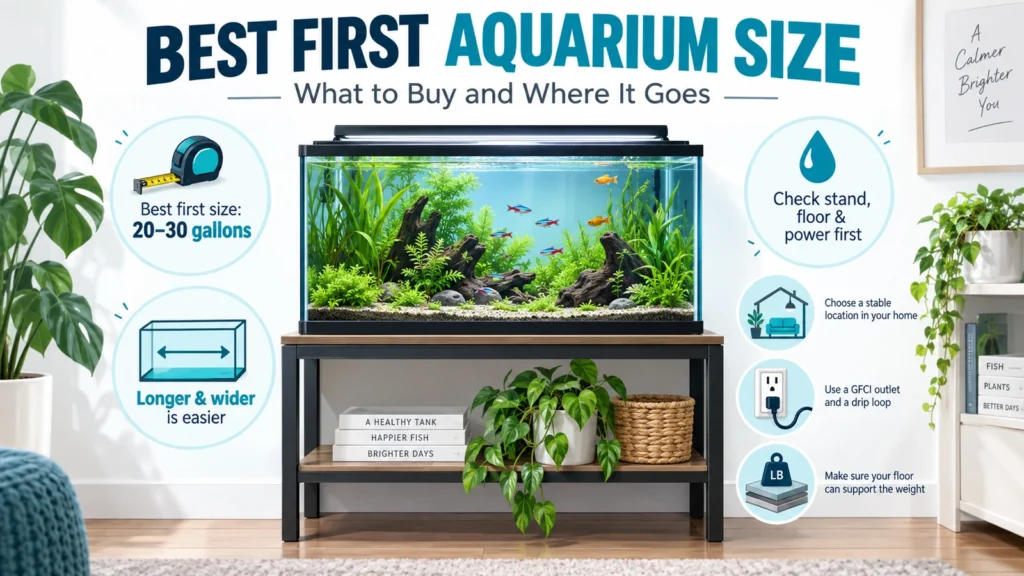
On the electrical side, let the cord hang in a loop that dips below the socket, so any water running down the cord drips off before it reaches the plug. If you want a GFCI (ground-fault) protected outlet where the tank sits and there is not one, adding it is work for a licensed electrician, not a weekend job. If you are still planning the whole tank, the beginner setup checklist covers where the heater fits in the order of things.
What a heater size cannot do for you
A heater's wattage tells you how much heat it can make. It does not tell you three things you actually care about:
- Whether it is working today. Only a thermometer you actually look at tells you that. The rating on the box is not a reading.
- Whether its thermostat is accurate. The dial and the water can disagree. Trust the thermometer, and adjust the dial until the thermometer shows your target.
- What happens when it fails. Any heater can fail. The sizing choice only decides how bad that failure can get, which is the whole point of the disagreement above.
I am also not naming a "best heater" here. This guide does not recommend products, and the choice of brand matters far less than the choice of size, the number of heaters and whether anyone checks the thermometer.
If you ever find the tank far warmer or colder than it should be and your fish are gasping at the surface, lying on the bottom or behaving strangely, stay calm and work through what to check first when something is wrong with your tank. Unplug a heater that appears stuck on, avoid sudden drastic changes, and if fish are showing signs of illness, contact an aquatic veterinarian. Panic causes more losses than the original problem.
Frequently asked questions
Is a 100 watt heater too big for a 10 gallon tank?
By Aqueon's rule of 5 watts per gallon, 100 watts is double the standard figure for a 10 gallon tank. The concern is not normal running, since the thermostat should switch off at the set temperature. It is failure: AquariumScience.org warns that a heater stuck "on" with a lot of spare power can overheat the water badly. If a cold room means you need more heat, several sources point to two smaller heaters instead.
Can I use two heaters in a 10 gallon tank?
Yes, and it is what several sources recommend when conditions are demanding. AquariumScience.org's own table for a 10 gallon tank uses two heaters, and Aquarium Co-Op notes that a single smaller heater stuck on is less likely to overheat the whole tank on its own. Place them where water flows, and keep the thermometer away from both.
Does the 5 watts per gallon rule work in a cold room?
Not as-is. Aquarium Co-Op ties the rule to heating the water up to 10 degrees above room temperature with a lid on. Aqueon says to use a larger size or a second heater in an especially cold room, on an exterior wall or near an outside door. Measure your room's overnight low before deciding.
Should I size the heater for 10 gallons if the tank has gravel and decor?
The heater only has to warm the water, and gravel, rock and wood displace some of it. The standard rule is written per gallon, so treat the tank's full volume as a ceiling rather than something to round up from. For a 10 gallon tank, the bigger factor is still the room temperature gap.
How do I know my heater is the right size once it is running?
Watch the thermometer, especially on the coldest mornings. If the water holds steady at the target with the room at its coldest, the heater is coping. If it drifts below target overnight, you need more heating capacity, ideally as a second heater. If the water climbs above target and keeps rising, unplug the heater and treat it as faulty.