The aquarium equipment for beginners that you truly need before any fish arrive is a short list: a tank on a stand that can carry its full weight, a filter, a heater if you plan to keep tropical fish, a thermometer, a water conditioner, and a liquid test kit. A light, substrate, a bucket, a gravel siphon and a net come next. Almost everything else a shop suggests, such as CO2, UV sterilizers, automatic feeders and bottles of "cure-all" additives, can wait until your tank gives you a reason to buy it.
My name is Hossain, and I run this site on one rule: if we cannot tell you why, we do not tell you to do it. So every item below comes with its reason, and every "later" item comes with the sign that tells you later has arrived.
The Whole List on One Screen
Before the detail, here is the triage. Read the right-hand column carefully, because it is the part that saves you money.
| Item | When you need it | Why it exists | The sign you need it (for "later" items) |
|---|---|---|---|
| Tank and stand | Before water | Holds the water and carries the weight | |
| Filter | Before water | Moves water and houses the bacteria that process waste | |
| Heater (tropical fish) | Before water | Holds temperature steady through day and night | |
| Thermometer | Before water | Tells you whether the heater is actually working | |
| Water conditioner | Before water | Treats tap water before it touches the tank | |
| Liquid test kit | Before fish | The only way to see ammonia and nitrite | |
| Light | Before fish | Lets you see your fish; plants need it to grow | |
| Substrate | Before fish | Covers the glass bottom; plants root in it | |
| Bucket, siphon, net | Before fish | Water changes and moving fish safely | |
| Air pump and airstone | Can wait | Adds surface movement | Fish crowd the surface, or your filter leaves the surface still |
| CO2 system | Can wait | Feeds demanding plants | You are growing plants that will not grow without it |
| UV sterilizer | Can wait | Clears some free-floating problems | A recurring problem a source ties to UV as a fix |
| Automatic feeder | Can wait | Feeds while you are away | You travel regularly |
| Medications | Do not stock | Treat specific diagnosed illness | An aquatic veterinarian tells you which one |
What You Need Before Water Goes In
These five decide whether a tank can support life at all. Skip one and nothing else you buy fixes it.
A tank, and a stand that can actually carry it
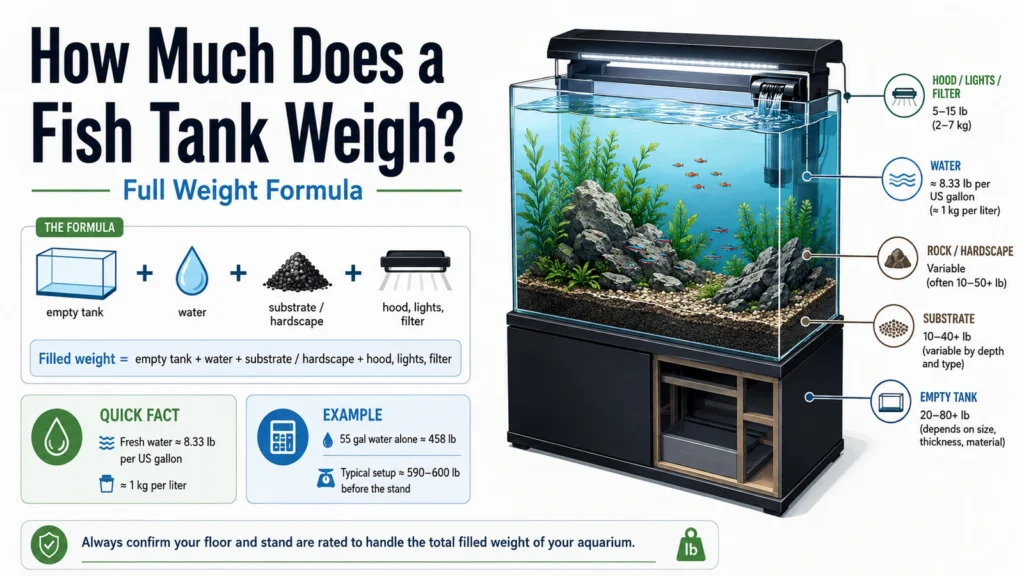
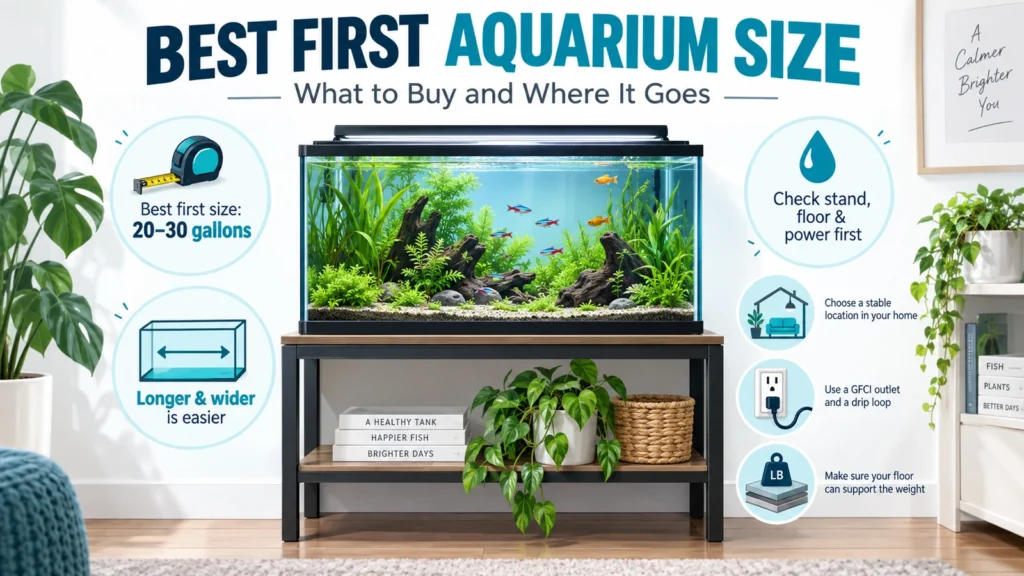
The tank is obvious. The stand is the item beginners underestimate. Water is heavy, glass is heavy, and gravel is heavy, and all of it sits on four small points of contact with your floor. A bookshelf or a dresser was built for books and clothes, not for a load that never moves and never gets lighter. Before you choose a spot, work out the filled weight with our full fish tank weight formula, then check that your stand is made for that load.
A filter
A filter does two jobs, and the second one matters more. It moves water so waste does not settle into still corners. It also gives beneficial bacteria a large surface to live on, and those bacteria are what turn toxic fish waste into something less harmful. That is why you never throw away or scrub a filter sponge in tap water: you would be throwing away the colony.
Filters come in several types, and the right one depends on your tank and what lives in it. A sponge filter is gentle and simple. A hang-on-back filter is common and easy to service. If you plan to keep shrimp, the intake matters more than the brand, and our guide to choosing shrimp-safe filtration explains why an unguarded intake can pull baby shrimp in.
A word on the box. Filters are sold with a "rated for" tank size. Treat that number as the maker's claim for their test conditions, not a promise for your tank, which may be more heavily stocked or have fish that make more waste.
A heater, sized for your room as well as your tank
Tropical fish need stable warmth, and "stable" is the key word. A room that feels comfortable to you in the afternoon can drop overnight, and a small volume of water follows it quickly. A heater with a built-in thermostat switches on and off to hold a set point.
Heaters are sold by wattage with a tank-size rating. As an illustration of how manufacturers state this, not a recommendation, the Fluval M50 product page (Fluval USA, read 2026-09-23) lists that heater as 50W and rated for tanks up to 15 US gallons or 50 liters. Fluval's own heater pages also tell buyers that when the room is much colder than the temperature you set, more heating capacity is likely to be needed. That is the part most charts skip. The tank-size rating assumes a room that is not far below your set point. A cold room, an uncovered tank or a spot near a window changes the answer, so read the maker's sizing notes for the exact heater you are looking at.
If you keep coldwater fish such as goldfish, the heater question is different, and that is a species decision to research before you buy.
A thermometer
A heater dial is a setting, not a reading. The thermometer is how you find out whether the heater is doing what its dial says. It is inexpensive, and it is the first thing to check when something looks wrong in the tank. Put it on the opposite side of the tank from the heater so you are measuring the water your fish live in, not the warm patch right beside the element.
A water conditioner
Most municipal tap water is treated with chlorine or chloramine to make it safe for people. Both harm fish and the bacteria in your filter. A conditioner neutralizes them. Veterinarian Jessie Sanders, DVM, DABVP (Fish Practice), writing in PetMD's guide to new tank syndrome (updated May 1, 2026, read 2026-09-23), says to always treat tap water with a conditioner to remove chlorine and chloramine and to match the new water's temperature to the tank before adding it. Follow the dosing directions on the bottle's own label; they are written for that specific product.
What You Need Before Fish Arrive
These can come a few days after setup, but they must be in place before the first fish comes home.
A liquid test kit
This is the item people skip, and it is the one that tells you the truth. Water can be perfectly clear and still carry enough ammonia to harm fish. Dr. Sanders makes the same point in that PetMD guide: testing tells you whether your tank is at risk so you can act before fish are lost. A test kit is how you know when a new tank has finished cycling, and it is how you know what to do if a reading looks off. If you ever see ammonia above zero, our page on what to do first when ammonia reads above zero walks through the calm, ordered response.
A light
Fish do not need a bright light, but you need to see them, and seeing them daily is how you notice problems early. Live plants are different: they need light to grow, and the right light depends on the plants. If you are starting with no plants, a basic light on a consistent daily schedule is enough.
Substrate
Gravel or sand covers the bottom, gives the tank a finished look and gives plants somewhere to root. It also collects waste, which is why the next item exists.
A bucket, a gravel siphon and a net
Water changes are the routine that keeps a tank healthy, and they need a bucket and a siphon. Buy a bucket that is used only for the aquarium. A bucket that has ever held soap or cleaning products can carry residue into your tank, so a dedicated one removes the question entirely. A soft net lets you move a fish without chasing it around with your hands.
A lid
A lid slows evaporation, helps the heater hold temperature, and keeps jumpers inside. Some fish jump, and a fish on the floor is a loss no piece of equipment can undo.
What Can Wait, and the Sign That It Is Time
Everything in this section is real equipment with real uses. The question is not "is it useful?" but "does my tank need it yet?" In most beginner tanks, the answer is not yet.
Air pump and airstone. Bubbles look like oxygen going into the water, but most gas exchange happens at the surface, where water meets air. An air pump helps by moving that surface. If your filter already ripples the surface, you may not need one. The sign it is time: fish hang at the top, or your filter leaves the surface glassy and still. If fish are gasping, treat that as a problem to investigate first, not a shopping trip.
CO2 systems. These feed demanding plants in heavily lit tanks. Many beginner-friendly plants grow without them. The sign it is time: you have chosen plants that will not thrive otherwise and you understand the extra monitoring pressurized gas needs.
UV sterilizers. A UV unit treats water that passes through it. It does not replace good maintenance, and it does nothing for a problem caused by the water chemistry itself. Wait until you have a specific, recurring problem that a reliable source ties to UV as the fix.
Automatic feeders. Useful if you travel. Not useful if you are home, because feeding by hand is when you watch your fish.
Bottled additives and "instant cycle" products. This is where beginners spend the most for the least. The PetMD guide notes that products claiming to instantly establish the nitrogen cycle are generally ineffective, and that ammonia-binding products may slow the growth of beneficial bacteria. A conditioner is essential. Most of the rest of the shelf is optional at best.
A medicine cabinet. Please do not buy medications in advance "just in case." Treating the wrong illness, or treating when the real cause is water quality, can do more harm than the illness. If a fish looks sick, check your water first and speak to an aquatic veterinarian before you medicate.
What No Shop List Includes
The most important items on this list cannot be bought, which is exactly why shopping lists leave them out.
Time. Equipment cannot skip the nitrogen cycle. According to the same PetMD guide, new tank syndrome is expected to last four to six weeks until biological filtration matures, and warmer tanks cycle faster than colder ones. Budget that time into your plan before you budget any money.
Cord routing. Every cord from the heater, filter and light should dip below the outlet before rising to it, forming a U-shaped "drip loop." The reason is simple: water that runs down a cord drips off the bottom of the loop instead of following the cord into the socket. Unplug equipment before your hands go into the water. Read each device's own manual for its electrical instructions, and if you are not sure whether an outlet near the tank is GFCI-protected, ask a licensed electrician rather than guessing.
A plan for bad days. Write down where your nearest aquatic veterinarian is before you need one. Bookmark our checklist for what to check, in order, when something is wrong with your tank. Panic causes more losses than the original problem, and a plan made on a calm day is the cure for panic.
Are Starter Kits Worth It?
A starter kit bundles a tank with some of the equipment above, and for many people that is a reasonable way to begin. The honest caveat is that a kit is a bundle chosen to hit a price, so check each piece against the list rather than assuming the box is complete.
Ask three questions of any kit. Is the heater's tank-size rating right for this tank in your actual room? Is the filter suitable for the fish you plan to keep? Does the box include a liquid test kit? Kits often leave that last item out, and it is the one you cannot do without. If a kit fails one of these, you can still buy it and add the missing piece.
For the order in which everything goes together once you have it, follow our step-by-step fish tank setup checklist for beginners.
What This Guide Cannot Tell You
You will notice there are no brand picks or prices here. That is deliberate. Prices change weekly and vary by country, and the right model depends on your tank size, your room and your fish. The goal of this page is to help you walk into a shop knowing which questions to ask, so you buy the short list first and let your tank tell you what it needs next.
It also cannot tell you which fish to keep. Your species choice changes the heater question, the filter question and the tank-size question, so decide on the fish before you finalize the gear.
Frequently Asked Questions
What is the most important piece of aquarium equipment for beginners?
The filter and the test kit together. The filter houses the bacteria that process fish waste, and the test kit is the only way to confirm those bacteria are doing the job. Clear water alone does not prove a tank is safe.
Do I need an air pump if I already have a filter?
Often not. Most oxygen exchange happens at the water surface, and many filters move the surface enough on their own. An air pump becomes useful when the surface is still or fish crowd near the top, which is also a sign to test your water.
How do I know what size heater to buy?
Start with the manufacturer's tank-size rating for the specific heater, then account for your room. Manufacturers such as Fluval note that a room much colder than your set temperature is likely to need more heating capacity. Always confirm the result with a separate thermometer.
Can I set up the tank and add fish on the same day?
No. A new tank needs time for beneficial bacteria to establish. PetMD's veterinary guidance describes this stage as typically lasting four to six weeks. Set up, let the tank cycle, test until the readings confirm it, and then add fish gradually.
Should I buy fish medications to keep on hand?
No. Medicating without knowing the cause can harm fish, and many problems that look like illness start with water quality. Test your water first, and speak to an aquatic veterinarian before using any treatment.