Short answer: an aquarium electrical safety drip loop is a U-shaped dip in each equipment cord that hangs lower than the outlet, so water running down the cord drips off at the bottom of the U instead of reaching the plug. Pair every loop with a GFCI-protected outlet, keep the power strip above the floor and away from splashes, and unplug equipment before your hands go in the water. If a plug or outlet ever gets wet, do not touch it: switch the power off at the breaker first.
If you have a power strip sitting under a tank full of water and a knot of cords behind it, you are right to look at it twice. Most of the fix costs nothing. I will explain what each measure does, why it works, where it stops working, and the specific situations where the right move is to leave it alone and call a licensed electrician. This guide is written for US homes on standard 120 V outlets; if you are elsewhere, your local wiring rules apply.
Why Water and Your Outlets Need a Plan
An aquarium puts two things side by side that should never meet: a large volume of water and several devices plugged into the wall. A heater, filter, light and air pump are four cords, and every one of them runs from the tank down to a socket.
Water reaches electricity in three ordinary ways:
- It runs along a cord. Splashes, condensation under the lid, and drips from your arm during maintenance all follow a cord downhill by gravity.
- It lands on a plug or power strip. Overfilling, a spilled bucket, or a filter that siphons over the rim can put water straight onto whatever sits below.
- It comes from inside a device. A cracked heater tube or a damaged cord can put a live part in contact with the tank water itself.
The drip loop handles the first. Placement handles the second. A GFCI is the backstop for all three, because it responds to the result (current going where it should not) rather than the cause.
How to Form an Aquarium Electrical Safety Drip Loop
Aqueon's setup sheet "Power Cord Drip Loop" (read on 2026-09-23) describes the idea plainly: the cords "approach the outlet from underneath the plug socket," so water on a cord "will fall off at the upward bend in the cord, never making it to the electrical outlet." Here is how to get there with each cord:
- Unplug the device first. Arrange cords with nothing live.
- Check the slack. The cord needs enough length to drop below the outlet and come back up. If it cannot, move the tank or the power strip rather than stretching the cord tight.
- Let the cord hang in a U. The lowest point of the U must sit below the socket it plugs into. Not level with it: below it.
- Keep the bottom of the U dry and clear. It should hang in open air, not rest on a puddle-prone patch of floor, and not pass behind the tank where drips collect.
- Hold the shape if needed. A cord clip on the wall or stand, placed so the U stays open, stops the loop from creeping upward over time.
- Repeat for every cord. Heater, filter, light, air pump, powerhead, timer. A loop on three cords out of four protects three sockets out of four.
- Plug in with dry hands, then look at the plug end. Is anything wet? If yes, stop and go to the stop conditions below.
Heater makers treat this as a requirement, not a tip. Zoo Med's Aquarium Heater instructions (read on 2026-09-23) say the heater "must be plugged into an appropriate GFCI receptacle with a drip loop," and describe the loop the same way: part of the cord lower than the level of the wall receptacle.
GFCI: The Device That Acts When Something Has Already Gone Wrong
A ground fault circuit interrupter (GFCI, sometimes GFI) is the single most important electrical protection near an aquarium, because it works even when every other precaution has failed.
The US Consumer Product Safety Commission's GFCI fact sheet (Pub. 099, read on 2026-09-23) explains the mechanism: a GFCI constantly compares the current flowing into a circuit with the current returning. If the two differ by as little as 0.006 amperes, it interrupts the power "faster than a blink of an eye," and it is designed to operate before the electricity can affect your heartbeat. The CPSC names circuits "where electrical equipment is near water" as places GFCI protection particularly belongs.
The CPSC describes three types:
| Type | What it is | Who installs it |
|---|---|---|
| GFCI receptacle | Replaces a standard wall outlet, with Test and Reset buttons | Per CPSC, a qualified electrician, or a consumer with adequate wiring knowledge. When in doubt, the electrician |
| GFCI circuit breaker | Sits in the breaker panel and protects the whole circuit | A qualified electrician |
| Portable GFCI | A plug-in adapter or a GFCI extension cord | Plugs in like any cord, no wiring |
For a renter, or anyone whose tank outlet is not GFCI protected, the portable type is the one that needs no tools and no wiring. Anything that involves opening a wall box or the panel is electrician work, and this article stops there.
Test It Monthly, Not Once
A GFCI is a device, and devices fail. The CPSC says to test every GFCI after installation, at least once a month, and after a power failure, following the maker's instructions. If you have no instructions, its procedure is: plug a lamp in and turn it on, press Test (the lamp should go out), then press Reset (the lamp should come back on). If the lamp does not go out, the CPSC says the GFCI is not working or was installed incorrectly. If it does not come back on, the GFCI needs replacing.
A tidy way to remember it: test the GFCI on the same day you do a water change, with the tank equipment unplugged and a lamp standing in for it.
Where the Power Strip Goes
This is the part most setups get wrong, usually by accident: the strip ends up on the floor, directly under the tank, because that is where the cords meet.
- Off the floor. Floors are where spills and overflow end up. Mount the strip on the wall or the inside side panel of the stand, higher than the floor but still low enough that each cord can loop down below it.
- Not directly under the tank. If the tank is ever going to drip, it drips straight down. Offset the strip to one side.
- One strip, straight into the wall. The Office of Congressional Workplace Rights, a US workplace-safety office, notes in its "Power Strips and Dangerous Daisy Chains" guidance that plugging power strips into each other violates OSHA regulations and the National Electrical Code, because the first strip ends up feeding far more devices than it was approved for. The fix is one strip with a long enough cord.
- Rated for the load. Zoo Med's heater instructions say that if an extension cord is necessary, use one with "the appropriate electrical rating." Check the strip's rating against the total of what you plug into it.
- Visible. A strip you cannot see is a strip you will not notice getting wet, warm or discolored.
A surge protector is not the same thing as a GFCI. A surge protector deals with voltage spikes from the supply. A GFCI deals with current leaking where it should not, including through a person. A tank near water needs the GFCI; the surge protector is optional.
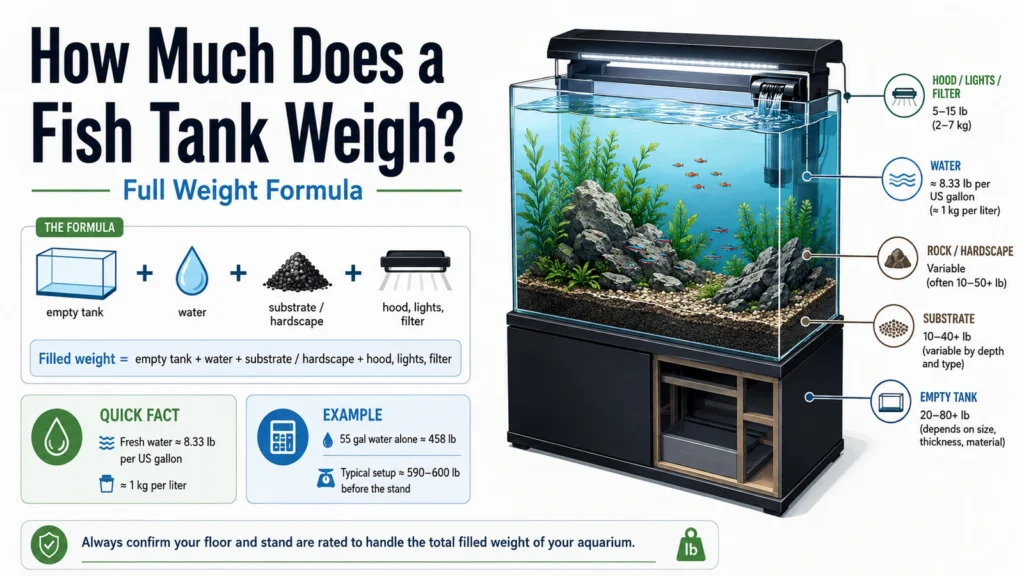
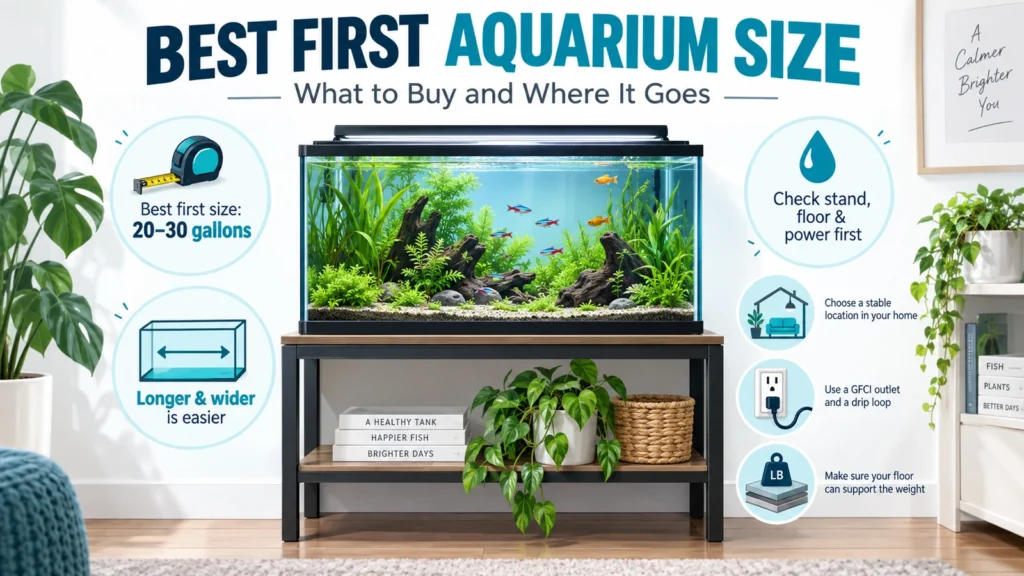
If you are still planning the tank, sort this out before the water goes in. Outlet location belongs on the list alongside the stand and the floor, which is why our fish tank setup checklist treats it as a placement decision, not an afterthought. A filled tank is heavy enough that you will not want to shift it later to reach a socket; our guide on how much a fish tank weighs works through the numbers.
Maintenance Habits That Keep Hands Safe
Maintenance is when hands, water and live equipment are closest together, so that is where the habits matter most.
- Unplug before your hands go in. Zoo Med's heater instructions list four situations to unplug: installing the heater, doing tank maintenance, before placing your hands in the water, and when the heater is not in use.
- Heaters need a cool-down. The same manual says to unplug the heater and allow it to cool before removing it from the water for any reason.
- Plug back in with dry hands, and only after the tank is refilled and any wet cords have been wiped and checked.
- Unplug by the plug, not the cord. Zoo Med says to grasp the plug and never pull on the cord, to avoid damaging it.
- Air pumps need a loop too. Sponge filters are driven by an air pump, and our article on shrimp-safe filtration explains why they are common on shrimp tanks. The pump's electrical cord gets its own drip loop, the same as any other device.
- Leave the power off during a large water change if you are unsure. Your equipment will not suffer from being off for the length of a water change, and a heater that ends up out of the water while powered is exactly the situation its manual warns against.
What a Drip Loop Cannot Do
Every guide to this topic sells the drip loop as the answer. It is a good answer to one problem, and it is worth being clear about the others:
- It does nothing if water lands directly on the plug or strip. That is a placement problem.
- It does nothing about a fault inside the tank. A cracked heater or damaged cord in the water is what the GFCI is for, which is why the two work as a pair.
- It does nothing if the loop sits in water. A loop whose lowest point rests on a wet floor has just moved the puddle to the cord.
- It is not a substitute for a working GFCI. A GFCI that has never been tested is an assumption, not a protection.
The layers only work together: loop, placement, GFCI, habits. Remove any one and the others are carrying more than they were designed for.
Stop Conditions: When to Cut Power and Call a Professional
These are the situations where this article stops. Please do not work past them.
- A plug, strip or wall outlet is wet. Do not grab it and do not unplug it. Zoo Med's instructions say not to grasp or unplug the cord until the power has been switched off at the main fuse or circuit breaker. Switch off at the breaker first, then deal with it.
- You feel a tingle or shock from the tank water or glass. Take your hands out, do not put them back, and switch off at the breaker. Do not test it again by touch. A licensed electrician should find the cause before power is restored.
- Someone is being shocked. Mayo Clinic's "Electrical shock: First aid" guidance says not to touch a person who is still in contact with the electrical current, to turn off the source if possible, and to call 911 for signs such as severe burns, confusion, difficulty breathing, heart rhythm problems or loss of consciousness.
- The GFCI fails its Test button. Per the CPSC, it is not working or was installed incorrectly, and a qualified electrician should correct it. Stop relying on that outlet until then.
- The GFCI trips repeatedly. It is reporting a fault. Do not bypass it or move the tank to an unprotected outlet. Stop using the circuit and have an electrician find the cause.
- A heater's glass is cracked, or a cord is cut, melted or exposed. Zoo Med says to discontinue use immediately if damage is observed or suspected, and never to splice, repair or modify the cord. Replace the device.
- An outlet or strip is warm, discolored, buzzing, or smells of burning. Leave it off and call a licensed electrician.
- You need a new outlet, a GFCI receptacle, or anything inside the wall or panel. That is licensed electrician work.
If the power loss or a failed heater has affected your fish, our guide to what to check when something is wrong with your tank walks through the order to work in once the electrical side is safe. For sick or injured fish, an aquatic veterinarian is the person to ask.
A Monthly Safety Check
- Every cord has a U-shaped loop, and each loop's lowest point sits below its outlet.
- The power strip is off the floor, not directly under the tank, and plugged straight into the wall.
- The outlet is GFCI protected, either at the wall, at the breaker, or through a portable GFCI.
- You have pressed Test and Reset this month, and both worked.
- No cord shows cuts, kinks, melting or exposed wire, and no strip is warm to the touch.
If any line fails and the fix is more than rearranging a cord, that is a job for an electrician.
FAQ
What is a drip loop on an aquarium?
A drip loop is a U-shaped dip in an equipment cord that hangs lower than the outlet, so water running down the cord drips off at the lowest point instead of reaching the plug. Aqueon's setup sheet describes cords approaching the outlet from underneath the socket for this reason.
Do I need a GFCI outlet for my fish tank?
Heater makers such as Zoo Med say their heaters must be plugged into a GFCI receptacle, and the CPSC describes GFCI protection as especially suited to places where electrical equipment is near water. If your wall outlet is not GFCI protected, a portable GFCI plugs in without wiring.
How often should I test the GFCI my aquarium is plugged into?
The CPSC says to test every GFCI after installation, at least once a month, and after a power failure. Press Test and a plugged-in lamp should go out; press Reset and it should come back on.
What should I do if my aquarium plug or power strip gets wet?
Do not touch or unplug it. Zoo Med's instructions say to switch the power off at the main fuse or circuit breaker first. Once the power is off, dry the area, check for damage, and have an electrician look at anything that shows scorching or damage.
Is a surge protector the same as a GFCI?
No. A surge protector handles voltage spikes from the supply. A GFCI cuts power when current leaks somewhere it should not, including through a person. Near an aquarium, the GFCI is the one that protects you from shock.