Short answer: when an aquarium heater is not working, it has failed in one of three ways. It is stuck on and overheating the tank, stuck off and letting the tank go cold, or its glass or housing is cracked. The first thing to do is the same for all three: switch the heater off at the plug with dry hands, and only if the plug and socket are dry. Then read an independent thermometer, not the heater's dial or light, to find out which failure you have. A cracked heater is never repaired. It is replaced.
My name is Hossain, and I write this site on one principle: if I cannot tell you why, I do not tell you to do it. So this guide explains why each step comes first, and where you should stop and call someone else.
First, stay calm and make it safe
Panic causes more losses than the original problem. A heater fault is rarely fixed by speed. It is fixed by doing things in the right order.
Before you look at the fish, look at the electrics:
- Is the plug or the socket wet? If it is, do not pull the plug. The printed safety instructions that ship with aquarium heaters from makers such as Tetra and Fluval say the same thing: switch off the fuse or circuit breaker that supplies that socket first, then unplug and check the socket for water.
- Can you see water inside the heater, a crack, or scorching on the cord? Do not put your hand in the tank. Switch off at the wall or the breaker first.
- Do you feel even a slight tingle when you touch the water? Take your hand out and do not go back in. Switch off the circuit at the breaker.
If any of those three apply and you do not know which breaker feeds the socket, or the socket itself looks burned or wet, that is where this article stops. Call a licensed electrician. A tank full of water next to a live fault is not a DIY job.
If nothing is wet and nothing is damaged, unplug the heater and carry on.
Aquarium heater not working? Find out which of three failures you have
Most pages on this topic treat every heater problem as "it stopped heating." That is the least dangerous version. Here is how the three failures actually compare, ranked by who is at risk first.
| Failure | What you notice | Who is at risk | First action |
|---|---|---|---|
| Cracked glass or housing | Hairline crack, water or fog inside the tube, tingle in the water | You, straight away: electricity and water | Switch off at the wall or breaker before touching anything |
| Stuck on | Thermometer reads well above your usual setting, indicator light still on | The fish, and it gets worse every minute it keeps running | Unplug, then cool the tank gradually |
| Stuck off | Thermometer reads below your usual setting, heater cold | The fish, usually more slowly if the room itself is heated | Check power and settings, keep the tank warm, replace |
The rest of this guide follows that order.
Cracked glass: why there is no repair
A crack in a submersible heater means water can reach the electrical parts inside. It does not matter whether the heater still warms up. The seal is the safety feature, and once it has failed, the heater is finished.
What to do:
- Switch off at the wall socket if the plug and socket are dry. If they are wet, switch off at the breaker.
- Leave the heater where it is while it cools. Aqueon's own guidance is to "unplug your aquarium heater and let it cool for at least 30 minutes before removing it from the aquarium." Other makers print different waiting times, so check the manual for your model.
- Remove it and throw it away. Do not tape it, glue it, or seal it with aquarium silicone.
Why the instructions are written this way: manufacturer guidance is built around two risky moments, a hot heater coming out of the water and a heater being switched on again before it has settled back in. That is why makers tell you to unplug before draining and to wait before switching back on. Aqueon's heater tips page (read on 2026-09-23) says: "After returning your heater to the aquarium, wait at least 30 minutes before plugging it back in," and to "replace the heater if any signs of damage or wear are detected."
Stop condition: if the socket, plug or cord shows scorching, melting or a burning smell, stop. Do not plug anything else into that socket. Have an electrician look at it.
Stuck on: the tank is too hot and the light is still on
This is the scenario people search for in the middle of the night: the thermometer reads far above normal and the heater light is still glowing. The most likely explanation is that the thermostat inside has stuck, so the heater keeps heating no matter what the dial says.
It is more urgent than a cold tank for a simple physical reason. Cold water can hold more dissolved oxygen than warm water, as the U.S. Geological Survey's page on dissolved oxygen (read on 2026-09-23) explains. So an overheating tank is losing oxygen capacity at the same moment the fish are under the most stress.
What to do, in order:
- Unplug the heater. This is the only step that stops the problem getting worse.
- Improve surface movement. Aim the filter outflow at the surface, or run an air stone if you already have one. Moving surface water helps oxygen get in.
- Let heat out. Lift the lid, turn off the tank light, and let room air move across the surface.
- Cool it gradually. Do not drop ice in or do a large cold water change. A sudden swing in temperature is its own stress, on top of the one the fish already have. Let the water come down slowly toward your normal setting.
- Watch the thermometer, not the clock. Check it regularly until it is back where you normally keep it.
I am deliberately not giving you a "safe" top temperature. The right range depends on the species you keep, and a number that suits one fish does not suit another.
Stop condition: if fish are lying on the bottom, gasping at the surface, or behaving very differently from normal, and that does not change as the water cools, contact an aquatic veterinarian. I cannot tell from a description what is happening to your fish, and neither can any website. Our step-by-step order for checking a tank when something is wrong covers what to look at while you wait.
Afterward: heat stress and any fish losses can upset the tank's balance. Test the water over the following days, and if ammonia appears, read what to do first when ammonia is above zero.
Do not plug a stuck-on heater back in "to see if it was a one-off." A thermostat that failed once has shown you how it fails.
Stuck off: the tank is cold and the heater does nothing
This is the most common complaint. It is also the one most often misdiagnosed, because some "dead" heaters are not dead at all.
Work through these in order, with the heater unplugged each time you handle it:
1. Power. Is the heater plugged in and switched on? Plug a lamp or phone charger into the same socket or power strip. If that does not work either, the socket or strip is the problem, not the heater. If a whole power strip has died next to a tank, stop and find out why before you plug anything back in.
2. The dial. Dials get bumped during maintenance. If the dial is set below the current water temperature, the heater is behaving correctly by staying off.
3. The light. An indicator light usually shows that the thermostat is asking for heat. It does not prove the heating element is working. So a light that is on with a cold tank points to a failed element, and a light that never comes on points to the thermostat or the power.
4. The thermometer. Aqueon suggests turning the dial slowly until the indicator comes on and placing a hand lightly on the lower part of the heater tube to feel for warmth. Only do that if the heater has no crack, no water inside it and an undamaged cord. I would rather you watch a separate thermometer over the next hour or two, because a thermometer does not need your hand in the water.
5. Size. A heater that runs all the time but never reaches the setting may be too small for the tank or the room. Aqueon's published guidance is "5 watts per gallon for aquariums 55 gallons or smaller, and 3 watts per gallon for those over 60 gallons," and it adds that a larger or second heater may be needed in an especially cold room, on an exterior wall or near an outside door. That is one maker's rule of thumb, not a law of physics, but it is a useful check.
While you wait for a replacement: keep the lid on, keep the room as warm as you reasonably can, and avoid pouring hot water into the tank. Adding heat in bursts creates the same swings you are trying to avoid.
Stop condition: if the heater is warm but the water is not, or it works on one socket and not another, and you cannot find the reason, stop troubleshooting and replace it. Heaters are sealed units. There is nothing inside that a hobbyist is meant to open.
The mistake behind most heater surprises: trusting the dial
Here is the part the other troubleshooting guides skip. Heater failures tend to be noticed late for one reason: the owner is reading the heater's own dial or light instead of measuring the water.
A heater dial is a setting, not a measurement. It tells you what the heater is trying to do. It cannot tell you that the thermostat has stuck. That is why a thermometer belongs on every setup checklist for a first fish tank: it is the only instrument in the tank that does not rely on the heater being honest.
Three habits make every failure in this article easier to catch:
- Use a separate thermometer and glance at it daily. Aqueon describes stick-on LCD thermometers as accurate and easy to read. Whatever type you use, learn your tank's normal reading, so an abnormal one stands out.
- Unplug before you drain. A water change can leave a heater sitting above the waterline while it is still switched on, which is exactly the situation the manuals warn against.
- Give it time to settle. After a water change, let the heater sit in the water before plugging it back in, for as long as your heater's manual says.
When to replace, not troubleshoot
Replace the heater without further testing if any of these are true:
- There is a crack, chip, fog or water inside it.
- It has stuck on even once.
- The cord is cut, melted or kinked near the cap.
- It fails, then works again, then fails. An intermittent heater will choose the worst moment.
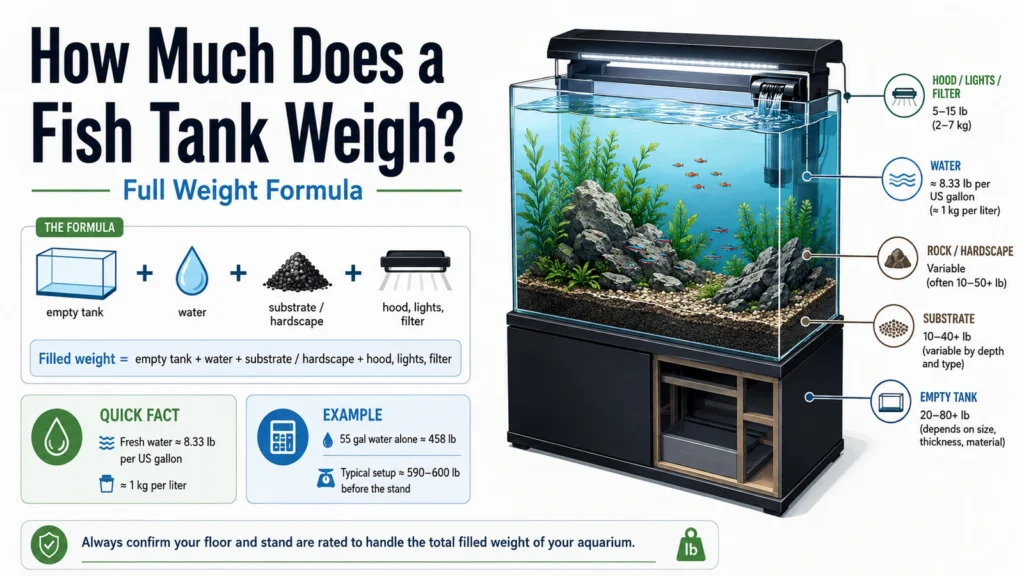
Choosing the replacement is a sizing question rather than a brand question. Match it to your tank volume and your room. And if you are rethinking the whole setup on a large tank at the same time, check your stand and floor before adding anything heavier: our guide to how much a fish tank weighs walks through the calculation.
Frequently asked questions
Why is my aquarium heater light on but the water is cold?
The indicator usually shows that the thermostat is calling for heat. If the light is on and the water stays cold after an hour or two on a separate thermometer, the heating element has most likely failed. Replace the heater rather than trying to open it.
Can I fix a broken aquarium heater?
No. Submersible heaters are sealed units, and the seal is what keeps water away from the electrics. Aqueon's guidance is to replace a heater that shows any signs of damage or wear. Do not glue, tape or reseal a cracked heater.
How long should I wait before taking out an unplugged heater?
It depends on the maker, so check your manual. Aqueon says to let it cool for at least 30 minutes before removing it, and to wait at least 30 minutes after putting it back before plugging it in.
Is a heater that is stuck on dangerous to fish?
It can be, because warm water holds less dissolved oxygen than cool water. Unplug it, increase surface movement, cool the tank gradually, and contact an aquatic veterinarian if fish remain in distress once the temperature is back to normal.
What do I do if the plug or socket got wet?
Do not pull the plug. The safety instructions supplied with aquarium heaters say to switch off the fuse or circuit breaker for that socket first. If you are unsure which breaker it is, or the socket looks damaged, call a licensed electrician.