The report is always the same. The tank was fine. Nothing changed. Over a day or two the shrimp went from grazing normally to sitting still, then to dead, and the fish in the same tank are completely unaffected.
That last detail is the signature. A die-off that takes the invertebrates and leaves the fish untouched points hard at copper, because copper is toxic to shrimp and snails at exposures fish barely register. It is used as an aquarium treatment precisely for that reason: it is effective against invertebrate parasites, and shrimp are invertebrates.
The frustrating part is that "nothing changed" is usually not true. Something was added. It just did not look like a poison.
Where it actually comes from
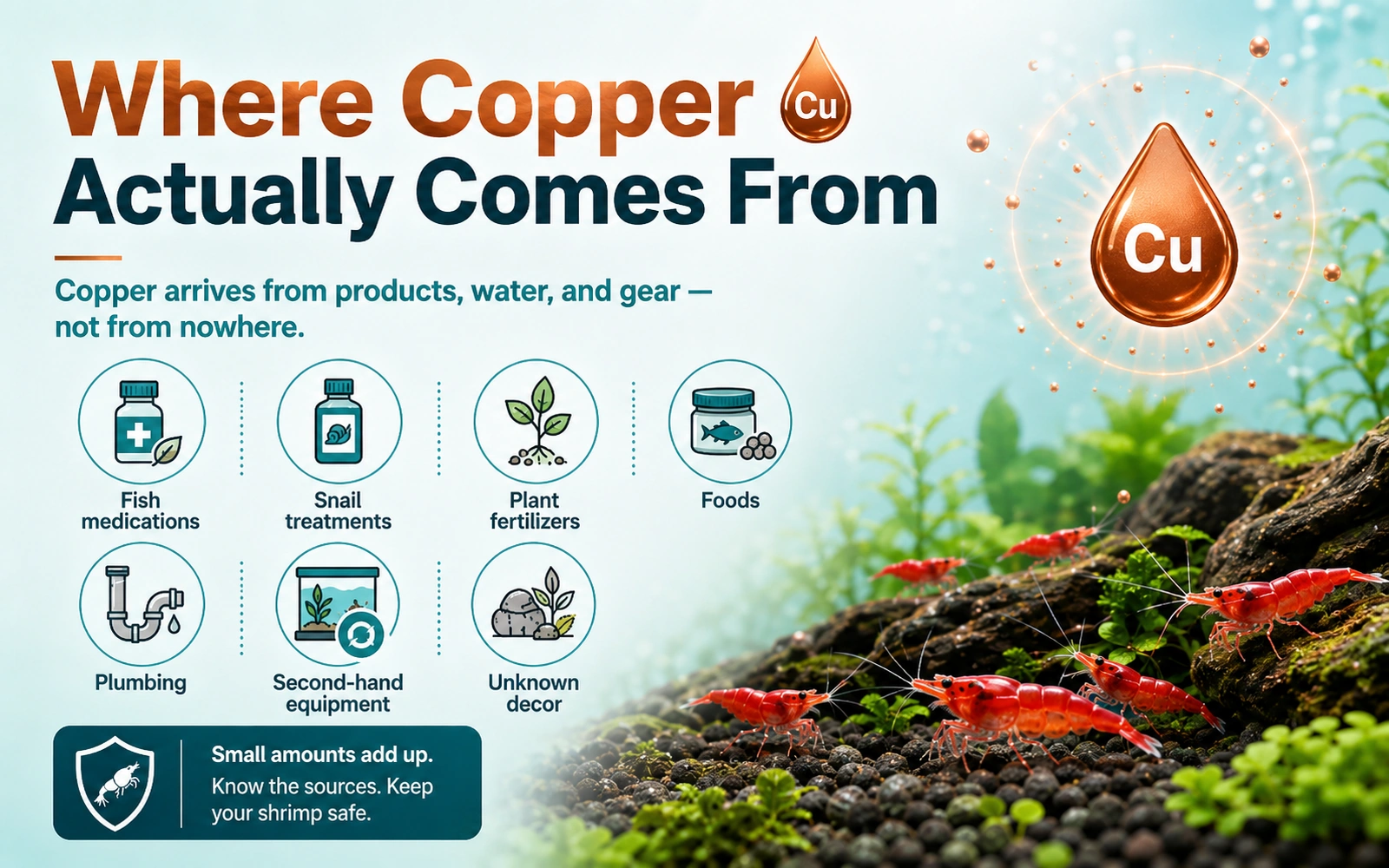
Copper does not appear from nowhere. It arrives, and it arrives from a short list of places that share one property: none of them announces itself.
Fish medications. Many treatments aimed at external parasites are copper based. This is the single most common source, and the sequence is almost always the same: a fish looked unwell, something was added to the display tank, and the colony was gone within days. Some of these products bind to substrate and to silicone and are not removed by a water change, so the exposure outlasts the treatment.
Snail treatments. Products sold to remove pest snails are, by design, lethal to the animals in this cluster. A shrimp is closer to a snail than to a fish in this respect.
Plant fertilizers. Copper is a plant micronutrient, so it appears in comprehensive fertilizer formulations. Some products are formulated with invertebrates in mind and say so. Many are not and say nothing.
Fish and shrimp foods. Copper appears in trace mineral supplementation in prepared foods. This is a smaller exposure than the others and it is not usually the cause of a crash, but it is worth reading the ingredients on anything you feed heavily.
Plumbing. Copper pipe, particularly in older houses, particularly in the first water drawn after a long stand. Water that has been sitting in pipes overnight has had many hours of contact.
Second-hand equipment. A tank, filter or decoration from someone who treated with copper carries a history you cannot see. This is one of the more genuinely invisible routes.
New decor and hardscape. Anything metallic, painted, or of unknown origin. If you cannot say what it is made of, it does not go in a shrimp tank.
Why there is no safe level on this page
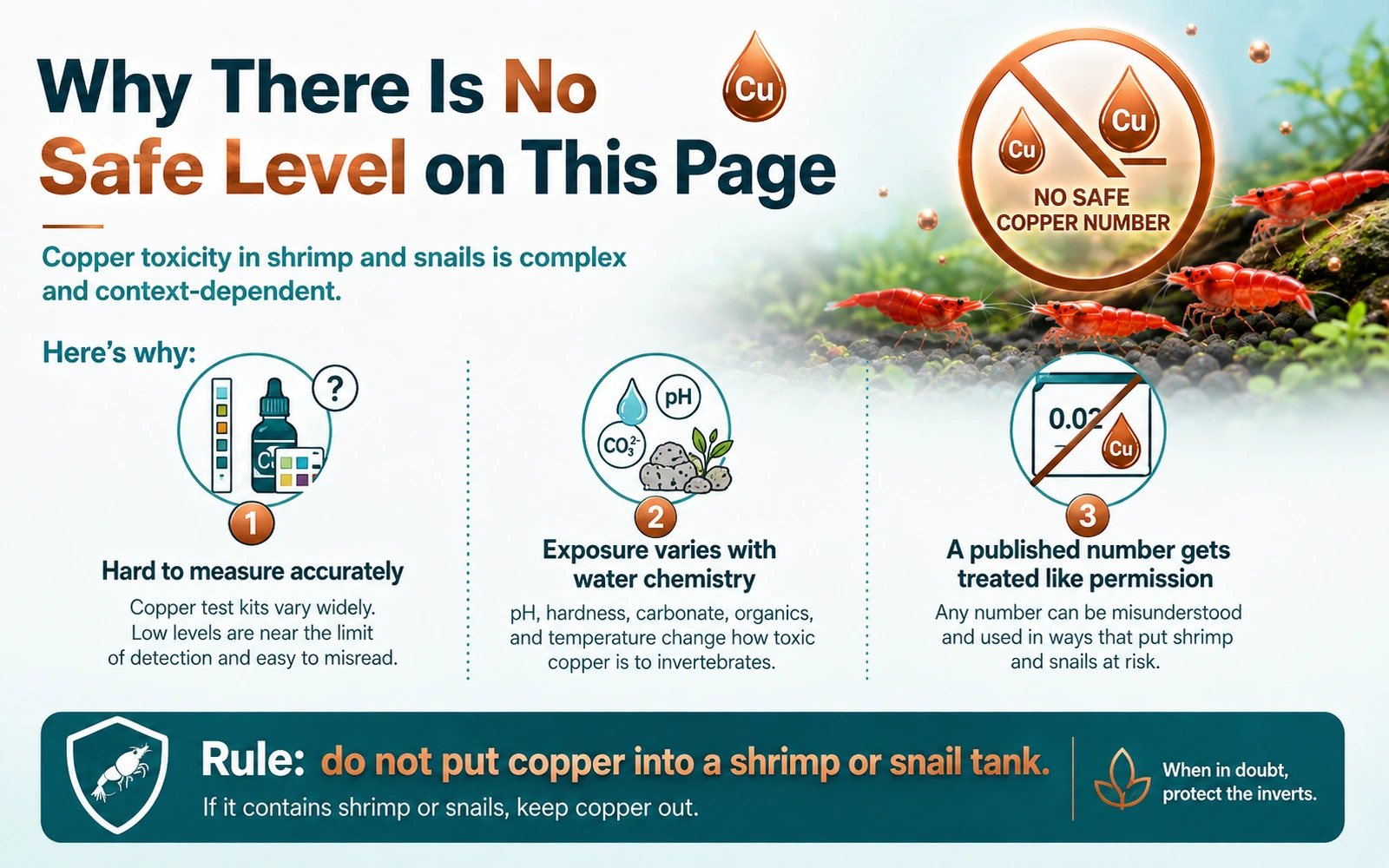
You will find pages that print a number: copper is safe below such-and-such, shrimp tolerate a trace, aim for under this figure. This site publishes none of that, and the refusal is deliberate enough to deserve its own section.
Three reasons.
You cannot measure what you need to measure. Hobby copper test kits are not designed for the precision this question needs, and total copper is not the same thing as the fraction that is actually available to harm an animal. A number you cannot verify is not a safety margin, it is a feeling.
A single figure describes an exposure, not a dose. How much reaches a shrimp depends on water chemistry, on what else is in the tank binding to it, on substrate, and on how long the exposure lasted. A concentration that one keeper's colony survived and another's did not is not evidence that one of them measured wrong.
A published tolerance is read as permission. The practical effect of printing a number is that somebody adds a copper product to a shrimp tank and watches the reading. That is the exact behavior this page exists to prevent, and no caveat attached to the number reliably prevents it.
The rule that replaces the number is simpler and is not a compromise: do not put copper into a tank that contains shrimp or snails, in any quantity, for any reason.
What to do if you think it has happened
There is no reversal, and it is worth being honest about that rather than offering a procedure that does not work.
If you have just added something and the colony is dying:
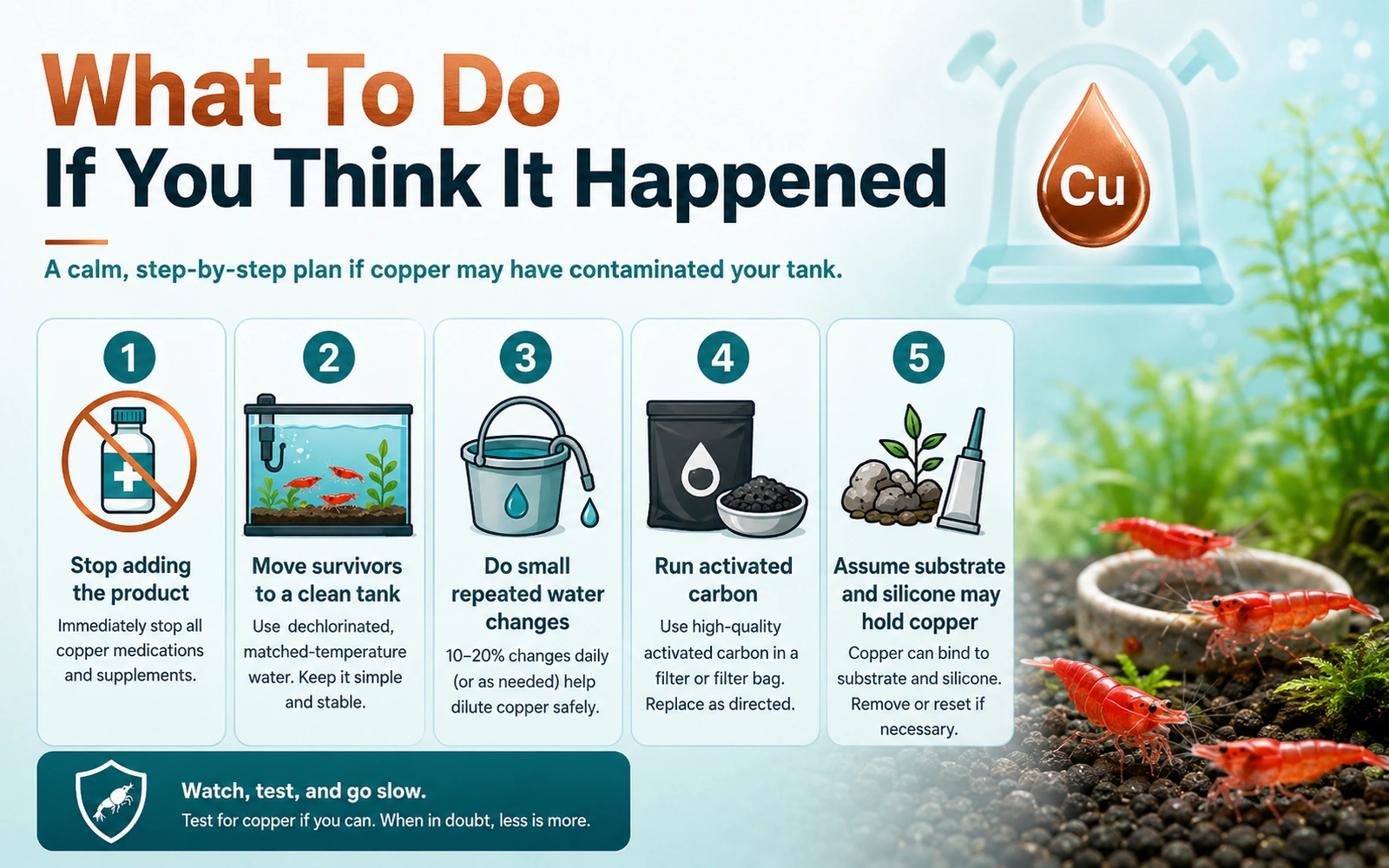
- Stop adding it. Read the bottle, all of it, including the ingredients and the warnings. Most products that are dangerous here say so somewhere on the label.
- Move any survivors to a tank that has never had the product in it, if you have one. Match the temperature and acclimate slowly even in an emergency, because a chemistry shock on top of an existing one does not help.
- Change water, repeatedly and gently, rather than doing one enormous change. Small and frequent, temperature-matched and conditioned. How to do a water change is the method.
- Run activated carbon if you have it. It removes some things from water and it is a reasonable thing to try, not a guarantee.
- Accept that substrate and silicone may hold it. A tank that has been treated with a copper product is not straightforwardly reusable for invertebrates, and replacing the substrate is the usual advice for a reason.
Do not add anything else in an attempt to fix it. A second product on top of the first is how a bad day becomes a worse one, and this site publishes no treatment, no dose and no schedule for any of it.
The habit that prevents it: read the label first
This is the whole of prevention and it costs ten seconds.
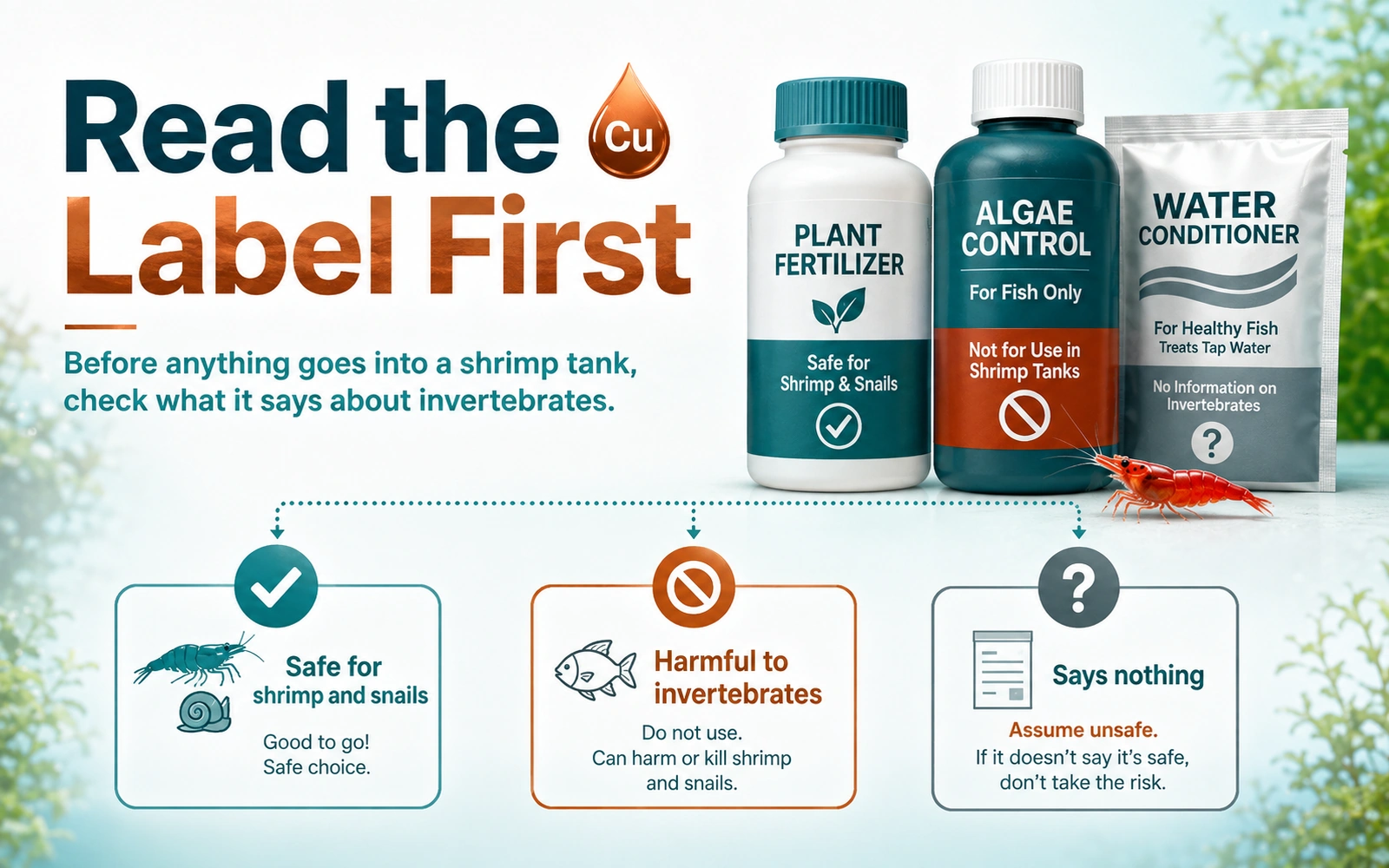
Before anything goes into a tank that contains shrimp or snails, read the label, and specifically look for what it says about invertebrates.
Three outcomes, and the third is the important one.
- It says it is safe for shrimp and snails. Good, and that is a claim the manufacturer has made deliberately.
- It says it is harmful to invertebrates, or not for use with them. Do not use it.
- It says nothing about invertebrates at all. Assume the answer is bad. A product that is safe for them is a selling point, and a manufacturer that could say so generally does. Silence is not reassurance.
The same rule applies to anything second-hand, anything you cannot identify, and any tank whose history you do not know.
The bit about fish medication, said plainly
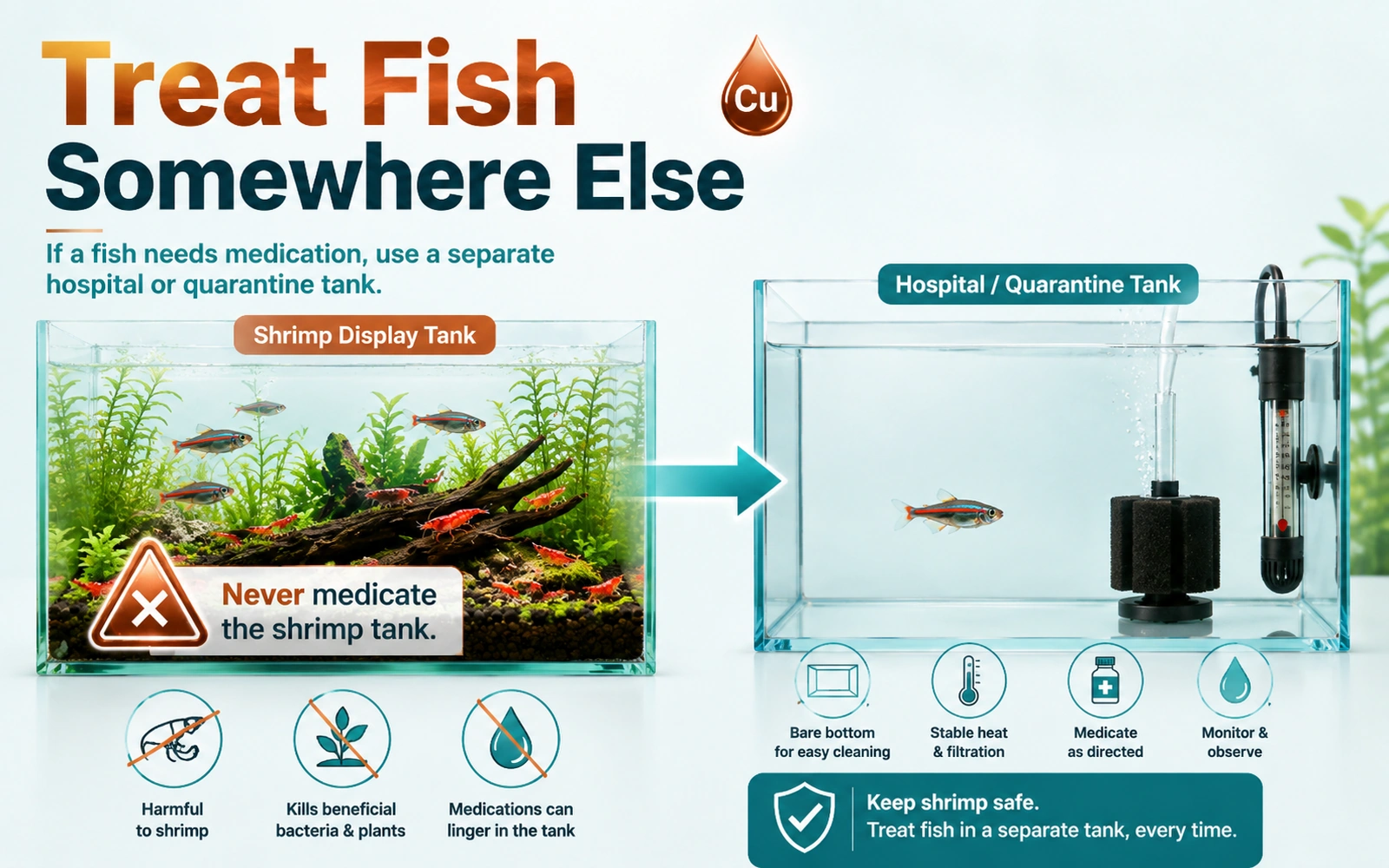
If a fish in a shrimp tank needs treating, the treatment does not happen in the shrimp tank. That is the practical consequence of everything above, and it is the main argument for having a bare separate container available before you need it.
It also means the diagnosis matters more, not less. Guessing at a disease and reaching for a bottle is how a fish problem becomes a colony wipe-out, and this site does not name medications or publish doses anywhere. When a fish is unwell and the water tests clean, that is a veterinary question, and when to contact an aquatic veterinarian and how to find one covers who can answer it, what to have ready, and the fact that much of it is done remotely.
Ruling out the ordinary causes first
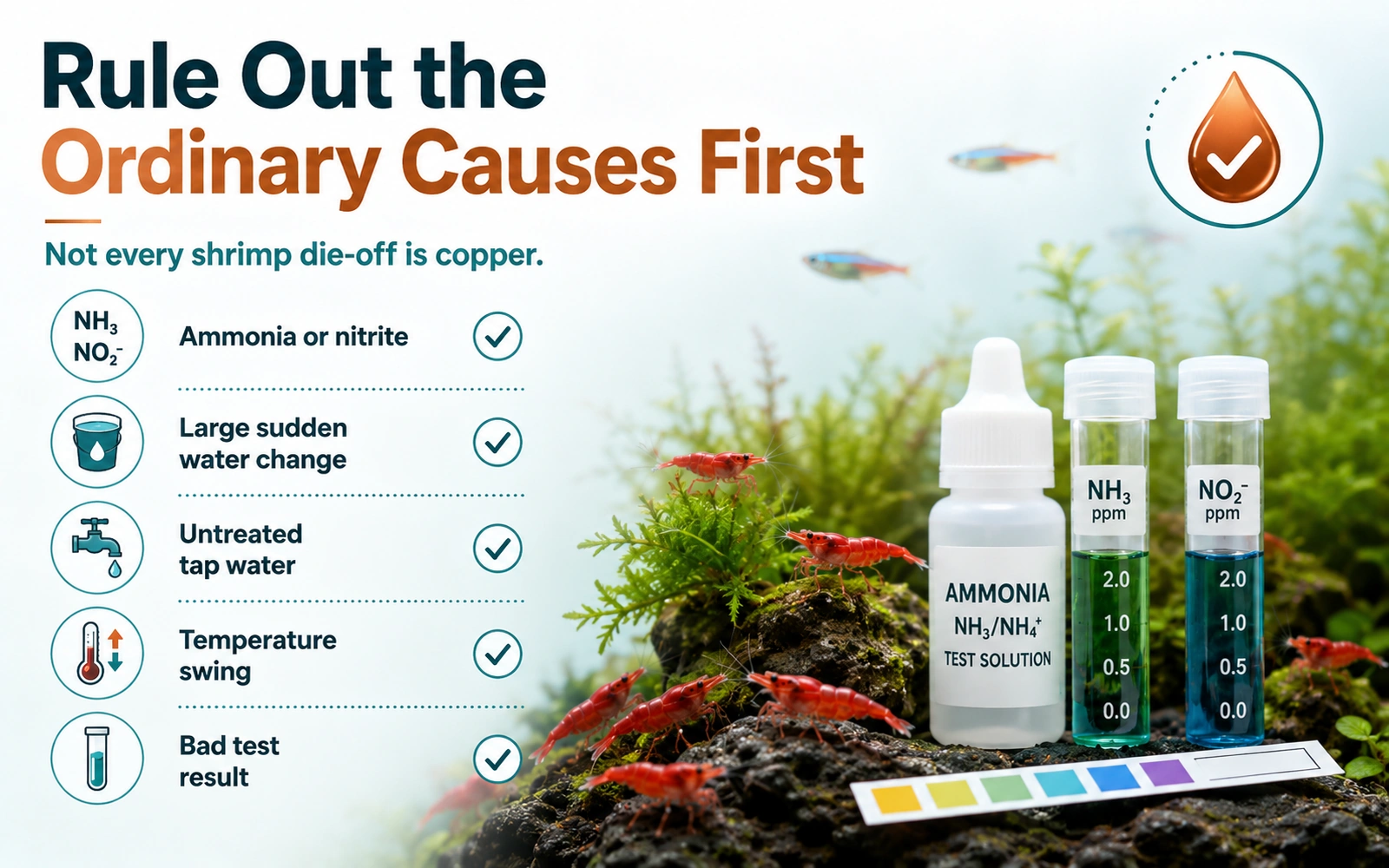
Before you conclude it was copper, make sure it was not the boring answer. A colony can also be lost to ammonia or nitrite, to a large sudden water change, to untreated tap water, or to a temperature swing, and all four are more common than people expect.
Test the water and write the numbers down. Aquarium water parameters covers what each reading means, and this site publishes no threshold at which shrimp begin to die because the honest answer depends on pH and temperature. What is reliable: detectable ammonia or nitrite in a tank with dying shrimp is the finding, whatever the number. Ammonia reading above zero is the next page if that is what you got.
And if the water is clean, the temperature is steady, nothing was added, and they still died, when a test kit gives a wrong reading is worth reading before you accept the clean result at face value.
The short version
- Invertebrates dying while fish are fine is the signature.
- Sources: fish medications, snail treatments, fertilizers, foods, plumbing, second-hand gear, unknown decor.
- No safe level is published here, on purpose. You cannot measure it usefully and a number gets read as permission.
- Read every label for what it says about invertebrates. Silence means assume the worst.
- Treat fish somewhere else. Always.
FAQ
Why did my shrimp die while the fish are completely fine? That pattern is the signature of copper. It is toxic to shrimp and snails at exposures fish barely register, which is exactly why it is used in treatments aimed at invertebrate parasites.
What is a safe copper level for shrimp? This site does not publish one, deliberately. Hobby test kits cannot measure what actually matters, a single figure describes an exposure rather than a dose, and a published tolerance gets read as permission. The rule that replaces the number: no copper in a tank with shrimp or snails, in any quantity, for any reason.
Where did copper come from if I never added any? The short list: fish medications, snail treatments, some plant fertilizers, trace minerals in some foods, copper plumbing, second-hand equipment with a treatment history, and decor of unknown origin. None of them announces itself.
Can copper be removed once it is in the tank? There is no reversal. Move survivors to an untreated tank if you have one, change water in small, frequent, gentle steps, and run activated carbon as a reasonable attempt rather than a guarantee. Substrate and silicone can hold it, which is why replacing the substrate is the usual advice.
Can I treat a sick fish in a shrimp tank? No. If a fish in a shrimp tank needs treating, the treatment does not happen in the shrimp tank. And when a fish is unwell and the water tests clean, that is a question for an aquatic veterinarian rather than for a bottle.