Nobody wants to hear that the two fish they just bought need their own tank for a month. It sounds like a rule invented by people with fish rooms, and the shop certainly did not mention it.
Here is the case made honestly, including the case against.
What quarantine buys you is not certainty. It is the difference between a problem confined to two fish in a plastic box and a problem loose in the tank you have spent months building. That is the whole argument, and whether it is worth the effort depends on things that are specific to you.
What actually arrives with a new fish
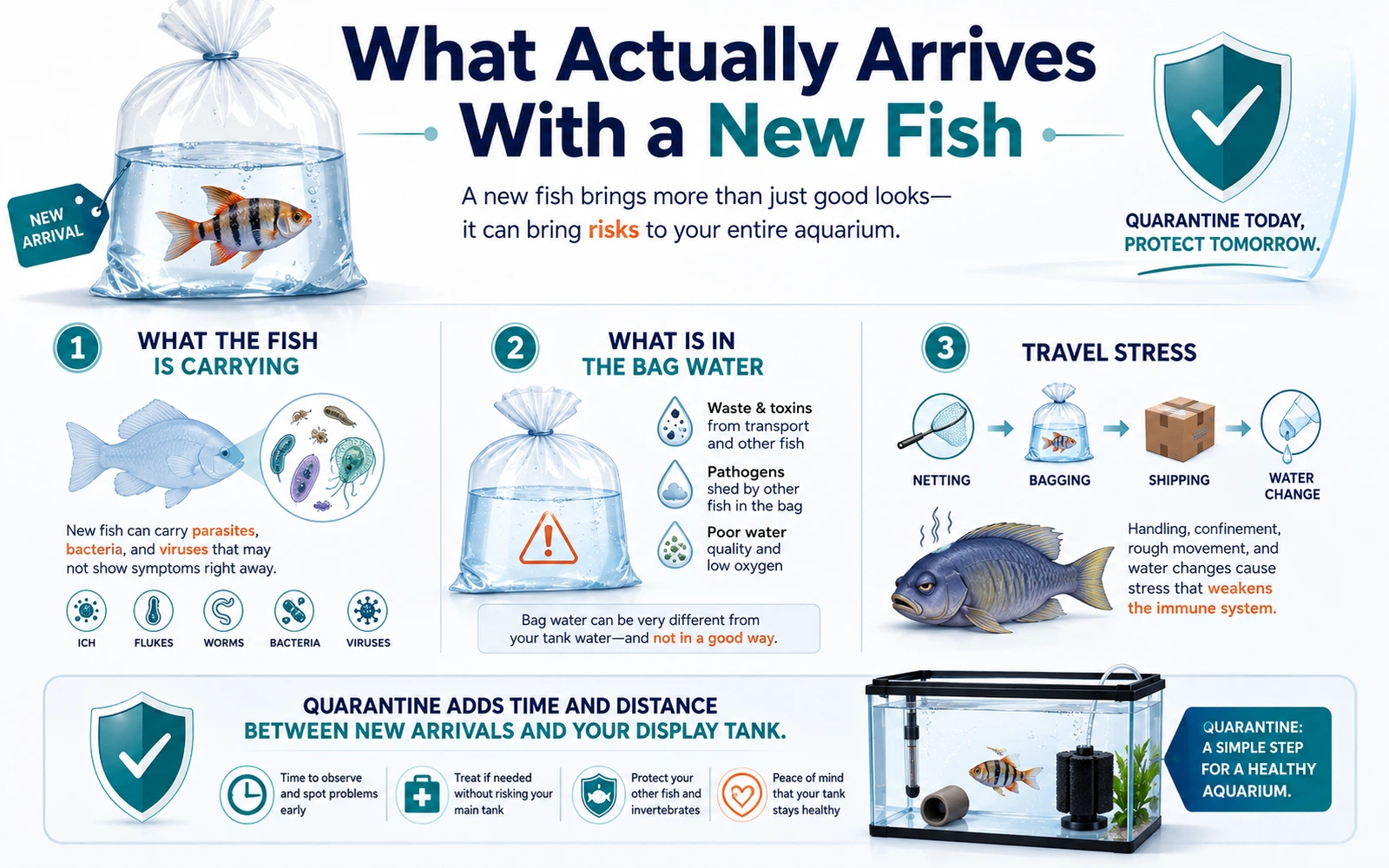
A fish leaving a shop has usually passed through several tanks and several countries, sharing water at each stop with fish from everywhere else. It may have been in that shop's system for days rather than weeks, and shop systems are commonly shared across many tanks.
That journey brings three separate risks, and only one of them is what people mean by disease.
Something the fish is carrying. Parasites and bacteria that a stressed animal in a shared system picks up, and that a healthy-looking fish can carry without showing anything for a week or more.
Something in the water it came in. Whatever is in the bag is in the bag, and pouring it into your tank is a decision you can decline.
The fish itself, unwell from the trip. Shipping, netting, bagging and a change of water chemistry are a lot for a small animal, and the days after arrival are when problems surface.
A quarantine tank addresses all three, mostly by putting time and a physical barrier between the new arrival and everything you already own.
What one actually is
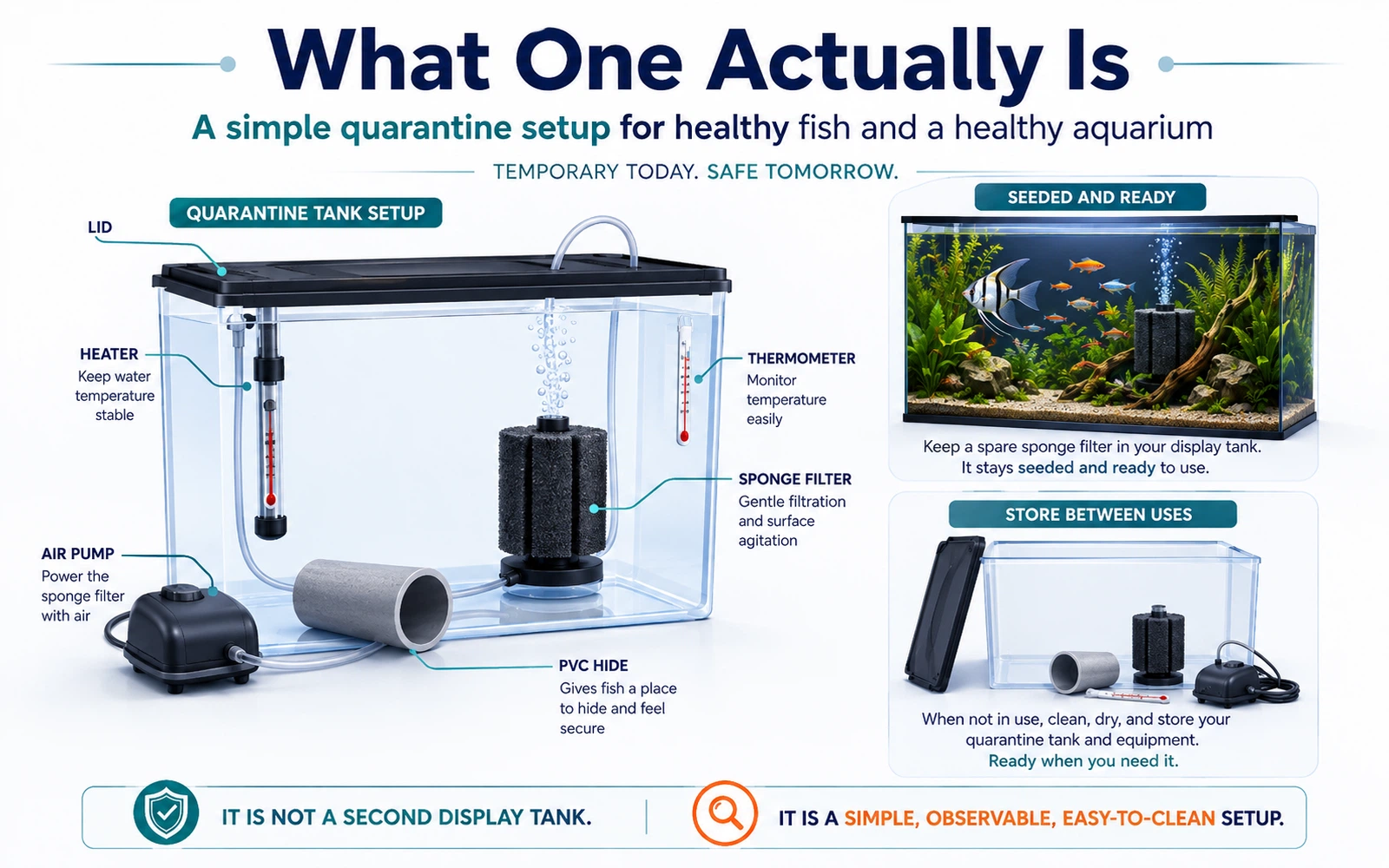
The mental image is the obstacle. People picture a second display tank, and that is not what this is.
A quarantine setup is: a plain container that holds water, a sponge filter, an air pump, a heater, a lid, a thermometer, and somewhere for the fish to hide. No substrate, no plants, no decoration, nothing porous. Bare is deliberate: it is easy to clean, easy to observe, and there is nothing for anything to hide in.
Two points that matter more than the shopping list.
It needs to be cycled, or it needs to be managed like an uncycled tank. A container of fresh water with a fish in it is a tank with no biological filter, and ammonia climbs quickly in a small volume. The standard solution is to keep a spare sponge filter running permanently in your main tank so it is colonized and ready to move across, which is the same principle described in seeding a new filter from an established tank. If you have not done that, you are running a fish-in cycle in a small volume and you need to be testing daily and changing water accordingly, which is a real commitment. Fish-in cycling covers what that involves.
It does not have to be permanently set up. The heater and the sponge filter live in your main tank between uses. The container lives in a cupboard. It goes up the day before you buy fish and comes down four weeks later.
How long, and why nobody agrees
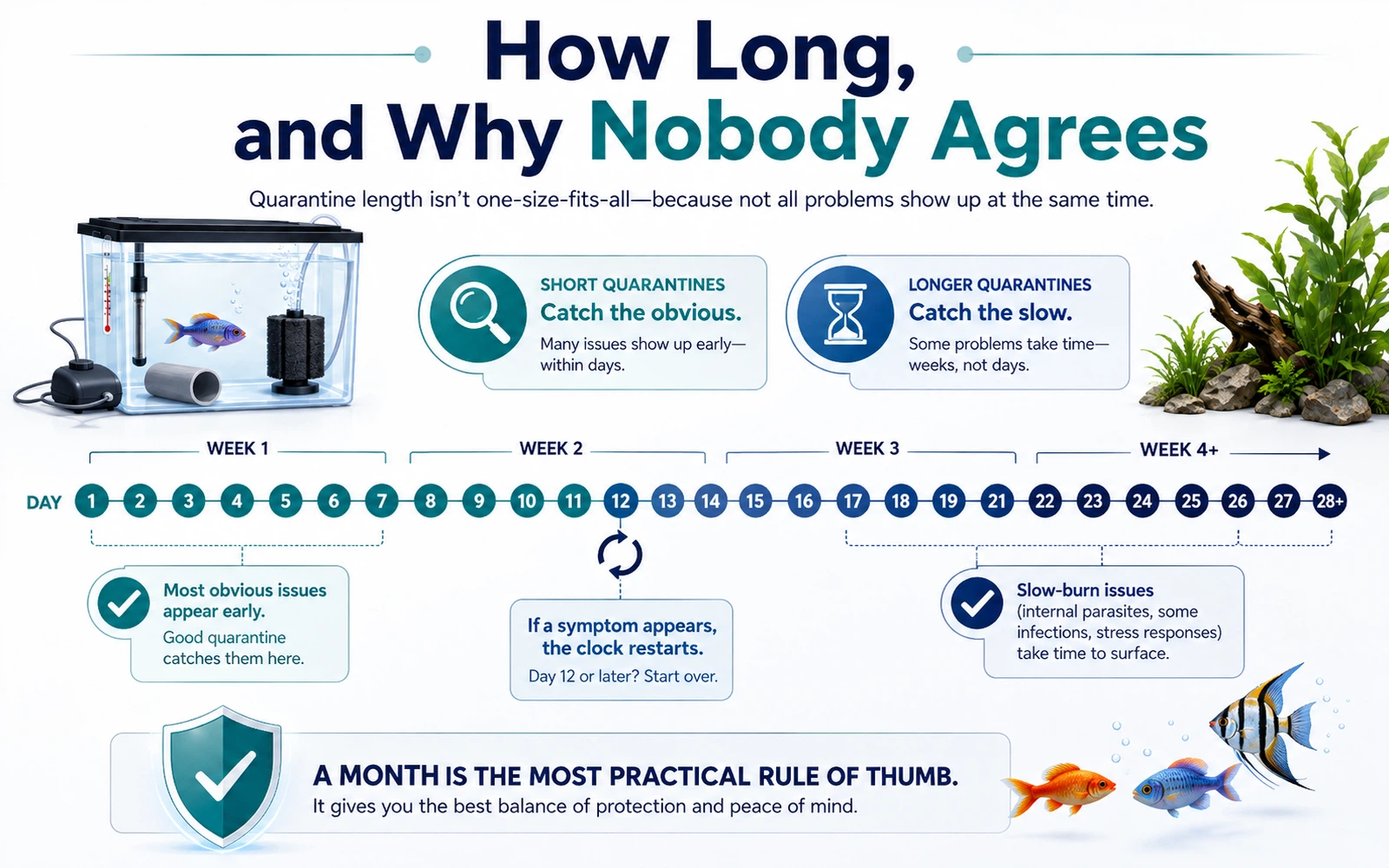
Published recommendations for quarantine length vary widely, and they vary for a defensible reason rather than because someone is wrong. Shorter periods catch the obvious: a fish that arrived already unwell will usually show it within days. Longer periods catch the slower ones, where an organism's life cycle means nothing is visible for a fortnight or more.
The commonly repeated figures sit anywhere from two weeks to a month or more, and you will find confident advocates of each. The rule that survives the disagreement is more useful than picking a number: the clock restarts if anything appears. A fish that shows a symptom on day twelve of a two-week quarantine has not nearly finished. It has started again.
The practical version most keepers land on is a month, because it comfortably covers the slower cases and because a month is a period a person can actually remember.
What you are doing during it
Less than you might think, and none of it involves adding anything.
- Watch, daily. Behavior, breathing, appetite, fins, body surface, waste. You are looking for a change rather than for a specific thing.
- Test the water, daily, because a small volume with no established filter moves fast. How often to test aquarium water covers what to look at.
- Change water when the test says to, with conditioned, temperature-matched water. How to do a water change is the method.
- Feed lightly. A small volume punishes overfeeding, and how much to feed aquarium fish covers the amount.
- Keep separate equipment, or at minimum a separate net, and do not move wet hands from one tank to the other without washing between. Cross-contamination through a shared net defeats the entire exercise.
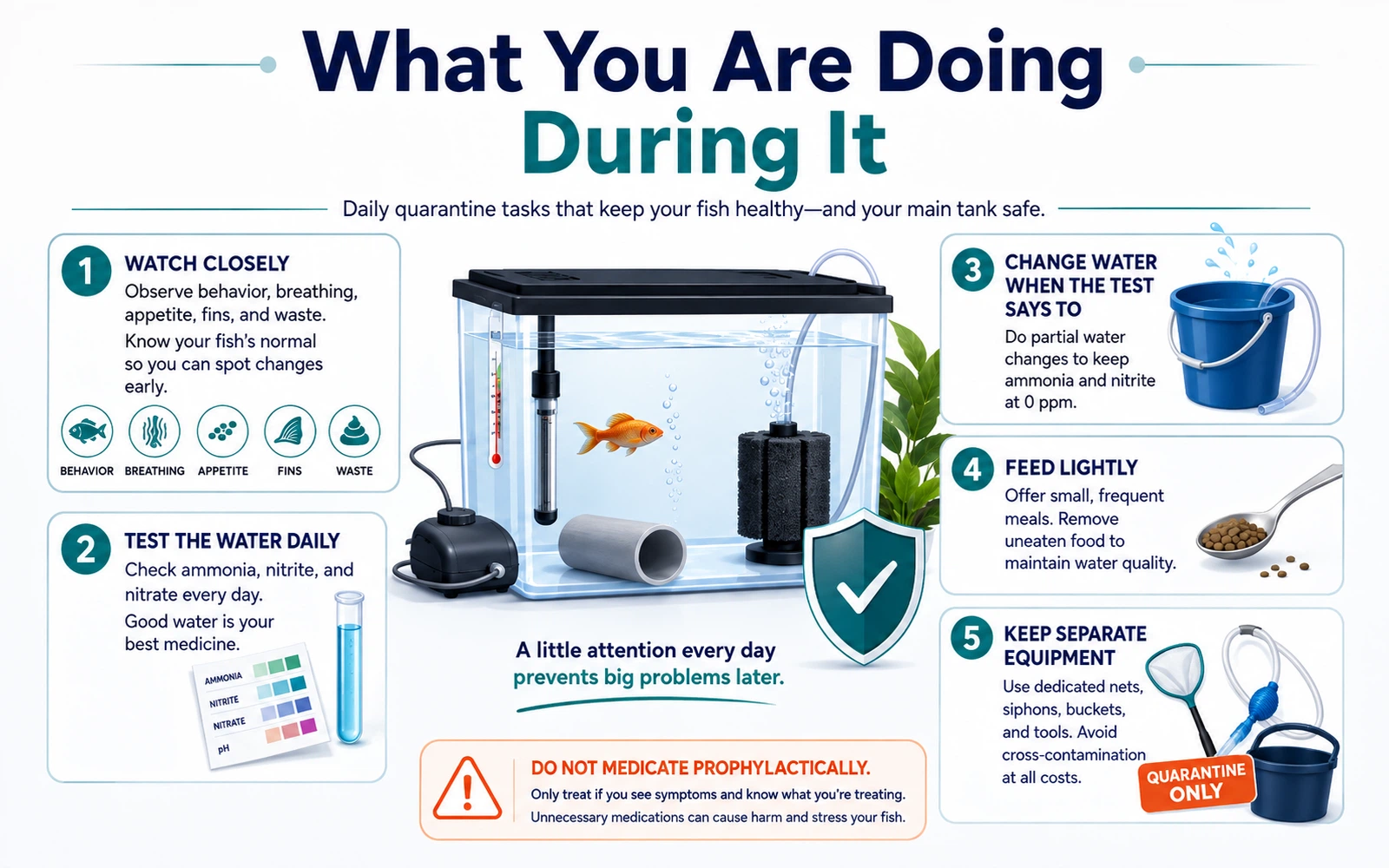
Do not medicate prophylactically. Treating a healthy fish for a disease it does not have is how resistance develops and how healthy animals get harmed, and this site publishes no medication, no dose and no treatment schedule anywhere. If something appears during quarantine, that is a diagnosis question, and when to contact an aquatic veterinarian and how to find one covers who can actually answer it. The advantage you have bought yourself is that the problem is in a bare box with two fish in it rather than in your display tank.
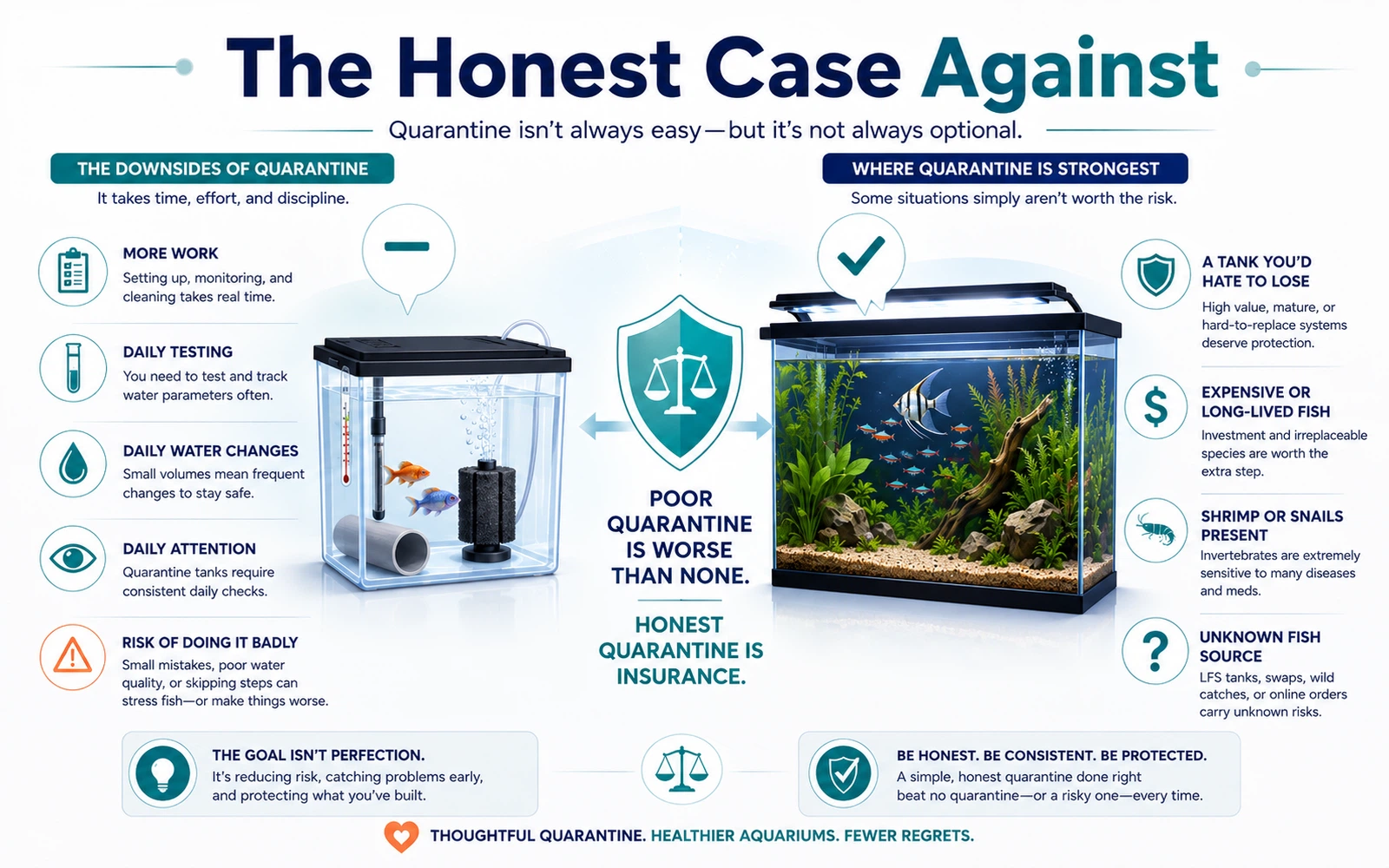
The honest case against
This site's rule is that no page recommends a purchase the reader does not need, so here is the other side stated properly.
Quarantine is genuinely more work, and done badly it is worse than not doing it. A new fish held in an uncycled container with rising ammonia, unwatched, is being harmed by the quarantine rather than protected by it. A poorly run quarantine is a worse outcome than adding the fish straight to a healthy, stable, uncrowded tank.
It also has a real cost in attention. Daily testing and daily water changes for a month is a commitment, and a person who knows they will not do it is better served by being honest about that now.
Where the argument is weakest: a single species-only tank you never plan to add to again, or a first fish going into a brand new empty tank, where there is nothing to protect.
Where it is strongest, and where it is close to non-negotiable: a tank that already holds fish you would be upset to lose, an expensive or long-lived fish going in, a tank with shrimp or snails in it, or fish bought from a source you have no history with.
If you are not going to do it
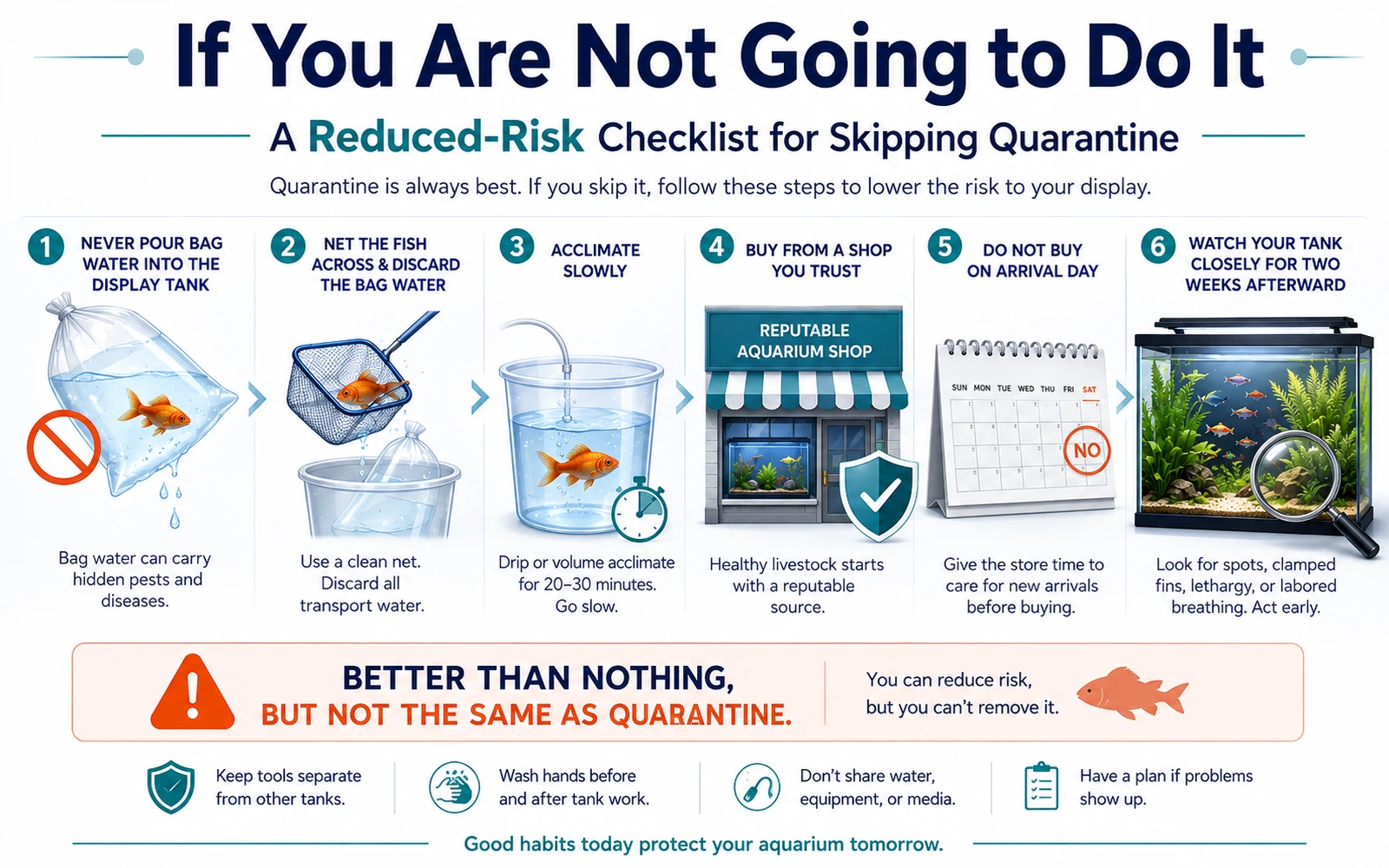
The reduced version, which is better than nothing:
- Never pour bag water into your tank. Net the fish across and discard the water.
- Acclimate slowly to temperature and to chemistry.
- Buy from one shop you have a history with, and look at its other tanks before you buy from any of them. A dead fish in a neighboring tank on a shared system is information.
- Do not buy on the day new stock arrives. Give the shop a week to find out what it received.
- Watch your own tank closely for a fortnight afterward, and know what you would do if something appeared. Something is wrong with my tank is the order of checks.
The short version
- A quarantine tank is a bare container, a sponge filter, a heater and a lid. It is not a second display tank.
- Keep a spare sponge filter running in your main tank so it is ready when you need it.
- Published durations disagree. The rule that survives is that the clock restarts if anything appears.
- Watch and test. Add nothing.
- Skip it honestly rather than run it badly, and if you skip it, at least never pour the bag water in.
FAQ
How long should new fish stay in a quarantine tank? Published recommendations range from two weeks to a month or more, and they disagree for defensible reasons. The rule that survives the disagreement is that the clock restarts if anything appears, and the practical version most keepers land on is a month.
Does a quarantine tank need to be cycled? Yes, or it needs to be managed like an uncycled tank, with daily testing and water changes as the results demand. The standard solution is to keep a spare sponge filter running permanently in your main tank so it is colonized and ready to move across.
Should I medicate new fish in quarantine as a precaution? No. Treating a healthy fish for a disease it does not have is how resistance develops and how healthy animals get harmed. If something appears during quarantine, that is a diagnosis question for an aquatic veterinarian, and the advantage you have bought is that the problem is confined to a bare box.
What equipment does a quarantine tank actually need? A plain container that holds water, a sponge filter, an air pump, a heater, a lid, a thermometer and somewhere for the fish to hide. No substrate, no plants, nothing porous, and it does not have to be permanently set up.
What if I decide not to quarantine? The reduced version is better than nothing: never pour bag water into your tank, acclimate slowly, buy from one shop you have a history with, do not buy on the day new stock arrives, and watch your own tank closely for a fortnight afterward.