The reason this page is about the first hour is that the evidence disappears fast. A body decomposes and starts adding ammonia to the water. The water itself changes as soon as you do a water change. The other fish either recover or do not, and by tomorrow you will be reasoning about a tank that is no longer the tank the death happened in.
So the order below is deliberate. Gather before you fix, because the fixing destroys the evidence, and the evidence is what tells you whether the rest of them are next.
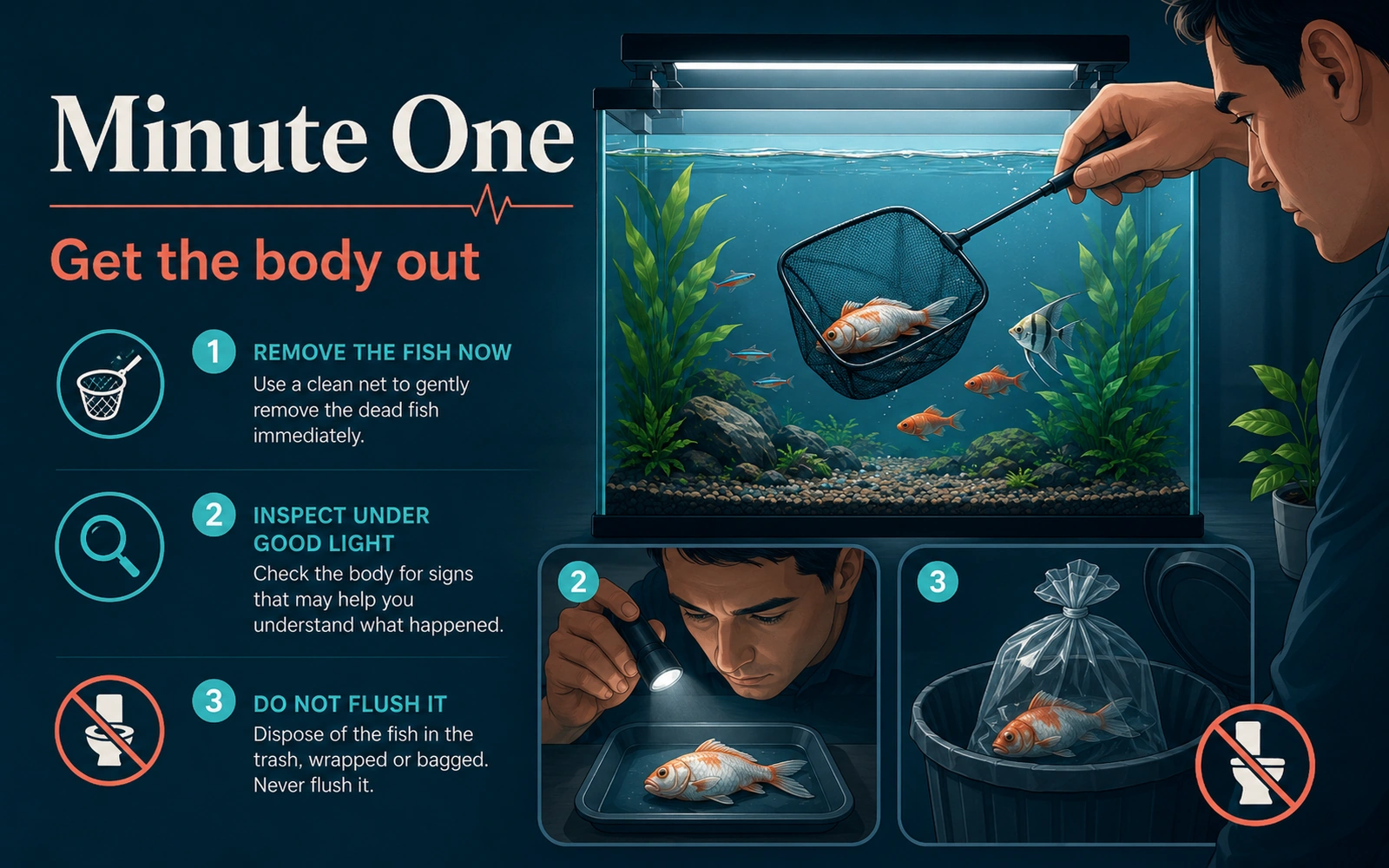
Minute one: get the body out
Remove the dead fish now. A body decomposing in a tank adds to the ammonia load, and in a small tank that alone can push a marginal situation into a bad one.
Take it out with a net, not with your hands, and look at it properly under good light before you dispose of it. This is the only chance you get.
Do not flush it. Wrap it and put it in the household waste, or bury it away from any water. Disease and non-native species both travel that way.
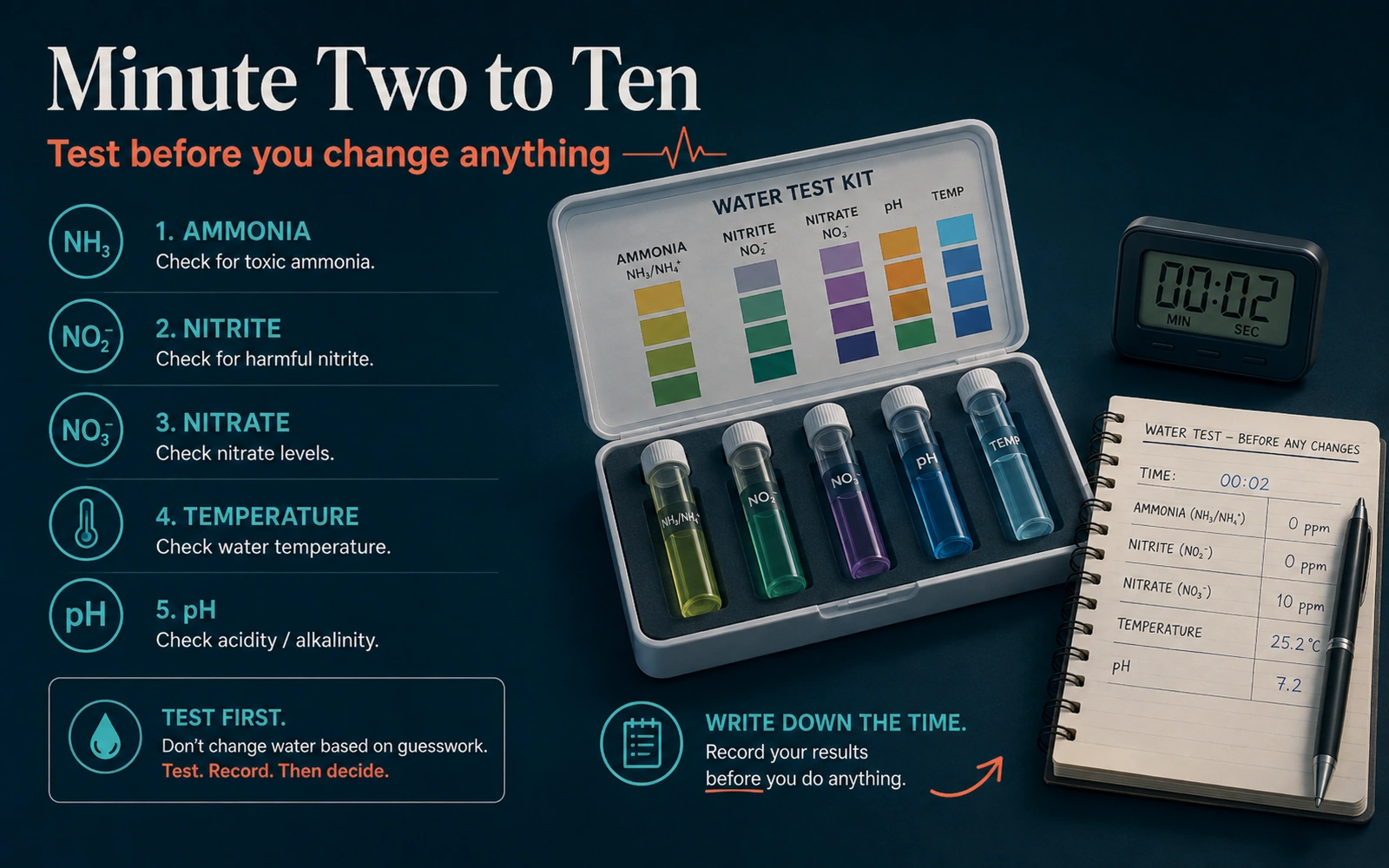
Minute two to ten: test the water, before you change anything
This is the step people skip, and it is the one that answers the question.
Test ammonia, nitrite, nitrate, temperature and pH, and write the numbers down with the time. Do it before a water change, because a water change destroys the reading you most need.
If you have a record of previous readings, compare. A tank that has been at zero and zero for weeks and is suddenly not is telling you something specific. Keeping an aquarium water test log covers why the columns most people leave out, what you did and what you saw, are the ones that make a log worth having.
Two things this page will not do. It will not name a level at which fish die, because there is no honest single number: ammonia toxicity rises sharply with pH and with temperature, so the same reading is a different exposure in two tanks. And it will not tell you that your reading is fine. What is reliable is that any detectable ammonia or nitrite in a tank where a fish has just died is the finding, and it is where you start. Ammonia reading above zero and nitrite reading above zero are the pages for each.
If your kit gives you a result that seems impossible, do not dismiss it and do not act on it blindly either. When a test kit gives a wrong reading covers the control test, which is the way to resolve a suspect kit rather than argue with it.
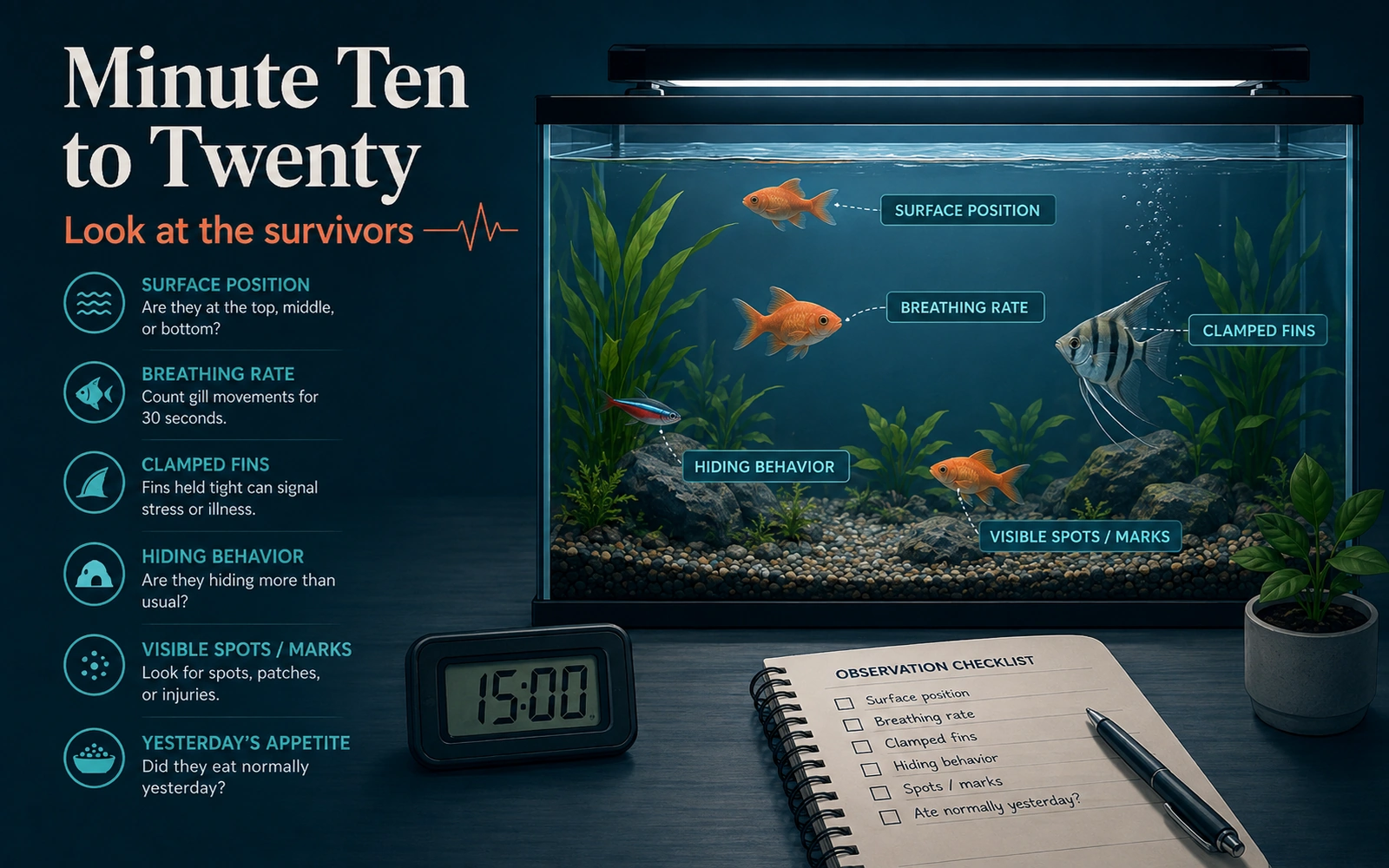
Minute ten to twenty: look at the fish that are still alive
The survivors are better evidence than the body, because you can watch them.
- Where are they in the tank? All crowded at the surface is a specific and urgent signal, covered in why fish gasp at the surface.
- Are they breathing fast? Count gill movements against a normal day if you have any sense of one.
- Are fins clamped? A fish holding its fins tight to its body is a fish under pressure.
- Is anyone hiding who does not normally hide?
- Is anyone else showing marks, spots, ragged fins, cloudiness or swelling?
- Are they eating? Do not feed as a test right now, but note whether they had eaten normally yesterday.
If every remaining fish looks and behaves normally, that shifts the odds toward something specific to the one that died rather than something environmental.
Minute twenty to forty: what changed in the last two weeks
Most sudden single deaths trace to something that happened, and the something is usually recent. Work through this honestly rather than defensively.
- New fish added, even one, even weeks ago. New arrivals bring things in, which is the whole argument for a quarantine tank.
- A filter cleaned, especially if the media was rinsed under a tap. That is one of the more common ways a tank loses its cycle overnight, and an aquarium cycle crash covers what it looks like afterward.
- A large or unusual water change, or a change done without conditioner.
- A power cut, even a short one. A filter that stops for hours is a filter that may come back with dead bacteria in it.
- A temperature swing, a heatwave, a window left open, a heater that failed.
- Anything added to the water: a treatment, a plant fertilizer, a new decoration that was not rinsed.
- Anything used in the room. Aerosols, paint, cleaning sprays, insecticide, scented products. The water surface takes in what is in the air, and this cause is invisible unless you go looking for it.
- New decor or new substrate, particularly anything painted, metallic or of unknown origin.
- Overfeeding, or food left uneaten and decaying under the substrate.
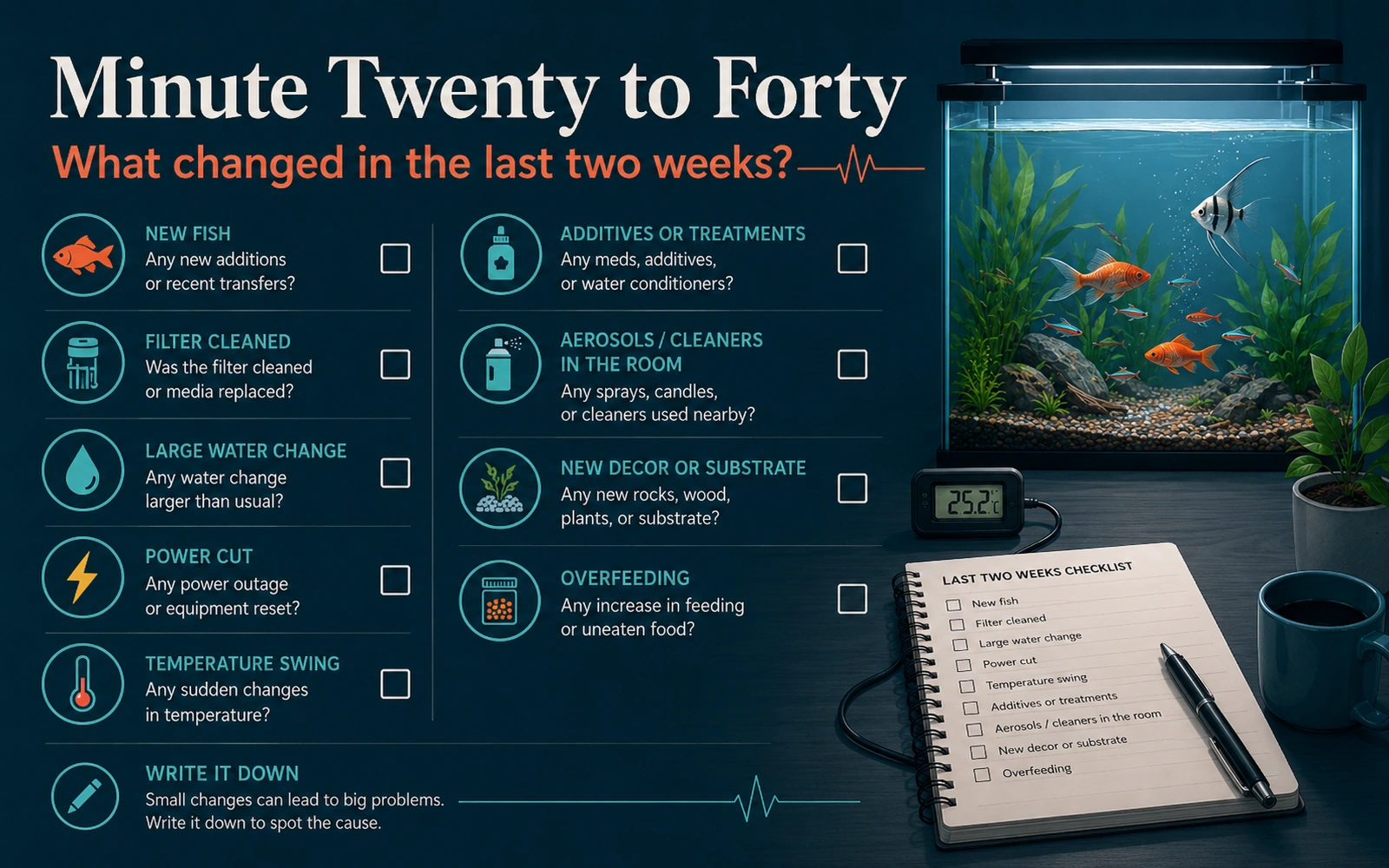
Write down anything on that list that happened. The pattern is often obvious once it is written and invisible while it is in your head.
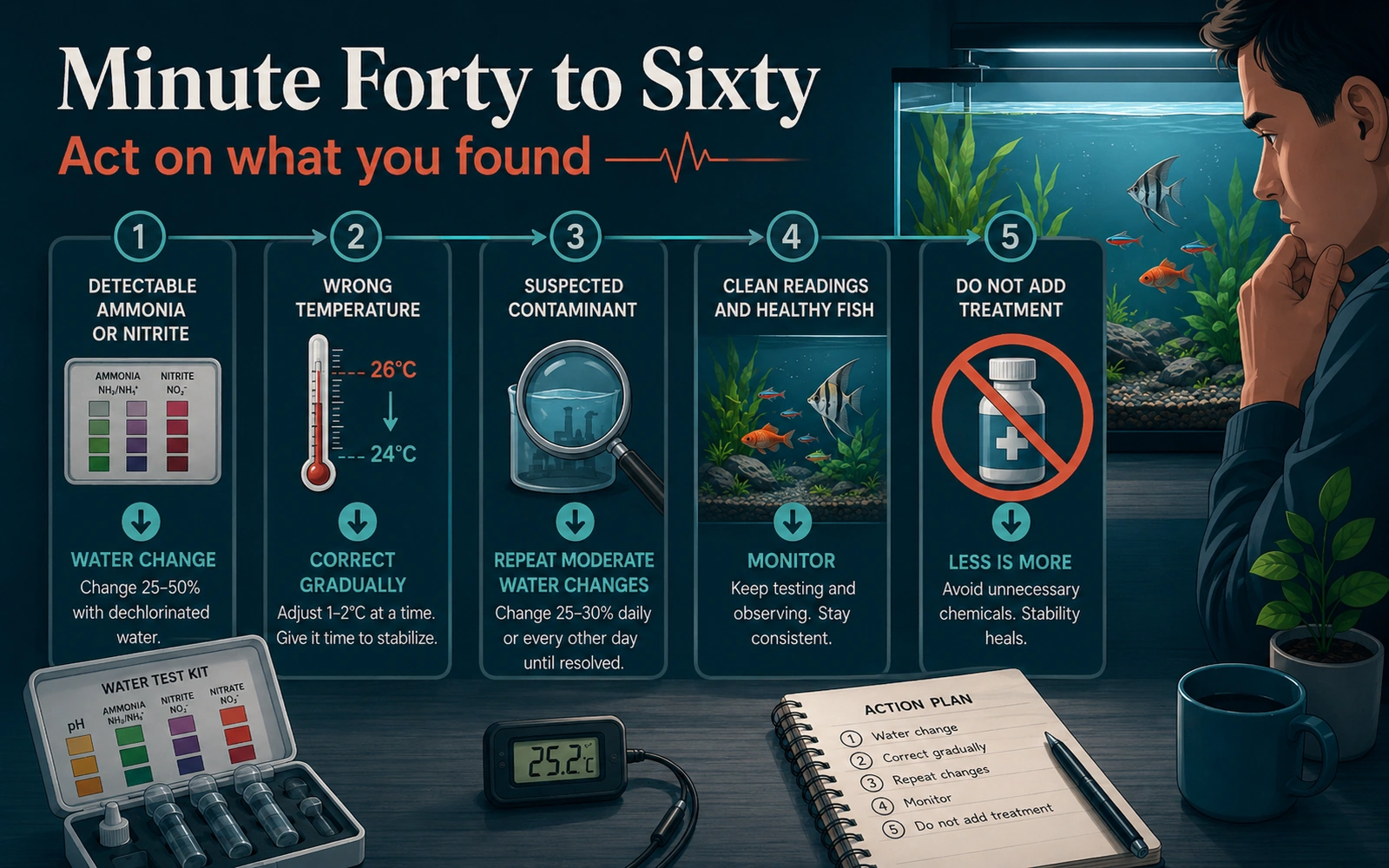
Minute forty to sixty: act on what you found, in this order
- If ammonia or nitrite is detectable, do a water change with conditioned, temperature-matched water. How to do a water change is the method. Then test again after a few hours.
- If the temperature is wrong, bring it back gradually. Fast temperature corrections are their own stress.
- If you suspect something got into the water, a water change is the response, and repeat it rather than doing one enormous one.
- If everything reads clean and the other fish are fine, do nothing dramatic. Test again tomorrow and the day after. A single death in a tank that is otherwise healthy happens, and reacting to it with a large intervention causes more harm than it prevents.
- Do not add any treatment. You do not have a diagnosis, and medicating a tank you have not diagnosed is how a single death becomes several.
The part nobody wants to read
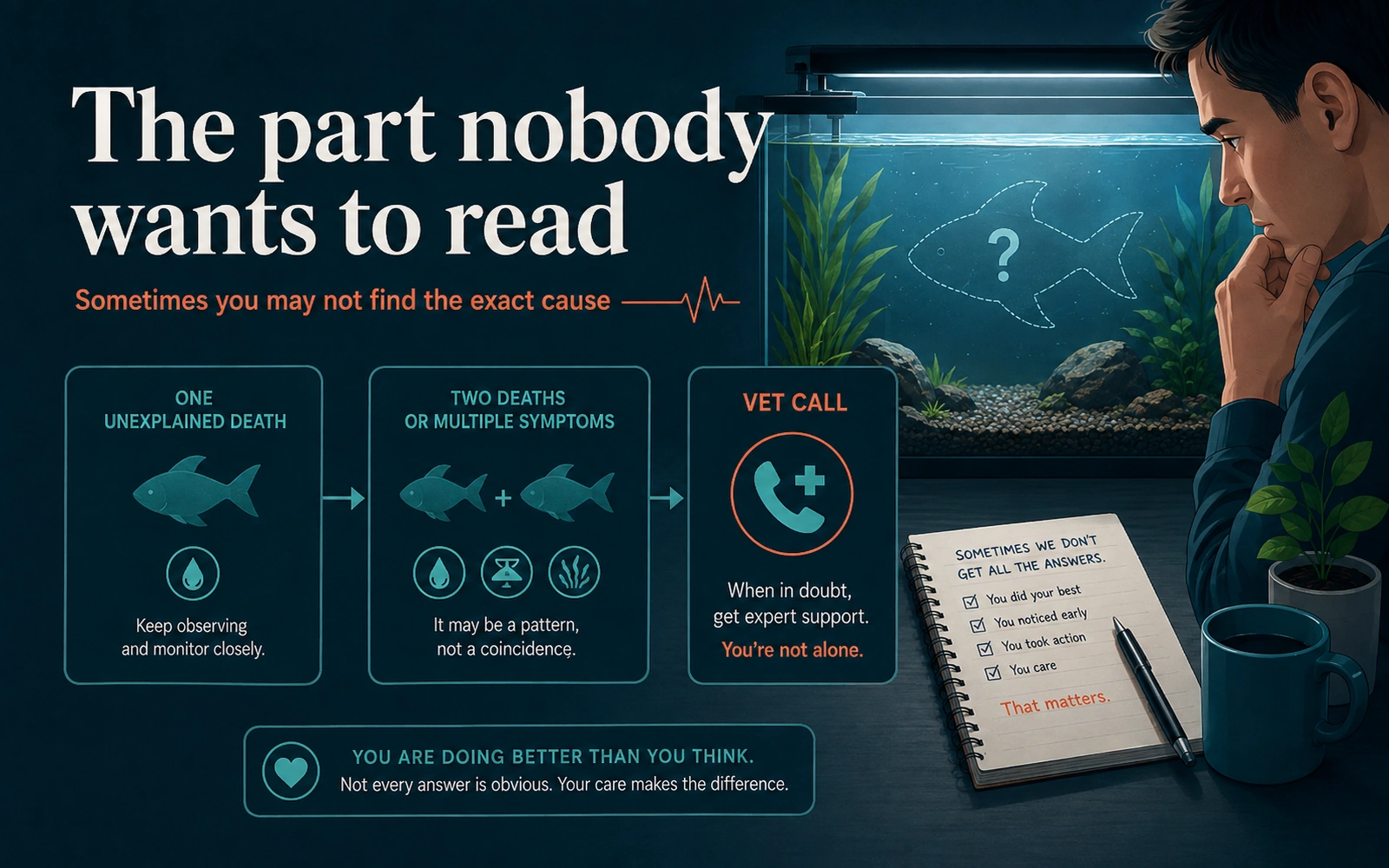
Sometimes the answer is that you will not find out. A fish can arrive from the shop already carrying something. An individual can have an internal problem that was never going to be visible. Fish also have lifespans, and some of the species sold as beginner fish are short-lived.
A single death in a tank with clean water, healthy tankmates and no recent changes usually stays unexplained, and that is a tolerable outcome. What is not tolerable is a second and a third, because that is a pattern and a pattern has a cause.
If a second fish dies within a week, or if several are showing symptoms, stop treating this as a mystery to solve alone. When to contact an aquatic veterinarian and how to find one covers how to find one, what to have ready before you call, and the fact that much of this work is done remotely with photographs and your test results. Multiple deaths with clean water is exactly the situation that page describes as the threshold.
What not to do in the first hour
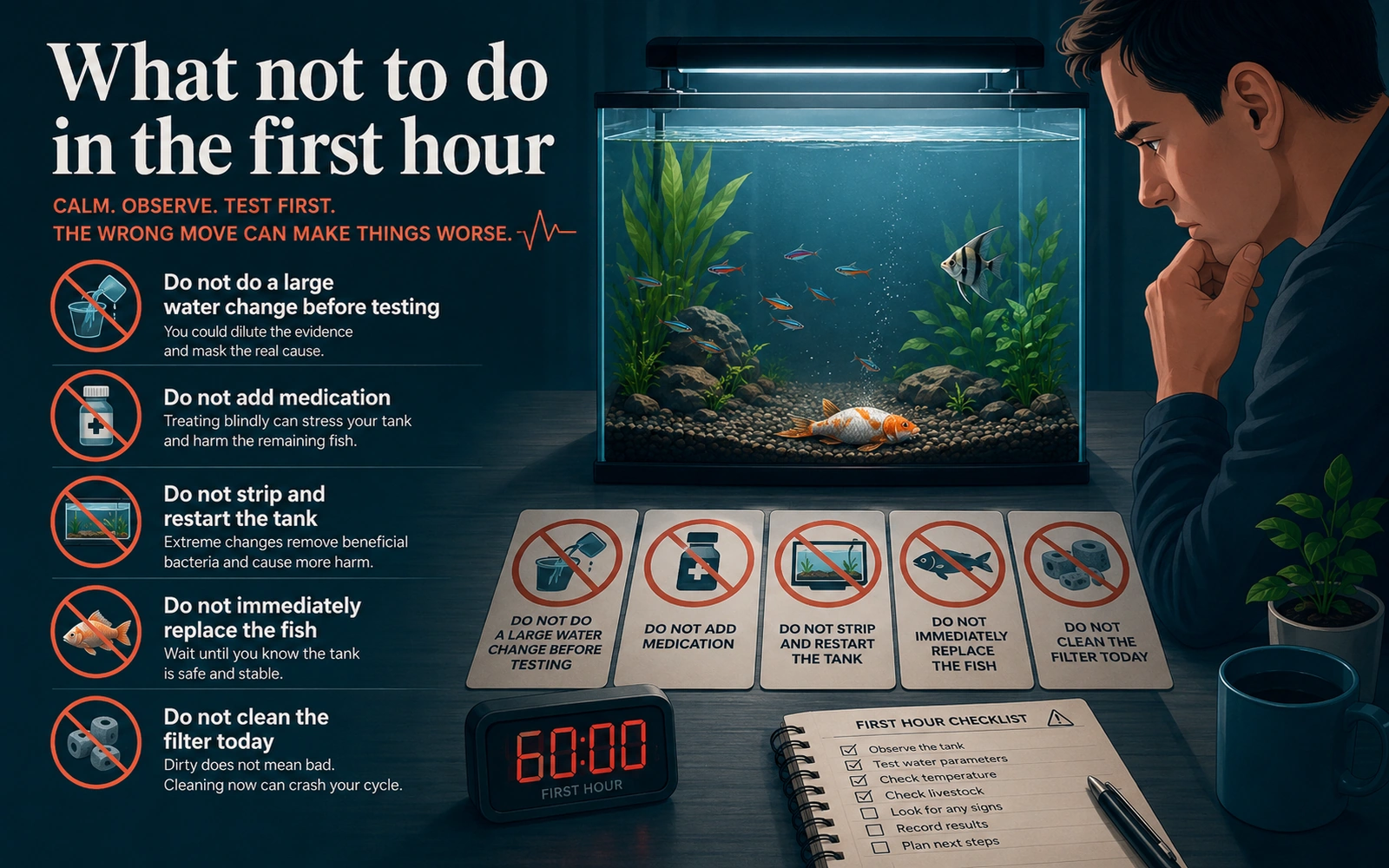
- Do not do a large water change before testing. You destroy the evidence.
- Do not add medication. No diagnosis, no treatment.
- Do not strip and restart the tank. You would be killing the filter bacteria that are keeping the survivors alive.
- Do not immediately replace the fish. Whatever this was, a new arrival walks into it.
- Do not clean the filter today. It is the one part of the system you most need working.
The short version
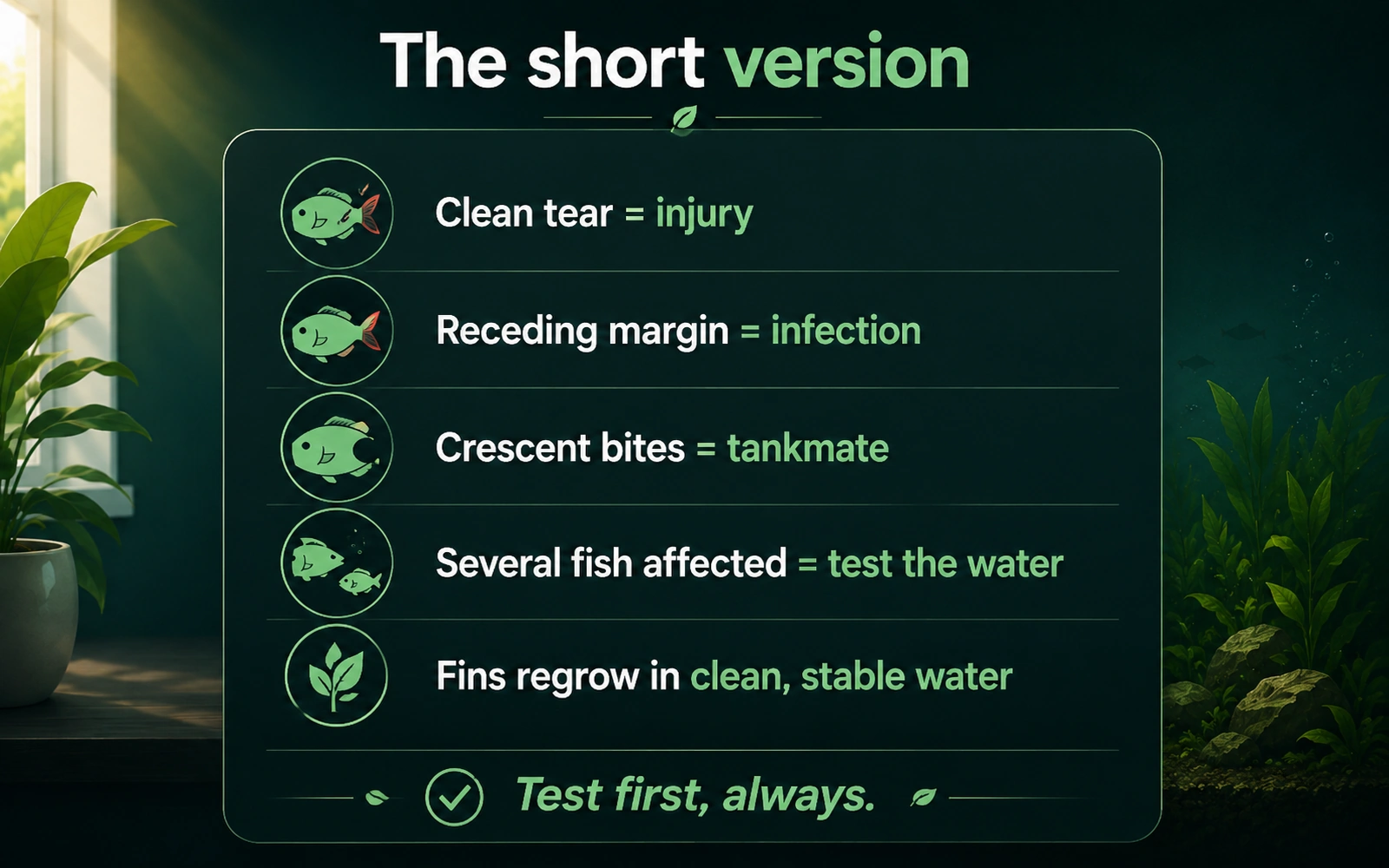
- Body out first. Look at it under light before you dispose of it.
- Test before you change anything. Write the numbers and the time down.
- Watch the survivors. They are the better evidence.
- List what changed in two weeks, on paper.
- Correct what the test found, gently, and then wait rather than intervene further.
- One unexplained death is survivable. Two is a pattern and a vet call.
FAQ
What should I do first when I find a dead fish in my tank? Get the body out with a net, look at it properly under good light before you dispose of it, and do not flush it. Wrap it for the household waste or bury it away from any water, because disease and non-native species both travel through flushing.
Should I do a water change straight away? No. Test first. Test ammonia, nitrite, nitrate, temperature and pH and write the numbers down with the time, because a water change destroys the reading you most need.
What ammonia level kills fish? There is no honest single number. Ammonia toxicity rises sharply with pH and with temperature, so the same reading is a different exposure in two tanks. What is reliable is that any detectable ammonia or nitrite in a tank where a fish has just died is the finding, and it is where you start.
What if the water tests clean and the other fish look fine? Do nothing dramatic. Test again tomorrow and the day after. A single death in a tank with clean water, healthy tankmates and no recent changes often stays unexplained, and reacting to it with a large intervention causes more harm than it prevents.
When does a fish death become a vet question? If a second fish dies within a week, or several fish are showing symptoms, stop treating it as a mystery to solve alone and contact an aquatic veterinarian. Much of that work is done remotely with photographs and your test results.