Do I need an air pump? Aquarium fish do not breathe the bubbles, so for most tanks with a working filter the honest answer is no. Oxygen enters the water at the surface, and a filter outflow that keeps that surface moving usually does the job on its own. You do need an air pump if a filter or ornament in your tank runs on air, as sponge and undergravel filters do. It also earns its place in warm water, in crowded or heavily planted tanks overnight, and during a power cut. Outside those cases it is mostly decoration and noise.
That is the short version. The rest of this page explains why, so you can look at your own tank and decide, rather than buying something because the shop put it in the basket.
What an Air Pump Actually Does (It Is Not the Bubbles)
Most people picture the bubbles carrying oxygen down to the fish. The useful part happens when the bubbles reach the top. They break, the surface ripples, and a moving surface is where water and air trade gases.
The University of Florida IFAS Extension fact sheet Dissolved Oxygen for Fish Production (read September 24, 2026) states that "There are three main sources of oxygen in the aquatic environment: 1) direct diffusion from the atmosphere; 2) wind and wave action; and 3) photosynthesis." That fact sheet is written for ponds, but the physics carries straight over to a glass box. Indoors there is no wind, so something has to stand in for it. In most tanks that something is the filter outflow. An airstone is simply a second way of doing the same job.
Gas exchange also runs in both directions. The same rippling surface that lets oxygen in lets carbon dioxide out. That matters later, for anyone injecting CO2 into a planted tank.
So the real question is not "does my tank have bubbles?" It is "is my water surface moving?" If you look across your tank and the surface is gently rippling and dimpling, you already have the thing an air pump would add.
So, Do I Need an Air Pump? Aquarium Setups That Say Yes
Here is how I would sort the common situations. Find the row that looks like your tank.
| Your situation | Air pump? | Why |
|---|---|---|
| Sponge filter or undergravel filter | Yes, required | The filter has no motor of its own; air is what moves the water through it |
| An ornament that bubbles or opens on air | Only for the ornament | It is decoration; any surface movement it adds is a side effect |
| Hang-on-back or canister filter that ripples the surface | Usually not | The surface is already moving |
| Filter outflow sits deep and the surface looks flat and glassy | Maybe; try raising or angling the outflow first | You want surface movement, and the filter may be able to give it for free |
| Room runs hot, or summer heat is pushing the tank up | Worth adding | Warm water holds less oxygen |
| Heavily planted tank, or one with a lot of algae | Worth running overnight | Plants use oxygen in the dark too |
| Tank carrying a lot of fish for its size | Worth adding | More fish means more oxygen demand |
| Planted tank with injected CO2 | Usually not while the lights are on | Surface churn drives off the CO2 the plants are using |
| Power cut | A battery-operated air pump is useful insurance | When the filter stops, the surface goes still |
If none of the "yes" rows describe your tank and your fish look settled, you can skip it with a clear conscience. That is not a budget compromise. It is the correct answer for that tank.
Warm Water, Night, and Crowding: When the Surface Is Not Enough
Three things push a tank from "fine without" toward "needs help," and they often arrive together.
Heat. The UF/IFAS fact sheet is blunt about this: "Warm water is much less capable of holding oxygen gas in solution than cool water. For example, water that is 90°F can only hold 7.4 mg/L DO at saturation, whereas water that is 45°F can hold 11.9 mg/L DO at saturation." A tropical tank sits between those two figures, and those are pond numbers rather than aquarium targets. The direction is what matters: as the room pushes your tank warmer, the water can hold less oxygen, even while your fish get more active and need more of it.
Night. The same fact sheet explains that "Oxygen levels drop at night because of respiration by plants and animals, including fish." In the day, plants under your aquarium light add oxygen. Once the light goes off, they keep using it. A heavily planted tank can therefore have its lowest oxygen in the hours before the light comes back on. That is why "turn the air pump off at night because it is noisy" can be exactly the wrong move in a planted tank.
Crowding. Every fish and every snail is using oxygen all day and all night. A tank that coped at one stocking level may not cope after a few more fish arrive, even though nothing about the equipment changed.
The Warning Sign, and Why Bubbles Are Not the Only Question
The sign people usually notice is fish hanging at the surface, mouths working at the top. An air pump might help. But gasping is a symptom, not a diagnosis, and low oxygen is not the only thing that produces it. Water quality problems can look very similar from the outside.
Adding aeration while you work out what is going on does no harm. It should not be the end of the investigation, though. I cover the other possibilities in a separate page on why fish gasp at the surface and what to do now, and it is worth reading before you assume the answer is oxygen.
If your fish are clearly in distress, or you have checked the obvious causes and still cannot explain what you are seeing, that is the point to involve a professional. An aquatic veterinarian who treats fish can examine what a blog post cannot. Panic causes more losses than the original problem, so work through it calmly and in order.
When an Air Pump Is Just Noise
An air pump in a tank that does not need one is not harmful, but it is not free either. It hums, it can buzz against whatever it sits on, and bubbles bursting at the surface make their own steady sound. If it lives in a bedroom, that matters.
If you already own one and the noise is the problem, the manufacturer's own troubleshooting is a good place to start. The Aquamanta SP air pump instruction manual (instruction version dated 15/03/2012, read September 24, 2026) lists these causes for a pump that is "very noisy":
- the airline is kinked
- the air stone needs replacing
- the rubber diaphragm inside the pump has worn out
- there is too much back pressure, because the pump is too small for the job
The same manual says to "Replace the air stone every 6 months or when it shows signs of deterioration," to avoid placing the pump on a carpeted surface, and to make sure the pump "is not going to vibrate off whatever surface you place it on." A pump that is rattling against a shelf is telling you it needs a steadier spot.
Two other cases where the bubbles work against you:
- Injected CO2. If you run pressurized CO2 for plants, a busy airstone during the lights-on period is working against the gas you are paying to add.
- Fish that are being pushed around. If a strong stream of bubbles is buffeting small fish, you can turn the flow down with an inline air control valve rather than removing the pump.
How to Install an Air Pump Safely: Backflow, Check Valves and Drip Loops
This is the part that matters more than the bubbles. An air pump is an electrical device connected to a tank of water by a tube. When the power stops, that tube can behave like a siphon and carry water back toward the pump. If the pump sits on the floor, that means water inside an electrical device and water on the floor next to a socket.
The Aquamanta SP manual gives the order of preference plainly:
- "Where possible place the pump above the aquarium."
- If that is not possible, "ensure that a check valve (sold separately) is fitted to the airline. It is best to position the check valve as close to the aquarium as possible."
A check valve lets air pass one way only. Fit it in the direction its own packaging shows, and keep it on the dry side of the tank rim. Treat it as a part that can fail. If you ever find water in the airline between the valve and the pump, replace the valve.
The manual's electrical safeguards apply to every piece of aquarium equipment, not just this pump:
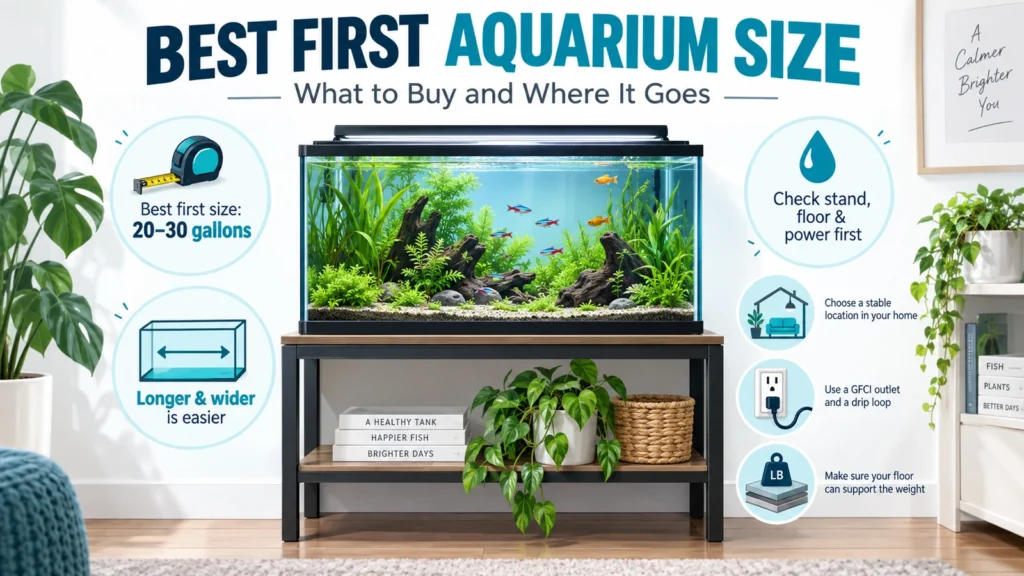
- Arrange a drip loop. The manual defines it as "the part of the cable below the level of the power supply. It prevents water travelling down the cable and coming into contact with the power supply."
- "A G.F.C.I (Ground fault circuit interrupter) & surge protector is recommended for all electrical appliances."
- If the pump falls into the water or gets wet, "do not reach for it. Unplug it and then retrieve it."
- If the plug or socket itself gets wet, "do not unplug the appliance. Disconnect the fuse or circuit breaker that supplies the power to the appliance," then unplug and check the socket.
Stop here if: a socket or plug near the tank is wet, discolored or warm, a breaker or GFCI keeps tripping, or you are not sure whether the outlet is protected at all. Those are not aquarium problems. The Aquamanta manual says that if you are in any doubt about the electrical installation, "you must consult a qualified electrician," and that is the right call. Do not open a breaker panel or rewire an outlet yourself.
What an Air Pump Cannot Do
It is worth being clear about the limits, because an air pump is often sold as a general fix.
- It does not remove ammonia or nitrite. Those are handled by bacteria and by water changes. Bubbles do not touch them.
- It does not cycle a tank. The one exception is indirect: in a sponge filter, the air pump drives water through the sponge, and the sponge is where the filter's useful bacteria live. If you want to understand that part, here is where beneficial bacteria actually live in an aquarium.
- It does not make an overstocked tank safe. It buys some oxygen headroom. It does nothing for the waste those fish produce.
- It does not replace watching your fish. A tank with an airstone can still have a problem. The bubbles are not proof that all is well.
My Honest Default for a First Tank
If you are setting up your first tank with a hang-on-back or canister filter, I would not put an air pump on the first shopping list. Set the filter so its outflow ripples the surface, watch the tank for a few weeks, and add aeration if one of the situations above appears. My first aquarium setup checklist covers what genuinely needs to be there on day one.
If you do buy one, running it is not a big electrical load. For scale, the Aquamanta manual lists power ratings of 2.8 W to 4.5 W across its four SP models. Check the rating on whatever pump you are considering, because it varies by size and maker.
The part I would not skip, if you buy one, is the check valve or the shelf above the tank. The pump is optional. The safe installation is not.
Frequently Asked Questions
Do I need an air pump if I already have a filter?
Usually not, if the filter is a hang-on-back or canister model and its outflow keeps the water surface moving. Surface movement is what brings oxygen in. You need an air pump if your filter is a sponge or undergravel type, because those run on air.
Should I turn my air pump off at night?
In a planted tank, night is when oxygen tends to be lowest, because plants and fish keep using it after the light goes off. That makes night the worst time to switch aeration off in that kind of tank. In a lightly stocked tank with good surface movement from the filter, turning it off makes little difference.
Does an air pump need a check valve?
If the pump sits below the water level, yes. Manufacturer instructions, such as the Aquamanta manual quoted above, say to place the pump above the aquarium where possible and to fit a check valve in the airline when that is not possible, so water cannot siphon back into the pump.
Can I run an airstone in a tank with CO2 injection?
You can, but it works against you while the lights are on, because surface agitation drives CO2 out of the water. If you want aeration in a CO2 tank, the logical time to run it is while the lights are off, when the plants are not photosynthesizing.
Do fish like bubbles?
Bubbles are not something fish need for their own sake. What they need is enough dissolved oxygen, and that can come from any surface movement. If bubbles are buffeting your fish around, turn the flow down.