Short answer: the "up to 20 gallons" printed on a filter box is a starting point, not a guarantee. Getting the aquarium filter size for tank and fish right means looking past the gallon rating to the flow figure in gallons per hour, then adjusting for how many fish you keep, what kind they are and how clean you keep the filter. A common rule of thumb, from retailer LiveAquaria, is to turn the tank's water over about four times per hour. A lightly stocked tank of small fish may be fine at the box rating. A busy tank of messy fish usually is not.
I will explain why each of those factors matters, because if I cannot tell you why, I will not tell you to do it.
What "rated for" on the box actually tells you
A filter box usually carries two numbers: a tank size ("for aquariums up to 20 gallons") and a flow rate in gallons per hour (GPH). Most people read the first and ignore the second. It should be the other way round.
The gallon rating is the maker's summary of which tanks the filter is meant for. I could not find a published industry standard that defines what "up to" has to mean, so each maker reaches that number its own way. What it cannot know is what lives in your tank. A 20 gallon tank holding a handful of small fish and a 20 gallon tank holding a pair of large, heavy-eating fish get the same rating on the same box, and they produce very different amounts of waste.
The GPH figure is more useful because you can check it against your own tank. It tells you how much water the filter moves in an hour under the maker's conditions. As we will see, your conditions are rarely as kind.
Why tank size alone is a weak guide
AquariumScience.org, an independent educational site, is blunt about this in its section on sizing filters (read September 24, 2026): "Aquarium size is actually pretty useless to determine the number or size of fish an aquarium can stock or to size filters." Its own method sizes the filter by the biological media surface area needed for the fish you keep, not by gallons.
You do not need to adopt that method to take its point. The filter's job is to handle waste, and waste comes from fish and food, not from water. Three tanks of the same size can need three different filters:
- Stocking: more fish, more waste.
- Species: big, heavy-eating fish produce far more waste than small, slow ones.
- Feeding: a tank that is regularly overfed has more waste to process, whatever its size.
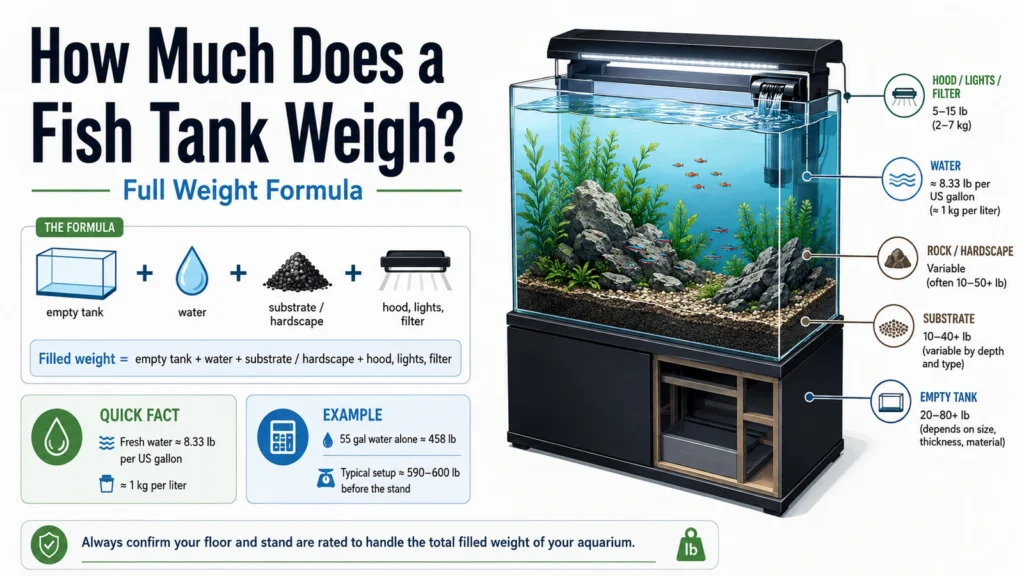
There is a quieter problem too. A "20 gallon" tank does not hold 20 gallons of water once gravel, rock and wood are in it. If you want to know what your tank really holds, I walk through it in how much a fish tank weighs, which starts with the real water volume.
The turnover rule of thumb, and where it comes from
Turnover is how many times per hour the filter moves a volume of water equal to your tank. It is the most common way hobbyists compare a filter's flow to a tank.
LiveAquaria, the aquarium livestock and supply retailer, puts it this way in its guide Choosing the Proper Flow Rate for Your Aquarium (read September 24, 2026): "We generally recommend that on average, you turn over your aquarium volume four times per hour." Its worked example: "If you have a 30-gallon tank, you need a pump and filter with flow rates of around 120 gph."
Notice the words "generally" and "on average." This is a rule of thumb, not a law, and other hobby sources suggest higher turnover for heavily stocked tanks. Treat it as a floor to check against, not as a target that guarantees clean water.
How to work out aquarium filter size for tank and stocking
Here is how I would size a filter without trusting the box blindly.
- Estimate your real water volume. Start from the tank's size and knock off something for substrate and decor. You do not need precision, just honesty.
- Find the GPH, not the gallon rating. It is usually on the box or the maker's product page. If a filter lists only a tank size and no flow figure, that tells you something too.
- Work out the turnover. Divide the GPH by your water volume. That gives you how many times per hour the filter moves your tank's water, before any real-world losses.
- Compare it to the rule of thumb. LiveAquaria's four times per hour is a reasonable floor for an average tank.
- Adjust for what lives there. Heavily stocked, big or messy fish: aim above the floor, or add a second filter. Lightly stocked small fish: the floor may be plenty.
- Leave room for dirt. LiveAquaria notes that "dirty or clogged filters have a significant effect on flow rates, slowing them down." The flow you get two weeks after a clean is lower than the flow on day one.
- Check the fish, not just the math. If the fish in your plans need gentle water, a high-flow filter may need turning down or baffling. More on that below.
The reason step 6 matters so much is that the box shows the filter at its best. Your filter spends most of its life partly clogged.
Flow is not the same as filtration
This is the part most sizing charts skip, and it changes how you think about "bigger."
A filter does two jobs. It catches floating debris (mechanical filtration), and it gives beneficial bacteria a surface to live on so they can turn ammonia into less harmful compounds (biological filtration). If you want the background on that second job, I explain it in the aquarium nitrogen cycle.
More flow helps the first job. It does much less for the second than people expect. AquariumScience.org's page on flow rate in an aquarium filter (read September 24, 2026) states that "Doubling the flow rate through a canister filter will add 5% to 15% to the filtration capacity," and describes a test where doubling the flow "added some 9% to the filter capacity." Its conclusion: a filter with twice the flow might filter only about 10% better if the media is the same.
What does that mean in practice? When you compare two filters, the amount and type of media inside matters as much as the GPH. A high-flow filter with a thin cartridge may move a lot of water while giving bacteria very little room. That is one source's measurement, from a site with a strong point of view, but the reasoning holds: bacteria live on surfaces, and flow does not create surface.
When a bigger filter is the wrong answer
"Buy the next size up" is common advice, and for many tanks it is reasonable. But more flow is not free. LiveAquaria lists the tanks where it causes trouble:
- Small fish, fry and bettas: "Small fish, baby fish, and betta tanks need a very slow flow rate. It can cause much unwanted stress for them to swim in the current all the time."
- Planted tanks: "Decreasing surface agitation helps hold in the CO2 much needed by plants. Most plants cannot tolerate being in the middle of the flow stream."
Add shrimp to that list. A strong intake can pull in baby shrimp, which I cover in shrimp-safe filtration.
The fair way to think about it: an oversized filter can often be turned down, baffled or fitted with a sponge over the intake. An undersized filter cannot be turned up. So a modest margin above the box rating is usually the safer mistake, as long as you are ready to tame the current for fish that need calm water.
The only test that settles it: your water
Once the filter is running, stop looking at the box and start looking at the tank. The filter is sized right if the tank's readings and appearance say so.
- Water tests. In a cycled tank, ammonia and nitrite should read zero. A filter that cannot keep up tends to show it here first, especially after feeding or adding fish. My guide to how often to test aquarium water has a schedule that makes this easy to watch.
- Debris. If waste settles in the same corners and never reaches the intake, the flow is not covering the whole tank, even if the turnover math looks fine.
- Clarity. Persistent haze in an established tank can point to weak mechanical filtration, though it has other causes too.
If readings climb and fish are gasping, lying on the bottom or acting strangely, a bigger filter is not an emergency fix. Test, do a water change if the readings call for it, stay calm, and contact an aquatic veterinarian if fish show signs of illness. Panic causes more losses than the original problem.
What the box cannot tell you
A filter's rating cannot tell you how many fish you will keep, how much you will feed, or how often you will clean it. It cannot tell you whether your fish want calm water or strong current. And it cannot tell you how much room the media leaves for bacteria.
That is why I am not recommending a specific filter or brand here. The honest answer to "what size filter do I need?" is a method, not a model: read the flow figure, do the turnover math, adjust for the fish, and let the water tests have the final word.
Frequently asked questions
Can a filter be too big for a fish tank?
For the water itself, rarely. For the fish, yes. LiveAquaria notes that small fish, baby fish and bettas need a very slow flow rate, and that plants struggle in strong flow. A large filter can often be turned down or baffled, so the real question is whether you can tame its current for the fish you keep.
Should I buy a filter rated for a bigger tank than mine?
For an average or busy tank, a modest step up is common advice, because the box shows the filter at its cleanest and flow drops as media clogs. For a tank of small, slow or long-finned fish, a bigger filter only makes sense if you can reduce its flow.
Is four times turnover per hour enough?
LiveAquaria recommends about four turnovers per hour on average, and it is a sensible floor. Heavily stocked tanks or big, messy fish often need more. Your ammonia and nitrite readings in a cycled tank tell you whether it is enough for your tank.
Is two small filters better than one big one?
It can be. Two filters spread flow across the tank, and if one fails or needs cleaning, the other keeps a bacterial colony running. The trade-off is more equipment to maintain.
My filter is rated exactly for my tank size. Is that okay?
For a lightly stocked tank of small fish, it may be fine. For a well-stocked or messy tank, it may struggle, especially between cleans. Work out the turnover from the GPH, then watch your water tests over the following weeks.