Yes, in the way that matters most: a small tank has less water to dilute waste, buffer temperature changes and absorb mistakes, so the same amount of fish food, the same missed water change or the same heater fault pushes water chemistry further and faster than it would in a larger volume. What a small tank does have going for it is less physical labor per cleaning and a lower running cost. The honest answer is that "harder" depends on which kind of hard you mean: chemically less forgiving, physically less demanding. This matters for welfare, not just convenience, because an unstable tank stresses and can kill the animals living in it, and no tank size is automatically right for every species.
So Are Small Fish Tanks Harder to Maintain, or Just Different?
Both. A 10-gallon tank and a 55-gallon tank do not fail in the same way or on the same timeline.
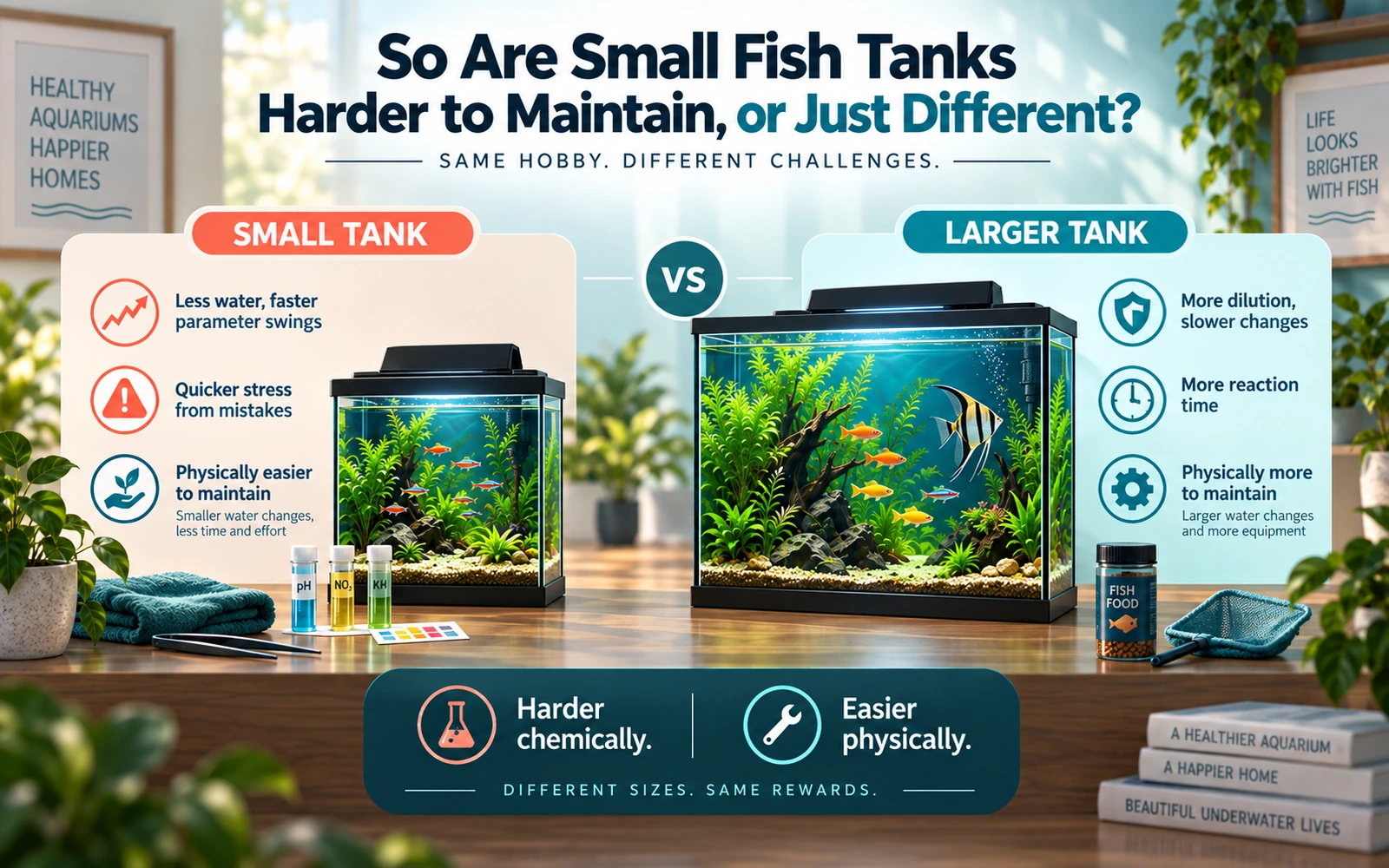
In a small tank, a skipped water change, an overfed meal, or one dead snail behind a decoration raises ammonia and nitrite proportionally more, because there is less water to spread that waste through. In a large tank the same event is diluted across far more gallons and the parameters move more slowly, giving a keeper more time to notice and correct course before a fish is stressed or harmed.
That is the chemical case for "harder." It is not the whole picture, and a fair answer has to include what gets easier, not just what gets harder.
Why a Smaller Volume of Water Behaves Differently
A tank is a small, closed ecosystem running on a colony of beneficial bacteria that convert fish waste (ammonia) into a less toxic form (nitrite, then nitrate). That colony needs weeks to establish and it needs a stable environment to keep working. A 2025 study in the peer-reviewed journal Animals, which tracked microbial establishment in a newly commissioned public aquarium over 54 days, found that ammonia-oxidizing microbes take real time to build up and that introducing animals shifts the microbial community substantially, which is exactly why a tank's biological filtration is fragile early on and stays sensitive to disruption (Oliaro et al., "The Role of Ammonia-Oxidizing Archaea During Cycling and Animal Introduction in a Newly Commissioned Saltwater Aquarium," Animals, read 2026-09-18).
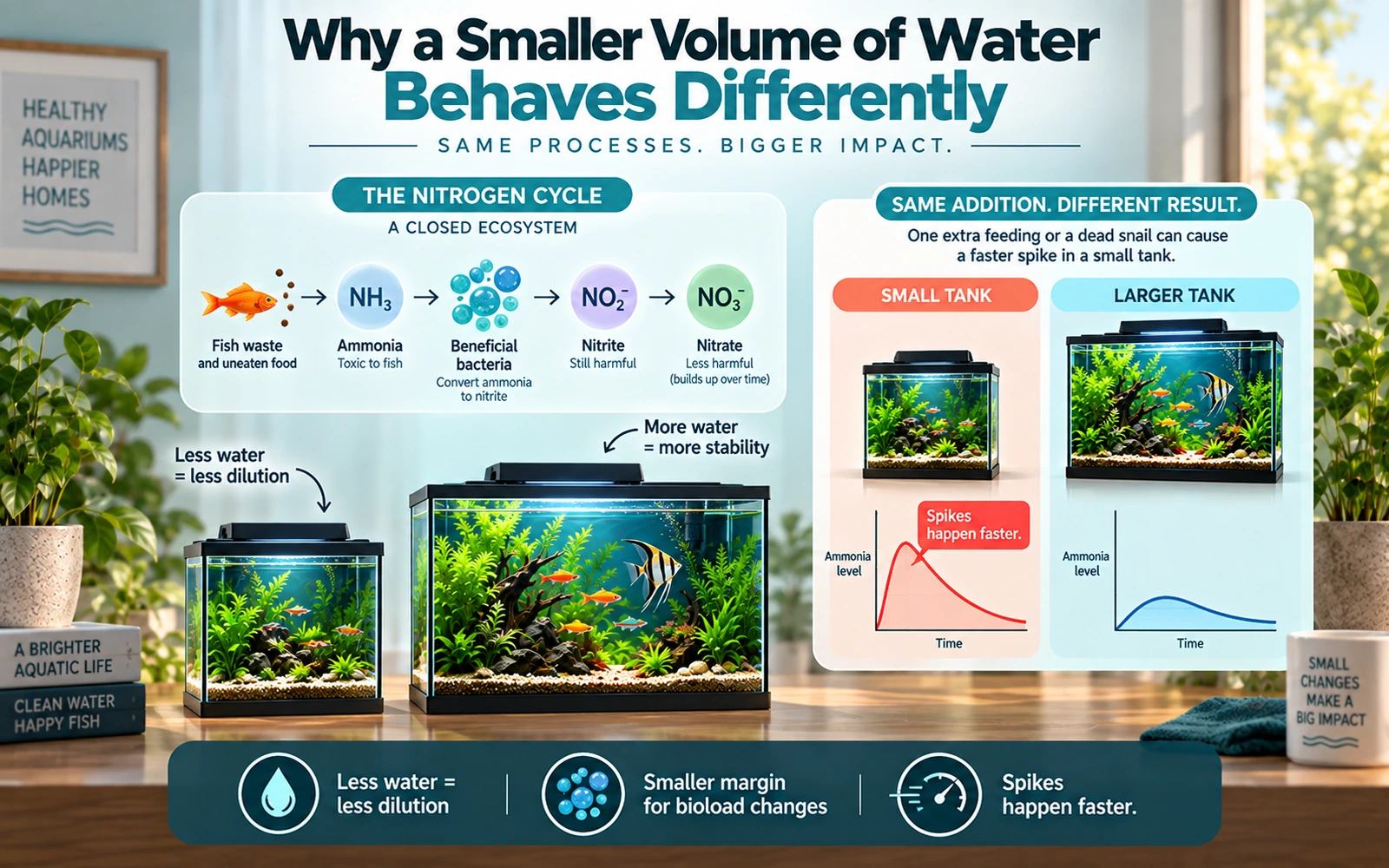
A small tank has less water and less surface area for that bacterial colony to live on, so it has a smaller margin before a bioload change (a new fish, a dead one, an overfeeding) outpaces what the bacteria can process. The result shows up as an ammonia or nitrite spike that reads on a test kit before it shows visibly in the fish, which is one reason is your tank actually ready for shrimp matters more, not less, in a small tank: "cycled" is a snapshot, and a small volume slides out of that snapshot faster than a large one does.
Temperature and Equipment Have Less Room for Error
The same dilution logic applies to heat. A heater sized correctly for a large tank is often badly oversized for a small one, because wattage needs to match volume, not just be "strong enough." If a heater's thermostat sticks in the on position, a large tank has enough water to absorb that extra heat for a while before anyone notices. A small tank has far less water to absorb it, so the same fault raises the temperature faster and further before a keeper catches it.
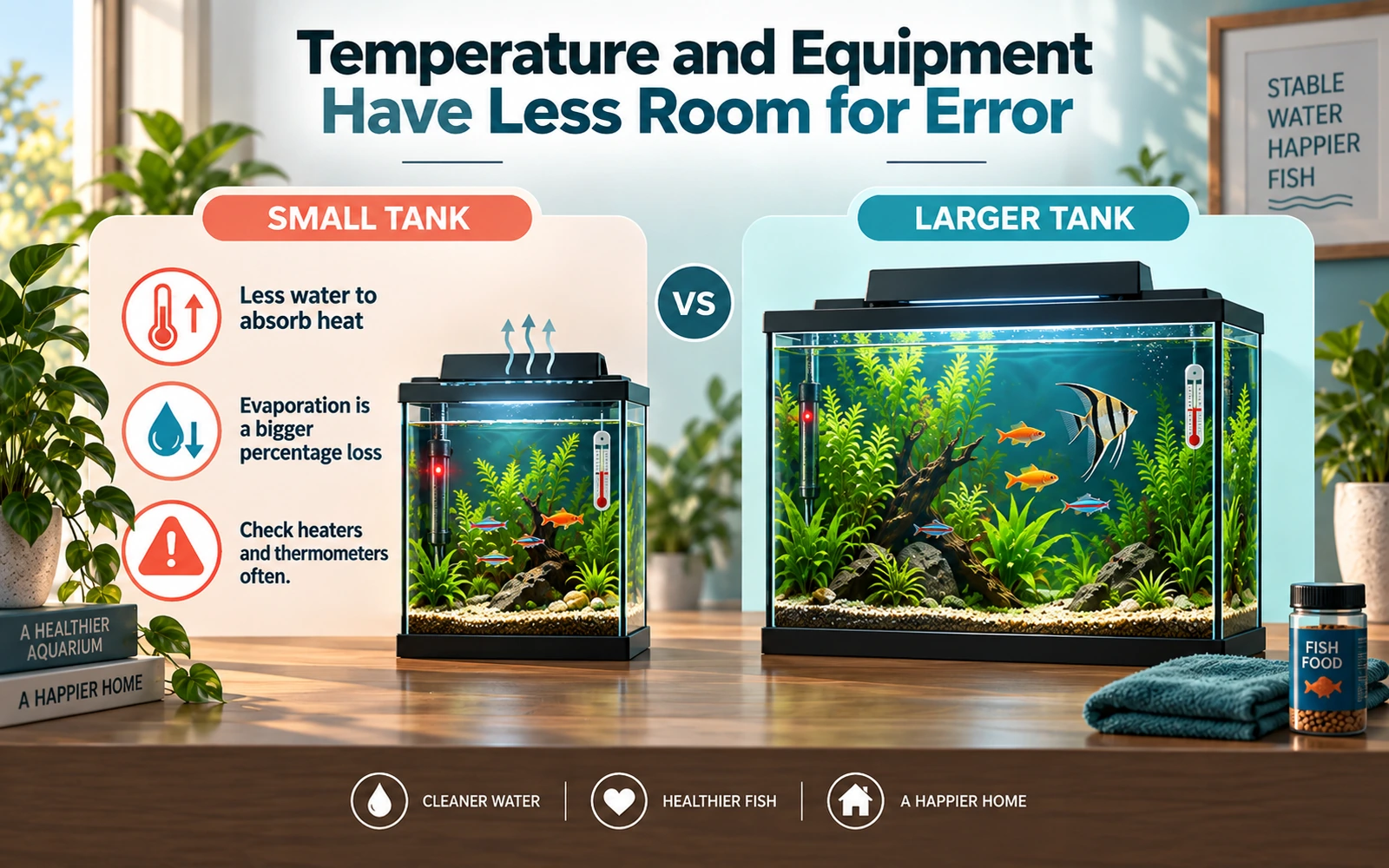
Evaporation compounds this. As water evaporates, the tank loses volume, and in a small tank that loss is a bigger percentage of the total, which concentrates whatever is dissolved in the remaining water and can leave a heater's element partly exposed. None of this is a reason to avoid small tanks. It is a reason to check a small tank more often than a large one, not less, and to treat "it has a heater and a filter" as the start of the maintenance routine rather than the end of it.
The Maintenance Schedule That Actually Differs
The chores are the same in a small tank and a large one: test the water, change part of it, clean the glass, check the equipment. What changes is how much slack the schedule can absorb.
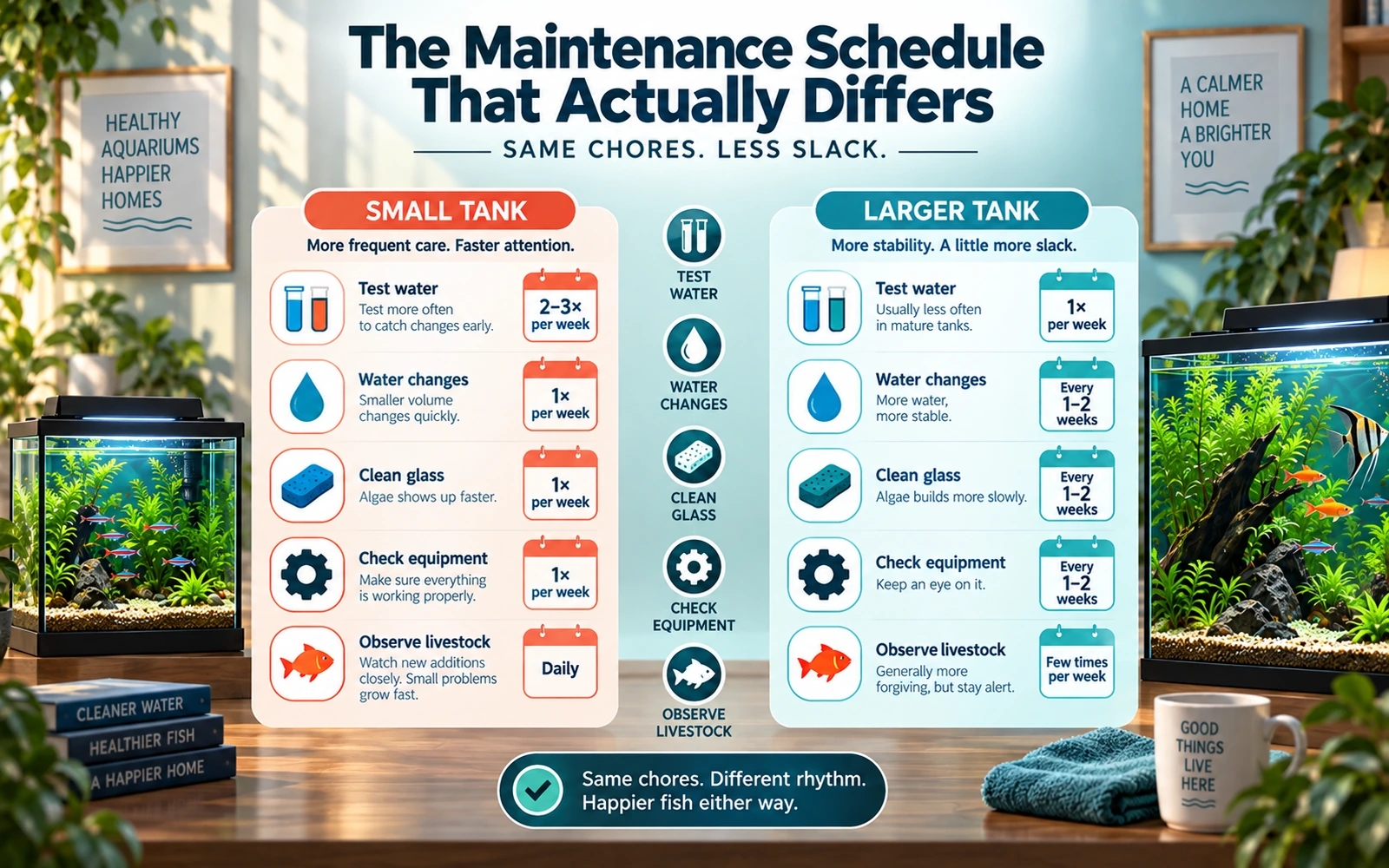
- Testing cadence. A small, newly cycled tank benefits from checking ammonia and nitrite more frequently than a large, mature one, because a spike develops faster and a missed week costs more.
- Water change size. Many keepers cap a single water change at a modest share of the tank at a time, because replacing too much shifts temperature and chemistry quickly enough to stress the animals in it. In a small tank, that same share is a smaller volume of new water, so temperature-matching and dechlorinating it correctly still matters just as much.
- New additions. Adding a new fish or invertebrate raises the bioload immediately, and a small tank has less room to absorb that jump. Quarantining new arrivals before they reach the main tank protects the display tank's stability as much as it protects against disease, because it lets the new arrival's waste load and any problems show up somewhere that is not already running close to its margin.
- Watching for trouble. Because a small tank moves faster, a change in behavior deserves a same-day check rather than a wait-and-see. If a fish dies without an obvious cause, the first hour after a fish dies covers what to test before doing anything else, and testing before changing water matters even more in a small volume where the evidence disappears quickly.
What Is Actually Easier About a Small Tank
A fair comparison has to include this, because pretending small tanks are worse in every way is not accurate.
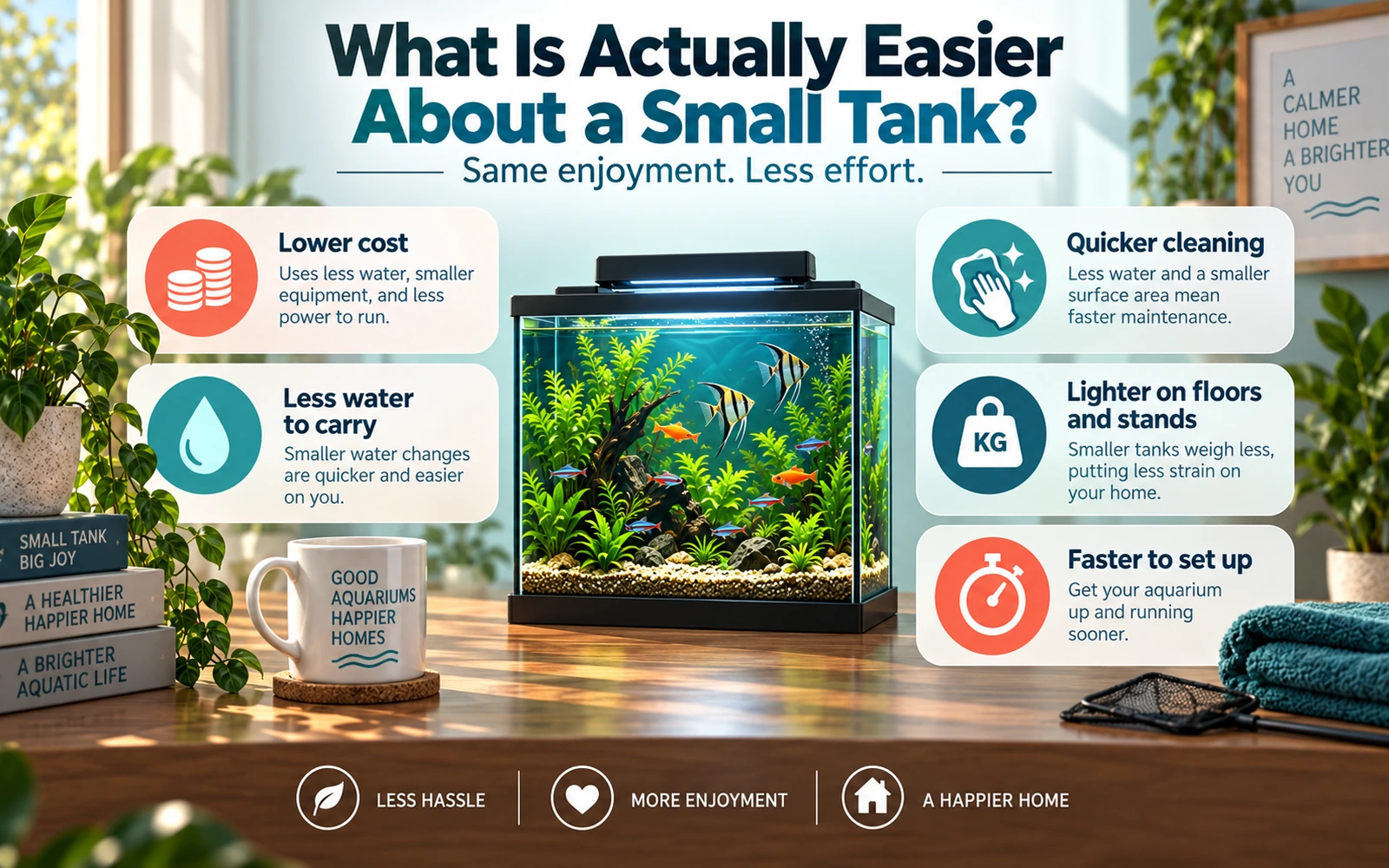
- Less physical labor per session. A smaller volume means less water to carry, less substrate to vacuum, and shorter cleaning sessions.
- Lower running cost. Less water, a smaller heater and a smaller filter generally cost less to buy and run.
- Lower structural load. A full small tank puts far less weight on a floor or stand than a full large one, which is a real practical reason some keepers choose small, especially upstairs. How much a fish tank actually weighs walks through the full weight formula rather than a single rule of thumb, because substrate, decor and the stand all add to the water's own weight.
- Faster to set up and move. A small tank is easier to relocate, drain for a deep clean, or replace if something fails.
The trade-off is real in both directions: less physical effort, less chemical margin.
Welfare Comes Before Convenience: Choosing What Goes In a Small Tank
A small tank is not automatically wrong to keep, but it is not automatically right for whatever a keeper wants to put in it either. Species differ in how much stable, uncrowded water they need, and getting this wrong is a welfare problem before it is a maintenance problem.
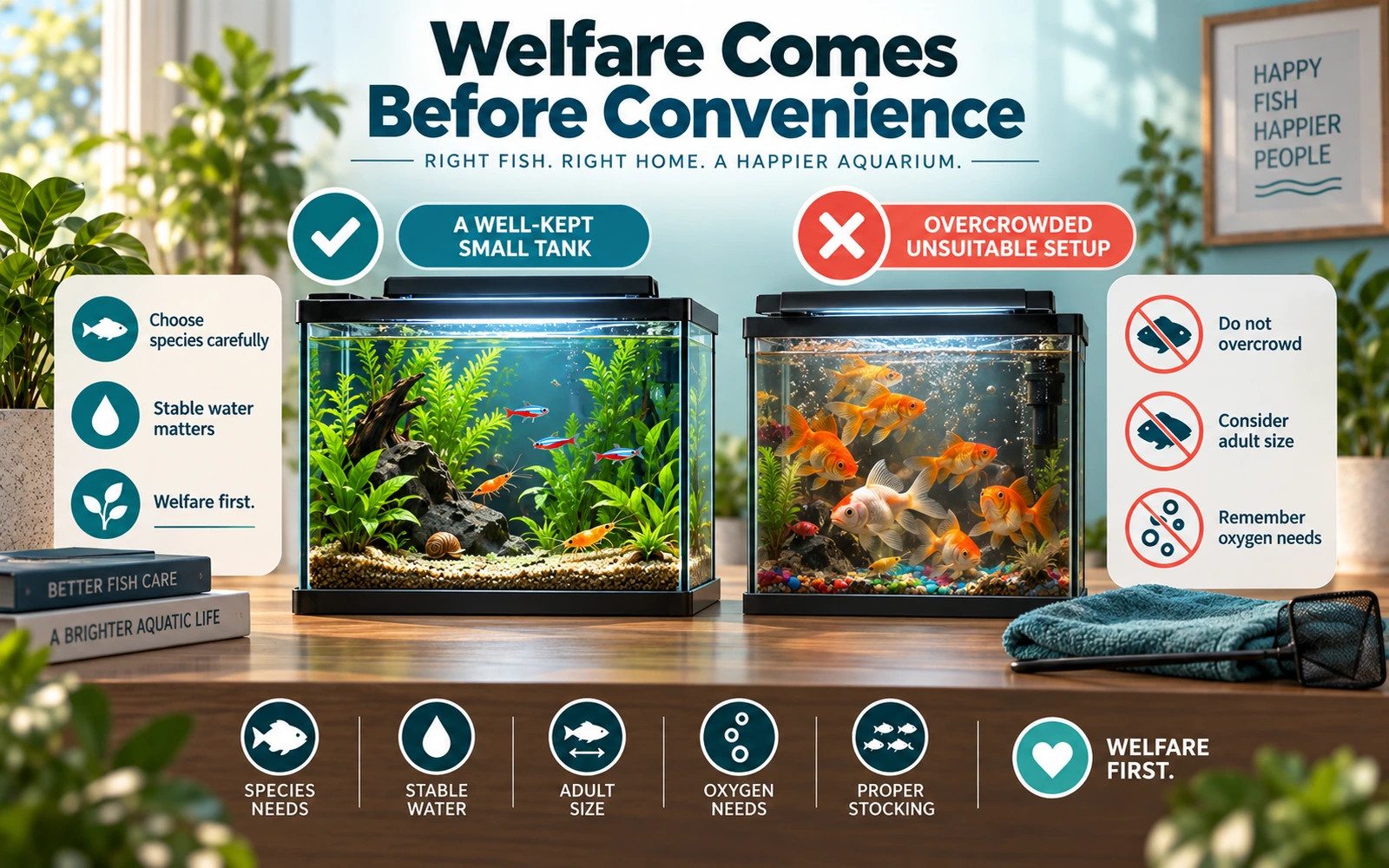
The RSPCA's guidance on fish environments is direct about why size and stability are linked: larger volumes hold temperature and water conditions more steadily, decorative bowls and jars are described as inadequate because their small size does not allow for a stable environment, and even for tropical fish generally, the organization gives a starting allowance based on the fish's length rather than a flat number that applies to every species and tank (RSPCA, "Choosing an Aquarium for Pet Fish," read 2026-09-18). That figure is a starting point from a named welfare organization, not a stocking recommendation this article is making, and it does not account for a specific species' adult size, temperament, or oxygen needs, all of which a keeper should confirm before choosing stock for any tank, small or large.
In practice, this is why some of the more forgiving small-tank residents are invertebrates with a genuinely low bioload rather than more fish squeezed into less water, and even then, they still need a fully cycled tank and stable parameters to thrive, not just a small footprint. Getting the stocking decision wrong in a small tank is where instability turns into a welfare issue, not just an inconvenience.
When Small-Tank Instability Becomes an Emergency
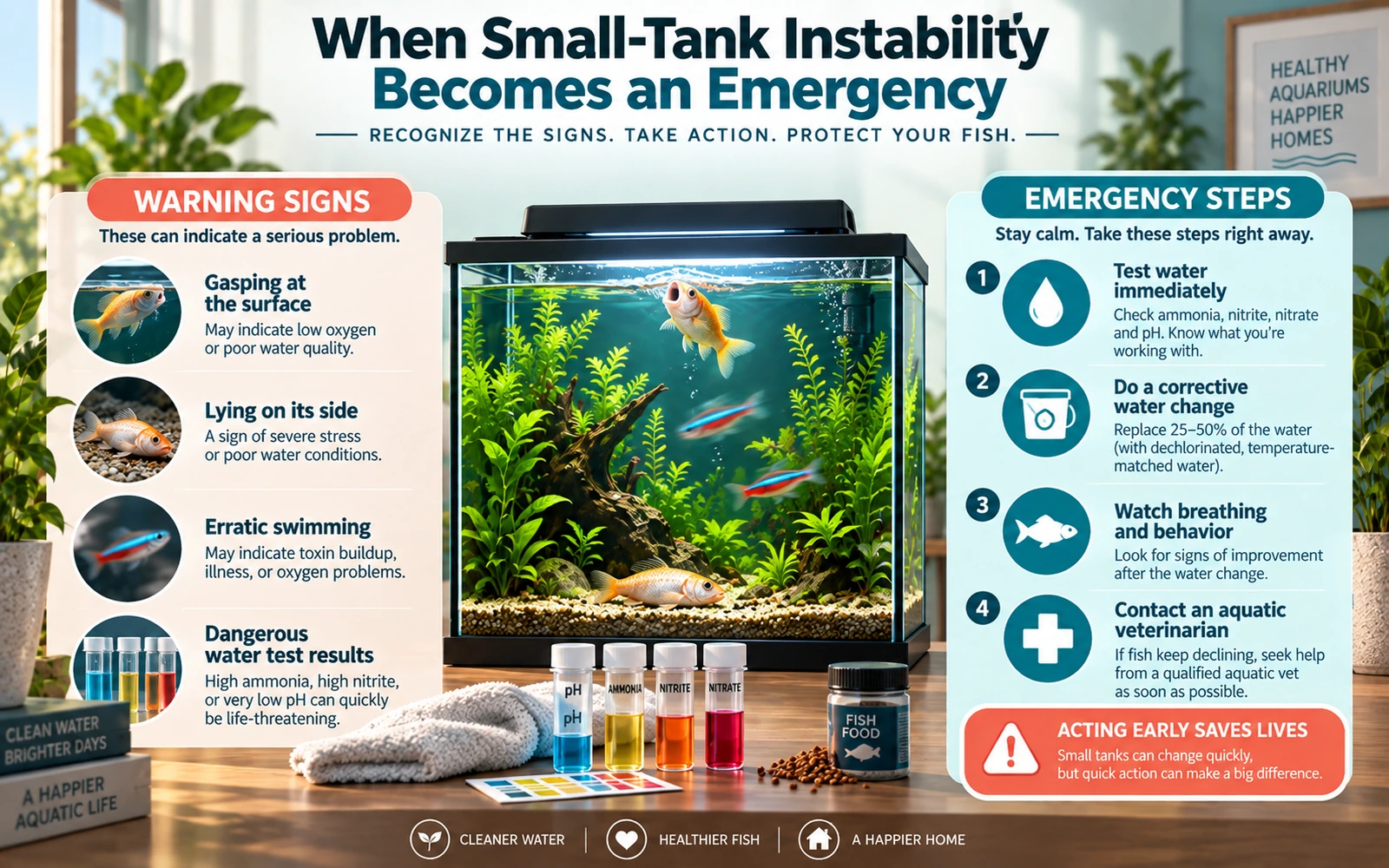
Because a small tank can move from stable to dangerous faster than a large one, it is worth knowing the line between "test and adjust" and "this needs help now." A fish gasping at the surface, lying on its side, or showing sudden erratic swimming is not a wait-and-see situation. If a fish's condition is declining and testing and a water change have not stabilized things, that is a call for an aquatic veterinarian, not a guess at a home treatment. Livestock health emergencies are not something a blog post can diagnose from a description, and treating a sick animal without a diagnosis risks making things worse.
Small vs Large Tank: What Actually Changes
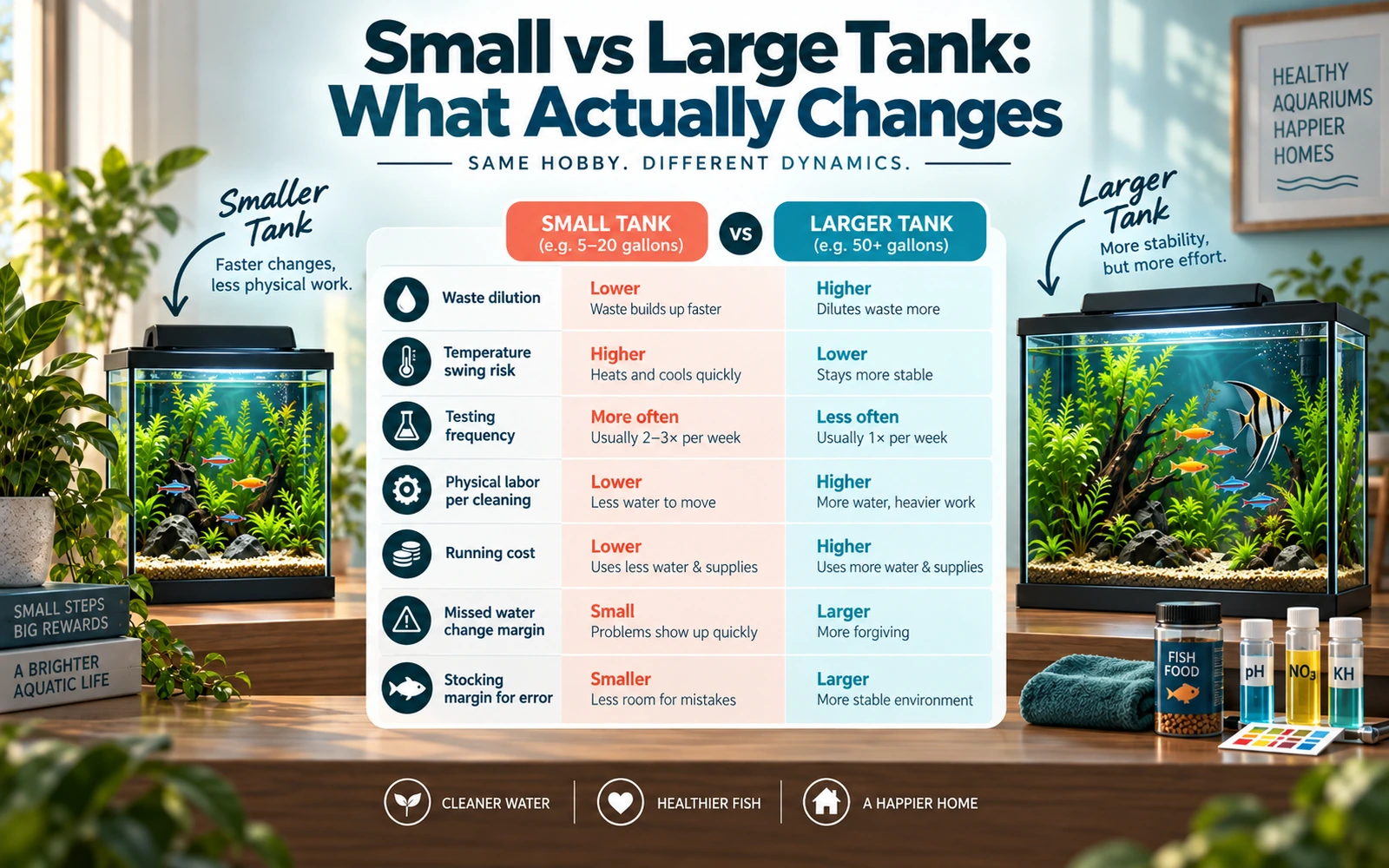
| Factor | Small tank (roughly under 20 gal) | Large tank (roughly 40+ gal) |
|---|---|---|
| Waste dilution | Lower; waste concentrates faster | Higher; more water spreads the same waste |
| Temperature swing risk | Higher; less water to absorb heater faults or drafts | Lower; more thermal mass |
| Testing frequency needed | More often, especially early | Less often once mature and stable |
| Physical labor per cleaning | Less | More |
| Running cost | Lower | Higher |
| Margin for a missed water change | Small | Larger |
| Species/stocking margin for error | Tighter; fewer suitable options | Wider |
The Short Version
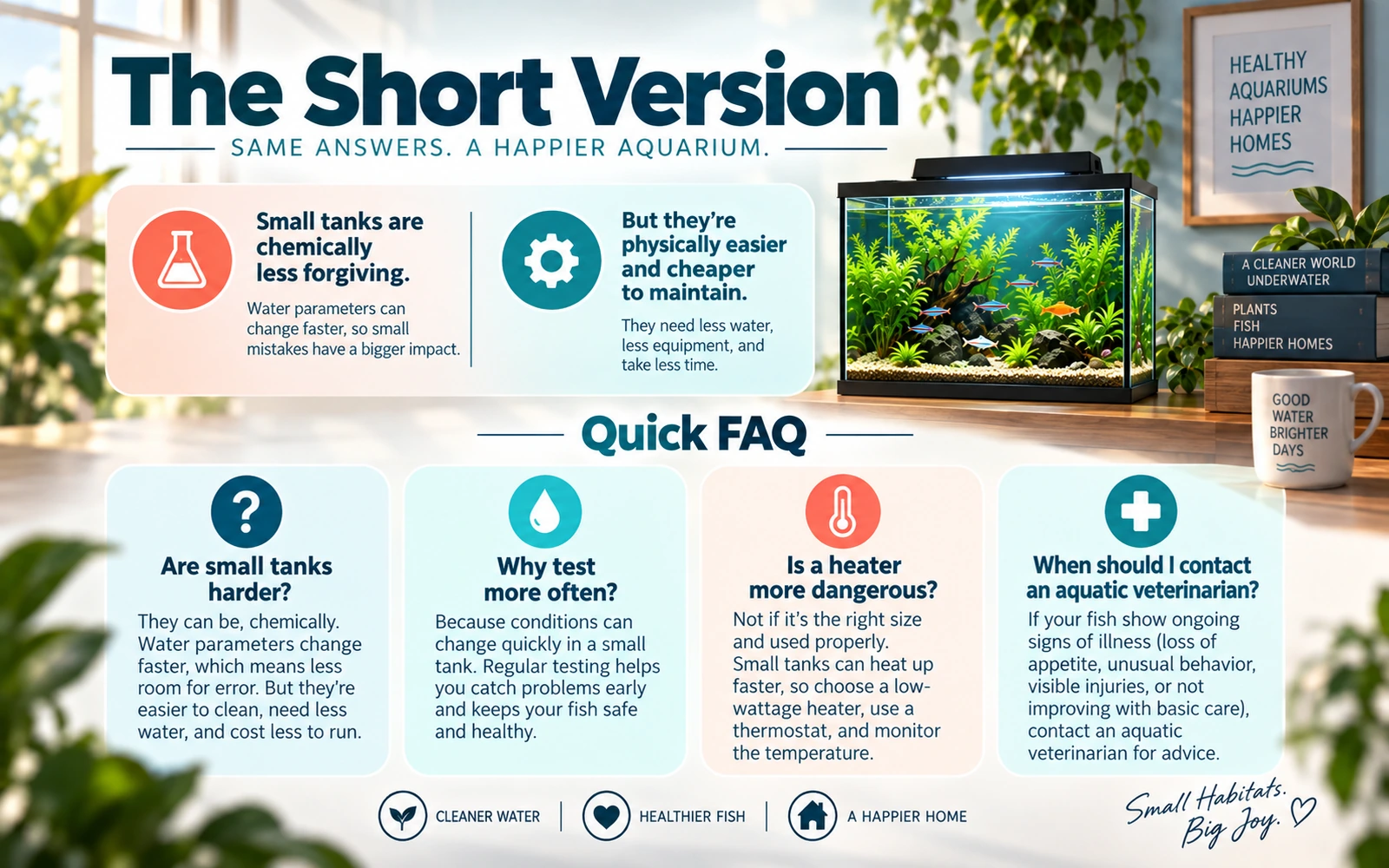
Small fish tanks are chemically less forgiving because there is less water to dilute waste and absorb temperature swings, which means testing more often, changing water on a stricter schedule, and quarantining new arrivals matters more than in a large tank. They are physically easier to maintain, cheaper to run, and lighter to place. Neither size is automatically the right choice; the right size depends on the species, the keeper's schedule for checking on it, and a willingness to treat a small tank's speed as a reason for more attention, not less.
FAQ
Are small fish tanks harder to maintain than large ones?
Chemically, yes: a small tank has less water to dilute waste and buffer temperature changes, so the same mistake or equipment fault affects it faster and more severely. Physically, a small tank is easier: less water to carry, less substrate to vacuum, and a lower running cost.
Why do small tanks need more frequent water testing?
A small volume concentrates waste faster than a large one, so ammonia and nitrite can rise from safe to concerning in less time. Testing more often, especially in a newly set up or lightly stocked small tank, catches a spike before it stresses the fish.
Is a heater more dangerous in a small tank?
A heater sized for a small tank has less water around it to absorb heat if the thermostat fails, so a stuck heater can raise the temperature further and faster than the same fault would in a large tank. Checking the heater and thermometer regularly matters more in a small setup.
What fish or invertebrates are suitable for a small tank?
It depends on the species' adult size, activity level and oxygen needs, and a small tank narrows the options rather than removing the need to check them. A source like the RSPCA's fish care guidance is a starting point for space allowances, but confirming a specific species' needs before buying is still the keeper's job.
When should I contact an aquatic veterinarian instead of adjusting the tank myself?
If a fish is gasping, lying on its side, swimming erratically, or its condition is not improving after testing the water and correcting anything out of range, that is a question for an aquatic veterinarian rather than a home guess. Multiple fish showing symptoms, or one fish continuing to decline, is the clearer signal to stop troubleshooting alone.