Every page about cherry shrimp opens with the same word, and the word is doing a lot of unearned work.
They are easy in the sense that they need almost nothing from you, and hard in the sense that they are unforgiving about the one thing they do need. A colony in a mature, stable, well-established tank will feed itself, breed without help, and outlive your interest in watching it. The same colony in a tank that is three weeks old, or that swings, or that had something added to the water, can be gone in two days with no warning at all.
So the honest version is this: cherry shrimp are easy to keep and difficult to start. Almost everything on this page is about the start.
What they actually are
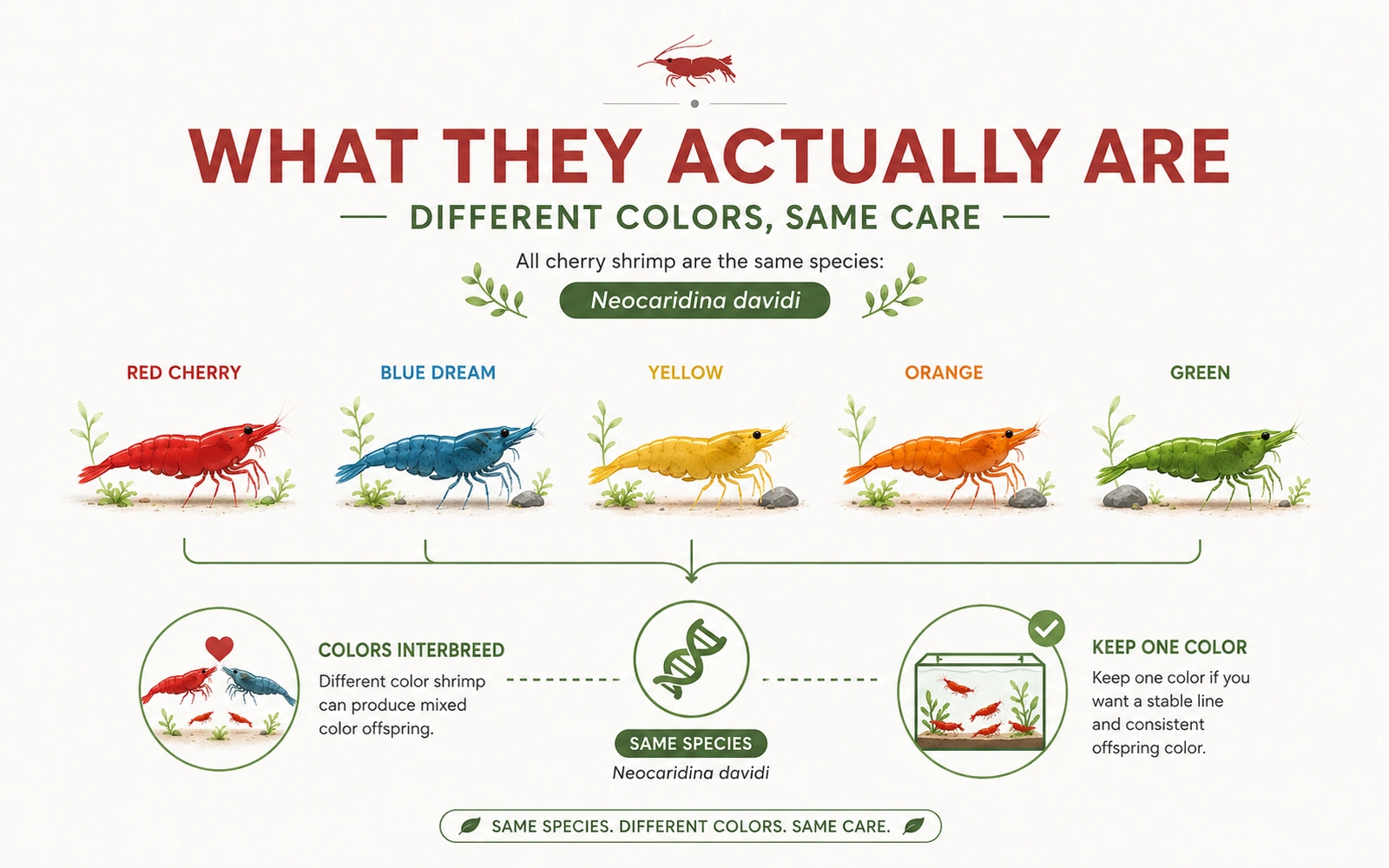
Neocaridina shrimp, sold under a long list of color names, all of which are the same animal selectively bred for color. Red cherry, fire red, blue dream, yellow, orange, green: the care is identical, the colors interbreed, and mixed colors revert toward wild coloration over generations. If you want them to stay one color, keep one color.
They are small, they live in the range of a year or two, and they breed readily enough that a healthy colony replaces itself without any intervention from you. That last part is the thing that makes them worth keeping: you are not maintaining a set of individuals, you are maintaining conditions, and the population takes care of the rest.
The one thing they need: a tank that has stopped changing
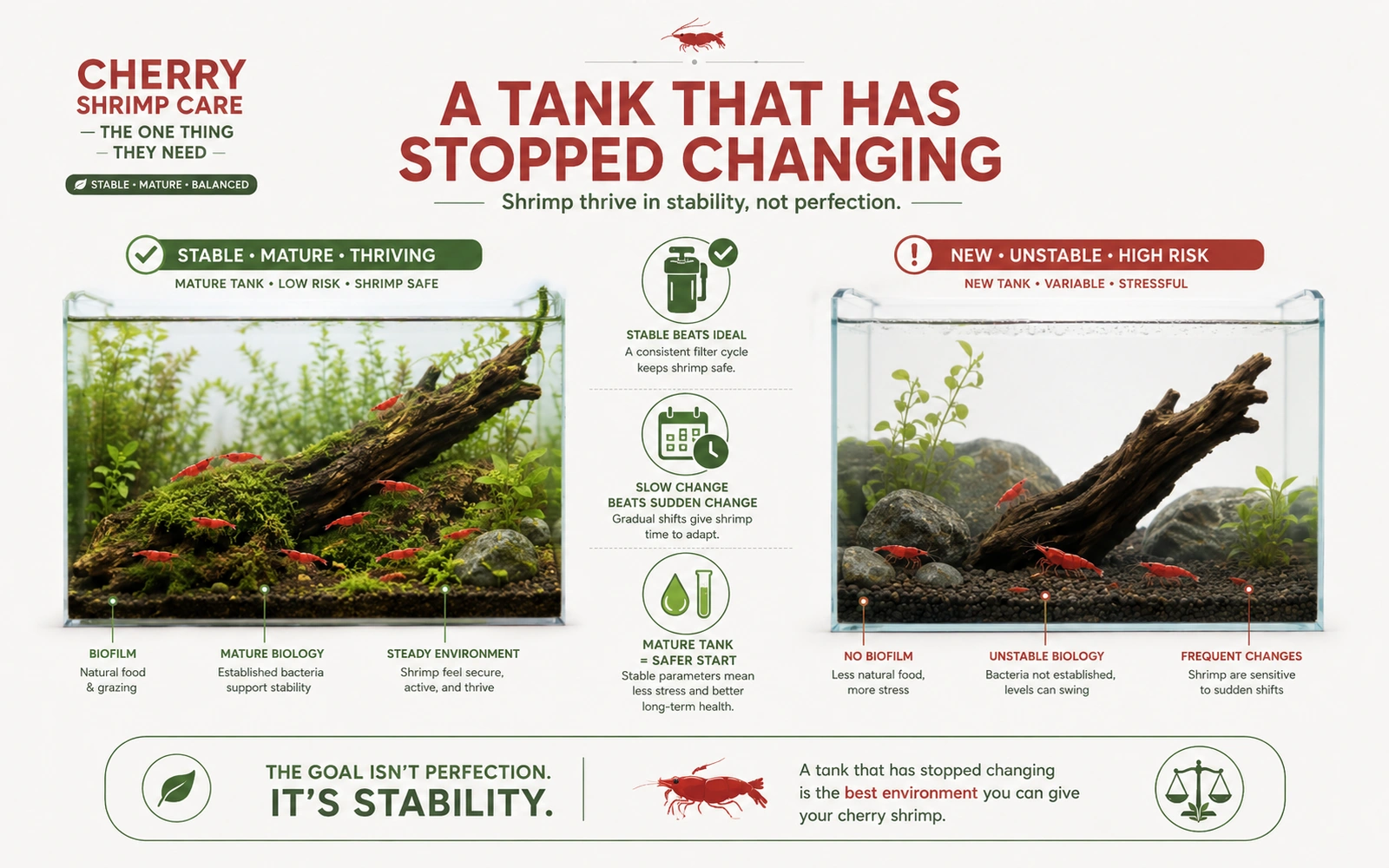
This is the whole of it, and it is worth stating flatly. Shrimp are far more sensitive to a change in conditions than to the conditions themselves.
A colony will settle into water that is harder or softer, warmer or cooler, more or less acidic than any recommended range, provided it got there gradually and stays there. The same colony will die in perfectly ideal water that arrived suddenly.
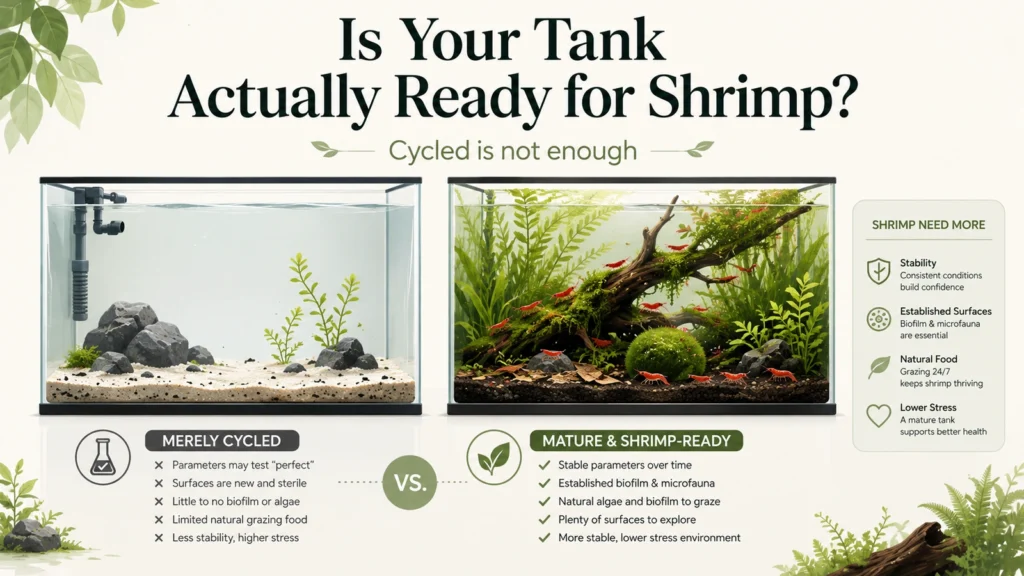
That is why the single most useful thing you can do is wait. A tank that has been running for months, with a mature filter, stable readings and a film of biofilm and algae on every surface, is a tank shrimp thrive in. A tank that finished cycling last week is not, even though every reading says zero. The nitrogen cycle explained covers what "finished cycling" actually means, and how long it takes to cycle a fish tank covers why the honest answer is longer than people want.
This site does not publish a parameter table for shrimp, and that is deliberate rather than an omission. The numbers you will find online contradict each other, and they contradict each other because they are describing colonies that adapted to different water. What is reliable is the direction: stable beats ideal, and a slow change beats a correct one.
What kills a colony
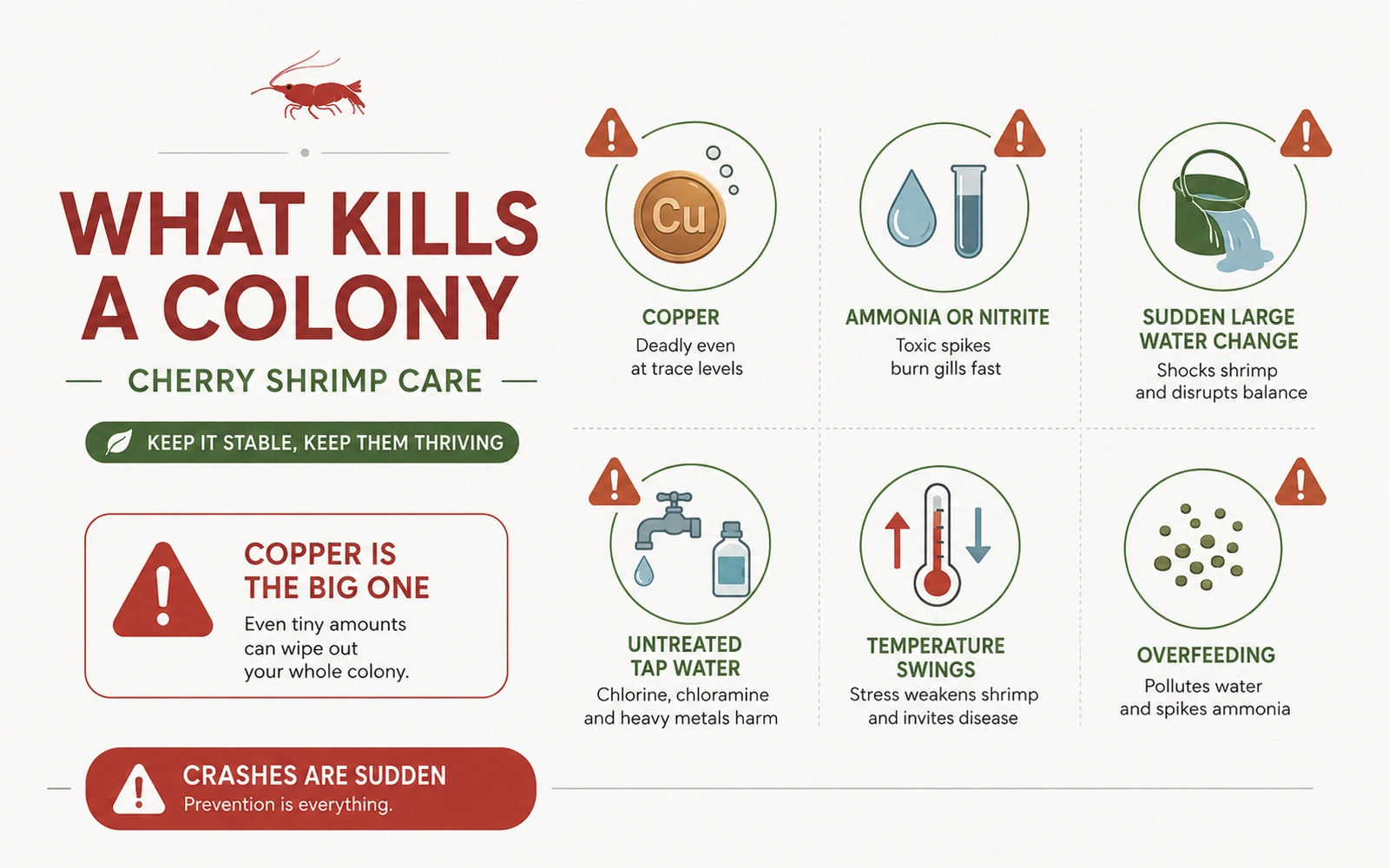
Colonies rarely decline slowly. They usually crash, and the causes are a short list.
Copper. This is the big one and it deserves its own treatment. Copper is lethal to shrimp at levels that are unremarkable for fish, and it arrives in ways that are almost invisible: in fish medications, in some plant fertilizers, in snail treatments, in some foods, and in old plumbing. A colony that dies within a day of something being added to the water is a copper story more often than any other single cause.
Ammonia or nitrite. Shrimp are less tolerant than most fish and they show it later, which is a bad combination. A cycle that stalls or crashes takes the shrimp before it takes the fish, which is why an aquarium cycle crash is worth understanding before you have shrimp rather than after.
A large or sudden water change. The most common self-inflicted cause. Shrimp handle small, frequent, temperature-matched changes with conditioned water and handle a sudden large one badly. How to do a water change covers the method; the shrimp-specific adjustment is smaller and more often.
Untreated tap water. Chlorine and chloramine are lethal, and chloramine in particular is not removed by letting water stand. Dechlorinator and chloramine covers what your conditioner actually does.
Temperature swings. Not a specific temperature, a swing. A heater that cycles wide, a tank in a sunny window, a room that gets cold at night. Aquarium water temperature covers what stability means in practice.
Overfeeding. A shrimp tank needs remarkably little added food, and uneaten food fouls the water it is sitting in.
Feeding, which is mostly not feeding
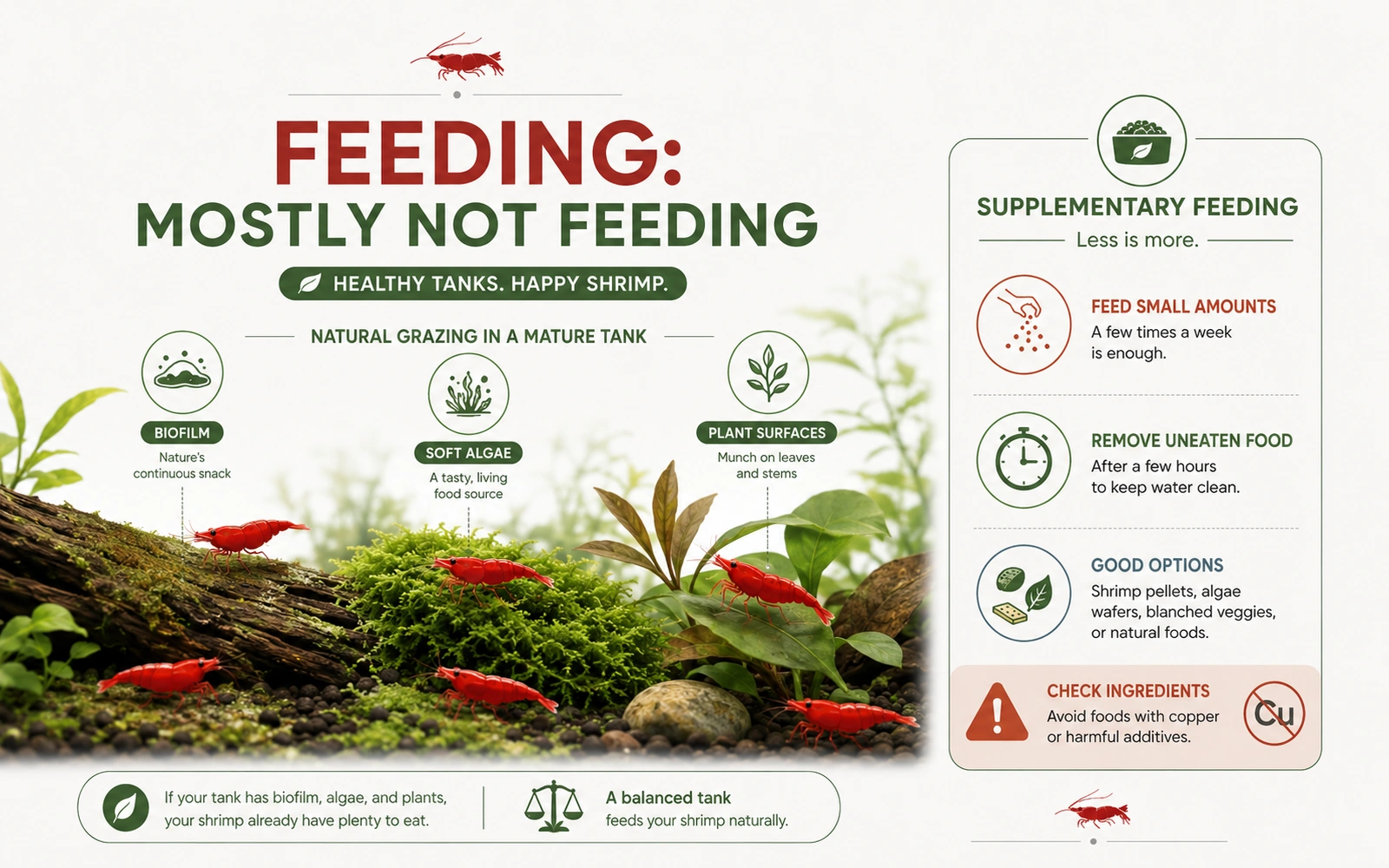
In a mature tank shrimp graze continuously on biofilm, soft algae and decomposing plant matter. That is their actual diet and it is already there.
Supplementary feeding is a small amount, a few times a week, of something that will be gone within a couple of hours. Blanched vegetables work. Any prepared shrimp food works. What matters is the amount and the removal: anything not eaten within a few hours comes out.
Two specific warnings. Check the ingredients of anything you add for copper, including fish foods. And a tank so clean that there is no biofilm anywhere is a tank with no shrimp food in it, which is one of the few situations where scrubbing every surface is actively counterproductive.
Water changes for a shrimp tank
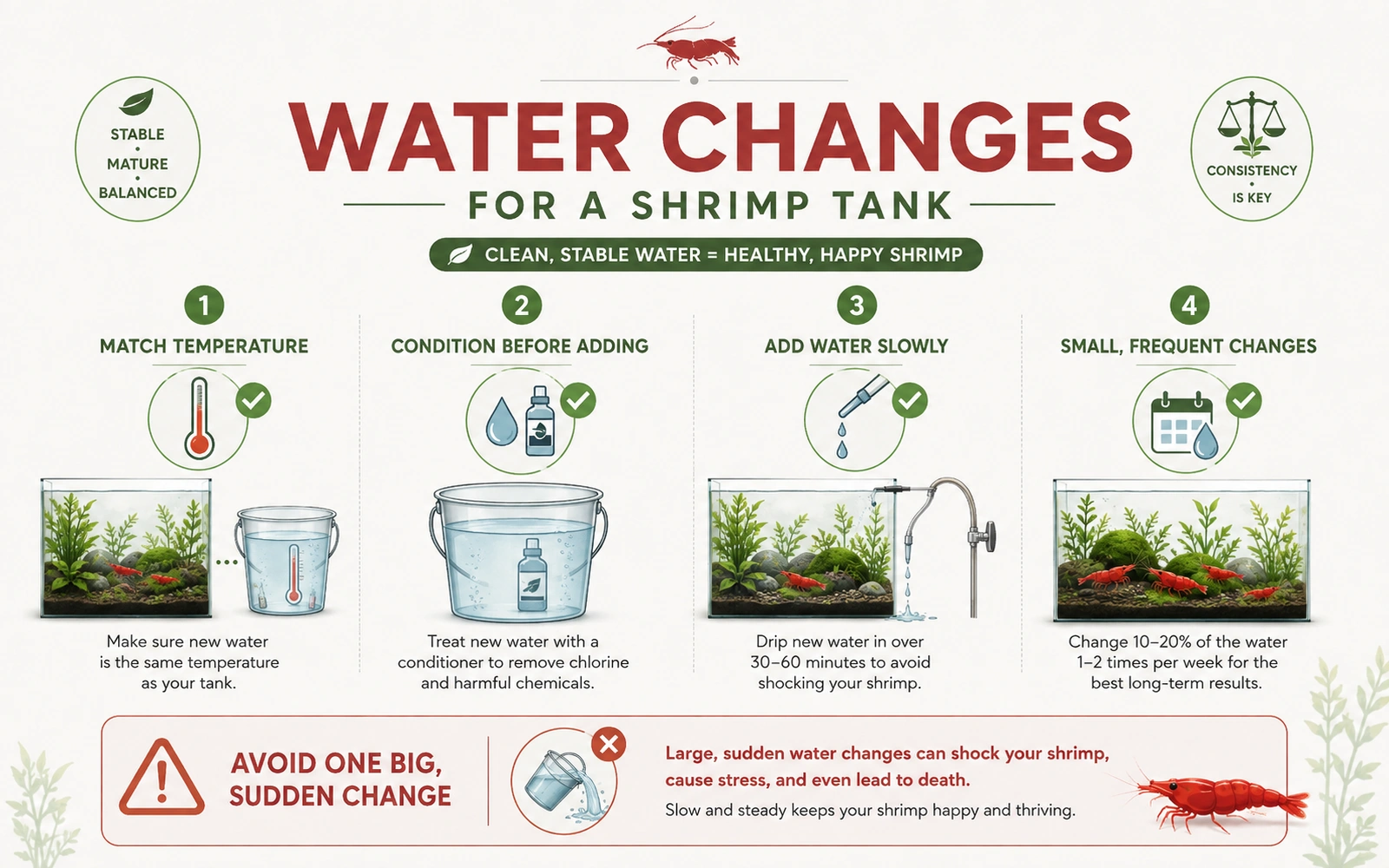
The general principle is different from a fish tank in one respect: smaller and more often, rather than larger and less often.
- Match the temperature before it goes in.
- Condition the water before it goes in, not after.
- Add it slowly. Poured in fast is a chemistry change as well as a temperature one.
- Do not skip changes for weeks and then do a big one. That is the pattern that kills colonies.
Nitrate management matters here too, though not as a threshold. Aquarium nitrate levels sets out why the slope matters more than the number: a tank climbing steadily is telling you the routine is not keeping up, whatever ceiling you subscribe to.
Breeding, which happens without you
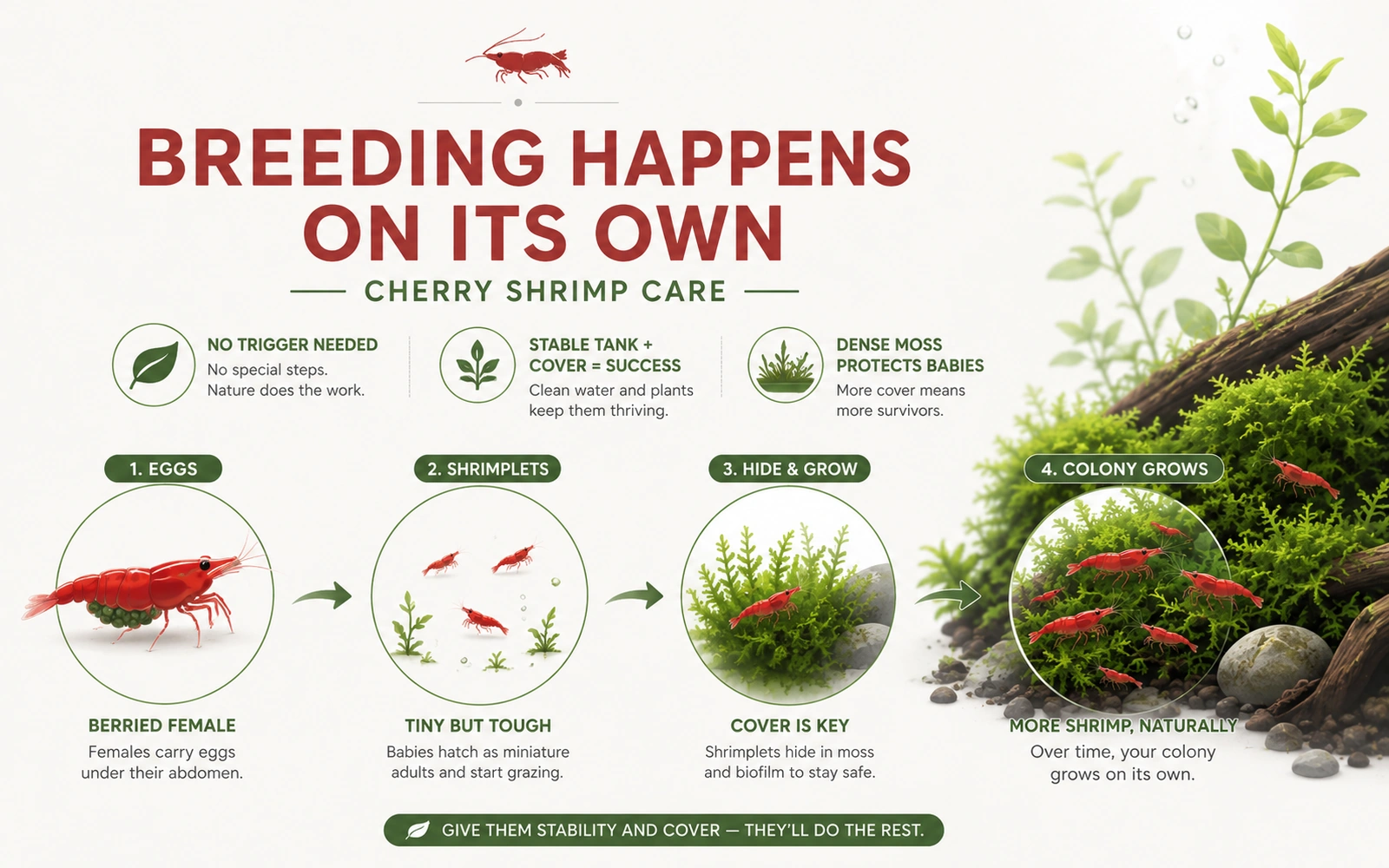
If the tank is stable and there are males and females, they will breed. There is no trigger to arrange.
A berried female carries eggs under her tail and fans them for a few weeks. The young are miniature adults from the moment they hatch, with no larval stage, which is why this species is the easy one to breed and why most others are not.
The only real requirement is cover. Baby shrimp are food for almost everything, including adult fish that ignore the adults. Dense moss, plants, and a mature tank full of surfaces to hide in is what turns a breeding colony into a growing one.
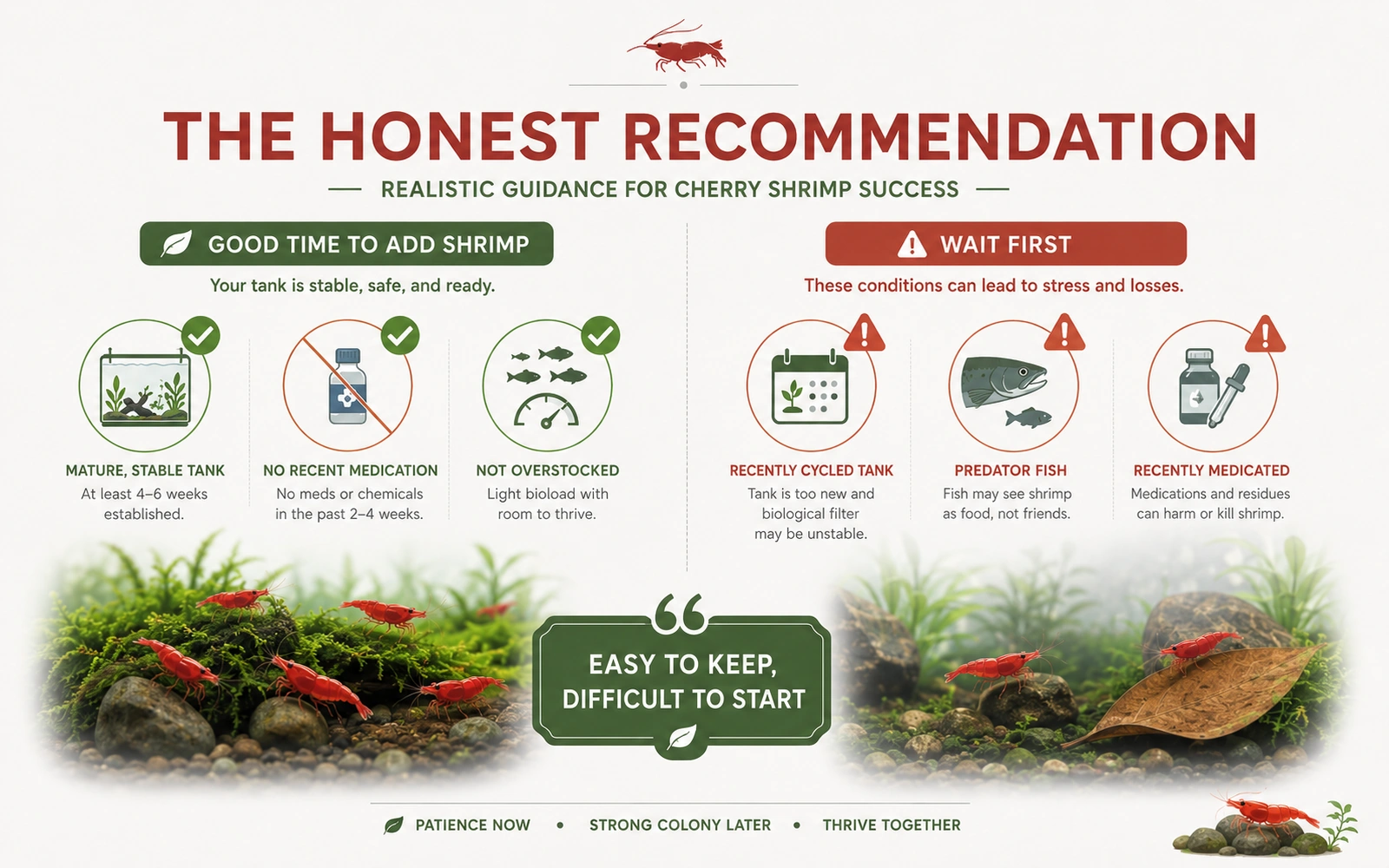
The honest recommendation
If you have a tank that has been running for months, is stable, is not overstocked, and has never had a fish medication in it, add shrimp and enjoy them.
If your tank finished cycling last month, wait. If you keep fish that will eat them, accept that you are keeping a snack rather than a colony. If you have recently medicated the tank for anything, be aware that some treatments persist and that a water change does not necessarily clear them.
And if anyone tells you shrimp are a good beginner's first livestock, be skeptical. They are a good second step, in a tank that has already taught you what a stable tank feels like.
The short version
- Stability matters more than any specific parameter. Slow changes, always.
- Copper is the colony killer. Read the ingredients of anything you add.
- A mature tank feeds them. Supplementary food is small and removed if uneaten.
- Small, frequent, temperature-matched, conditioned water changes.
- They breed on their own if there is cover. Your job is conditions, not intervention.
FAQ
Are cherry shrimp really easy to keep? They are easy to keep and difficult to start. In a mature, stable, well-established tank a colony feeds itself and breeds without help. In a tank that is three weeks old, or that swings, or that had something added to the water, the same colony can be gone in two days.
When can I add cherry shrimp to a new tank? Wait until the tank has been running for months, with a mature filter, stable readings and biofilm on every surface. A tank that finished cycling last week is not ready, even though every reading says zero.
What kills a cherry shrimp colony fastest? Copper is the biggest single cause, and it arrives almost invisibly in fish medications, some plant fertilizers, snail treatments, some foods and old plumbing. The others are ammonia or nitrite, a large sudden water change, untreated tap water, temperature swings and overfeeding.
How often should I feed cherry shrimp? In a mature tank they graze continuously on biofilm, soft algae and decomposing plant matter, so supplementary feeding is a small amount a few times a week of something gone within a couple of hours. Anything not eaten in that time comes out.
Do cherry shrimp breed on their own? Yes. If the tank is stable and there are males and females, they breed with no trigger to arrange, and the young hatch as miniature adults. The only real requirement is dense cover, because baby shrimp are food for almost everything.