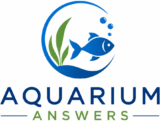
If you have fish in the tank and any ammonia reading above zero, treat it as something to act on today rather than something to watch. In order: confirm the reading is real, do a partial water change with dechlorinated, temperature-matched water to dilute what is there, stop feeding for a day or two, leave the filter media alone, and then find the cause. The target is zero, and the sequence above is the same whether the number is faint or obvious. What changes is how fast you move.
The Direct Answer: What to Do in the Next Hour
- Retest before you act, especially if the reading is faint. The next section explains how to check the kit itself.
- Do a partial water change with water that has been dechlorinated and matched to tank temperature. Dilution is the one action that reduces ammonia immediately and carries no downside for the tank's biology. How to do a water change without stressing your fish covers doing it without adding a second problem.
- Stop feeding for a day or two. Less food in means less ammonia produced, and healthy fish are unharmed by a short fast.
- Do not clean or replace filter media, and do not deep-clean the substrate. That is where the bacteria that consume ammonia live, and removing them now is the opposite of what the tank needs.
- Do not add more fish, and do not add anything to the water that you cannot explain the purpose of.
- Test again the next day, and keep testing daily until it reads zero twice in a row.
Then work out why it happened, because dilution treats today and the cause decides whether tomorrow is the same.
Why This Site Will Not Give You a "Safe" Ammonia Level
Almost every page ranking for this query opens with a table of levels. This one does not, and the reason is worth two minutes of your time.
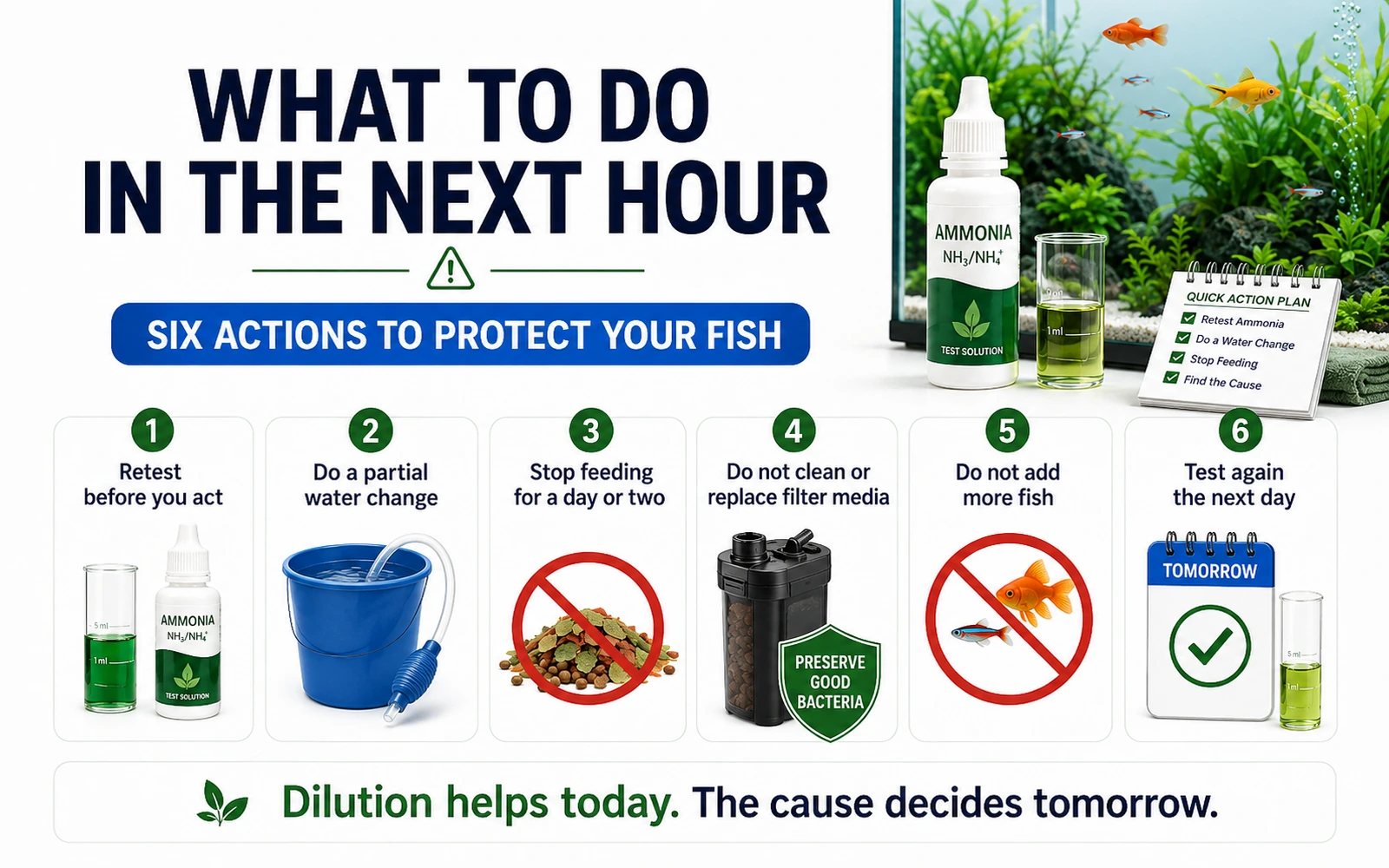
Ammonia in water exists in two forms that shift back and forth depending on pH and temperature. The form that does the damage becomes proportionally more prevalent as water gets warmer and more alkaline. A home test kit reports both forms together as a single number, so the same reading represents a genuinely different situation in a cool, softly acidic tank than in a warm, alkaline one.
That means any single "safe up to X" figure is either wrong for most tanks or so hedged as to be useless, and a beginner reading it will do the natural thing: relax at a number where they should not. So there is no threshold on this page. Zero is the target, anything above it has a cause worth finding, and how urgently you act depends on your fish's behavior and your own tank rather than on a line in somebody's chart.
First, Make Sure the Reading Is Real
The most common version of this question is not a dramatic spike. It is a low reading that will not go away in a tank that otherwise looks perfectly healthy, and there is a simple check that most articles skip.
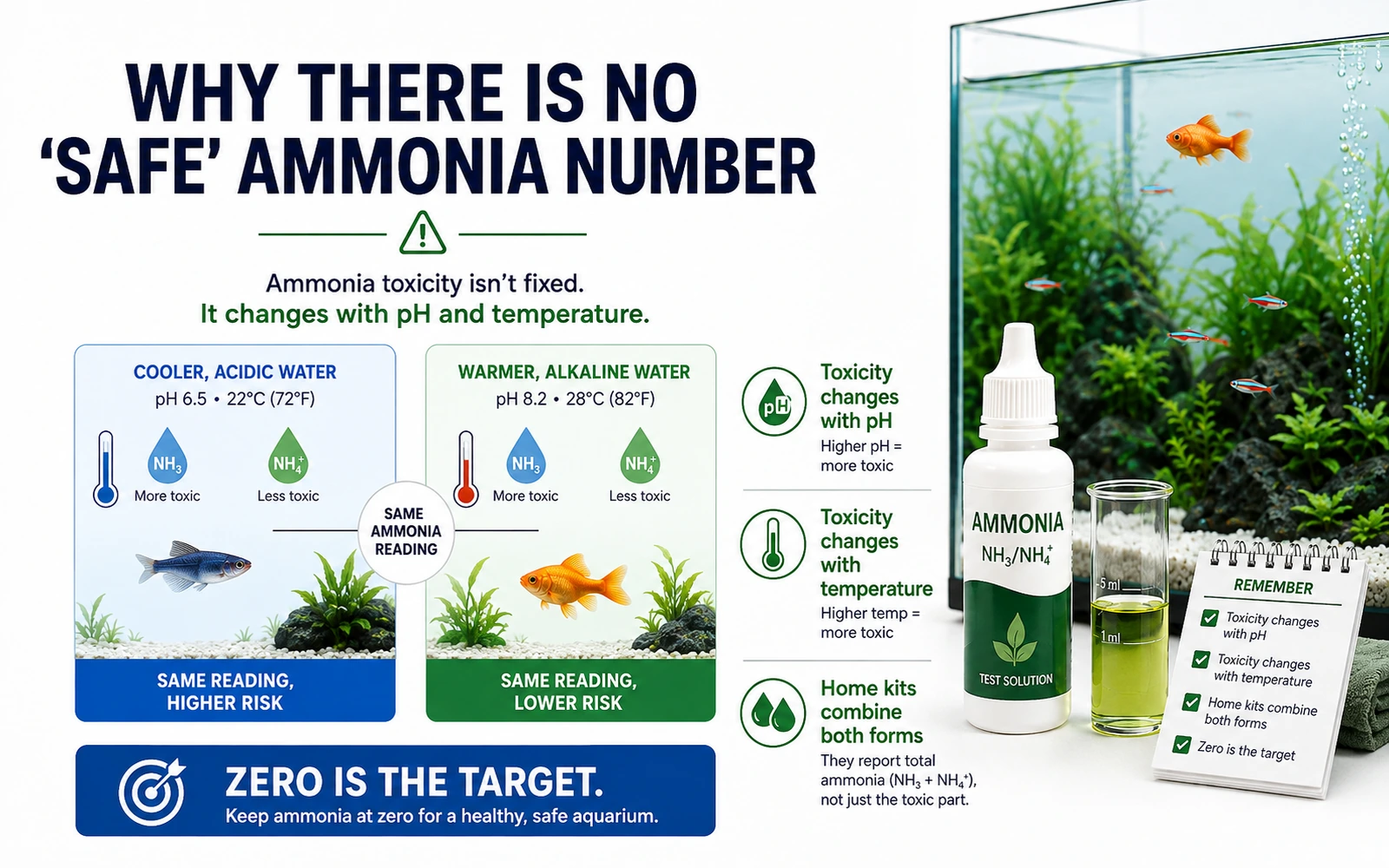
Test a sample of water you know is clean. Distilled or RO water from a shop should contain no ammonia at all. Run it through your kit exactly as you would tank water. If your kit reports a trace on that sample too, the trace is coming from the kit or the procedure, not your aquarium.
Other things that produce a reading you should not act on:
- Some tap water contains chloramine, which is chlorine bonded to ammonia. Dechlorinating it breaks that bond and releases the ammonia, so a test taken shortly after a water change can show a reading your filter is already dealing with. Dechlorinator, chlorine and chloramine covers this in detail.
- Strips read the low end poorly, which cuts both ways: they can miss a real trace and they can also be misread as showing one. Test strips vs liquid test kits covers where each is reliable.
- Expired or badly stored reagents drift. Check the dates.
If the control sample reads clean and your tank does not, the ammonia is real. Move on.
A New Tank and an Established Tank Are Two Different Problems
This is the fork in the road, and it changes everything about what happens next.
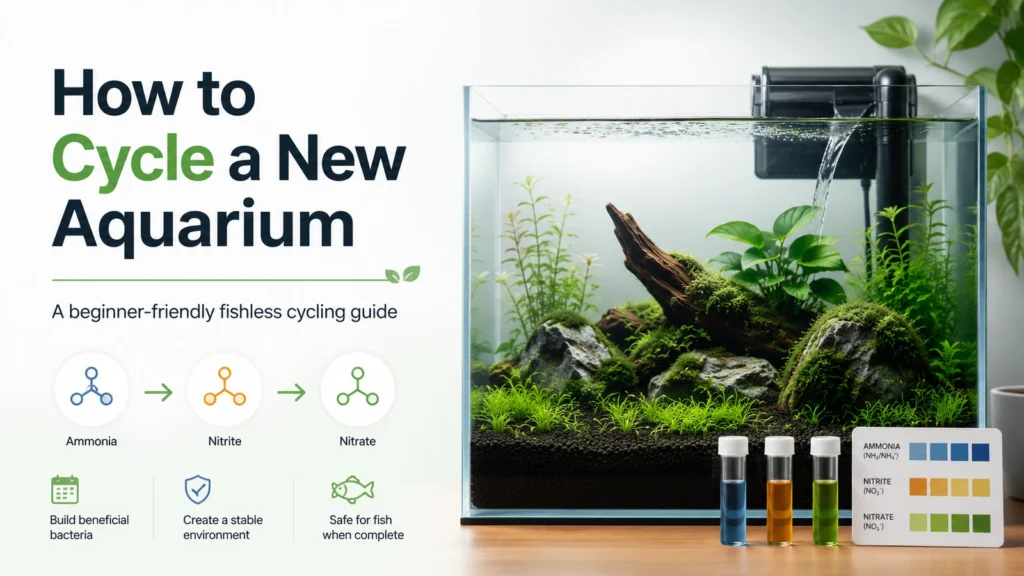
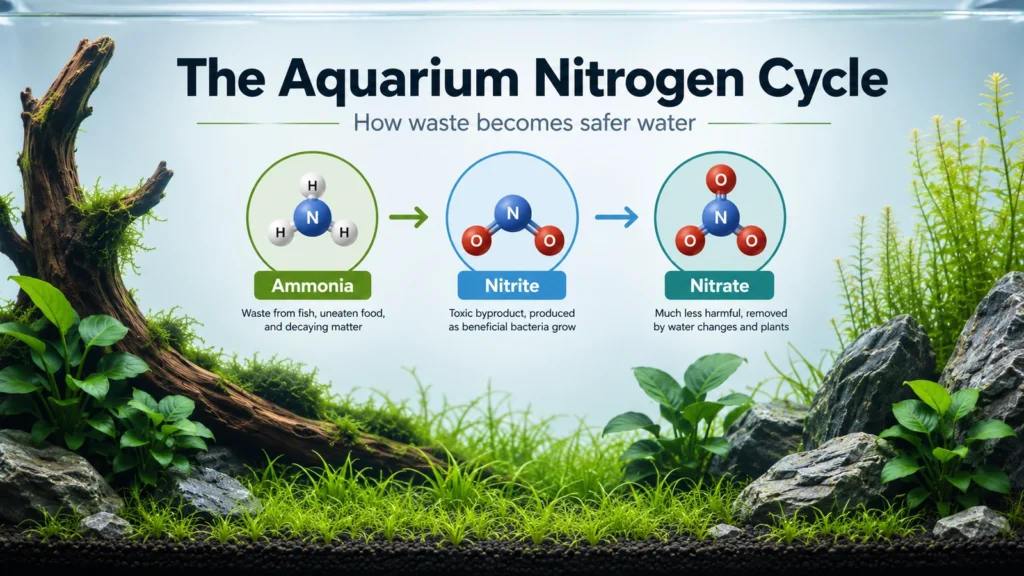
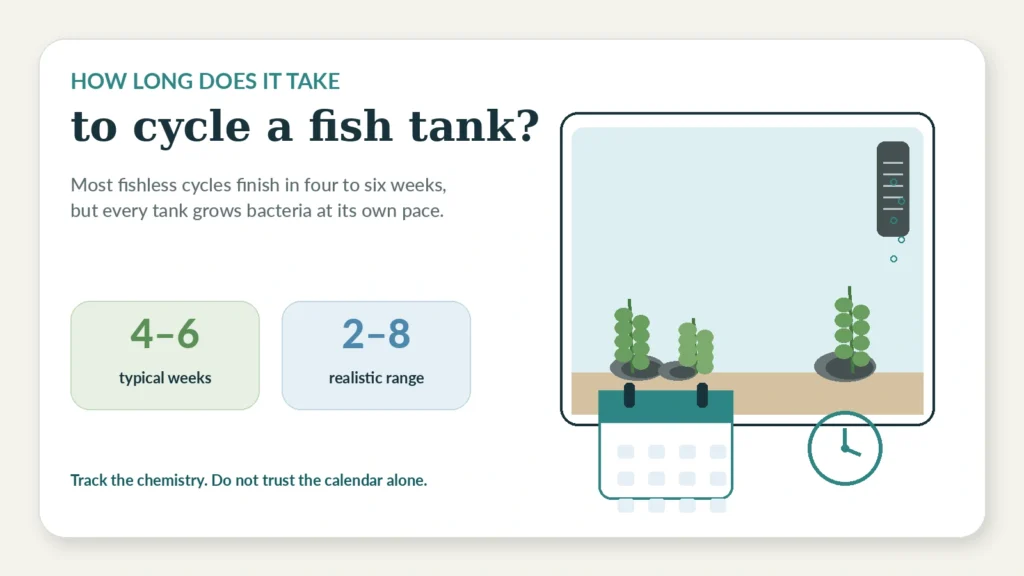
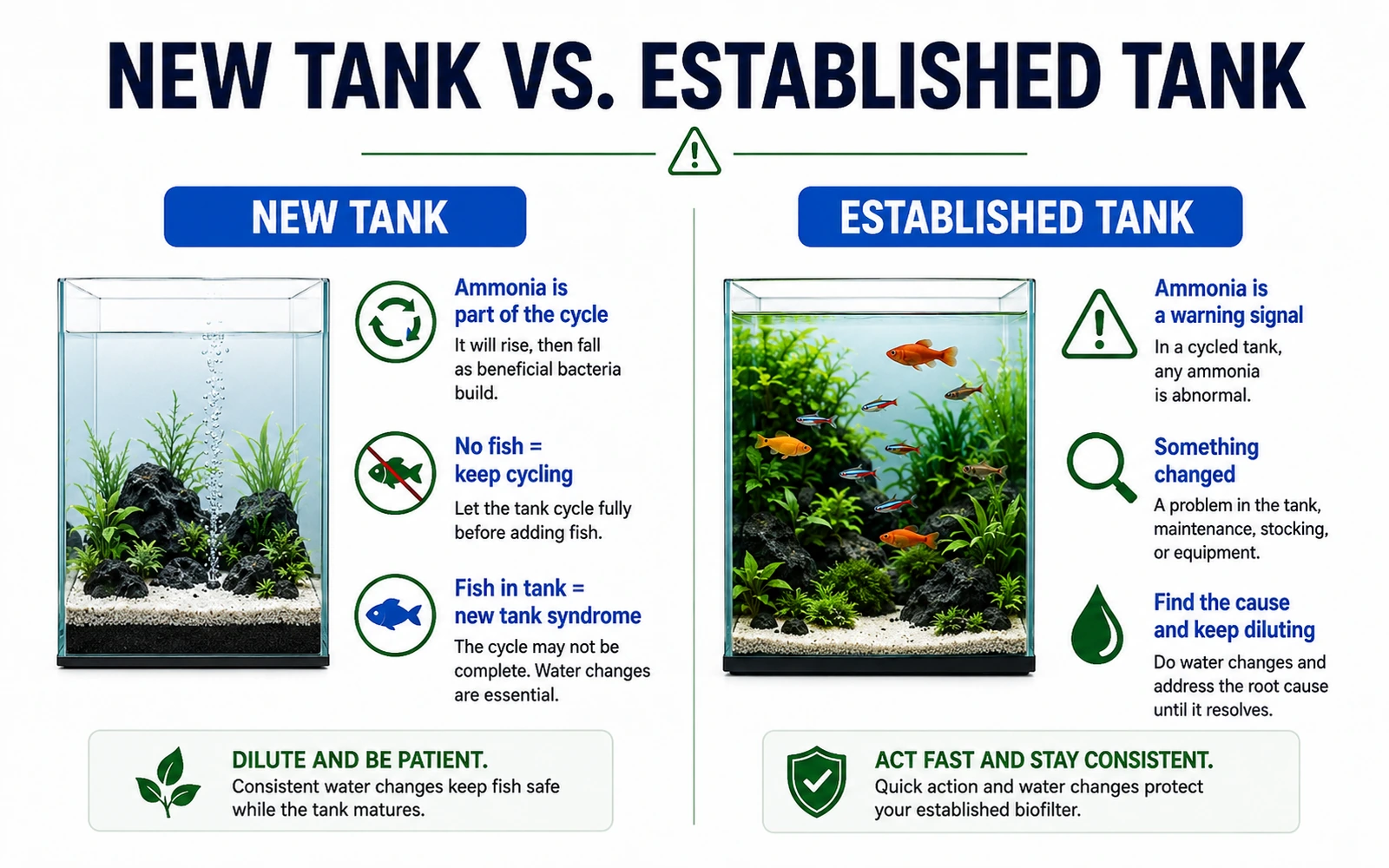
A new tank. Ammonia is expected here. It is the first stage of the nitrogen cycle and its presence means the process is underway rather than that something is broken. If there are no fish in the tank yet, this is normal and you keep going: how to cycle a new aquarium covers the sequence, and my cycle is stalled and the ammonia will not drop covers the case where it stops falling. If there are already fish in a tank that has not finished cycling, that is the situation described in new tank syndrome, and the water changes above are not optional maintenance, they are what is keeping the fish safe until the bacteria catch up.
An established tank that used to read zero. This one is a signal, not a stage. Something changed. A tank that processed its own waste last month and does not this month has either lost bacterial capacity or gained waste, and the next section is the list of usual suspects.
What Actually Causes Ammonia in a Running Tank
- Overfeeding. Uneaten food decomposes directly into ammonia, and it is the most common cause by a distance. How much and how often to feed covers finding the right amount, and the test kit itself is the feedback signal.
- Something died out of sight. A lost fish, or a snail behind the filter, produces a surprising amount of ammonia for its size. Count your fish. Look under and behind the decor.
- Overstocking, or a recent addition. Adding several fish at once raises waste production faster than the bacterial colony can grow to meet it. Adding your first fish without restarting the cycle covers pacing.
- The filter was cleaned too thoroughly, rinsed in tap water, or the media was replaced rather than reused. Chlorinated tap water kills the colony on contact. So does letting media dry out.
- The whole substrate was deep-cleaned at once. Gravel vacuuming covers why a third at a time is the usual guidance.
- The filter stopped, even briefly. A power cut, a clogged intake or a pump left off during maintenance starves the bacteria of oxygen and flow.
- Medication in the tank. Some treatments affect nitrifying bacteria. If anything has been added recently, that is a candidate.
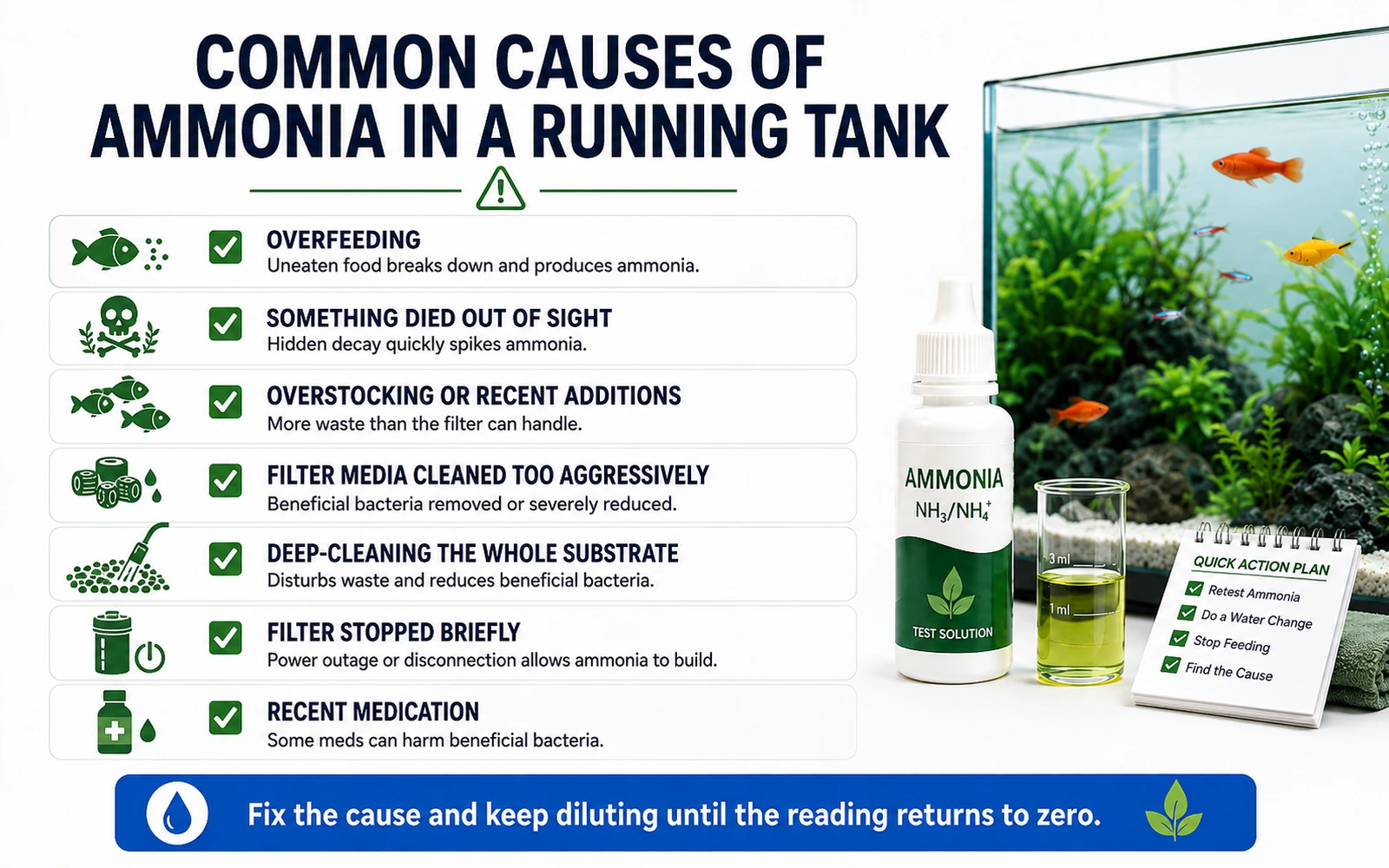
Fix the cause and the reading resolves on its own. Keep diluting until it does.
What a Detoxifier Does and Does Not Do
Water conditioners that claim to detoxify ammonia are widely recommended in this situation and they are genuinely useful, but they are frequently misunderstood.
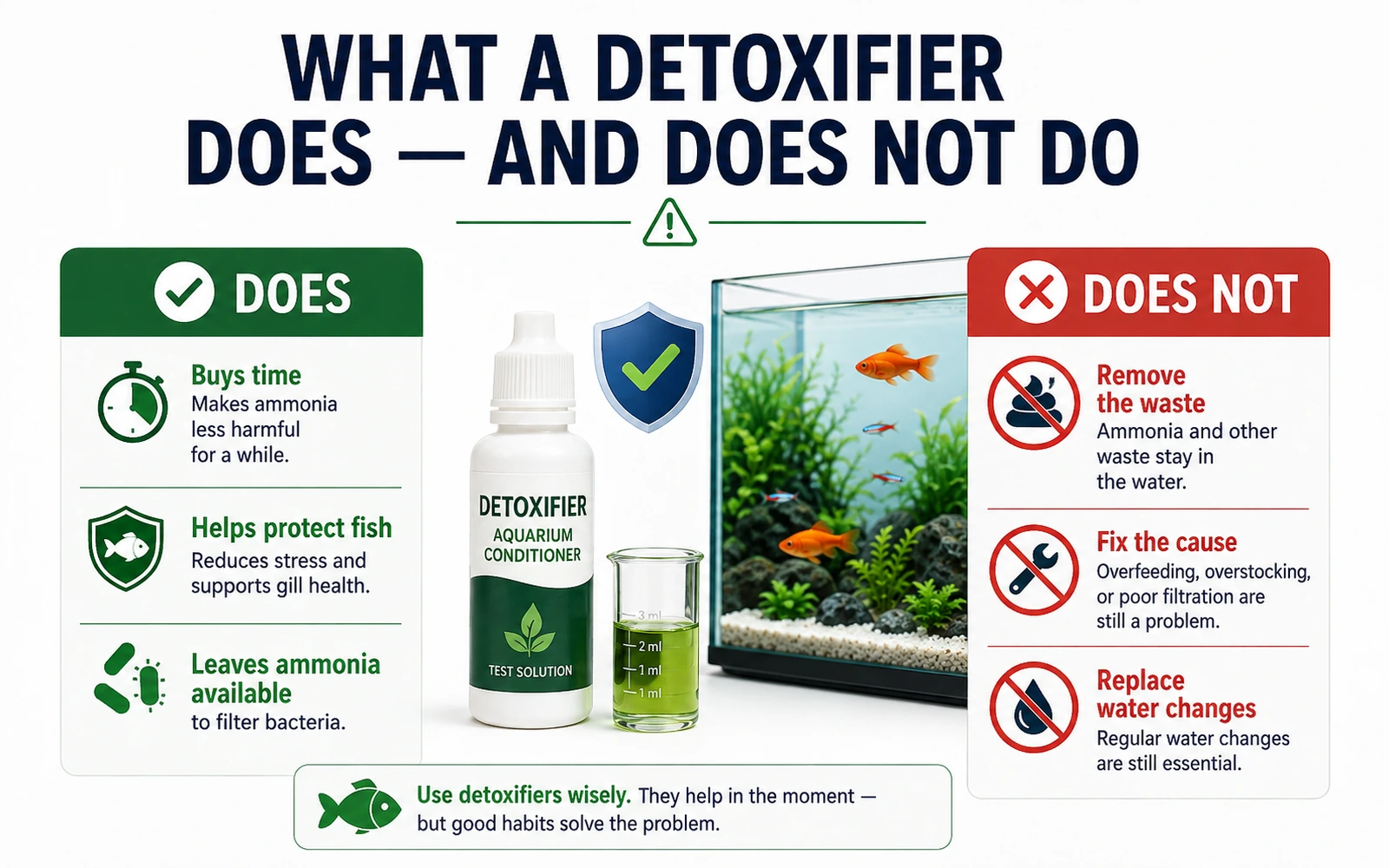
These products convert ammonia into a form described as less harmful to fish while still leaving it available to your filter bacteria. Two consequences follow, and both matter. First, your test kit will usually still show the ammonia, because most home tests measure both forms together. A reading that has not fallen after using one does not mean the product failed. Second, and more importantly, nothing has been removed from the tank. The waste is still there and the cause is still whatever it was.
So a conditioner buys time while the water changes and the bacterial colony do the actual work. It is not a fix and it is not a substitute for finding the reason. Use the label directions for any product you add; this site does not publish dosing for anything.
When It Is No Longer a Water-Quality Problem
Everything above is about the water. Fish are the other half, and this article will not tell you what is wrong with a specific animal.
If fish are gasping at the surface, sitting on the bottom, hanging in a corner with clamped fins, showing red or inflamed gills, or dying, that is happening now and needs the immediate steps on the aquarium emergency help page rather than a diagnosis from a web page. Ammonia is one possible reason among several for every one of those signs. For the surface-breathing case specifically, my fish are gasping at the surface covers what to do first and why ammonia produces it.
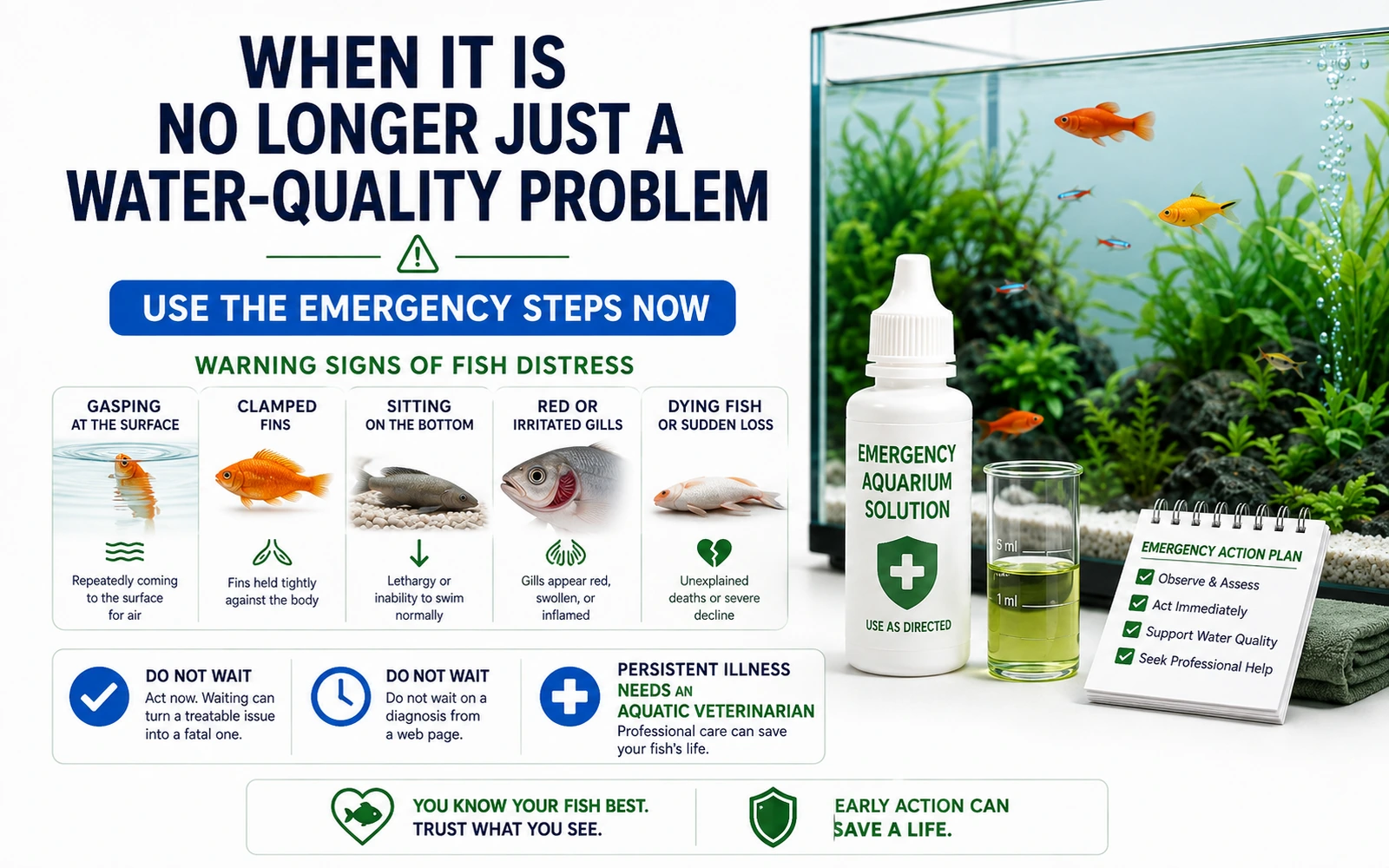
And if fish remain unwell after the water is right, or you are being asked to identify a disease, that is a question for an aquatic veterinarian. This site does not diagnose fish and does not publish medication doses, because both get animals killed when they are wrong, and a dose that depends on tank volume and species is not something to take from a stranger's blog.
FAQ
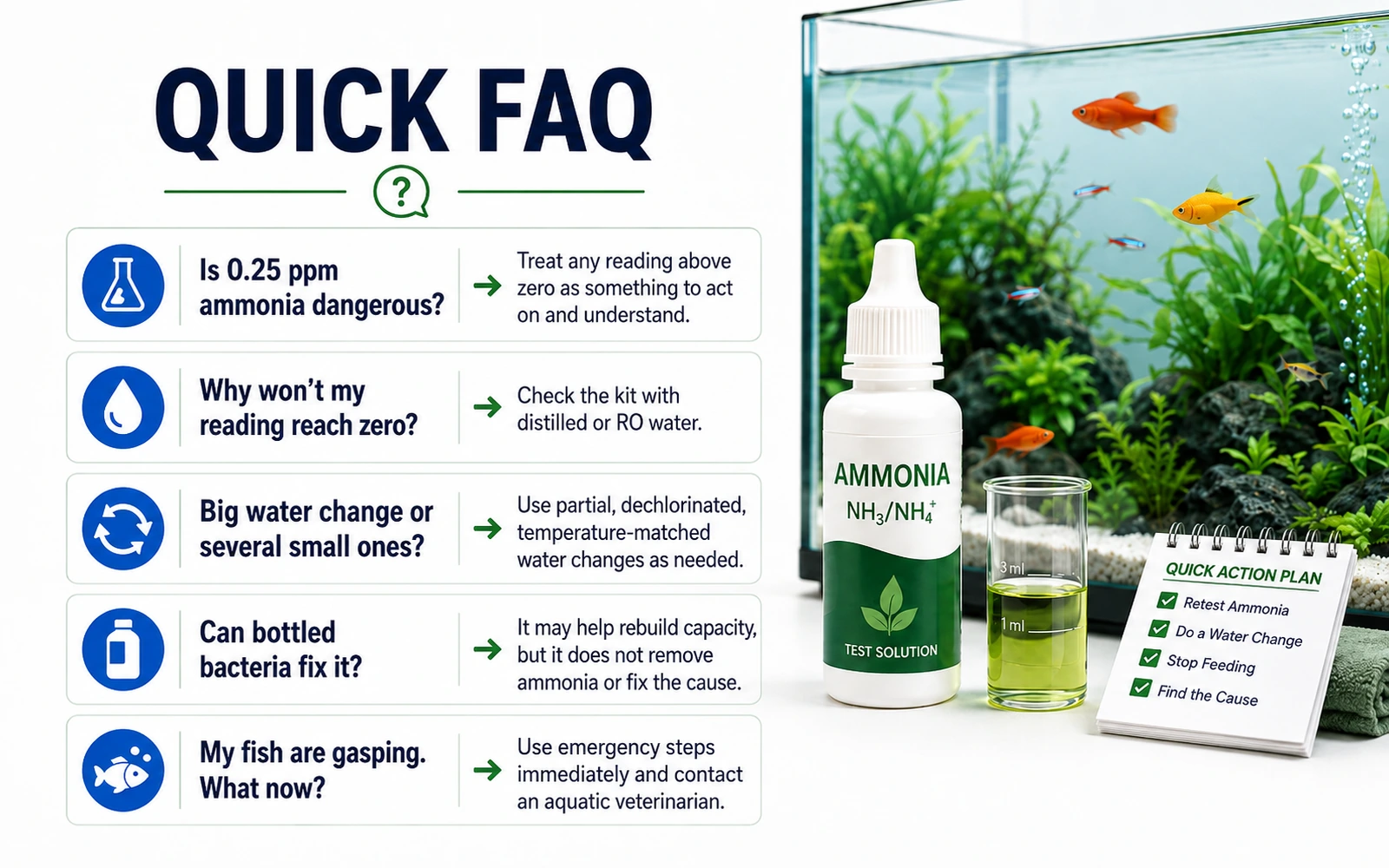
Is 0.25 ppm ammonia dangerous in my tank?
There is no threshold this site will publish as safe, because ammonia's toxicity shifts with pH and temperature and a home kit reports both forms as one number. Treat any reading above zero as something with a cause worth finding, verify that the reading is not a kit artifact, dilute with a water change, and watch your fish's behavior rather than a chart.
Why does my ammonia reading never quite reach zero?
Very often the kit rather than the tank. Test distilled or RO water with the same kit; it should read zero. Chloramine in tap water released by dechlorinator, degraded reagents, and misread strips all produce persistent faint readings in tanks that are otherwise fine.
Should I do a big water change or several small ones?
Partial changes with dechlorinated, temperature-matched water, repeated as needed while you fix the cause, are the standard approach. Very large sudden changes can swing temperature and chemistry enough to stress fish, so match the water carefully whatever size you choose.
Can I just add a bottled bacteria product to fix it?
It may help a tank rebuild capacity, but it does not remove ammonia and it does not address the cause. Do bottled bacteria products actually speed up a cycle covers what they can and cannot do.
My fish are gasping at the surface. What do I do right now?
Follow the aquarium emergency help page immediately rather than waiting on a test result, and contact an aquatic veterinarian. Gasping has several possible causes and this page will not tell you which one is yours.