Cloudy water in an established aquarium is not the same problem as cloudy water in a new one, and it is not something to wait out. A mature tank that suddenly goes hazy has a trigger, and in practice it is nearly always one of five things: something died, something was overfed, the substrate or filter was disturbed, filter media was cleaned too thoroughly or replaced, or the stocking has quietly outgrown the maintenance. Your first move is to test ammonia and nitrite, then work backward through the last ten days. If the readings are bad, treat it as a water-quality event and follow something is wrong with my tank.
Step One: Is It a Bloom or Is It Debris?
These two look similar through the front glass and have different causes, so separate them before you do anything.
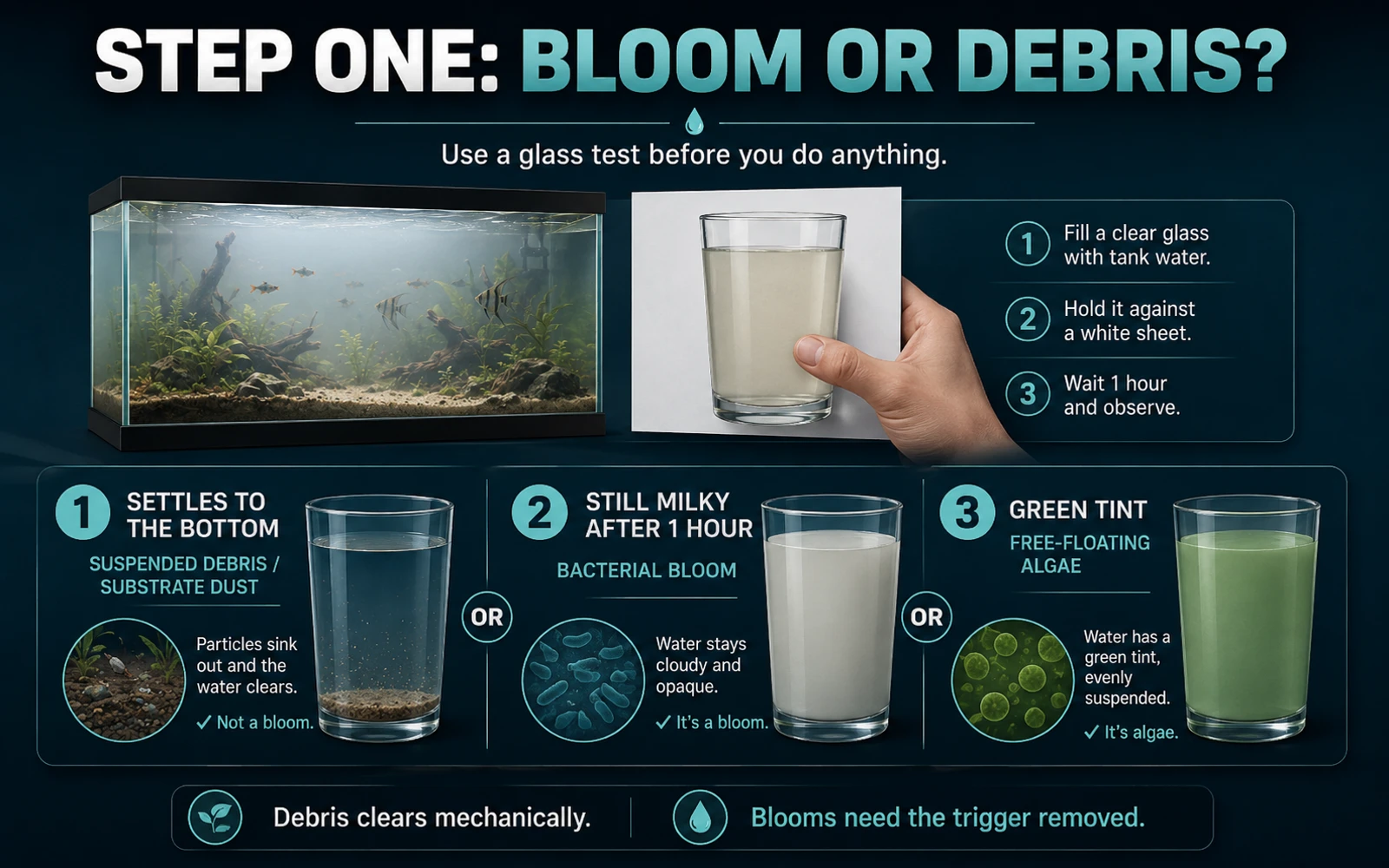
Take a glass of tank water and hold it against a sheet of white paper, then leave it on the counter for an hour.
- The glass looks clear on its own, and the sediment settles to the bottom: you have suspended particulate. Something physical is in the water column: stirred substrate, detritus knocked loose, fine sand, or dust from new decor or a new filter medium.
- The glass still looks milky after an hour, with nothing settled: you have a bacterial bloom. Free-floating bacteria do not settle out, which is exactly why they are so persistent.
- The tint is green rather than white: that is not a bloom at all. It is free-floating algae, which behaves differently and clears differently. See green water.
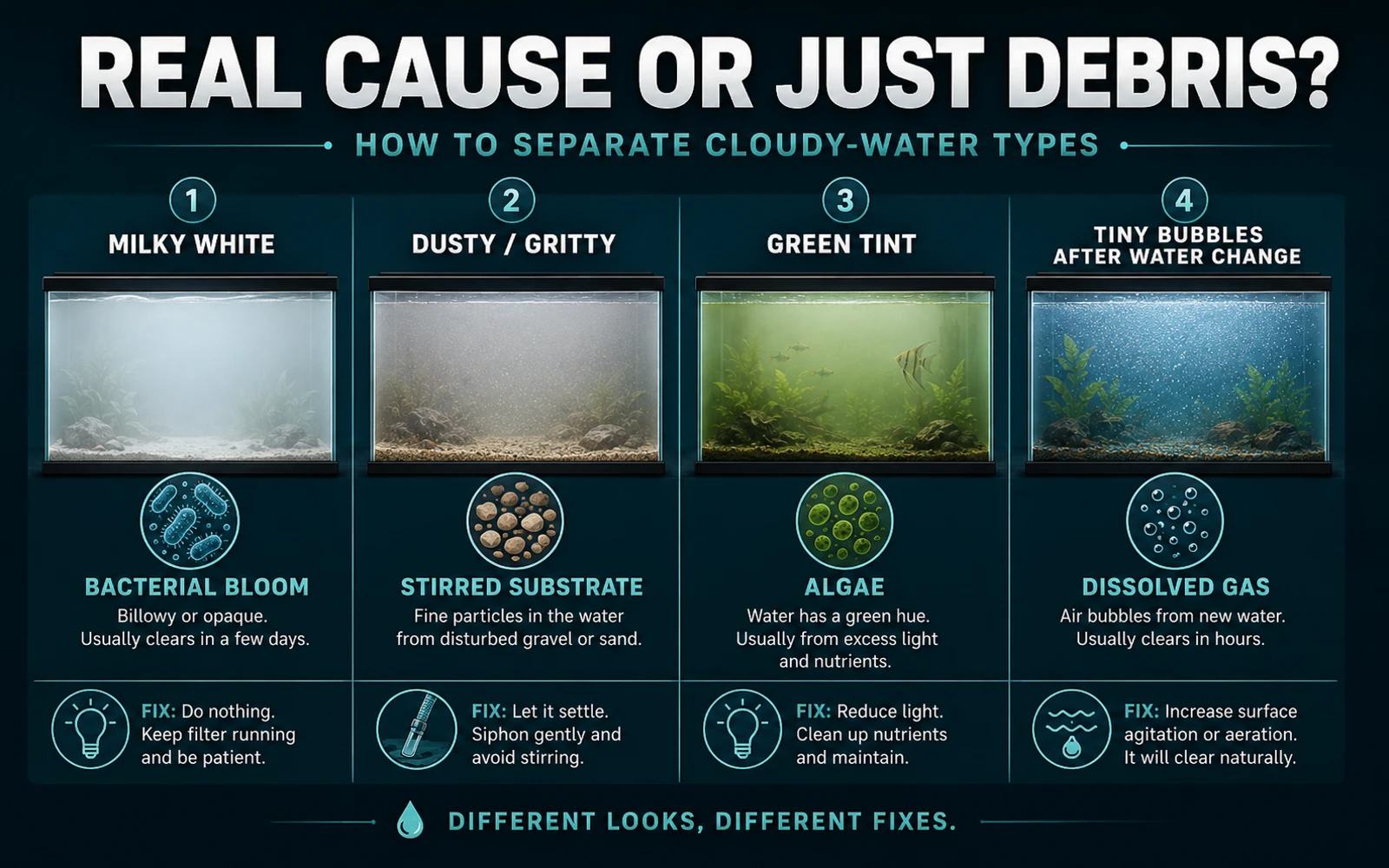
Debris clears mechanically, usually within a day or two, and the filter does most of the work. A bloom needs its food supply cut off, and that means finding the trigger.
Step Two: What Happened in the Last Ten Days?
This is the section other pages skip in favor of a generic causes list, and it is the one that actually solves it. An established tank has a working biological filter. For the water to go milky, something must have delivered more organic material than that filter could process. Go backward.
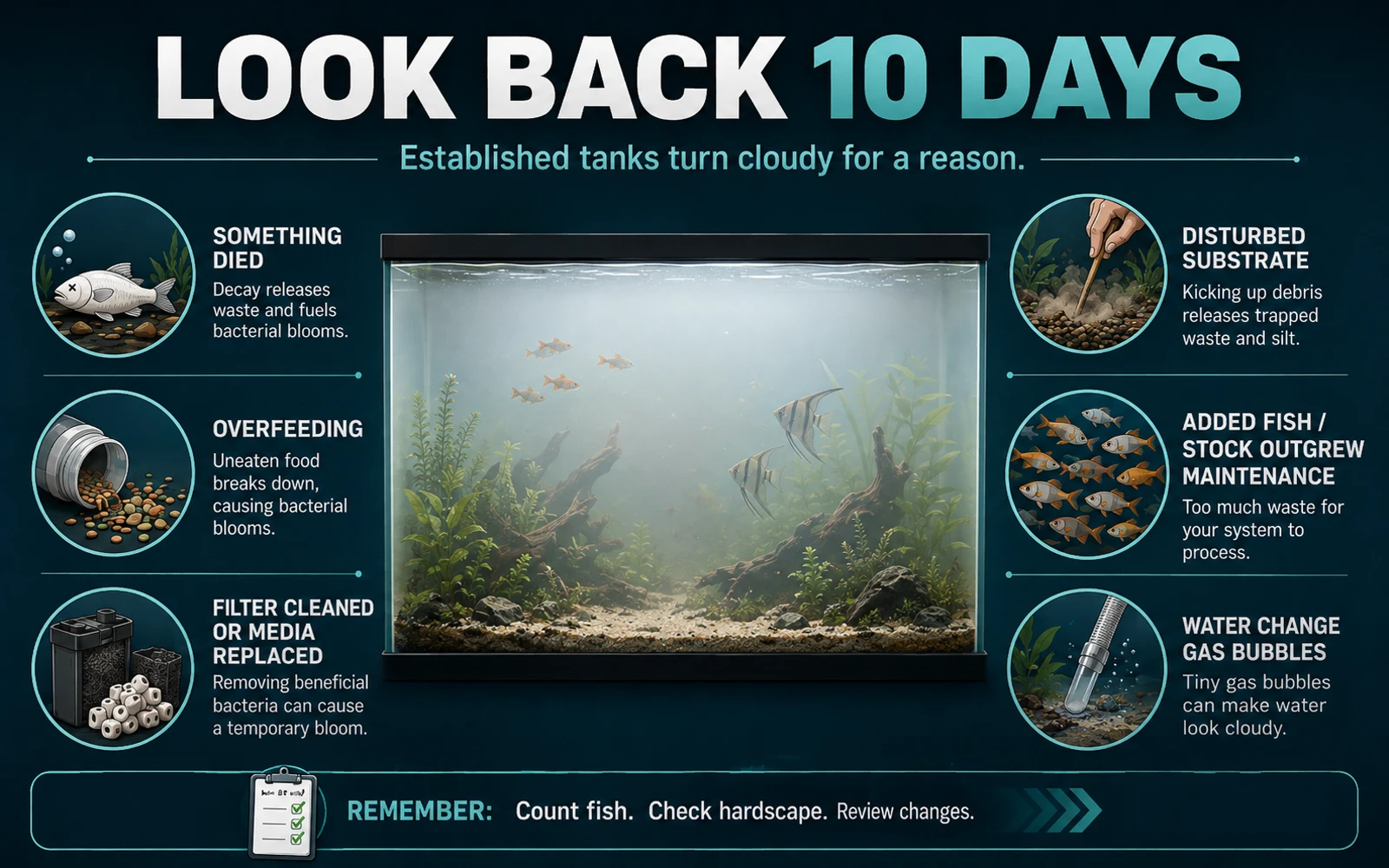
Did something die? A fish you have not counted recently, or a snail, decomposing behind the filter or under a rock. This is the single most common cause of an unexplained bloom in a settled tank, and it is also the easiest to miss because a small body decomposes out of sight. Count your fish. Look under and behind hardscape.
Did you overfeed, or feed something new? A heavy feed, a holiday block, a well-meaning house guest, or a switch to a richer food all dump organics in at once. Overfeeding is the cause named most often across aquarium retailer and hobby guides, and it is also the easiest to fix. How much to feed aquarium fish covers what a reasonable amount actually looks like.
Did you disturb the substrate? Deep-vacuuming a bed that has not been touched in a long time, moving a large rock, replanting, or rescaping releases everything that has been quietly composting down there.
Did you clean or change the filter? This is the one that catches careful keepers. Rinsing all media at once, rinsing in tap water, or replacing a cartridge removes a large fraction of the bacterial colony. The tank then behaves like a partially cycled tank for a while, which can produce both a bloom and an ammonia reading. If your readings confirm it, an aquarium cycle crash explains what is happening and how to nurse it back.
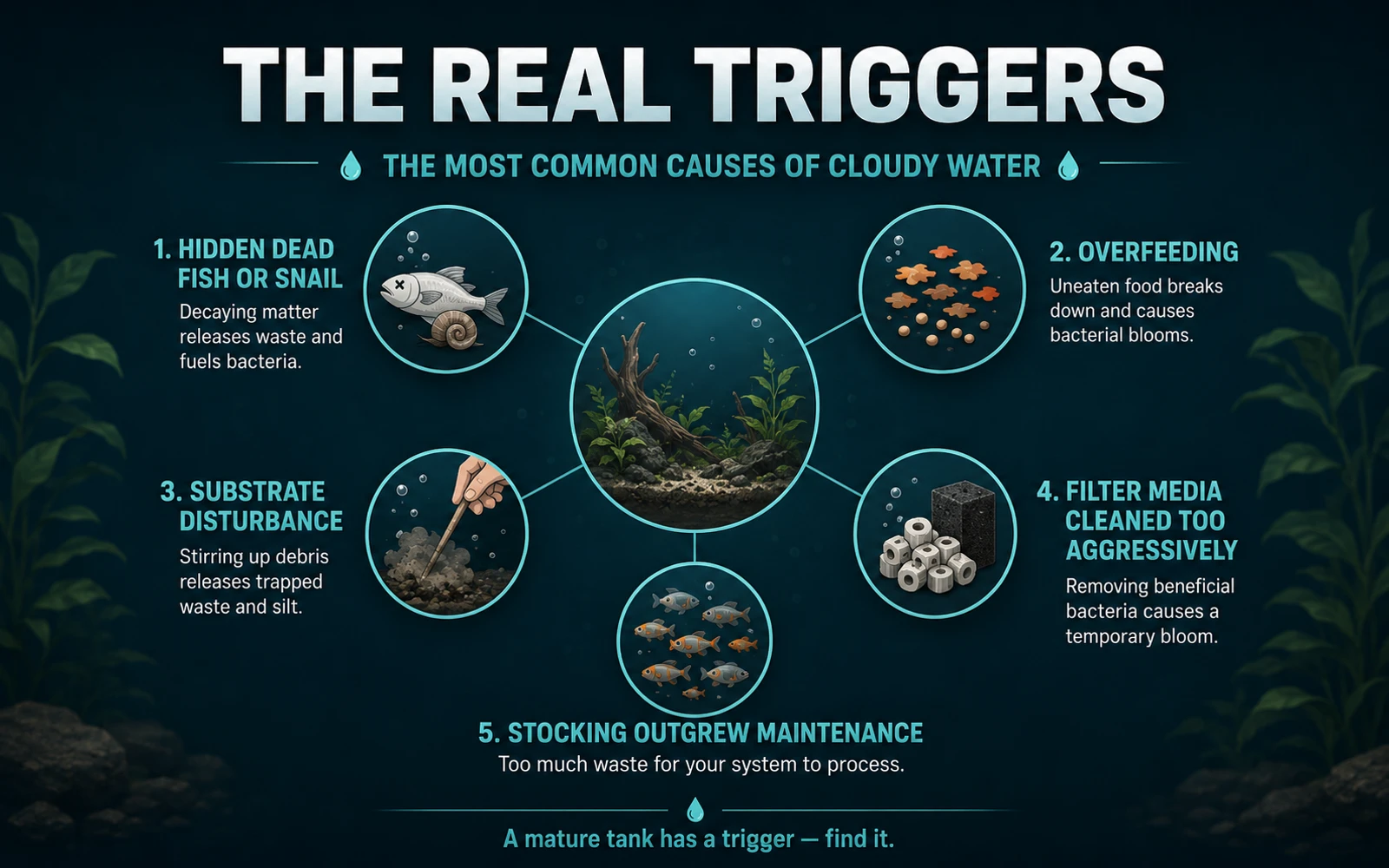
Did you add fish, or has the stock grown? Fish grow, and a stocking level that was fine at purchase size may not be fine now. This is the slow version of the same problem, and the tell is that the cloudiness keeps coming back.
Did the water source change? After a water change, cloudiness can simply be dissolved gas coming out of solution, which looks like a fine mist of tiny bubbles and clears from the bottom up within an hour or two. That one is harmless and needs no action.
Step Three: Test, Because Cloudiness Is a Symptom
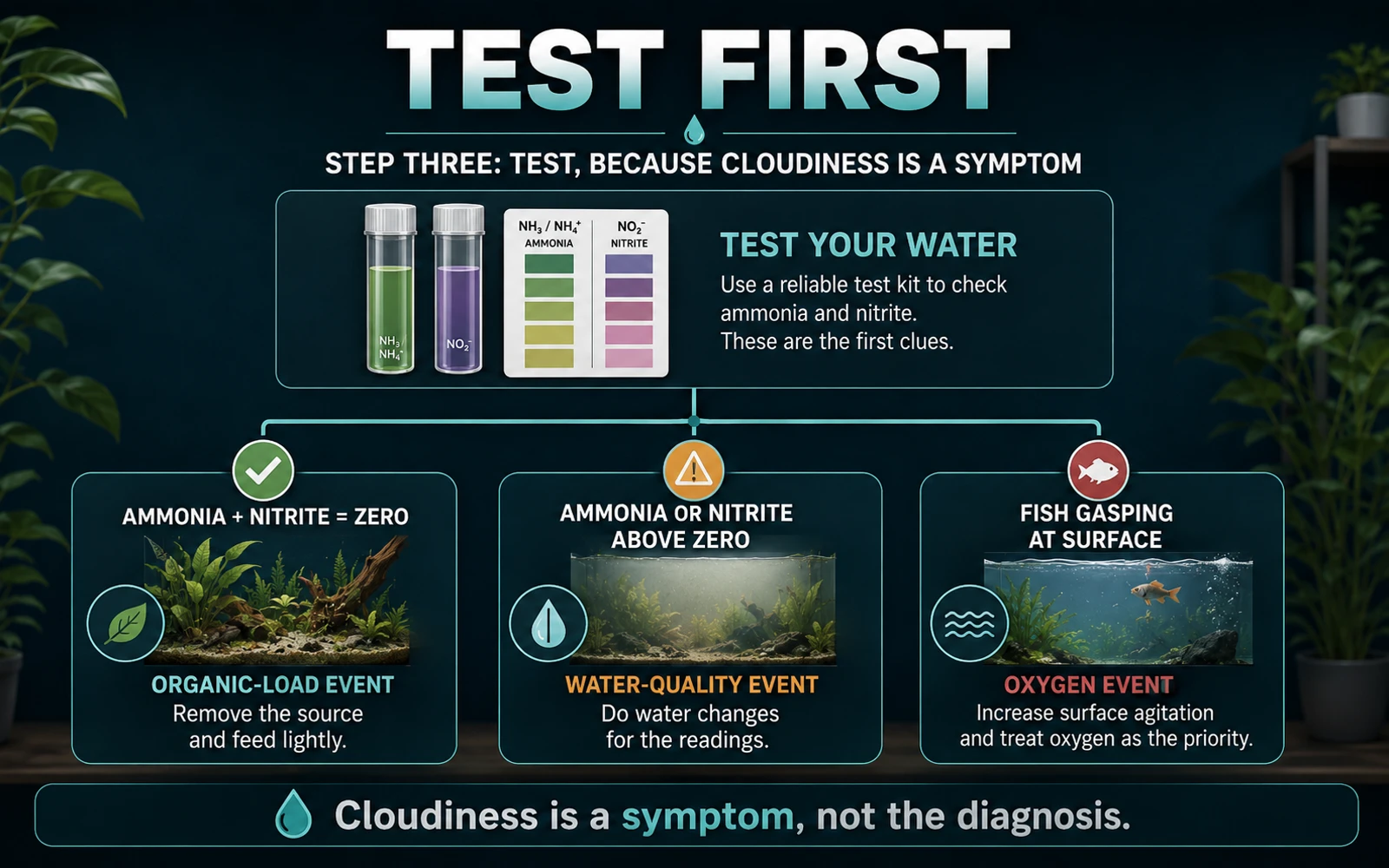
Whatever the trigger, the question that decides urgency is whether ammonia or nitrite is above zero.
- Both zero, fish behaving normally: you have an organic-load event, not a filtration failure. Find and remove the source, feed lightly for a few days, and let the filter catch up.
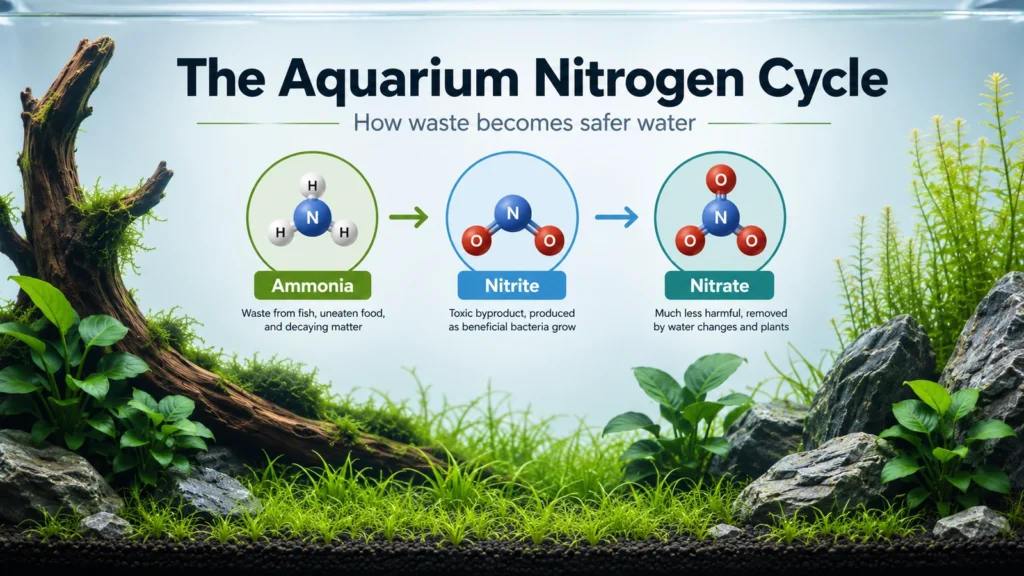
- Ammonia or nitrite above zero: the biological filter is not keeping up, whatever the reason. Now you do water changes, and you do them for the readings.
- Fish gasping at the surface as well as cloudy water: treat this as the priority. A dense bacterial bloom consumes oxygen, and in a warm, heavily stocked tank that can matter. Increase surface agitation and address the oxygen question first.
Algae and blooms do not make fish sick on their own. If fish have visible lesions, spots or damaged fins alongside the cloudiness, that is a separate problem happening at the same time, and when to contact an aquatic veterinarian covers where the boundary sits between what you can handle and what needs professional help.
What Not to Do
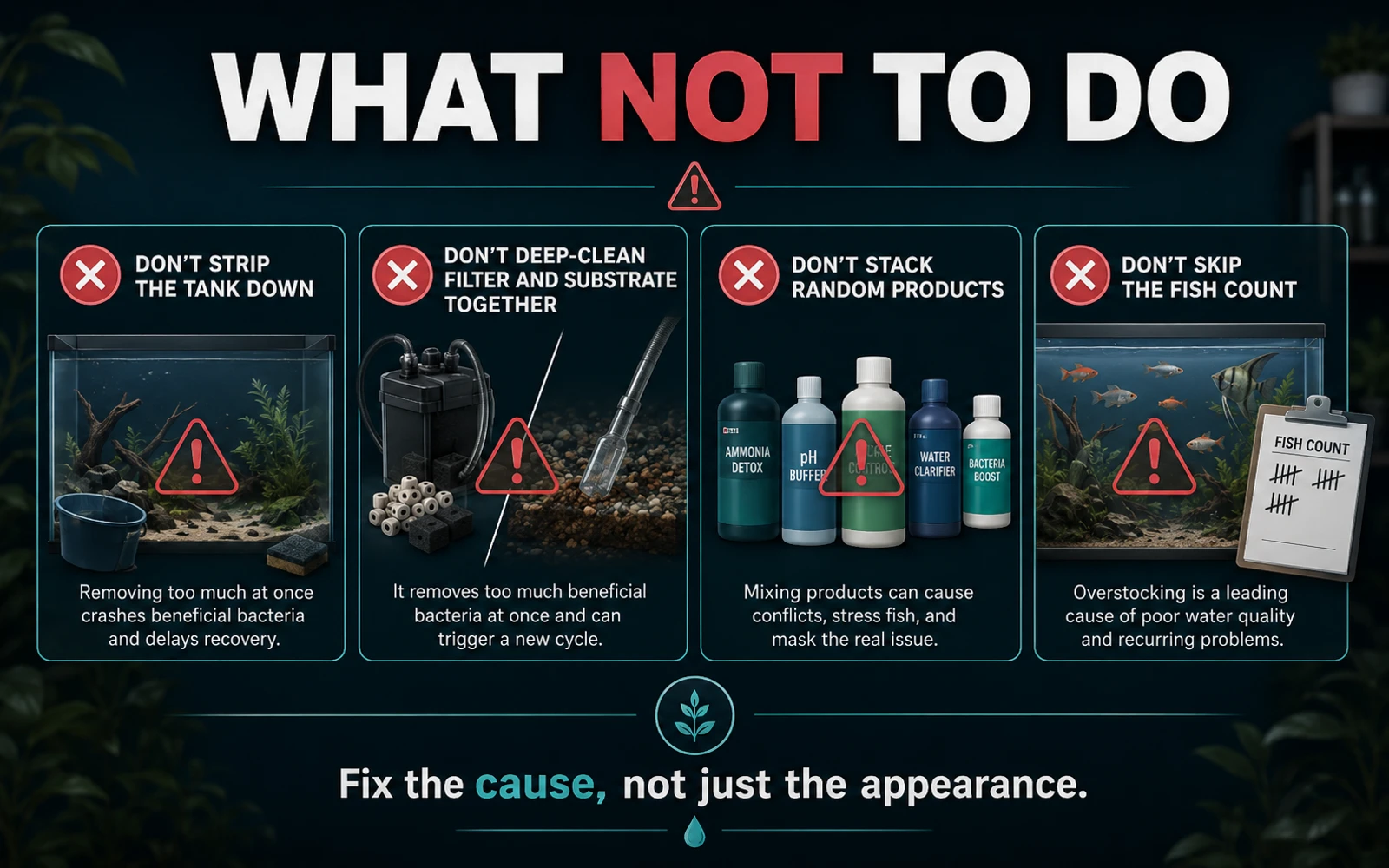
Do not strip the tank down. The instinct to give everything a thorough clean is exactly backward. Deep-cleaning the filter and the substrate at the same time removes the biological capacity you need and stirs up more of what caused the problem.
Do not stack products. A clarifier plus a bacterial supplement plus a treatment for something you have not diagnosed leaves you with water you cannot interpret. If you use a clarifier, use it knowing that it treats appearance, not cause.
Do not skip the count. Assuming all your fish are present is how a decomposing body goes unfound for a week.
The Honest Trade-off on Water Changes
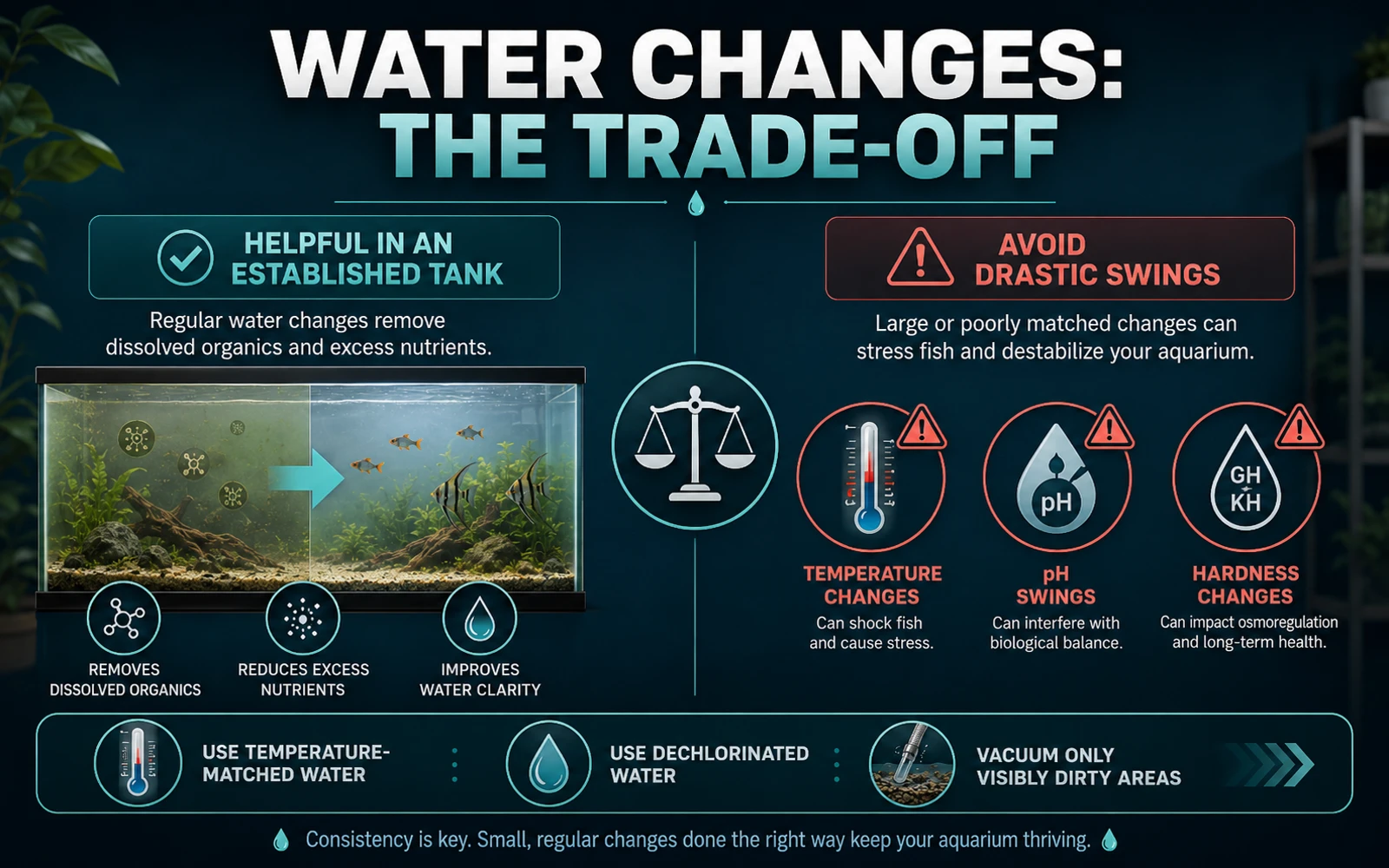
In a new tank, water changes tend to prolong a bloom. In an established tank the calculation is different, because here you are usually removing the dissolved organics that are feeding it rather than interrupting a cycle that needs to finish.
I am not going to hand you a fixed percentage, because the right size depends on how far your readings are from zero and how large the disturbance was. Most keepers work somewhere in the range of a quarter to a half of the volume for a corrective change, and the reason for the upper limit is not the fish's tolerance of clean water but the speed of the change: swapping a large fraction at once moves temperature, pH and hardness faster than fish adjust comfortably. Temperature-matched, dechlorinated water, and gravel vacuuming the visibly dirty areas rather than the whole bed, is the safer version of the same intervention.
If the tank is new rather than established, the reasoning flips entirely, and cloudy water in a brand new tank is the page you want.
FAQ
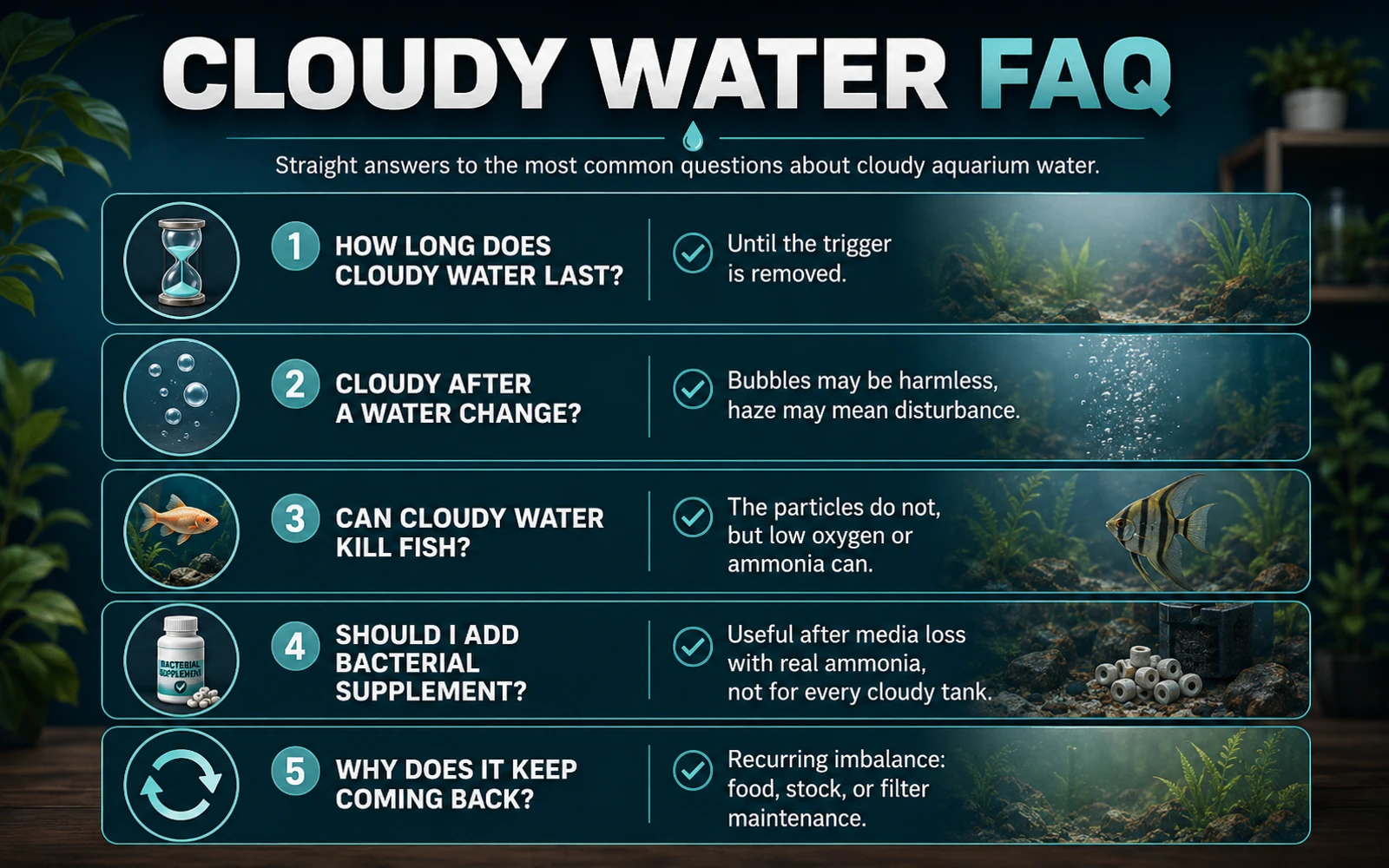
How long does cloudy water last in an established tank? It depends entirely on whether the trigger is still present. Debris usually clears within a day or two once the filter catches it. A bloom persists as long as it is being fed, which is why finding the source matters more than any treatment.
My tank went cloudy after a water change. Did I do something wrong? Possibly not. A fine mist that clears from the bottom up within an hour or two is dissolved gas and is harmless. A milky haze that persists for days after a water change usually means filter media was cleaned at the same time, or that the substrate was disturbed.
Can cloudy water kill fish? The particles themselves do not. A heavy bacterial bloom can reduce dissolved oxygen, and the ammonia that often accompanies a filtration failure certainly can. Judge by your test results and by the fish's behavior, not by the water's appearance.
Should I add a bacterial supplement? It is a reasonable move if you have just lost filter media and have a real ammonia reading. It is not a fix for cloudiness in a tank that is testing zero on ammonia and nitrite.
Why does my tank keep going cloudy every few weeks? Recurrence points at a standing imbalance rather than an incident: too much food going in, more fish than the maintenance routine supports, or a filter that is undersized or cleaned too aggressively. Look at the pattern, not the individual episode.