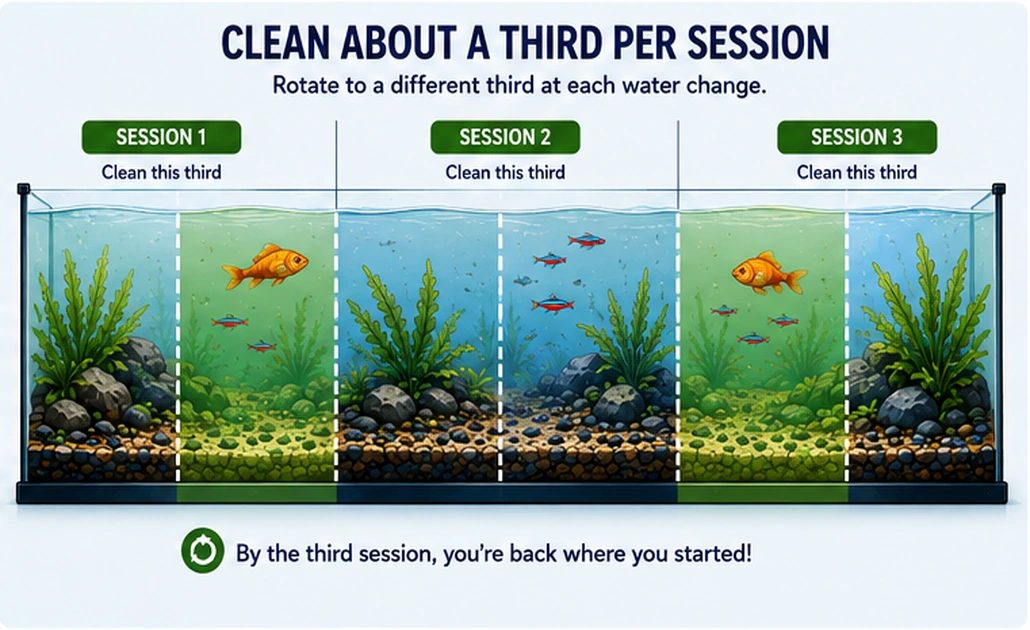
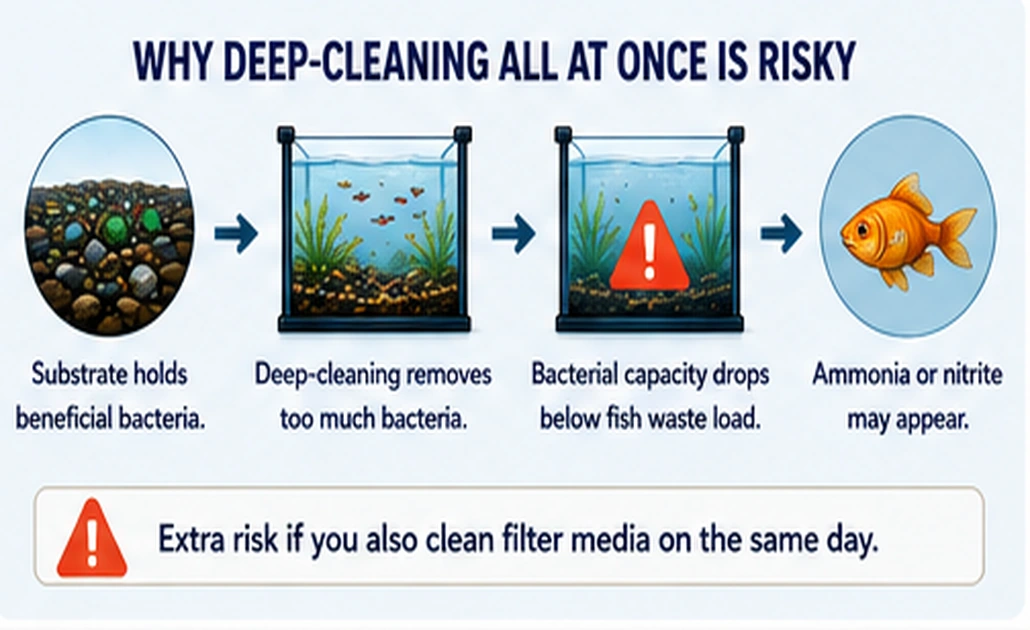
Clean roughly a third of your substrate in any one session and rotate to a different third at the next water change, so the whole tank floor gets covered over a few weeks without ever being stripped all at once. Petco and Aquarium Co-Op both publish this one-third guidance, and the reason behind it is the part that matters: the substrate holds part of your tank's biological filtration, and deep-cleaning all of it in a single pass removes more of that colony at once than the tank can comfortably replace.
The Direct Answer: About a Third Per Session, Rotating Around the Tank
If you take one thing from this page, take the fraction. Petco's gravel vacuum guide tells readers to clean about a third of the substrate and to move on to the next third at the following water change. Aquarium Co-Op frames the same limit from the other direction, advising against deep-cleaning more than one-third of the substrate per session. Different words, same instruction.
The practical version looks like this. Divide the tank floor into three areas in your head, front to back or left to right, whichever suits your layout. Vacuum one of them properly during this week's water change. Do the next one next time. By the third session you are back where you started, and no part of the tank has gone more than a few weeks without attention while no part has been stripped bare either.
That is the answer to "am I supposed to clean all of it." No. Cleaning all of it is the thing to avoid.
How the Vacuum Actually Works (and Why Gravel Falls Back)
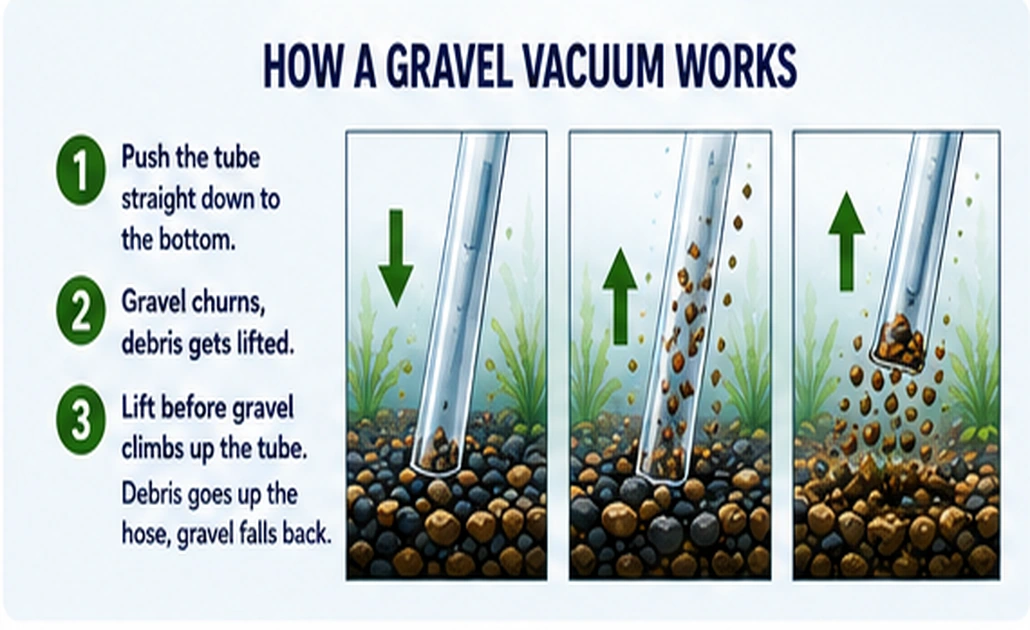
A gravel vacuum is a wide rigid tube on the end of a siphon hose. The width is the whole trick. Water moving up the hose is fast enough to lift light waste, but once that water enters the much wider tube it slows down, and the heavier gravel drops back out. Debris keeps going up the hose and into your bucket; the substrate stays in your tank.
Working with that rather than against it is the technique the whole SERP agrees on. Push the tube straight down into the substrate until it reaches the glass. Watch the gravel churn inside the tube. When it starts climbing toward the top, lift the tube, let the gravel settle back, and move to the next spot. Petco describes working across the tank in rows, like mowing a lawn, which is a good mental model because it stops you from vacuuming the same easy patch three times and missing the rest.
If gravel keeps disappearing up the hose, the tube is too narrow for your substrate size or your siphon is running too fast. Pinching the hose slightly slows the flow without changing anything else.
Why Deep-Cleaning the Whole Floor at Once Is the Risk
The warning you will read everywhere is that over-vacuuming disturbs beneficial bacteria and can disrupt the nitrogen cycle. That is true, and it is worth understanding rather than just obeying.
Your nitrifying bacteria are not floating in the water. They live on surfaces, and the largest concentration in most tanks is in the filter media, with the substrate, decor and glass holding the rest. That is covered in more detail in where beneficial bacteria live. So the substrate is not the whole colony, but it is a meaningful share of it, and the deeper and more thoroughly you scour it, the more of that share leaves with the waste water.
Take out too much at once and the tank's processing capacity drops below what its current fish load produces. What you see afterwards is ammonia or nitrite appearing in a tank that was previously reading zero. That pattern, and how to tell it apart from a bad test, is covered in did my cycle crash, or is my test kit lying.
This is also why the classic beginner disaster is not one mistake but two stacked together: vacuuming the entire substrate deeply and rinsing the filter media in tap water on the same day. Either alone is survivable in most established tanks. Together they remove both halves of the colony at once.
Gravel, Sand and Planted Soil Are Not Vacuumed the Same Way
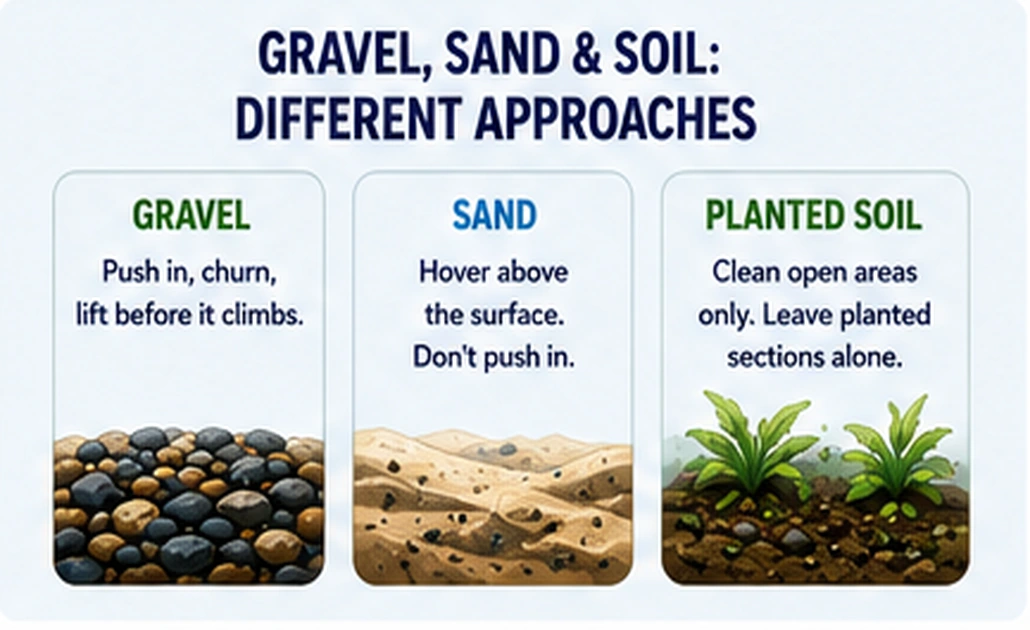
Most guides are written for gravel and leave everyone else guessing. The three common substrates want three different approaches.
Gravel is the straightforward case, and the method above is written for it. Push in, let it churn, lift before it climbs.
Sand should not be pushed into at all. Sand is fine enough to travel up the hose easily, and it compacts rather than letting water flow through it. Hold the tube an inch or two above the surface and let the current lift the waste that sits on top, which is where sand debris collects anyway rather than sinking in. Many keepers also stir the sand gently by hand or with a stick between cleanings to release trapped gas pockets, without siphoning the sand itself.
Planted-tank soil is largely left alone. Nutrient-rich aquatic soil exists to feed roots, and vacuuming it removes the nutrients you paid for and clouds the water. In a planted tank the usual approach is to siphon the open areas and the surface debris and leave the planted sections undisturbed. Cycling a tank that already has live plants covers how these substrates behave in the first weeks, when they release ammonia of their own.
How Often, and How to Tell From Your Own Tank Instead of a Schedule
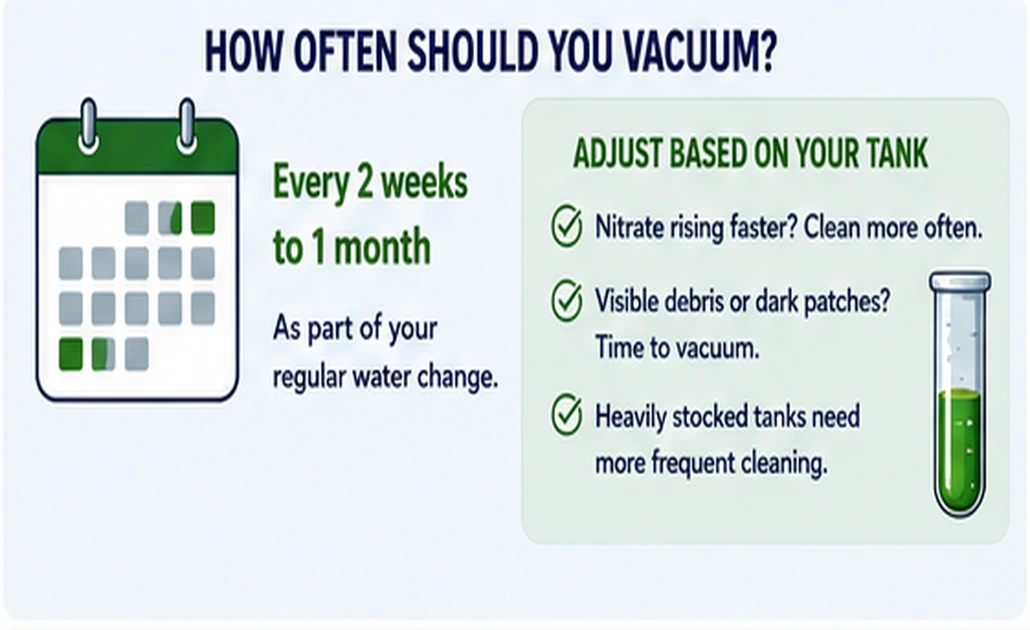
The commonly published cadence for freshwater tanks is every two weeks to once a month, and it makes sense to attach it to a water change you are doing anyway rather than treating it as a separate chore. How often to change aquarium water covers setting that schedule, and how to do a water change without stressing your fish covers the surrounding procedure.
But a published range is a starting point, not a reading of your tank. A heavily stocked tank with messy eaters and no plants will need attention sooner than a lightly stocked planted one. The honest signal is your own nitrate trend: if nitrate climbs faster between changes than it used to, waste is accumulating faster than you are removing it, and the substrate is one of the places it accumulates. Aquarium water parameters covers what to do with the numbers once you have them.
The visible signals are worth trusting too. Debris that puffs up in a cloud when a fish swims low, or dark patches you can see through the glass at the front, both say the same thing.
The Spots People Miss, and Why They Matter More Than Depth
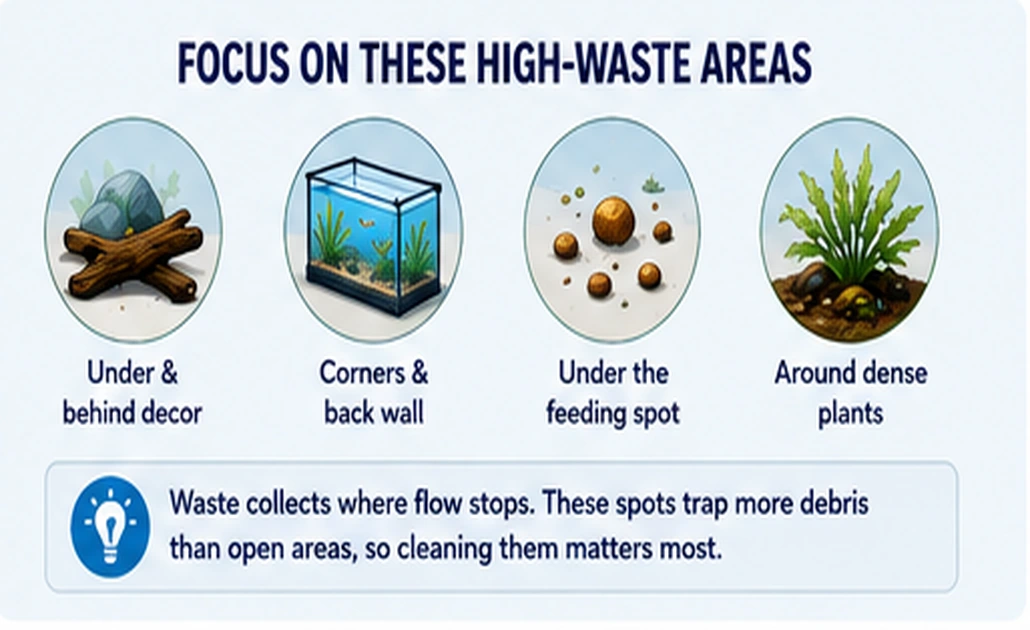
Vacuuming less does not mean vacuuming carelessly. Waste does not settle evenly. It collects where flow stops, which is almost always the same handful of places:
- Under and behind decor, rocks and driftwood, where debris drifts in and never leaves. Lifting an ornament during a water change and vacuuming under it is worth more than an extra inch of depth in open gravel.
- Corners and the back glass, especially behind a hang-on-back filter where the flow returns forward and leaves the back wall dead.
- Directly under the feeding spot, where uneaten food sinks in the same place every day.
- Around the base of dense plants, where leaves trap detritus. Work gently here rather than skipping it entirely.
Those spots are where trapped organic waste actually breaks down into ammonia, so clearing them is the point of the exercise. Depth over the whole floor is not.
FAQ
How much of the gravel should I vacuum at one time?
About a third of the substrate per session, rotating to a different third at each following water change. Petco and Aquarium Co-Op both publish this guidance, and the reasoning is that the substrate holds part of your biological filtration, so removing all of it at once takes out more of that colony than the tank can quickly replace.
How often should I vacuum aquarium gravel?
Commonly published guidance for freshwater tanks is every two weeks to once a month, done as part of a water change. Treat that as a starting point and adjust to your own tank based on how quickly nitrate climbs between changes and how much visible debris settles.
Can vacuuming gravel really crash my cycle?
Deep-cleaning the entire substrate in one session can measurably reduce the tank's bacterial capacity, and the risk is much higher if you also clean your filter media on the same day. Ammonia or nitrite appearing after a thorough clean in a tank that previously read zero is the usual sign.
How do I vacuum sand without sucking it up?
Hold the tube above the sand rather than pushing into it and let the water flow lift the waste that sits on the surface. Sand compacts, so debris tends to stay on top rather than working down into it. Slowing the siphon by pinching the hose helps.
Do I need to vacuum a planted tank with soil substrate?
Usually only the open areas and the surface. Nutrient soil is there to feed plant roots, and disturbing it removes those nutrients and clouds the water. Siphon debris from open spots and leave planted sections alone.