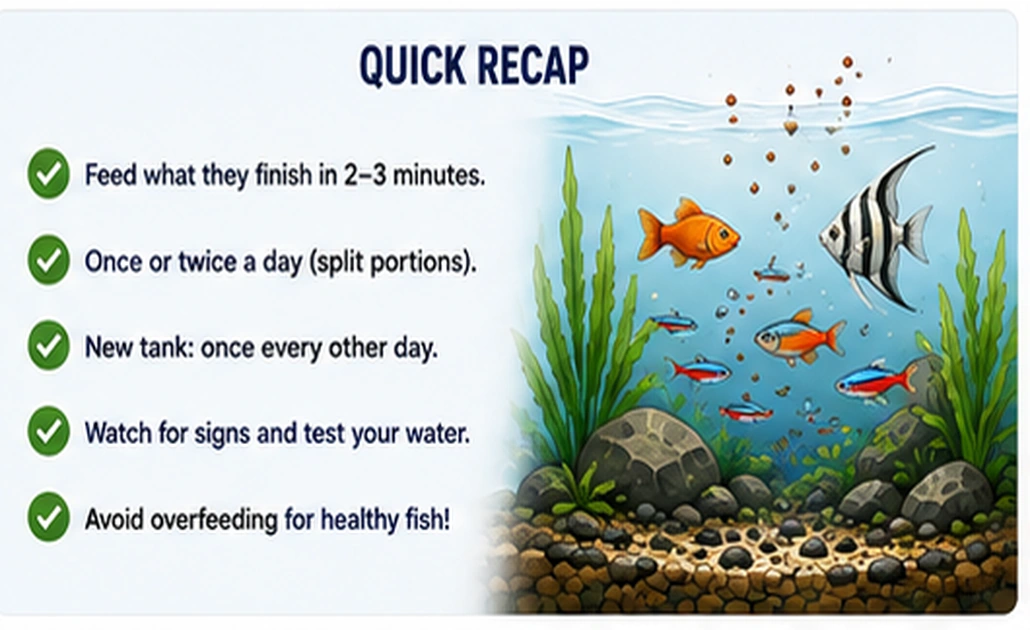
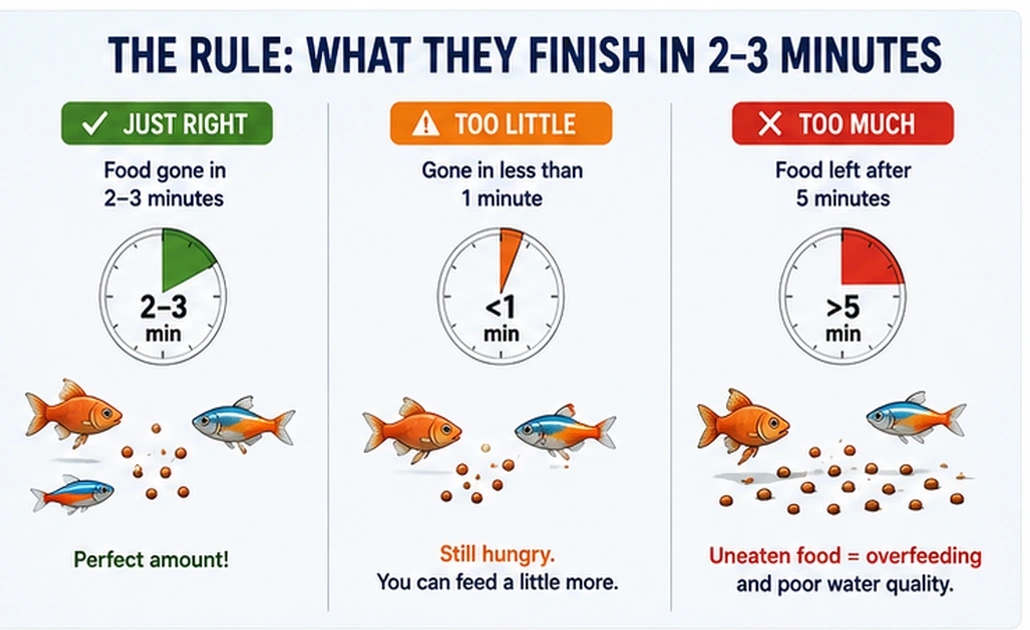
Feed only what your fish finish in about two to three minutes, once or twice a day for most community tanks. That is the rule nearly every aquarium source agrees on, including Aquarium Co-Op, Aqueon and Tankarium, and it works because it measures the amount against your actual fish rather than against a spoon. Start smaller than you think is right, watch them eat, and add a little more only if it disappears in well under two minutes. Anything still sitting on the substrate after five minutes was too much.
The Direct Answer: What They Finish in Two to Three Minutes
The two-to-three-minute window is the closest thing this hobby has to a universal answer, and it is worth understanding why it works rather than treating it as a magic number. It scales automatically. A tank of six small tetras and a tank of twenty will eat very different amounts in the same two minutes, and the rule handles both without you having to calculate anything.
Two details make it reliable in practice. First, watch the fish rather than the clock alone; food that vanishes in twenty seconds with fish still searching means you can offer slightly more, and food that is still drifting past uneaten at the two-minute mark means you gave too much. Second, judge by what is left afterwards. Tankarium's marker is uneaten food still in the tank after five minutes with the fish showing no further interest. That is the clearest single signal of overfeeding there is.
What "a Pinch" Actually Means, and How to Find Yours
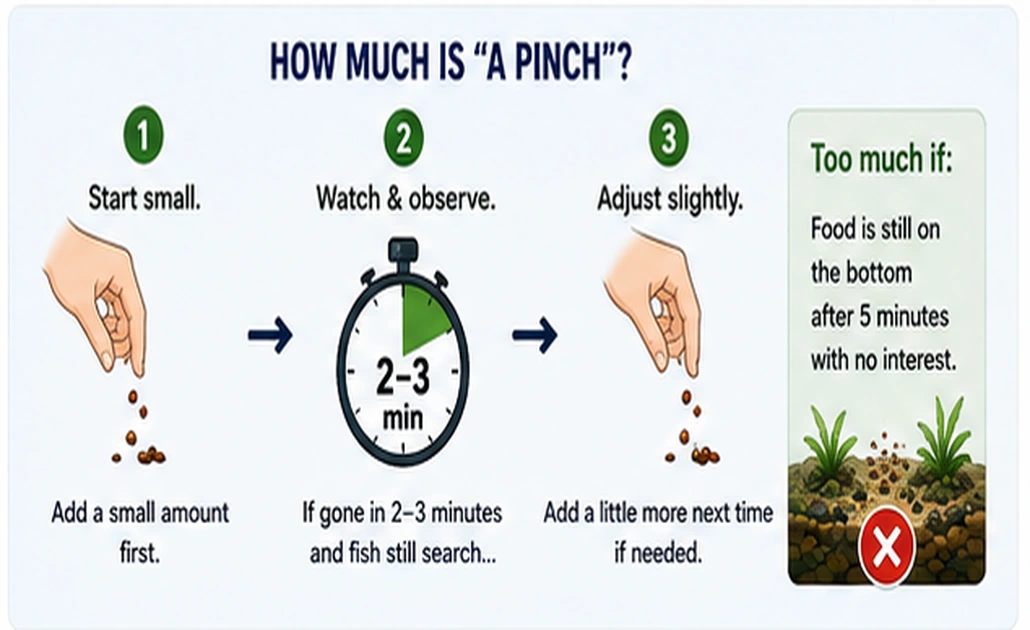
"A pinch" is not a measurement and never was. It is shorthand for an amount small enough that a beginner will not accidentally dump half the container in. The honest way to convert it into a number for your own tank is to find it by observation once and then reuse it.
Put in a deliberately small amount, less than you believe is correct. Watch. If it is gone in under two minutes and the fish are still actively hunting, add a little more, and note roughly what the total looked like. That total is your tank's portion. Most people find it is visibly less than what they were feeding before.
Two things make this easier to judge. Feed at the same place in the tank each time so you can see what reaches the substrate. And feed with the tank lights on and the surface calm rather than in a hurry, because a portion that looks small floating on the surface can be a great deal of food once it is spread through the water column.
How Often: Once a Day, Twice, or Every Other Day
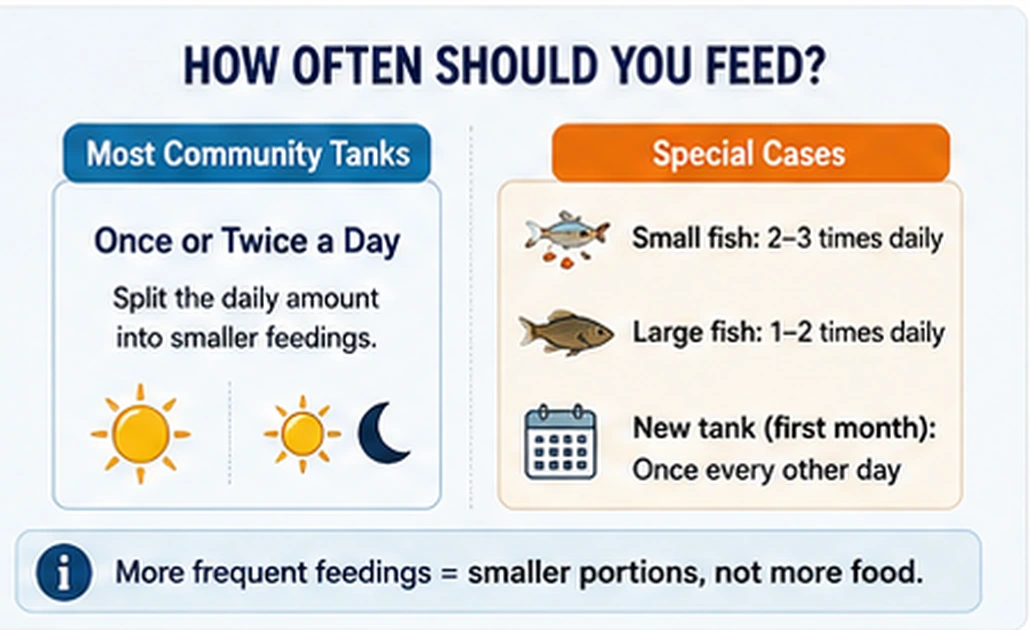
For most beginner community tanks, once or twice a day is the standard advice, and splitting the daily amount across two feedings rather than adding a second full portion is the part people miss. Charterhouse Aquatics and Aqueon both describe smaller, more frequent meals as easier for fish to process than one large one, and Tankarium notes that smaller fish are commonly fed two to three times daily while larger fish typically take one or two meals.
Species matter more than a single rule can capture. Small, fast-metabolism fish genuinely benefit from more frequent small meals. Larger, slower fish do not. Nocturnal bottom dwellers may not compete for daytime food at all and are often fed after lights out. If you keep a specific species, its own requirements outrank the general pattern.
None of this changes the amount. Twice a day means dividing the portion, not doubling it.
Feeding a Brand-New Tank Is a Different Question
If your tank was set up recently, the general advice does not apply yet, and this is the single most useful correction on this page.
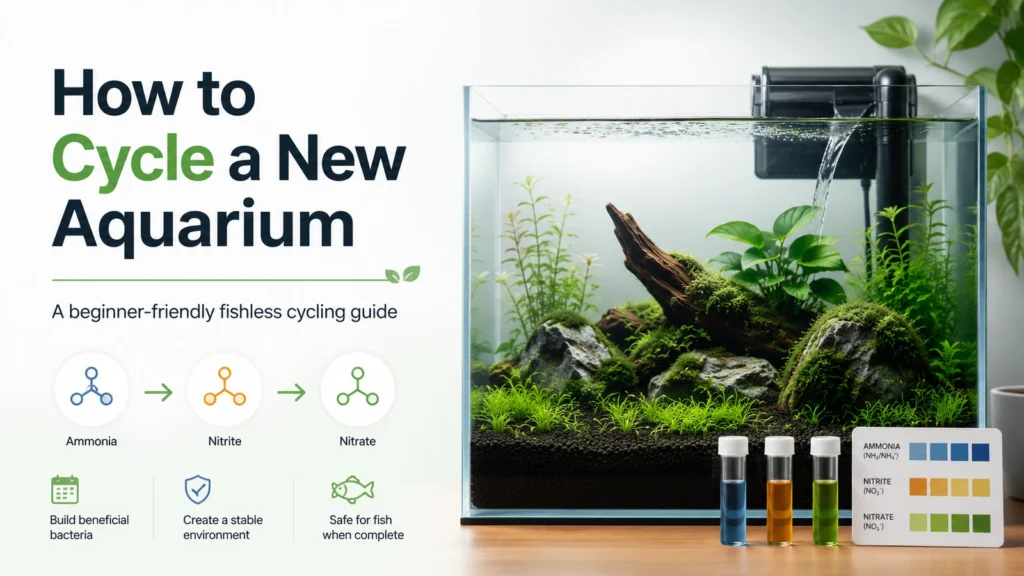
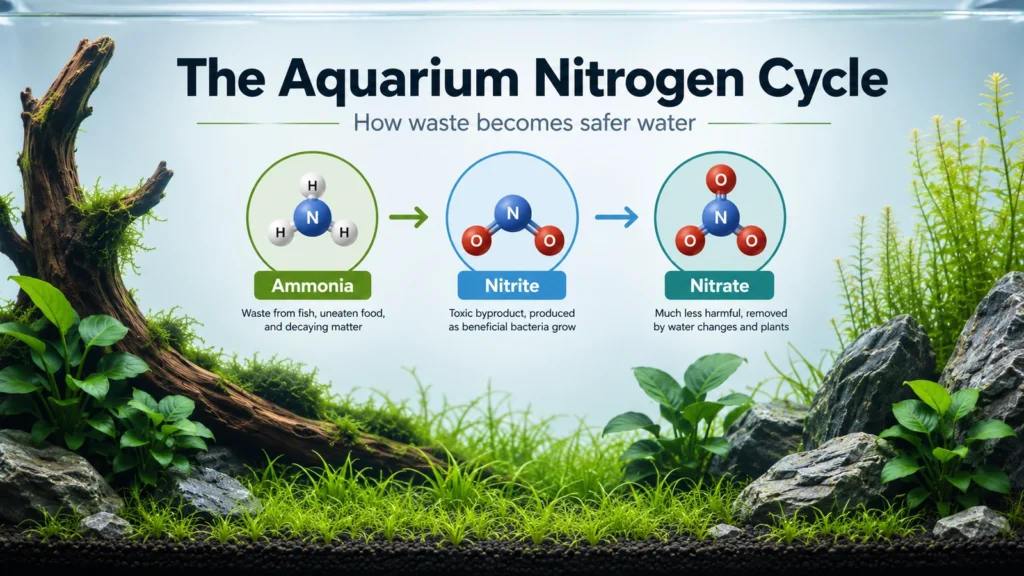
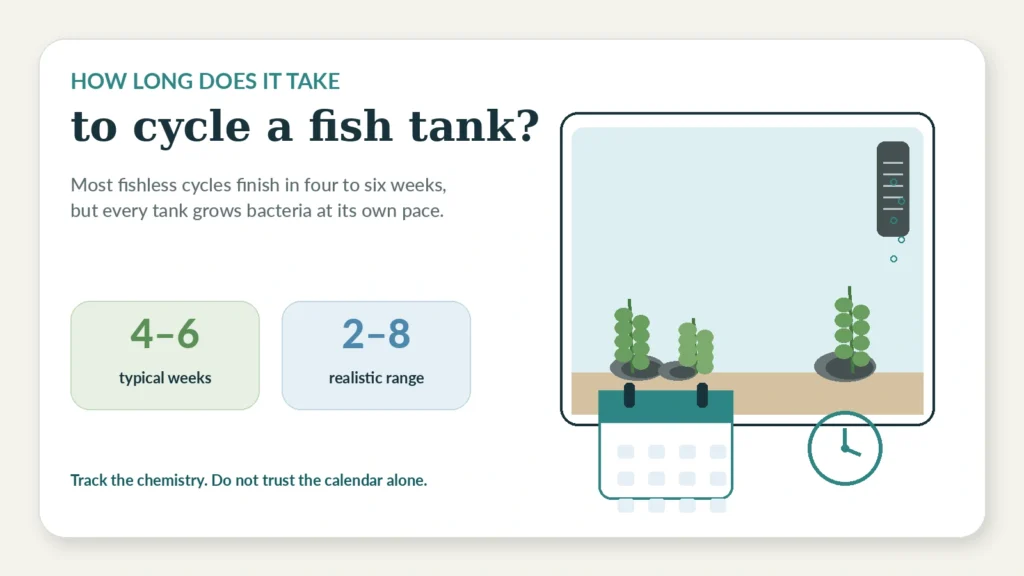
Aqueon recommends feeding once every other day when an aquarium is new, specifically because overfeeding is most damaging at that stage, then moving to once a day after about a month. The reason is biological rather than nutritional. In a new tank the bacterial colony that converts ammonia to nitrite and then to nitrate is still small, so the tank's ability to process waste is at its lowest exactly when a nervous new keeper is most tempted to feed generously. How to cycle a new aquarium explains what that colony is doing and how long it takes to establish.
Practically: for the first weeks after fish go in, feed lightly and less often than you eventually will, and test the water rather than guessing. Fish are far more tolerant of being underfed for a few weeks than of living in water their filter cannot keep up with.
Your Test Kit Will Tell You If You Are Overfeeding
This is the part almost no feeding guide connects, and it turns a vague rule into an answer for your specific tank.
Everything you put in comes back out as waste. Uneaten food decomposes directly into ammonia; eaten food becomes fish waste, which becomes ammonia too. So your feeding amount shows up in your test results, and you do not have to guess whether you are overdoing it.
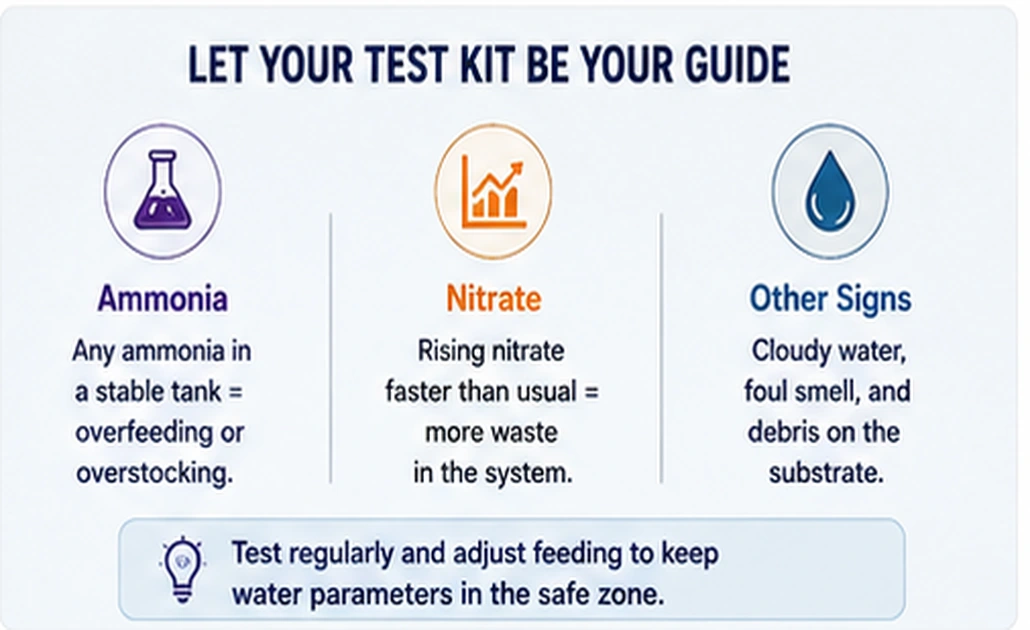
- Any ammonia in an established, previously stable tank is a signal that waste production has outrun the filter's capacity. Feeding is one of the two usual causes, along with stocking.
- Nitrate climbing faster between water changes than it used to, with nothing else changed, means more waste is entering the system than before. Feeding is the most common reason.
- Cloudy water and a persistent smell are the visible versions of the same thing, both commonly listed as overfeeding symptoms.
Aquarium water parameters covers what each reading means and what to do next, and how often to change aquarium water covers using your own nitrate trend to set a schedule rather than copying somebody else's. If those numbers move after you increase feeding, that is your answer, and it is a far better one than any rule of thumb.
What Overfeeding Actually Does, in Order of How Fast It Happens
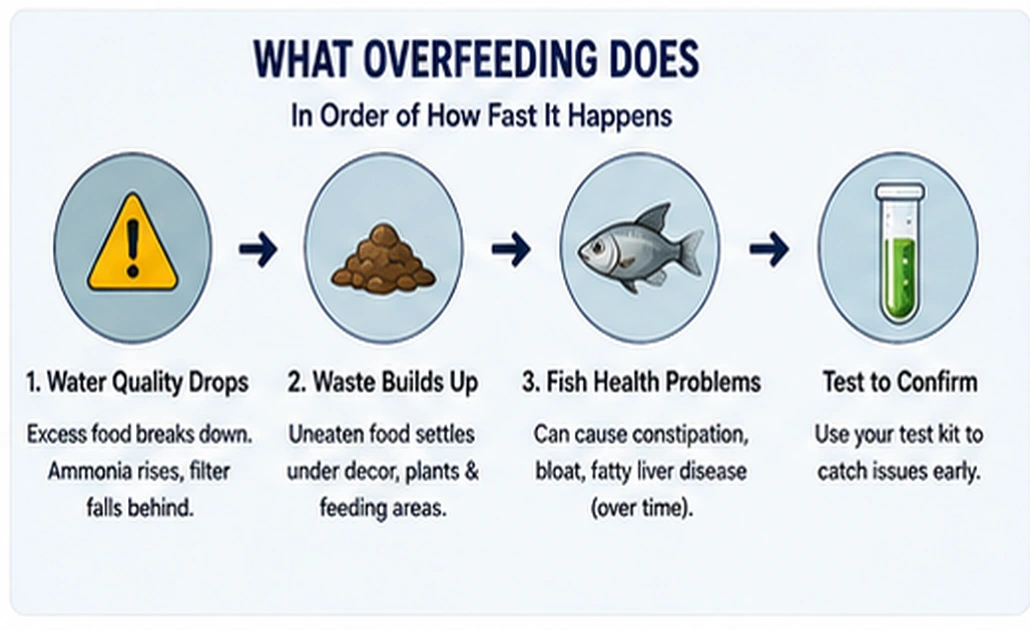
The water-quality damage arrives first and is measurable. Excess food breaks down, ammonia rises, the filter falls behind, and the tank's chemistry moves in the direction that harms fish. That can happen within days. It is also the part you can verify yourself with a test kit, which is why it belongs at the top of the list.
The physical waste is next. Uneaten food does not disappear; it settles under decor, at the base of plants and directly beneath wherever you feed, where it keeps breaking down out of sight. Gravel vacuuming covers clearing exactly those spots.
The fish-health consequences are slower and less visible. Constipation, bloat and fatty liver disease are all documented as consequences of chronic overfeeding in aquarium fish. Naming them is not the same as identifying them in your tank, and this article will not attempt that. If a fish looks swollen, stops eating, or behaves abnormally, that is a question for an aquatic veterinarian rather than a feeding adjustment, and the aquarium emergency help page covers what to check first while you arrange it.
Fasting Days, Fussy Eaters, and Bottom Feeders
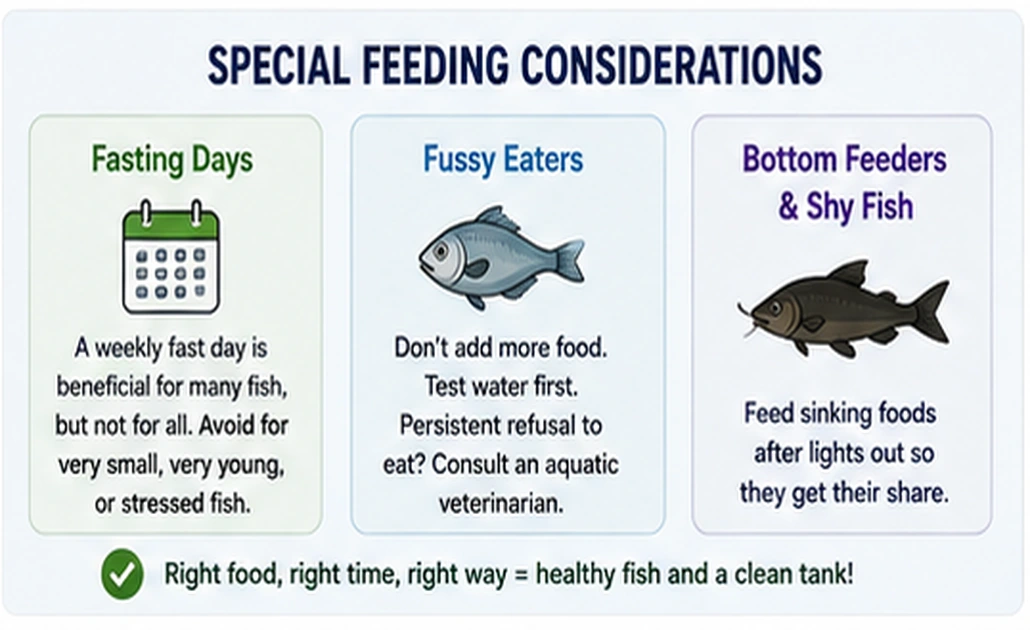
Fasting days. A weekly fast day is commonly recommended for many aquarium fish and is described by several sources as beneficial, particularly for species prone to digestive problems. It is a common practice rather than a universal requirement, and it is not appropriate for every fish, notably very small species with fast metabolisms and recently added or already stressed fish.
A fish that will not eat. Reduced appetite has many possible causes, from a recent move to water quality to illness, and it is not something to solve by offering more food. Test the water first, because a parameter problem is both common and quickly checkable. Persistent refusal to eat is a reason to consult an aquatic veterinarian, not to change brands.
Bottom feeders and shy fish. Catfish, loaches and similar species often will not reach flake food that the faster mid-water fish clear in seconds, and keepers frequently mistake this for the tank being adequately fed. Sinking food offered after lights out is the usual answer. This is one of the few situations where a tank is genuinely underfed while looking well fed.
FAQ
How much food should I give my aquarium fish?
Only what they finish in about two to three minutes. Start with less than you think is right, watch them eat, and add a small amount more only if it disappears well within that window. Food still sitting uneaten after five minutes means the portion was too large.
How often should I feed my fish?
Once or twice a day suits most beginner community tanks, with the daily amount split between feedings rather than doubled. Smaller fish are commonly fed two to three times daily and larger fish one or two times. In a brand-new tank, Aqueon recommends once every other day for about the first month.
What are the signs I am overfeeding?
Uneaten food remaining after five minutes, cloudy water, a foul smell, debris collecting on the substrate, and, most reliably, ammonia appearing or nitrate climbing faster than usual on your test kit.
Can I skip a day of feeding?
Healthy adult fish tolerate a missed day well, and a weekly fast day is a commonly recommended practice for many species. It is not right for every fish, particularly very small, very young, or recently stressed ones.
My fish always act hungry. Does that mean they need more food?
Not usually. Most aquarium fish forage more or less continuously and will beg whenever someone approaches the glass, so behavior is a poor guide to whether they have eaten enough. The two-to-three-minute rule and your test results are more reliable than the fish's opinion.