Once your tank passes the completion test, add a small group first, commonly just one or two fish, or a small group of a few individuals if you are keeping a schooling species, then test ammonia after a day or two before adding more. A commonly repeated pace across hobby guidance is roughly one fish, or one small addition, per week, though this is a rough rhythm to work from rather than a strict rule. The reason for the caution is not superstition: your bacteria colony is currently sized to the ammonia dose it was fed during cycling, not to a fully stocked tank, so adding everything on day one can outpace it and trigger a smaller version of the cycling process you just finished.
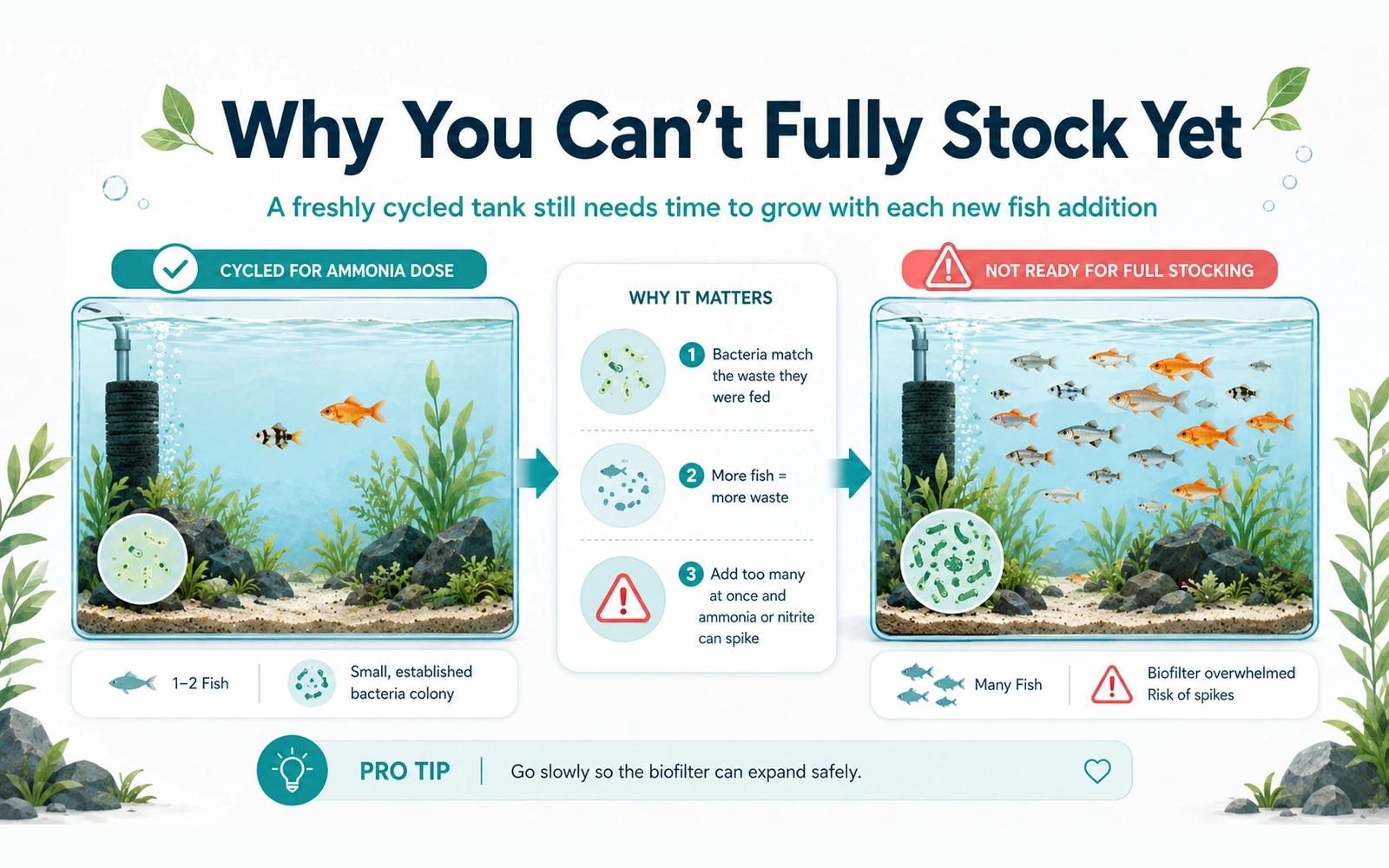
Why a Freshly Cycled Tank Is Not Ready for Full Stocking Yet
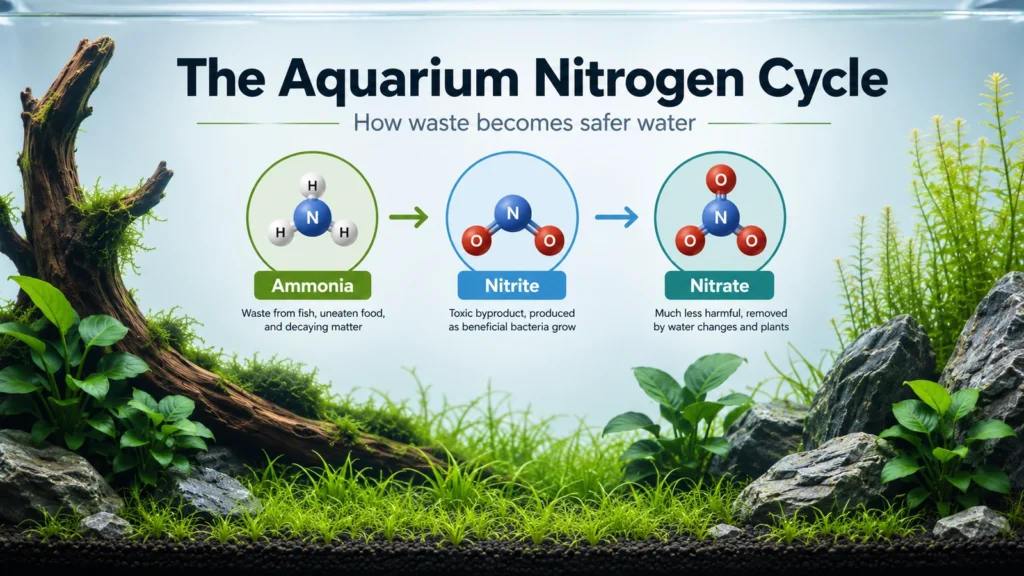
During fishless cycling, the bacteria colony grows to match whatever ammonia load you dosed it with, commonly a moderate target used throughout the process. A fully stocked tank, especially one with several fish added at once, can produce meaningfully more waste than that dosing schedule simulated. The colony has to grow further to keep up, and that growth takes real time, the same way the original cycle did. Add too much stock too quickly, and you can outpace the existing colony before it has a chance to expand, producing a temporary ammonia or nitrite spike in what looked like a finished, safe tank. This is the same underlying mechanism covered in the nitrogen cycle explainer: the colony's capacity is tied to what it has actually been processing, not to the tank's theoretical maximum.
A Practical Weekly Schedule
- Week one: add a small first group. For most beginner setups, this means one or two individual fish, or a small group of three to five very small schooling fish if that is what you are stocking.
- Test ammonia and nitrite after one to two days. Both should still read zero. If either shows any reading at all, hold off on adding more until it returns to zero and stays there.
- If both are clear, wait roughly a week, then add the next small group. This rough weekly rhythm gives the bacteria colony time to grow to match the new waste load before the next addition arrives.
- Feed lightly during this stocking-in period. Overfeeding adds an additional, avoidable waste source on top of the fish themselves, right when the colony is still catching up.
- Repeat until you reach your planned stocking level, continuing to test after each addition rather than assuming the pattern will hold indefinitely without checking.
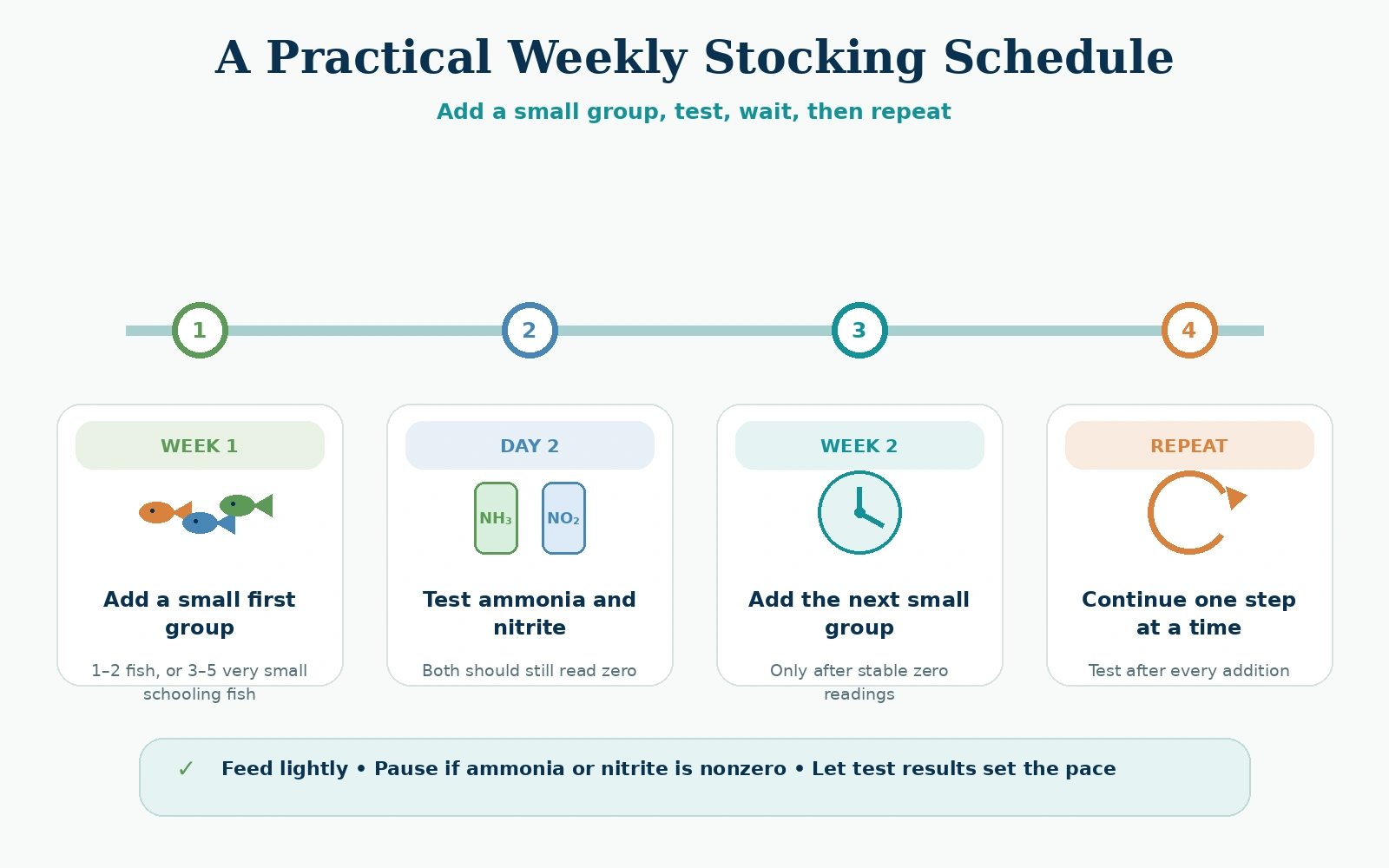
This pace is a practical starting rhythm reported commonly across hobby guidance, not a fixed law. A very lightly stocked plan, or a tank with a generously oversized filter, may tolerate a slightly faster pace; a more heavily stocked plan warrants more caution, not less.
Schooling Fish: How This Changes for Fish Kept in Groups
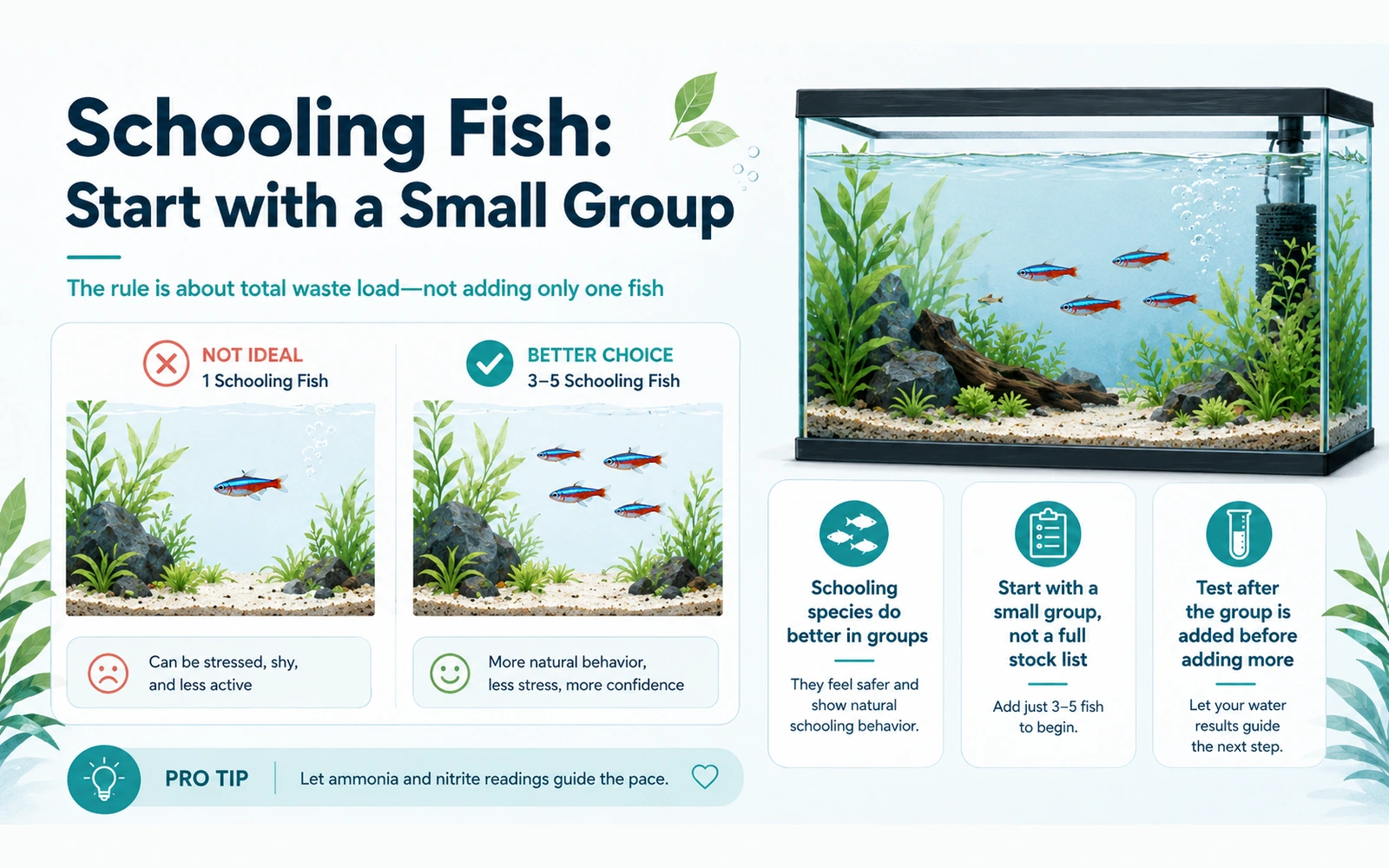
Many popular beginner fish are schooling species that are commonly kept in groups rather than singly, and treating "one fish per week" as a literal rule does not map cleanly onto them. In practice, a small starting group of a schooling species, rather than a single individual, is a reasonable first addition, since the point of the caution is managing total waste load and monitoring the colony's response, not enforcing an arbitrary fish count. Test after adding the small group exactly as described above, and let the ammonia and nitrite readings, not a fixed number, tell you when it is time for the next addition.
What to Watch For After Each Addition
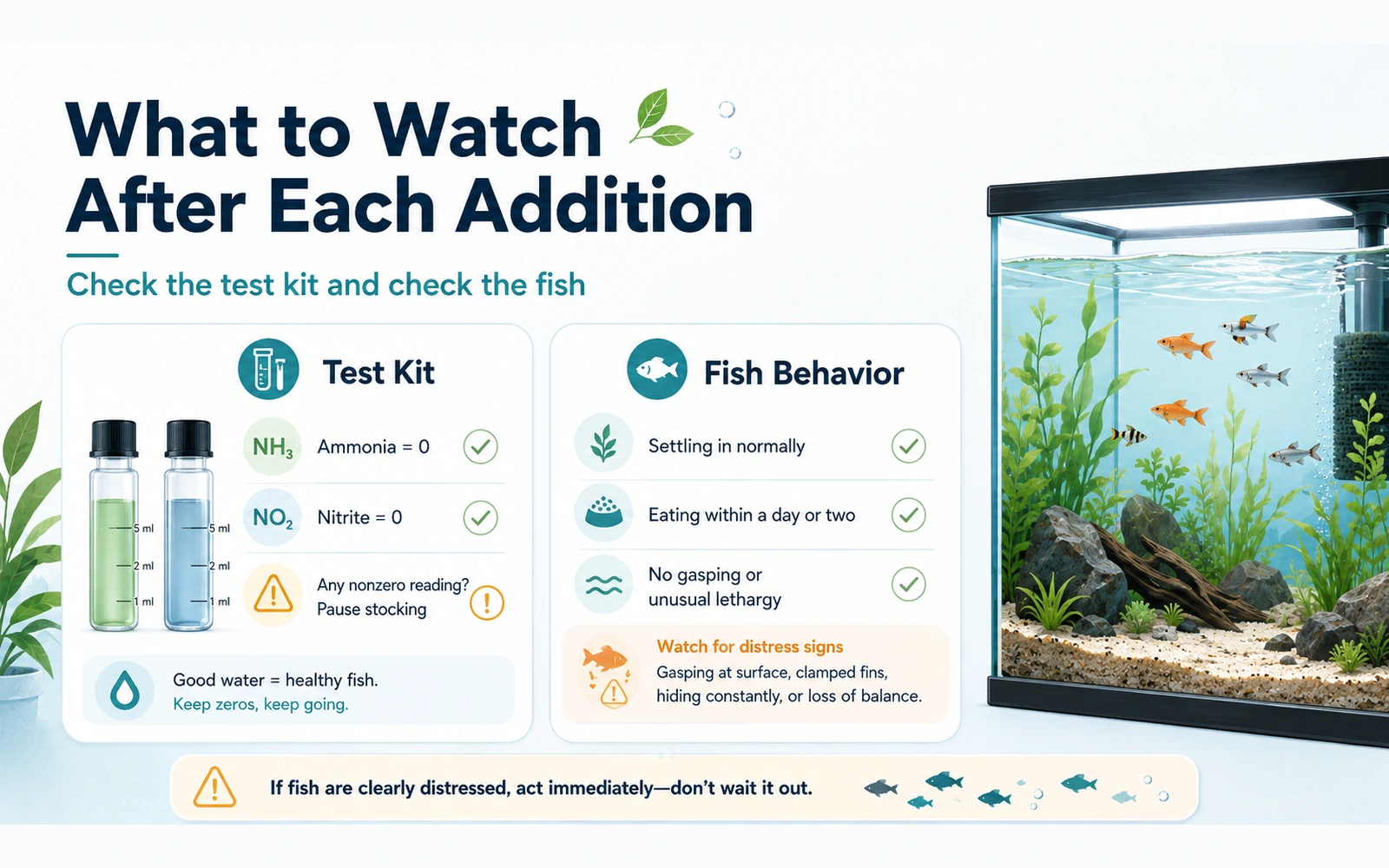
After every addition, the two things worth checking are the test kit and the fish themselves. On the test kit side, any nonzero ammonia or nitrite reading in the days following an addition is your signal to pause and wait rather than continue stocking. On the fish side, new arrivals settling in, eating, and behaving normally within the first day or two is a reasonable sign things are going well; a new or existing fish that is gasping at the surface, unusually lethargic, or otherwise clearly distressed is not something to wait out. If you see that, aquarium emergency help walks through the calm, immediate steps, and new tank syndrome symptoms covers what an overstocking-triggered spike commonly looks like if you want to understand what may be happening.
Acclimating Each New Arrival
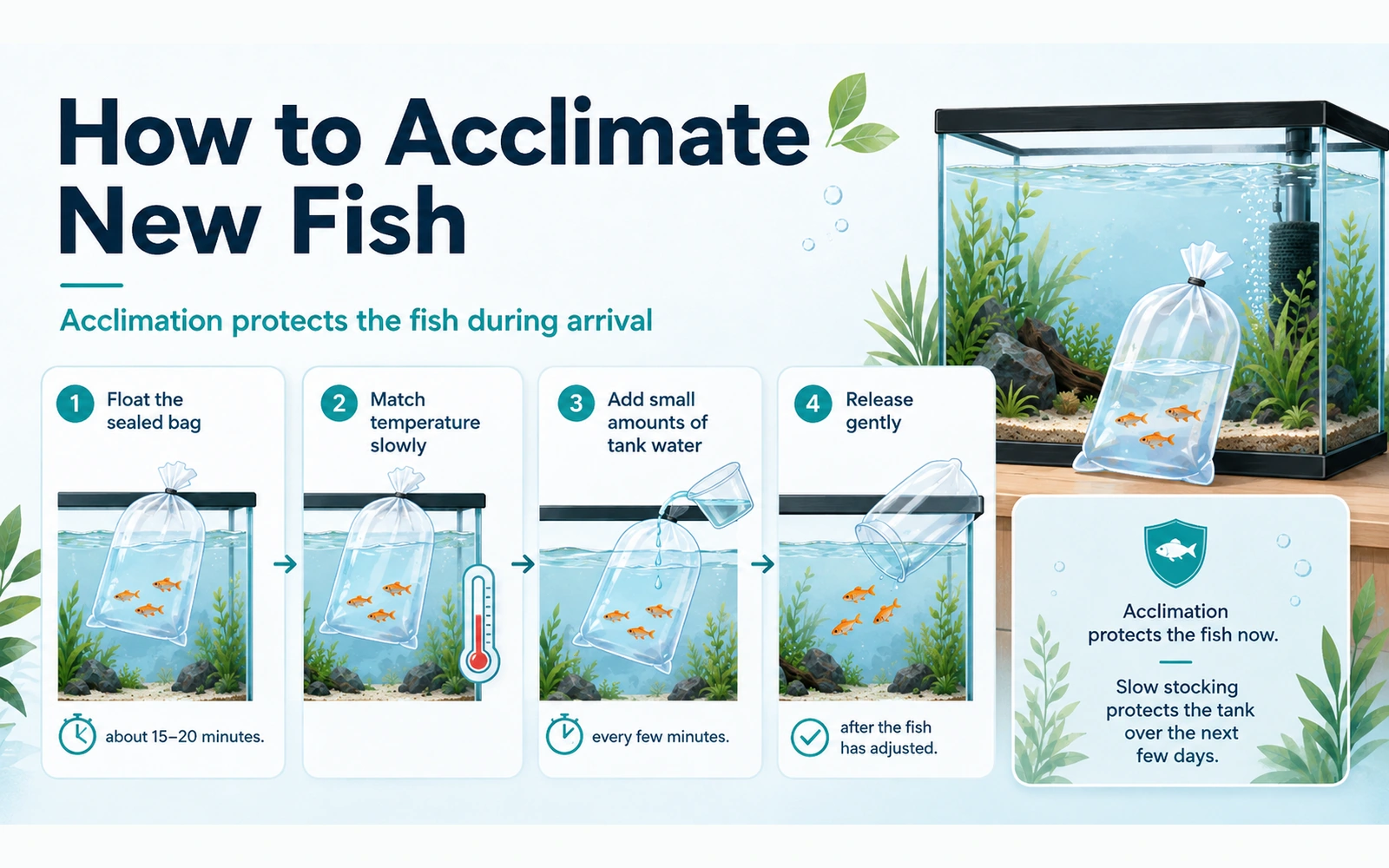
Slow stocking and acclimation solve different problems, but both matter every time a fish comes home. Before releasing a new fish into the tank, float the sealed bag in the water for roughly fifteen to twenty minutes so the temperature equalizes gradually, then add small amounts of tank water into the bag every several minutes over a similar stretch of time so the fish adjusts to your water chemistry rather than being dropped into it all at once. This does not replace the weekly stocking pace above; it protects the individual fish at the moment of transition, while the weekly pace protects the tank's biological capacity over the following days.
A Note on Quarantine
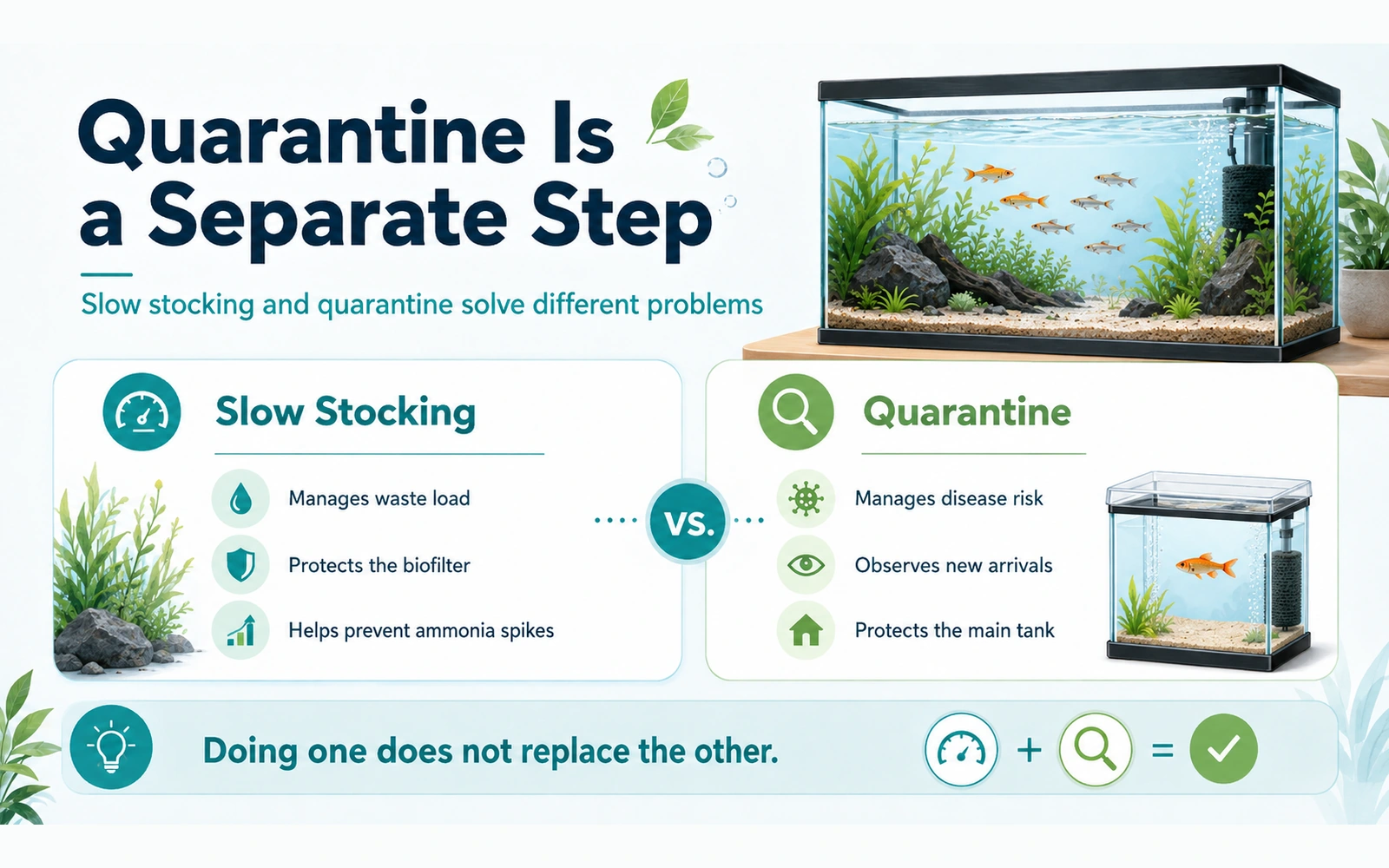
Everything above addresses colony capacity, how much waste load your bacteria can currently handle. It does not address disease risk from a new fish itself, which is a separate concern with its own separate practice: quarantining new arrivals in a dedicated tank before introducing them to an established one. That is a more cautious, more protective approach than what this guide covers, and it is worth knowing it exists as a distinct option even though it is not detailed here. Slow stocking and quarantine solve two different problems, and doing one does not replace the other.
FAQ
How many fish can I add to a newly cycled tank at once?
A small first group, commonly one or two fish, or a small group of three to five very small schooling fish, is a reasonable starting point. Test ammonia and nitrite after a day or two before adding more.
How often can I keep adding fish after that?
A commonly repeated pace across hobby guidance is roughly one addition per week, using the test results rather than the calendar as the real signal that it is safe to continue.
Why can't I just add all my planned fish on day one if the tank passed the cycle test?
Your bacteria colony is currently sized to the ammonia load it was dosed with during cycling, not to a fully stocked tank. Adding everything at once can outpace that colony before it grows to match the new waste level, producing a temporary spike sometimes called a mini-cycle.
Does the "add slowly" rule apply the same way to schooling fish?
Not literally. A small starting group, rather than a single individual, makes more sense for a schooling species. The underlying principle, test after each addition and let the readings guide the pace, still applies.
Is quarantining new fish the same thing as adding them slowly?
No, they address different risks. Adding fish slowly manages how much waste load your bacteria colony can currently handle. Quarantine manages the risk of introducing disease from a new fish. Doing one does not replace the other.